
We are reader supported. When you purchase through links on our site, we may earn an affiliate commission. Also, as an Amazon affiliate, we earn from qualifying purchases.
Aquarium plants look their best when minerals are in balance. When one nutrient runs low, growth slows, colors fade, leaves twist, and algae takes advantage. Early detection saves time and plants. This guide shows you how to identify mineral deficiencies with clear signs, simple tests, and a repeatable workflow you can trust.
Introduction
Most plant problems come from three areas. Light sets demand. CO2 and minerals must meet that demand. If light is strong but nutrients or CO2 lag, plants show stress fast. If light is low, plants need less, but they still need steady basics. You do not need lab gear or guesswork. You only need to learn where to look, what each symptom means, and how to adjust without making things worse.
Why Mineral Balance Matters
Plants build tissue from carbon, hydrogen, oxygen, and minerals. Carbon comes from CO2. Minerals come from water, substrate, and fertilizer. Each mineral has a job. When any one is too low, the whole system slows down. This is why dosing a little of everything works better than chasing one value in isolation.
The Role of Demand and Supply
Light increases demand. Stronger light drives faster growth, which needs more nitrogen, phosphorus, potassium, iron, and others. CO2 keeps that growth efficient. Minerals supply the building blocks. Keep all three in balance and plants stay stable. Break the balance and plants send clear signals. The key is to read those signals before algae does.
Macro and Micro Nutrients at a Glance
Macronutrients are needed in larger amounts. These include nitrogen N, phosphorus P, potassium K, magnesium Mg, calcium Ca, and sulfur S. Micronutrients are needed in trace amounts but still vital. These include iron Fe, manganese Mn, boron B, zinc Zn, copper Cu, molybdenum Mo, and others. Most aquarium fertilizers group micros together as traces, often chelated to stay available in water.
Mobile vs Immobile Nutrients
Mobile nutrients can move from older leaves to new leaves. When mobile nutrients run low, older leaves decline first while new growth tries to stay healthy. Nitrogen, phosphorus, potassium, and magnesium are mobile.
Immobile nutrients cannot move well inside the plant. When immobile nutrients run low, the newest growth shows problems first. Iron, calcium, boron, zinc, and manganese are mostly immobile.
This one rule helps you narrow issues fast. Look at where symptoms start. Old leaves first points to mobile. New growth first points to immobile.
Know Your Baseline Before You Diagnose
Good diagnosis starts with a known baseline. If you skip this, you may chase the wrong cause and waste weeks.
Water Source and Hardness
Check your tap water report if you can. General hardness GH estimates magnesium and calcium. Carbonate hardness KH buffers pH. Many soft waters are low in calcium and magnesium. Very hard waters may have plenty of calcium but still lack magnesium. If you use reverse osmosis water, you must remineralize GH and often KH on purpose.
CO2 and Light First
Confirm that CO2 is stable and that light is not excessive for your experience level. Poor CO2 or too much light can mimic deficiencies. Aim for steady CO2 during the entire photoperiod. Keep a consistent photoperiod. If in doubt, reduce light a little while you correct nutrients.
Simple Tests That Help
Test nitrate and phosphate to understand macro levels. If nitrate is near zero at the end of the week, nitrogen is likely low. If phosphate is always undetectable, phosphorus may be limiting. A GH test tells you if calcium and magnesium are present at all. You do not need to chase exact numbers, but you need to avoid zeros.
How to Read Plant Symptoms
Start with the location of symptoms. Then study the pattern on each leaf. Finally, consider growth rate and overall color. Take clear photos and compare over a week. New leaves show current status. Old leaves show history.
Leaf Age and Pattern
Old leaves first suggests nitrogen, phosphorus, potassium, or magnesium. New leaves first suggests iron, calcium, boron, zinc, or manganese. Interveinal chlorosis means yellowing between green veins. Necrosis means dead spots or holes. Distorted tips and twisted new leaves suggest issues with calcium or boron.
Deficiency Signs by Nutrient
Nitrogen N
Typical signs include pale older leaves that turn light green to yellow, overall slow growth, and smaller new leaves. Stems may be thin. Red species may lose depth of color. If nitrate always reads near zero by week end, nitrogen is likely low. Correction involves adding a reliable nitrogen source and keeping it non zero through the week. New growth should regain healthy green within 7 to 14 days.
Phosphorus P
Signs include dull, dark, or bluish older leaves, very slow growth, and sometimes small brown spots that expand into necrotic patches on older foliage. Green spot algae on slow leaves and glass can appear when phosphate is low under stronger light. If phosphate always tests at zero, raise it to avoid limitation. Expect response in new growth within 7 to 14 days.
Potassium K
Look for pinholes on older leaves that expand and gain yellow or brown edges. Margins can look burned. Veins often stay green longer than the tissue between them. New growth may still look okay at first. Potassium rarely shows on test kits, so dose based on a schedule. New leaves should look clean after a week or two. Old damaged leaves will not repair.
Iron Fe
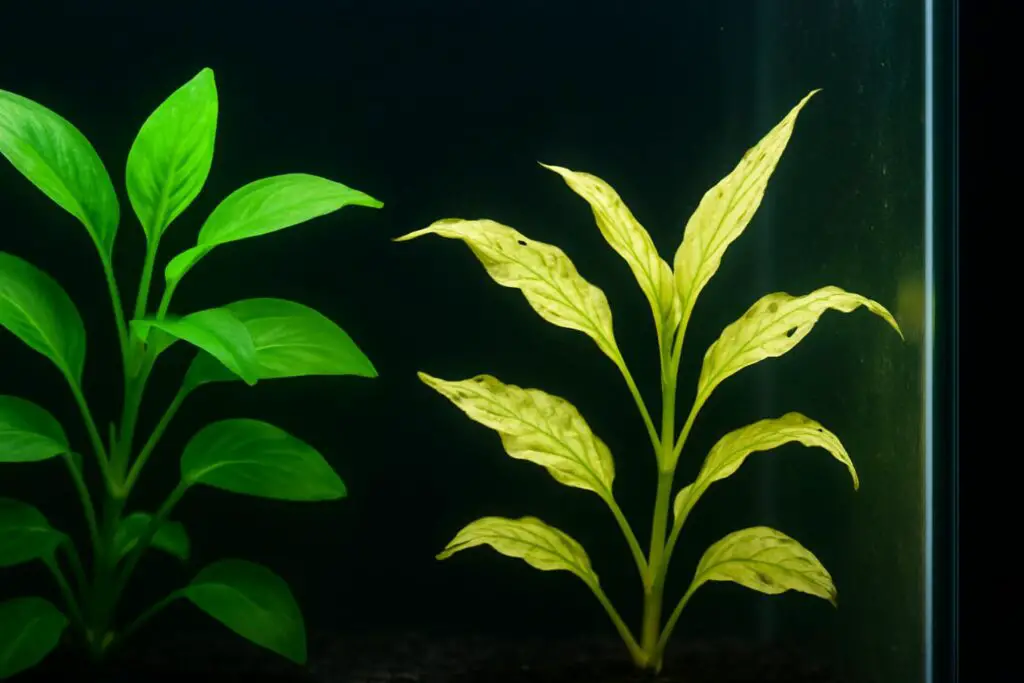
New leaves emerge very light with green veins, a classic interveinal chlorosis on fresh growth. Reds fade and look washed out even under strong light. Stems may be weak. If your water is high in KH, some iron chelates become less available. Dose small but frequent iron. Look for richer new growth within 7 to 14 days. Keep dosing steady rather than large single doses.
Magnesium Mg
Older leaves show interveinal chlorosis where veins stay greener than the areas between. The pattern is often more uniform than potassium issues and does not start as holes. GH that is very low can point to a lack of magnesium. If your tap is high in calcium but plants still show older leaf chlorosis, you may need a magnesium boost. Epsom salt magnesium sulfate is a common source in many GH boosters. New growth improves within two weeks.
Calcium Ca
New growth looks twisted, crinkled, or hooked. Growing tips may stunt or stop. Roots can be weak and short. In soft water with low GH, calcium often runs short. In very hard water, calcium is usually fine, but other immobile nutrients can still be low. Add a GH booster or a calcium source if GH is very low. Expect smoother new tips within 7 to 14 days.
Manganese Mn
New leaves can show interveinal chlorosis similar to iron, but often with tiny necrotic specks. This can show when trace dosing is very low or when water conditions reduce trace availability. Increasing a complete trace mix usually covers manganese along with iron and others. Watch for cleaner new leaves within two weeks.
Boron B
Newest tips can distort, with thickened, brittle, or cracked young tissue. Growth slows and internodes shorten. Boron is part of most complete trace mixes. If you see calcium like symptoms while GH is adequate and iron dosing is fine, raise trace dosing slightly and watch new tips. Improvements should show in a couple of weeks.
Zinc Zn
New leaves can be small with interveinal chlorosis and short internodes. Growth looks compressed. Since zinc is included in most trace mixes, consistent trace dosing usually prevents this. If you run very lean traces with strong light, consider a small increase. Monitor for healthier new growth within 7 to 14 days.
Sulfur S
True sulfur deficiency is rare in aquariums because it comes with many salts and water changes. If present, newer leaves may show uniform pale yellowing without green veins standing out. A balanced macro mix and regular water changes prevent this.
Issues That Mimic Deficiencies
CO2 Instability
Fluctuating CO2 causes pale, stunted, or melting tips, and can trigger algae even if nutrients are fine. If symptoms appear across many species at once, check CO2 delivery and circulation. Stable CO2 during the light period is essential.
Excess Light
Too much light raises demand beyond your dosing and CO2. Plants starve even while you dose. Algae appears quickly. If diagnosis is unclear, reduce light intensity or duration slightly while you correct nutrients.
Melt and Transition
Some species melt when moved or when water chemistry changes. Old leaves die while new submerged leaves form. This is not a mineral shortage. Look at new growth to judge success, not the melting old leaves.
Substrate vs Water Column Feeding
Root feeders like sword plants and crypts prefer nutrients at the roots. If large root feeders show weakness while stem plants look fine, consider root tabs or a richer substrate. Water column dosing still matters, but roots need a base to draw from.
Toxicity and Antagonism
Too much of one element can block another. High potassium can worsen magnesium uptake in some cases. Excess iron or traces can stress sensitive species and stain water. If you push one nutrient hard, raise it in small steps and keep water changes regular.
A Practical Troubleshooting Workflow
Use the same steps each time. This keeps you calm and prevents overcorrection.
Step 1: Stabilize Light and CO2
Set a consistent photoperiod. Confirm even CO2 distribution. Aim for steady CO2 during lights on. Avoid large day to day swings.
Step 2: Reset With a Water Change
Do a large water change, around thirty to fifty percent. This clears buildup and gives you a clean slate. Resume dosing on a schedule.
Step 3: Identify Where Symptoms Start
Old leaves first suggests a mobile nutrient. New growth first suggests an immobile nutrient. Note the exact pattern, such as interveinal chlorosis, pinholes, or twisted tips.
Step 4: Adjust Dosing Safely
Increase the suspected nutrient by a small, measured amount. For macros like nitrogen, phosphorus, and potassium, increase by ten to twenty percent per week until new growth looks normal. For traces like iron and manganese, make small, frequent doses rather than large pulses. Keep weekly water changes steady to prevent buildup.
Step 5: Track New Growth Only
Damaged leaves rarely heal. Prune the worst leaves so you can judge progress. Watch the newest few nodes and tips. Healthy new growth is proof you fixed the shortage.
Step 6: Keep Notes
Record light settings, CO2 timing, GH and KH, dosing amounts, and weekly observations. Notes prevent you from repeating the same mistake months later.
Dosing Approaches That Work
A consistent routine beats perfect numbers. Choose a method that fits your tank and time.
Estimative Index EI Style
Provide non limiting macros and traces through the week and reset with a weekly water change. This avoids zeros and keeps plants fast. It works well with strong light and stable CO2. You do not chase test kit numbers. You watch plants and adjust within a safe range.
Lean Dosing
Offer lower nutrients that still avoid true shortages. This can help control algae in low to medium light tanks and can improve color in some species. Lean dosing needs closer observation to avoid hitting zero nitrate or zero phosphate.
Commercial All in One
Use a complete fertilizer per the label, then adjust based on plant response. Increase dose slightly if you see mobile nutrient shortages. Add a separate iron supplement if new growth shows iron chlorosis. Keep the routine steady.
Timeline and Expectations
After correcting a deficiency, do not expect old leaves to recover. Focus on the tip and the newest two or three leaves. For most nutrients, new growth should look normal within 7 to 14 days. For slow species, allow a bit longer. If you see no change after two weeks, revisit light, CO2, and your diagnosis. You may be chasing the wrong nutrient or suffering from unstable CO2.
Real World Scenarios
Scenario 1: Pinholes in Older Leaves
Tank has moderate to high light, CO2 injected. Older leaves on several stems show small holes with yellow rims. Nitrate and phosphate test above zero. This points to potassium shortage. Increase potassium dosing by about ten to twenty percent and maintain weekly water changes. New leaves should be clean within two weeks.
Scenario 2: New Tips Twisted in Soft Water
Soft tap water with very low GH. New leaves on multiple species are twisted and stunted. Old leaves are okay. This suggests low calcium. Raise GH with a balanced remineralizer that adds calcium and magnesium. Expect smoother new tips in 7 to 14 days.
Scenario 3: Pale New Growth With Green Veins
New leaves are light yellow with green veins. Old leaves are fine. Phosphate and nitrate are not zero. This points to iron deficiency. Add a small daily or alternate day iron dose. If KH is high, choose a stable iron source made for higher pH. New growth should regain color within two weeks.
Scenario 4: Dark Dull Old Leaves and Slow Growth
Old leaves look dark and lack luster. Growth is slow. Phosphate always tests near zero by week end. This fits low phosphorus. Raise phosphate gently and keep it non zero during the week. Watch for stronger growth and cleaner leaves within 7 to 14 days.
Preventative Maintenance
Regular Water Changes
Weekly water changes clear organics, reset nutrients, and stabilize conditions. They give you a clean baseline, making diagnosis easier.
Steady Dosing
Pick a schedule you can keep. Small, frequent additions keep levels stable and reduce swings that stress plants.
Pruning and Replanting
Remove damaged leaves and replant healthy tops. This prevents algae from gaining a foothold on weak tissue and redirects energy to new growth.
Substrate Care
Root tabs under heavy root feeders keep them supplied. Replace or refresh tabs on a schedule. For inert substrates, water column dosing stays essential.
Monitor GH and KH
Track GH in soft water systems. If GH drops too low, calcium and magnesium issues appear. In very hard water, watch traces closely and keep dosing steady since some chelates become less available at high KH.
Conclusion
Mineral deficiencies are predictable once you learn where to look. Start with light and CO2 stability. Confirm that macros never hit zero. Use the mobile versus immobile rule to focus on the right nutrients. Adjust in small steps, prune damage, and judge only new growth. Within 7 to 14 days you should see clear improvement. Repeat the same workflow whenever problems arise. Consistency solves more plant issues than any single product.
FAQ
Q: How do I tell if a deficiency is in a mobile or immobile nutrient
A: If older leaves show symptoms first, the nutrient is mobile such as nitrogen, phosphorus, potassium, or magnesium. If new growth shows symptoms first, it is likely an immobile nutrient such as iron, calcium, boron, zinc, or manganese.
Q: What are the most common deficiency signs in aquarium plants
A: Pale yellowing of older leaves points to nitrogen, dark dull older leaves and slow growth suggest phosphorus, pinholes with yellow or brown edges on older leaves indicate potassium, very light new leaves with green veins indicate iron, interveinal yellowing on older leaves suggests magnesium, and twisted or deformed new leaves with stunted tips point to calcium.
Q: How long before plants recover after fixing a deficiency
A: New growth should look normal within 7 to 14 days for most nutrients, and damaged leaves rarely heal so prune them to track progress.
Q: What should I check first when diagnosing plant problems
A: Check light intensity and duration, confirm stable CO2 during the photoperiod, test nitrate and phosphate to avoid zeros, and verify GH and KH from your water source.
Q: Can I overdose fertilizers and how should I adjust safely
A: Yes, excess of one nutrient can block uptake of others, so increase macros by small steps of 10 to 20 percent per week, keep weekly water changes of 30 to 50 percent, and watch for algae or stalled growth as early warnings.