
We are reader supported. When you purchase through links on our site, we may earn an affiliate commission. Also, as an Amazon affiliate, we earn from qualifying purchases.
Aquarium salt is a simple tool that can solve common problems when used with care. It is inexpensive, easy to apply, and effective for many freshwater issues. Yet it is also often misused. This guide shows you clear benefits, safe dosages, and step-by-step methods that beginners can follow with confidence.
Introduction
New fishkeepers often hear that salt fixes everything. That claim is not true. Salt can help with external parasites, mild bacterial and fungal issues, nitrite stress, and general recovery after shipping or injury. It also supports osmoregulation and a healthy slime coat. Used at the right dose, it is both gentle and strong. Used the wrong way, it can harm plants, invertebrates, and sensitive fish. The difference is in the details, and you will learn them here.
What Aquarium Salt Is and Is Not
Pure sodium chloride for freshwater care
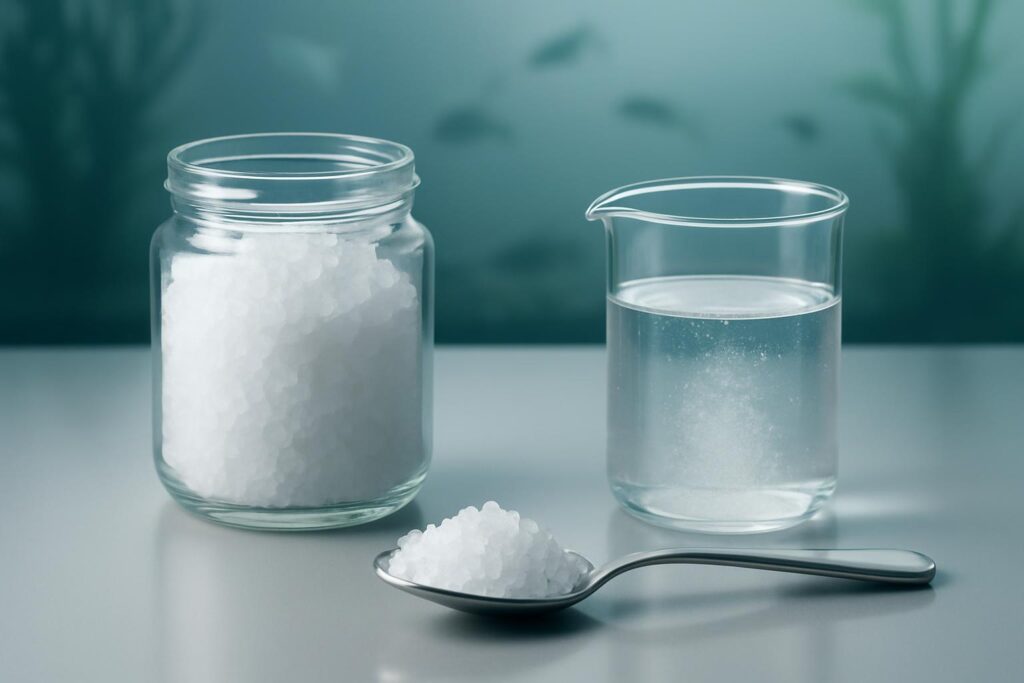
Aquarium salt is plain sodium chloride without additives. It is sold for freshwater use. You can also use non-iodized kosher or rock salt that has no anti-caking agents. The goal is clean, simple salt that dissolves fully and predictably.
Not marine salt mix
Marine salt mix is for reef and marine systems. It contains buffers, minerals, and trace elements to create seawater. Do not use aquarium salt as a substitute for marine salt mix. These products are not interchangeable.
About iodized table salt
Some table salts include iodine and anti-caking agents. While small amounts of iodine are usually not a problem, it is safer for fish to avoid additives when possible. Choose pure, non-iodized salt for predictable results.
Why Use Aquarium Salt
Improves osmoregulation and reduces stress
Freshwater fish constantly balance water and salts moving through the gills and skin. A low level of added chloride can ease this work during illness, transport, or recovery. Fish often breathe easier and show calmer behavior after a correct salt dose.
Supports slime coat and healing
Salt gently irritates the outer tissues in a controlled way, which stimulates a stronger protective slime coat. This helps shield wounds and reduces opportunistic infections while the fish heals.
Helps against external parasites and mild infections
Salt can make the environment less favorable for some external parasites such as ich, and it may slow mild bacterial and fungal growth on fins, skin, and gills. It is not a cure for all diseases, but it is a strong supportive tool.
Buffers nitrite toxicity
Chloride ions compete with nitrite at the gills. This reduces nitrite uptake during a spike. This does not fix the root cause, but it buys time while you manage water quality.
When You Should Not Use Salt
Planted and invertebrate tanks
Many aquatic plants are salt sensitive. Shrimp and snails are also sensitive. Even low doses can harm them. Avoid salt in tanks with most live plants or invertebrates such as shrimp and snails; use a separate hospital tank instead.
Sensitive fish
Scaleless fish such as loaches and many catfish can react poorly to salt. If you must treat them, use the lowest dose, raise it in small steps, and watch closely. When in doubt, move the fish to a hospital tank and treat there.
Do not use as a routine forever
Salt is a treatment and a tool, not a permanent fix for poor water quality. Stable parameters and clean water matter more than any additive.
Choosing the Right Salt
Best options
Use aquarium salt labeled for freshwater. Pure rock salt or non-iodized kosher salt without anti-caking agents also works. Check the label for additives. If unsure, choose aquarium salt.
Grain size and measuring
Fine salt packs more tightly than coarse salt. This changes how much fits in a spoon. If you have a small kitchen scale, dosing by weight is more precise. If you do not, spoon measures still work as long as you stay consistent and raise the dose slowly.
Understanding Dosages
Quick reference by tablespoons and teaspoons
Standard treatment: 1 tablespoon per 5 gallons. This is the most used starting point for ich support, fin issues, and general external problems.
Mild tonic: 1 teaspoon per 10 gallons. Use this very light level for short-term support after shipping or during a small nitrite spike while you fix the root cause.
Stronger treatment: 1 tablespoon per 3 gallons. Use this only if fish are tolerating the standard level but symptoms persist.
Maximum short-term: 1 tablespoon per 2 gallons. Use this only for hardy species and only for a few days under close observation and strong aeration.
Quick reference by percentage and grams per liter
0.1 percent is 1 gram per liter. 0.2 percent is 2 grams per liter. 0.3 percent is 3 grams per liter. If you own a small scale, weigh the dose for accuracy. These levels map closely to the spoon-based doses above.
Time and tolerance
Fish handle salt better when the dose ramps up. Always split the target dose into 2 to 4 portions over 12 to 24 hours. Watch gill movement and behavior. Stop raising the dose if the fish show stress.
How to Dose Correctly
Step 1: Calculate real water volume
Subtract the space taken by substrate, rocks, and wood. A tank labeled 20 gallons may hold only 16 to 18 gallons of water. Base your dose on the actual water volume.
Step 2: Dissolve before adding
Pre-dissolve salt in a small container of warm, dechlorinated water. Stir until clear. Pour slowly into a high-flow area of the tank. This prevents crystals from burning gills or plants.
Step 3: Add in stages
Split the plan into portions. For example, for 1 tablespoon per 5 gallons, add one third now, one third in 6 to 8 hours, and one third after 12 to 24 hours. Observe the fish at each step.
Step 4: Increase aeration
Salt slightly reduces oxygen solubility. Add an airstone or raise filter output to keep oxygen high, especially at stronger doses.
Maintaining and Redosing After Water Changes
Salt does not evaporate
Salt stays in the water until you remove it. Do not re-dose after top-offs. Re-dose only when you perform a water change.
How to re-dose correctly
Only replace the salt for the water you removed. If you treated a 20 gallon tank at 1 tablespoon per 5 gallons and change 25 percent, add back 1 tablespoon.
Worked example
Your 20 gallon tank actually holds 18 gallons of water. At 1 tablespoon per 5 gallons, the initial dose is about 3.5 tablespoons. After a 30 percent change, you removed 5.4 gallons, which contained about 1.1 tablespoons of salt. Add that amount back to keep the same level.
Duration and Exit Strategy
How long to keep salt in
For external issues such as ich or fin rot, hold the dose until several days after visible signs are gone. A common range is 7 to 14 days in total. If fish show stress, reduce sooner.
How to remove salt
Lower salt through a series of water changes over 1 to 2 weeks. Do not drop from a high level to zero in one step. Gradual removal protects the gills and avoids rebound stress.
Salt Dips and Baths
When to use dips and baths
Use a dip or bath for localized problems or as a quick external parasite knockdown before moving a fish to quarantine. These methods act fast but require close supervision.
Short salt dip
Prepare a 3 percent solution at 30 grams per liter using tank water, dip the fish for 2 to 5 minutes with close observation, and stop immediately if the fish shows severe distress. Return the fish to the main or hospital tank afterward.
Longer, gentler bath
Use 0.5 to 1.0 percent for 30 to 60 minutes in a separate, heated, and aerated container. Match temperature and pH to the home tank. Never leave a fish unattended during any salt treatment.
Special Scenarios
Nitrite spikes
During a nitrite spike, a small dose of chloride can reduce uptake at the gills. Use 1 teaspoon per 10 gallons as an emergency support while you correct filtration and perform partial water changes. Test daily and address the cause.
Livebearers and brackish-tolerant fish
Some livebearers and brackish-tolerant species handle salt well. In a bare-bottom quarantine, a light, temporary tonic such as 1 teaspoon per 5 to 10 gallons can ease acclimation. Do not run this long term, and do not use it in planted or invert tanks.
Quarantine and hospital tanks
Salt works best in a simple hospital setup. There are no plants or invertebrates to harm. You can change water often, adjust the dose quickly, and keep oxygen high.
Compatibility With Medications
Use caution with combinations
Salt increases osmotic pressure on the fish. Some medications add their own stress. If you plan to combine salt with any strong medication, check the product guidance and start at the lower salt dose. When unsure, use salt alone first and evaluate results.
Activated carbon and salt
Activated carbon does not remove salt. If you switch to a medication that carbon can adsorb, remove carbon during medication and reinstall it after the course is done.
Aeration and Temperature
Keep oxygen high
Always increase aeration at medium and high salt levels. Add an extra airstone or raise filter flow. This keeps gills comfortable and supports healing.
Hold temperature steady
Stable temperature reduces stress. If you use heat to aid ich treatment, raise temperature slowly and monitor all fish closely. Combine warmth with strong aeration.
Myths and Limits
Salt is not a cure-all
Salt does not fix poor maintenance, ammonia burns, or internal parasites. It does not replace antibiotics when there is a proven systemic bacterial infection. Use it as a targeted tool within a broader plan.
More is not better
Do not jump to the maximum dose. Most cases improve at the standard level. Reserve high doses for short-term use and only with hardy fish under strong aeration.
Step-by-Step Quick Plan
Assess and prepare
Confirm your fish is a freshwater species that tolerates salt. Move plants and invertebrates to a safe place or use a hospital tank. Measure actual water volume.
Choose dose
Start with 1 tablespoon per 5 gallons for general external issues. For mild support or nitrite spikes, use 1 teaspoon per 10 gallons. Plan a 12 to 24 hour ramp-up.
Dissolve and add
Dissolve each portion in dechlorinated water. Add to a high-flow area. Increase aeration immediately.
Monitor daily
Watch gill movement, appetite, and swimming. Test ammonia and nitrite. Maintain the dose for 7 to 14 days or for several days after symptoms clear.
Exit slowly
Remove salt through staged water changes over 1 to 2 weeks. Do not re-dose unless you are maintaining treatment.
Common Mistakes to Avoid
Confusing aquarium salt and marine salt
They are not the same. Marine salt mix is for seawater systems only. Aquarium salt is plain sodium chloride for freshwater treatment.
Overdosing or adding too fast
Rushing the dose can shock fish. Split additions into stages over 12 to 24 hours and watch behavior.
Redosing after top-offs
Do not add more salt when you only replace evaporated water. Salt remains in the tank until you remove it during a water change.
Treating planted or shrimp tanks
Salt can injure plants and invertebrates. Treat fish in a separate hospital tank when possible.
Conclusion
Used with intention, aquarium salt is a precise and reliable tool. It eases osmoregulation, supports healing, helps with certain external parasites, and reduces nitrite stress. The key is matching the dose to the problem, raising it in steps, keeping oxygen high, and protecting sensitive plants and invertebrates. Do the math, dissolve before dosing, and replace only what you remove during water changes. With these habits, you will get the benefits of salt without the risks.
FAQ
Q: What is the standard aquarium salt dosage for general treatment?
A: Use 1 tablespoon per 5 gallons of water, which is roughly 0.1 percent, added gradually over 12 to 24 hours.
Q: How do I re-dose salt after a water change?
A: Only replace the salt for the water you removed. If you treated a 20 gallon tank at 1 tablespoon per 5 gallons and change 25 percent, add back 1 tablespoon.
Q: Can I use aquarium salt in planted or shrimp tanks?
A: Avoid salt in tanks with most live plants or invertebrates such as shrimp and snails; use a separate hospital tank instead.
Q: What is a safe recipe for a short salt dip?
A: Prepare a 3 percent solution at 30 grams per liter using tank water, dip the fish for 2 to 5 minutes with close observation, and stop immediately if the fish shows severe distress.
Q: Does salt evaporate from the aquarium?
A: No. Salt stays in the water. It leaves the system only when you remove water, so do not re-dose after top-offs, only after water changes.