
We are reader supported. When you purchase through links on our site, we may earn an affiliate commission. Also, as an Amazon affiliate, we earn from qualifying purchases.
Chlorine and chloramine in tap water can burn fish gills, destroy beneficial bacteria, and stall a new aquarium. Dechlorinators work fast, but water sources can change without notice. Testing is the only way to confirm your tap water and treated water are truly safe. Below are five reliable chlorine test kits that give clear answers before the water ever reaches your tank.
What To Look For In A Chlorine Test Kit
Free vs Total Chlorine
Free chlorine measures unbound chlorine. Total chlorine measures free chlorine plus chloramine and other combined forms. If your utility uses chloramine, total chlorine testing is essential. If you only test free chlorine, you may miss chloramine.
Bottom line: Test total chlorine to catch chloramine. Test free chlorine to see how much unbound chlorine remains after treatment.
Detection Range And Resolution
Aquarium safety target is 0 ppm at the point water enters the tank. Look for kits that can resolve very low levels so you know you have truly reached zero. High sensitivity is helpful for both tap screening and confirming dechlorination.
Speed And Convenience
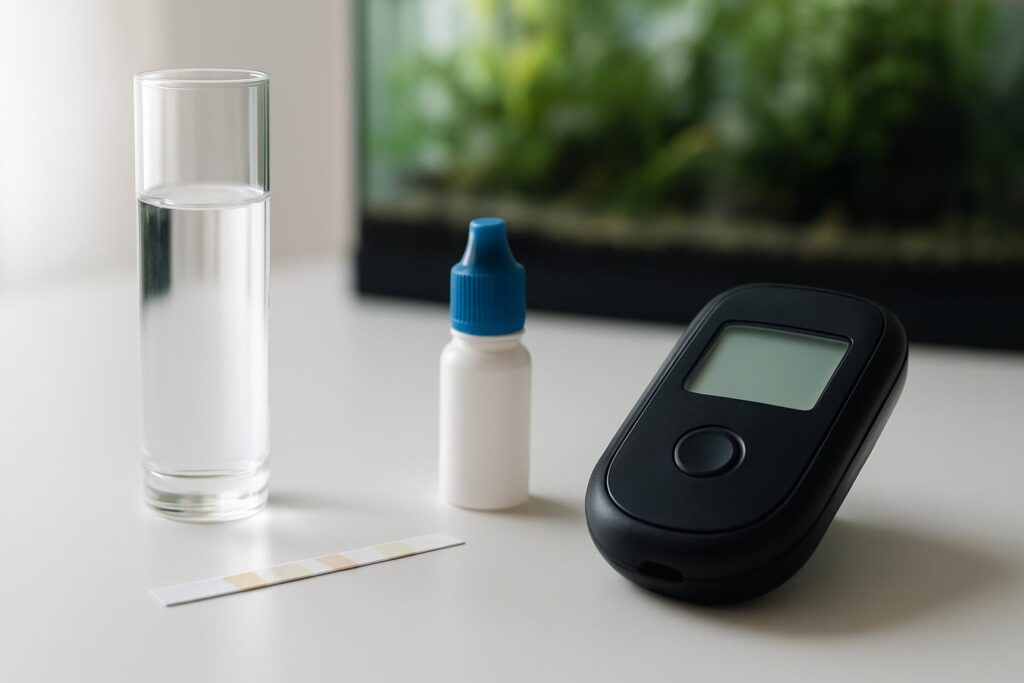
Strips are fast for a quick check. Liquid drop tests improve precision. Digital colorimeters provide lab-like repeatability and easy-to-read numbers. Choose the format you will actually use at every water change.
Reagent Type And Ongoing Cost
Strips are low cost per test. Liquid reagents are economical but require counting drops and timing. Digital meters use individual reagent packets and cost more per test. Balance accuracy needs with your budget and routine.
When And How Often To Test
Test every water change, any time your water looks or smells different, after utility maintenance notices, and if fish show stress after a change. Confirm 0 ppm chlorine before water goes into the tank and again 2 to 5 minutes after dosing dechlorinator.
The 5 Best Aquarium Chlorine Test Kits For Tap Water
1) Seachem MultiTest Free and Total Chlorine
This kit measures both free and total chlorine, so it can detect chloramine that free-chlorine-only kits miss. Its low-level sensitivity is suited to aquarium use, where the goal is zero before water hits the tank.
Why it helps: Confirms your dechlorinator is removing both chlorine and chloramine. You can test untreated tap water, dose dechlorinator, then retest to verify 0 ppm total chlorine.
Best for: Planted and reef keepers who need certainty that chloramine is handled, and anyone on municipal water with seasonal disinfectant changes.
Key features: Free and total chlorine capability, colorimetric liquid reagents, readable color card with low-level focus.
Potential downsides: Color matching takes good lighting and careful timing. Reagents need sensible storage and replacement when expired.
2) API Tap Water Chlorine Test Kit
A simple, fast drop test designed for tap water. It gives a clear yes or no on chlorine presence and is friendly for beginners who want a straightforward workflow.
Why it helps: Verifies that treated water is safe before adding it to your aquarium. Accurate enough to confirm zero without complicated steps.
Best for: New hobbyists, community tanks, and anyone who prefers a direct, budget-friendly check without extra complexity.
Key features: Liquid reagent drops, quick results, easy color comparison focused on low-level readings.
Potential downsides: Measures chlorine effectively but does not separate free from total chlorine in the same level of detail as dedicated dual-function kits. If your city uses chloramine, pair it with periodic total chlorine checks.
3) Hanna Instruments HI701 Checker HC Free Chlorine Colorimeter
This handheld digital colorimeter reads free chlorine as a precise number on a screen. It removes guesswork from color matching and is excellent for documenting results over time.
Why it helps: High repeatability and easy-to-read digital output show exactly how close you are to zero. This is useful when troubleshooting inconsistent water treatment or fine-tuning dosing.
Best for: Advanced freshwater and reef keepers who value numeric precision and consistent logs.
Key features: Digital readout, reagent packets, compact meter with consistent, low-level detection for free chlorine.
Potential downsides: Measures free chlorine only, not total. Reagent packets add ongoing cost, and you must follow timing steps accurately.
4) Hach Total Chlorine Test Strips
These total chlorine strips are fast and clear, with color blocks optimized for low to moderate ranges. Hach is known for water testing products used in labs and facilities, which inspires confidence for hobby use.
Why it helps: Total chlorine reveals chloramine left behind after treatment. A quick dip confirms whether combined chlorine is still present before water goes near fish.
Best for: Keepers on chloraminated city water and anyone who wants a rapid total chlorine screen during big water change days.
Key features: Fast dip-and-read, reliable color scale, suitable for tap water checks right at the sink.
Potential downsides: Strips are less precise than drop tests or digital meters. Store carefully and use before expiration for best consistency.
5) Taylor K-1515-A FAS-DPD Chlorine Test
This FAS-DPD titration kit is well known in water testing for pinpoint accuracy at low levels. It can differentiate free and combined chlorine by using separate steps.
Why it helps: Drop-by-drop titration gives a sharp endpoint. Ideal for aquarists who want clear differentiation between free and combined chlorine without subjective color cards.
Best for: Advanced users managing sensitive stock, large systems, or breeding setups where consistent 0 ppm is non-negotiable.
Key features: Titration method, clear endpoint color change, strong resolution at low concentrations.
Potential downsides: More steps than basic kits and a steeper learning curve. Reagent care and periodic replenishment are required.
How To Use Chlorine Tests For Reliable Results
Confirm Tap Water Before Treatment
Test a sample straight from the tap. This tells you the starting chlorine or chloramine level and helps you size dechlorinator dosing correctly.
Test Again After Dechlorination
Mix dechlorinator per directions, wait the recommended contact time, then retest. You are aiming for 0 ppm free chlorine and 0 ppm total chlorine before the water enters the aquarium.
Match The Kit To The Job
- Fast screening: Strips for a quick yes or no.
- Routine accuracy: Drop tests for better precision at low levels.
- Tracking and troubleshooting: Digital colorimeter or titration for numeric clarity.
Keep Variables Consistent
Use clean glass or plastic vials, take samples at the same tap flow rate, follow timing exactly, and read colors in neutral daylight. Consistency reduces noise and makes results comparable over time.
Conclusion
Safe aquariums start with chlorine-free water. Your target is 0 ppm before water reaches the tank. Use total chlorine testing to catch chloramine, and free chlorine testing to ensure unbound chlorine is gone. For quick checks, strips will do. For routine confidence, a good drop kit is reliable. For detailed tracking, digital or titration kits deliver clarity. Pick the tool you will use at every water change, verify after dosing, and keep your fish protected from unseen disinfectants.
FAQ
Q: What chlorine level is safe for aquariums?
A: The goal is 0 ppm before water enters the tank.
Q: Do I need to test both free and total chlorine?
A: Test total chlorine to catch chloramine and free chlorine to confirm unbound chlorine is gone. If your utility uses chloramine, total chlorine testing is essential.
Q: How often should I test tap water for chlorine?
A: Test every water change, after utility maintenance notices, if the water looks or smells different, and if fish show stress after a change.
Q: Are strips accurate enough for aquarium use?
A: Strips are good for quick screening. For low-level confirmation at or near zero, drop tests or digital meters offer better precision.
Q: What is the best way to confirm my dechlorinator is working?
A: Test straight from the tap, dose dechlorinator, wait the contact time, then retest for 0 ppm free and 0 ppm total chlorine before adding water to the tank.