
We are reader supported. When you purchase through links on our site, we may earn an affiliate commission. Also, as an Amazon affiliate, we earn from qualifying purchases.
Keeping salinity stable is non-negotiable for healthy marine fish, corals, and inverts. Yet many reef keepers still chase numbers with tools that drift or are hard to read. For 2026, I tested and compared the options hobbyists rely on most and narrowed the field to three picks that are accurate, practical, and beginner-friendly. Below you will find what actually matters, the best use cases for each device, and clear setup tips so you avoid common pitfalls from day one.
What Matters When Choosing a Salinity Monitor in 2026
Accuracy, repeatability, and stability
One precise reading means little if the next one drifts. Look for devices with good temperature compensation and stable sensors. Consistent, repeatable results beat theoretical lab accuracy you cannot achieve at home.
Ease of use and calibration
Simple calibration with a standard solution removes guesswork. If you cannot calibrate in under a minute, you will skip it and your readings will drift. Tools that use common 35 ppt or 53.0 mS/cm standards are preferred.
Display and useful scales
Marine keepers usually track specific gravity at 25°C, PSU, or ppt. Screens that toggle between scales reduce conversion mistakes. Backlit displays help in dim rooms or cabinets.
Durability, water resistance, and upkeep cost
Saltwater is harsh. Devices that are waterproof or splash-proof and easy to rinse last longer. Factor in probe care and the cost of replacement sensors or calibration fluid.
Target ranges for typical systems
Most reef tanks do best around 1.025–1.026 specific gravity at 25°C, roughly 35 ppt. Fish-only systems commonly run 1.020–1.023. Choose a monitor that reads cleanly in your target range and holds calibration there.
The 3 Best Aquarium Salinity Monitors for 2026
1) American Marine Pinpoint Salinity Monitor
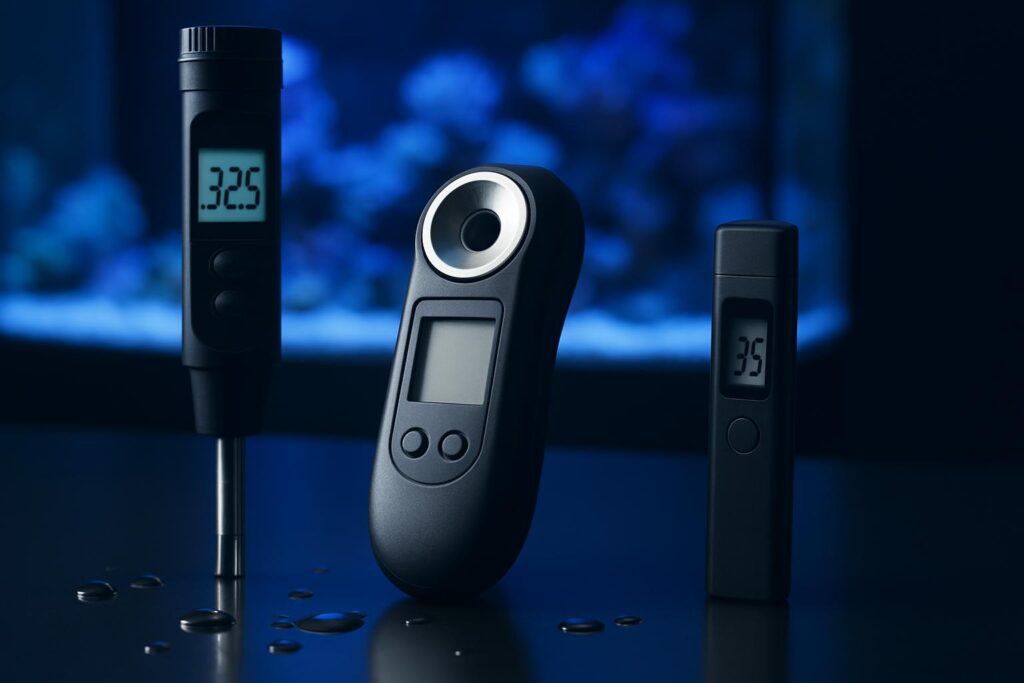
This is a dedicated conductivity-based monitor designed for continuous saltwater measurement. It uses a probe to read salinity in real time, making it ideal for stability-focused reefers. Calibrate with a standard solution, mount the probe in the sump, and glance at the display any time you need confirmation.
Why it helps: Continuous readout catches drift before it becomes a problem. It is excellent for diagnosing issues with auto top-off, dosing, or skimmer overflow because you can see trends, not just snapshots.
Best for: Reef tanks that value tight stability, larger systems, and hobbyists who want a permanent monitor without committing to a full controller ecosystem.
Potential downsides: Requires periodic calibration with solution, careful probe care, and occasional probe replacement. It is not pocket-portable and needs power or a battery.
Key strengths: Real-time data, reliable temperature compensation, clear digital display, and proven track record in the hobby.
Setup tips: Rinse the probe in RO/DI after each maintenance session. Calibrate with fresh, sealed solution at room temperature. Mount in an area of steady flow but away from microbubbles.
2) Milwaukee Instruments MA887 Digital Seawater Refractometer
The MA887 is a digital refractometer that turns a few drops of aquarium water into a precise salinity or specific gravity reading within seconds. It is easy to operate, easy to clean, and removes the guesswork of reading analog scales.
Why it helps: Fast, accurate spot checks drive better maintenance habits. Use it before and after water changes, when mixing new saltwater, and whenever livestock behavior seems off.
Best for: Hobbyists who prefer handheld testing with lab-style reliability. Great for those who mix lots of saltwater and want dead-accurate batches every time.
Potential downsides: Requires clean technique. Residue on the prism or trapped bubbles can skew readings. It also benefits from calibration fluid and careful zeroing with RO/DI water.
Key strengths: Clear digital readout, multiple scales, quick results, and stable readings when cleaned and calibrated properly.
Setup tips: Warm samples to room temp for consistency. Wipe the prism with a soft, lint-free cloth after each test. Use a 35 ppt standard to confirm accuracy weekly or whenever results seem off.
3) Hanna Instruments HI98319 Marine Salinity and Temperature Tester
This pocket tester measures conductivity and converts to salinity or specific gravity with automatic temperature compensation. It is compact, rugged, and simple to use, making it a solid choice for new reefers or as a reliable backup to a main monitor.
Why it helps: It lives in your maintenance caddy and gives instant, repeatable readings without the learning curve of traditional hydrometers.
Best for: Beginners who want easy, dependable checks or experienced hobbyists who need a portable validation tool to verify their primary monitor.
Potential downsides: Like all EC-based testers, it needs periodic calibration and careful rinsing. Long-term sensor neglect can cause drift.
Key strengths: Lightweight, waterproof design, straightforward calibration with standard solution, and quick stabilization.
Setup tips: Rinse the probe in RO/DI before and after each test. Store dry as the manufacturer instructs. Calibrate monthly or whenever results deviate from your baseline.
Quick Comparison and How to Choose
If you want constant visibility and the earliest warning of salinity drift, choose the American Marine Pinpoint Salinity Monitor. It is a set-and-forget station once you build the habit of quick calibration checks.
If you prioritize batch mixing accuracy and fast spot checks with top-tier precision, choose the Milwaukee MA887. It shines when preparing new saltwater and verifying display tank readings.
If you favor simplicity, portability, and value, choose the Hanna HI98319. It is the most beginner-friendly option and a reliable second opinion for any system.
Setup and Care Basics for Stable Results
Calibrate on a schedule
Use fresh, sealed standards. Calibrate at least monthly, after any major cleaning, and any time your reading disagrees with livestock behavior or another trusted tool.
Control temperature and technique
Take readings at room temperature when possible to reduce variability. Avoid bubbles on sensors or prisms. Always rinse with RO/DI water between tests.
Log your numbers
Record readings with date and maintenance notes. Trends reveal small drifts a single test cannot show and help you pinpoint causes like evaporation, skimmer overflow, or batch mixing errors.
Know your target range
Reef tanks: 1.025–1.026 specific gravity at 25°C. Fish-only: 1.020–1.023. Pick a tool that reads cleanly in this window and stick to one primary scale to avoid confusion.
Conclusion
Salinity stability drives coral health, fish osmoregulation, and biofilter performance. The right tool turns this from guesswork into a simple routine. For 2026, the American Marine Pinpoint offers the best continuous monitoring, the Milwaukee MA887 delivers top-notch spot checks for pristine batches, and the Hanna HI98319 gives beginners a durable, easy tester they will actually use. Pick the one that matches how you maintain your tank, calibrate on a schedule, rinse after use, and your system will reward you with fewer surprises and better growth.
FAQ
Q: Which monitor should I pick if I want real-time tracking of salinity drift?
A: Choose the American Marine Pinpoint Salinity Monitor for continuous, real-time readings and early warning of changes.
Q: What is the best tool for mixing new saltwater batches accurately?
A: The Milwaukee MA887 digital refractometer excels at fast, precise spot checks when preparing and verifying new saltwater.
Q: I am a beginner and want something simple. What should I get?
A: The Hanna HI98319 is portable, straightforward to calibrate, and beginner-friendly for quick, dependable checks.
Q: How often should I calibrate my salinity monitor or tester?
A: Calibrate at least monthly, after major cleaning, and any time results disagree with your baseline or another trusted tool.
Q: What salinity range should I target for a reef tank?
A: Most reef tanks do best around 1.025–1.026 specific gravity at 25°C, roughly 35 ppt.