
We are reader supported. When you purchase through links on our site, we may earn an affiliate commission. Also, as an Amazon affiliate, we earn from qualifying purchases.
Arowana are stunning centerpieces, but they are also powerful predators with fast growth and strong personalities. Building a community tank around an Arowana is possible, but it demands planning, restraint, and a clear stocking strategy. This guide shows you which fish work, which do not, and how to keep the peace long term. Keep reading if you want a display that looks impressive and stays stable as your Arowana matures.
Why Arowana Community Tanks Are Different
Understand Arowana Behavior First
Arowana are surface cruisers. They patrol the top zone, watch everything, and strike upward. They are territorial around feeding time and can chase tankmates that crowd the surface. They are not relentless killers, but anything small enough to fit in their mouth will be eaten. Their long body and power mean they can injure other fish with one fast burst. Tankmates must be large, robust, and generally mid to bottom dwelling.
Size and Growth Change the Rules
Juvenile Arowana look calm and may tolerate smaller fish. This changes as they hit 30 to 60 centimeters. Fish that were fine for months can become food or targets. Always stock with adult size in mind. If a species tops out under 15 to 18 centimeters, it is risky long term. Aim for tankmates that reach 20 to 35 centimeters and that can live comfortably in your tank footprint.
Water Parameters That Match
Most Arowana do best at 25 to 28 Celsius, pH 6.5 to 7.5, soft to moderately hard water. Asian Arowana prefer slightly acidic to neutral. Silver and Black Arowana handle neutral to slightly alkaline. Stability is more important than chasing a precise number. Choose tankmates that share this range and do not need strong current.
Tank Dimensions Matter More Than Volume
Length and width determine success. A 180 to 240 centimeter tank gives swim room for an adult Arowana and space for tankmates to avoid conflict. Height is less important than footprint. Use a tight lid with heavy-duty braces. Arowana jump when startled. Leave open surface lanes and keep tall decor away from the center line to prevent spooking.
Traits of Good Arowana Tankmates
Large Enough, But Not Aggressive
Ideal tankmates are too large to swallow, fast enough to avoid bumps, and calm enough not to provoke the Arowana. Avoid chronic fin nippers and hyperaggressive cichlids. Semi-bold fish that do not crowd the surface work best.
Mid or Bottom Zone Specialists
Pick species that prefer the middle and bottom zones. Midwater schooling fish disperse attention and calm the tank. Bottom dwellers add interest without competing for the surface lane.
Strong Body Shape and Grouping
Deep-bodied fish are harder to swallow. Schooling fish should be kept in proper numbers to reduce stress and chasing. Thin, torpedo-shaped fish must be large and very fast or they will get harassed.
Best Categories and Species Options
Midwater Schooling Workhorses
Silver dollars: Deep-bodied, fast, and hardy. Go for standard silver dollars, spotted, or red shoulder types. Redhook types can nip fins at high stress or when underfed, so select calmer species and keep a proper group. Adults reach 15 to 20 centimeters.
Tinfoil barbs: Strong swimmers that handle size and activity well. Choose the standard tinfoil barb over smaller variants. Keep in a group of five or more to diffuse aggression. Adults reach 25 to 35 centimeters, so plan for space and filtration.
Bala sharks: Peaceful, active, and visually striking. Require a group to feel secure. They can be skittish, so provide long swim lanes. Adults reach 25 to 30 centimeters.
Peaceful to Moderately Assertive Cichlids
Severum: Calm, intelligent cichlid that stays in the mid to lower zone. Usually ignores the Arowana and focuses on its territory. Adults reach 20 to 25 centimeters.
Uaru: Gentle plant grazers with steady behavior. Need clean, warm water and a stable group or a pair. Adults reach 25 to 30 centimeters.
Geophagus eartheaters: Constant sifters that occupy the bottom area. Provide sand substrate. Keep a group to spread minor disputes. Adults reach 15 to 25 centimeters depending on species.
Chocolate cichlid: Slow, peaceful, and easygoing. Not a bully, but needs good water quality. Adults reach around 25 centimeters.
Bottom Predators and Oddballs That Play Nice
Bichirs: Polypterus species are ideal. They stay low, ignore the Arowana, and add prehistoric charm. Choose larger species like endlicheri, delhezi, ansorgii, or ornate. Provide caves and smooth wood. Secure the lid completely since they are escape artists.
Ropefish: Similar niche to bichirs. Keep in groups for confidence. Fully cover the tank. They handle neutral water and warm temperatures well.
Robust Catfish That Do Not Outgrow the Tank
Synodontis featherfin and related species: Active at dusk and night, armor plated, and not easily bullied. Adults reach 15 to 25 centimeters. Avoid very small species that could be swallowed.
Hoplo catfish and large Corydoras relatives like Brochis: Peaceful bottom cleaners. Ensure mature size is safe. Hoplo reach 15 to 20 centimeters.
Raphael catfish and other Doradids: Armored, reclusive, and sturdy. Great for hiding under wood. Make sure they are large enough as adults.
Avoid giant predators like redtail catfish or Tiger shovelnose. They outgrow most home tanks fast and will eat everything.
Plecos for Cleanup Without Trouble
Royal pleco and other Panaque: Strong wood-eaters that can handle size. Provide driftwood and good oxygenation. Adults reach 30 to 40 centimeters.
Green phantom L200 and Blue phantom L128: Attractive and sturdy. Provide caves and moderate flow. Ensure they reach at least 15 to 20 centimeters before cohabiting with a large Arowana.
Avoid common plecos that rasp mucus at night. Some individuals develop a habit of sucking on the Arowana. If you see this behavior, rehome the pleco.
Quick Species Guide With Notes
Midwater and Dither Choices
Silver dollar group: Adult size 15 to 20 centimeters. Keep six or more. Risk low if well fed. Watch for fin nipping in stressed groups.
Tinfoil barb group: Adult size 25 to 35 centimeters. Keep five or more. Risk low to moderate due to activity. Needs large tank and heavy filtration.
Bala shark group: Adult size 25 to 30 centimeters. Keep five or more. Risk low if tank is long and well covered.
Cichlids
Severum pair or trio: Adult size 20 to 25 centimeters. Risk low. Avoid cramped layouts that trigger territory fights.
Uaru group or pair: Adult size 25 to 30 centimeters. Risk low. Requires warm stable water and plant-safe planning.
Geophagus group: Adult size 15 to 25 centimeters. Risk low. Needs sand substrate for natural behavior.
Chocolate cichlid pair: Adult size around 25 centimeters. Risk low. Not for high current tanks.
Oddballs and Bottom Dwellers
Bichirs mix: Adult size 25 to 60 centimeters depending on species. Risk low with proper size. Feed sinking meaty foods. Ensure lid is tight.
Ropefish group: Adult size 30 to 45 centimeters. Risk low. Escape-proof tank is mandatory.
Catfish and Plecos
Synodontis featherfin group: Adult size 15 to 20 centimeters. Risk low. Night active and hardy.
Raphael catfish: Adult size 15 to 25 centimeters. Risk low. Provide wood and caves.
Hoplo catfish: Adult size 15 to 20 centimeters. Risk low. Good general scavenger.
Royal pleco Panaque: Adult size 30 to 40 centimeters. Risk moderate due to size and waste. Provide wood diet and strong filtration.
Species To Avoid or Keep Only With Caution
Too Small or Thin
Small tetras, rasboras, danios, and livebearers will be eaten. Rainbowfish under 12 to 15 centimeters are also risky with maturing Arowana.
Chronic Fin Nippers
Tiger barbs, small Leporinus, and some redhook silver dollars can shred fins when stressed. Avoid or keep only with very large groups and steady feeding, which still carries risk.
Overly Aggressive or Territorial
Oscars, Jack Dempseys, green terrors, and flowerhorns can challenge or ram an Arowana. Some keepers succeed, but many report torn fins and constant tension. Not recommended for beginners.
Massive Predatory Catfish
Redtail catfish, Tiger shovelnose, and hybrids grow beyond home aquariums and will eat tankmates. Avoid.
Stingrays Are Advanced Only
Freshwater rays can work with Arowana but require huge footprint, impeccable water, and specific feeding. Do not attempt unless you have ray experience and a very large tank.
Stocking Plans That Work
180 Gallon With Juvenile Silver Arowana
A juvenile Silver at 20 to 30 centimeters can live short term in a 180 gallon while you plan an upgrade. Pair it with five to seven silver dollars, three to five Geophagus, and a Synodontis group. Add one pleco like a Royal or a large phantom. Monitor growth every month. Move to a 240 to 300 gallon as the Arowana reaches 45 to 60 centimeters.
240 to 300 Gallon With Adult Silver Arowana
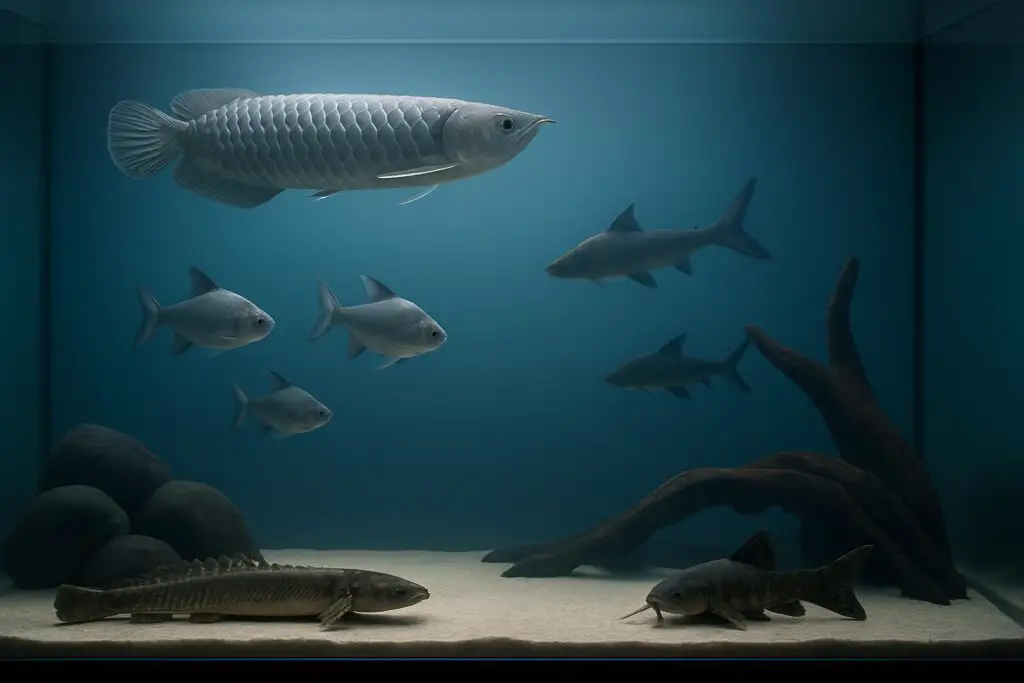
One adult Silver at 60 to 75 centimeters. Add six to eight tinfoil barbs or bala sharks, three severum, and a group of bichirs on the bottom. Include one or two larger catfish like Raphael or Synodontis. Keep decor minimal for swim lanes, with wood and rocks grouped at ends.
180 to 220 Gallon With Asian Arowana
One Asian Arowana at 35 to 55 centimeters can work with four to six silver dollars, a pair of severum or a group of Geophagus, and one or two medium catfish. Asian Arowana can be more territorial, so give more hiding and sight breaks than you would with a Silver. Keep feeding controlled and regular.
Jardini or Leichardti Setup
These Australian species are more aggressive. Plan for a mostly single-specimen display or choose a small list of sturdy tankmates added together when the Jardini is young. Options include a group of large silver dollars, a robust pleco, and one or two bichirs. Be ready to remove fish if aggression spikes. Many end up with a solitary Jardini for long term peace.
Feeding Strategy To Reduce Aggression
Balanced Diet
Feed high-quality floating pellets for carnivores as a staple. Rotate with frozen or fresh foods like shrimp, krill, silversides, and tilapia strips. Add vitamin soaked offerings weekly to support color and health.
Controlled Schedule
Two small meals per day for juveniles, one to two moderate meals for adults. Do not overfeed tankmates before the Arowana eats, or it may chase them for sport. Target feed bottom dwellers at lights out with sinking sticks or gel foods.
Avoid Feeder Fish
Feeder fish bring parasites and reinforce chase behavior. Use prepared and frozen foods instead. If you must use live food for training, quarantine and gut-load thoroughly, then phase out quickly.
Tank Layout and Equipment Tips
Open Surface, Structured Ends
Keep the center lane open for the Arowana. Place tall wood and rock piles at the ends and corners. Provide caves for catfish and bichirs, and a sand area for Geophagus. Use smooth wood and rounded rocks to reduce injury risk.
Filtration and Flow
Use oversized filtration. Aim for 6 to 10 times turnover per hour with both mechanical and biological capacity. Add prefilters on intakes for easy maintenance. Flow should be moderate with calm zones, not a blasting river.
Water Changes and Stability
Change 30 to 50 percent weekly. Keep nitrates under 20 to 30 ppm. Vacuum lightly around decor. Rinse filter media in tank water to preserve bacteria. Stability prevents stress and aggression spikes.
Security and Lids
Use a solid cover with clamps or weight. Block gaps around cables. Dim the room lights before tank lights switch off to prevent startle jumps. Place the tank away from sudden traffic and slamming doors.
Quarantine, Acclimation, and Long Term Peace
Quarantine Every New Fish
Hold new fish for 3 to 4 weeks in a separate tank. Observe, deworm if needed, and confirm steady feeding. Introducing disease to an Arowana display is costly and avoidable.
Add Tankmates Together When Possible
Adding multiple tankmates at once spreads attention and reduces targeting. Rearrange decor before introduction to reset territories. Dim lights during the first day.
Watch the First 72 Hours
Feed lightly and observe. Expect some chasing but stop it if it becomes one-sided and relentless. Use a divider if needed. Remove chronic bullies or tankmates that hover at the surface in panic.
Troubleshooting Common Problems
Arowana Chasing One Species
Increase that group size if appropriate, or swap to a deeper-bodied species. Improve feeding schedule and reduce surface competition. Add sight breaks at mid-level.
Fin Nipping From Schooling Fish
Raise group numbers and increase fiber and greens in their diet for satiety. Offer blanched vegetables to silver dollars. If nipping continues, rehome the offenders.
Pleco Rasping the Arowana
Remove the pleco immediately. Some individuals will not stop. Replace with a different species that has no history of rasping.
Skittish Bala Sharks or Barbs
Add background covers, reduce sudden noise, and keep the school together. Use steady light cycles. Increase decor at ends for security while keeping the center open.
FAQs For New Keepers
Can I start with small tankmates since my Arowana is a juvenile
Do not. Stock for adult size from day one. Small fish will be eaten as the Arowana grows.
Do I need a lid if my Arowana has never jumped
Yes. All Arowana jump eventually. A tight lid is mandatory.
Can two Arowana live together
Not safely in home tanks. They fight and injure each other. Keep one per tank unless you have commercial scale systems and experience.
Which Arowana is best for community tanks
Silver and Black Arowana are often more tolerant. Asian Arowana can work with careful stocking. Jardini and Leichardti are the most aggressive and often end up solo.
What about live plants
You can keep hardy plants like java fern and anubias attached to wood and rocks. Expect some damage from large fish movement. Floating plants can spook surface cruisers and trap them, so use sparingly.
Putting It All Together
Plan Backwards From Adult Size
Choose species that will still be safe and comfortable when the Arowana is fully grown. This prevents rehoming and stress. Confirm maximum sizes and group needs before buying.
Stock In Layers
Surface layer is for the Arowana. Mid layer gets schooling fish like silver dollars or bala sharks. Bottom gets Geophagus, bichirs, and catfish. This layering avoids direct competition and reduces conflict.
Feed With Intention
Give the Arowana first access to floating foods. Then feed sinking foods in target zones for bottom species. Keep schedules steady. A fed Arowana is less likely to chase out of frustration.
Maintain Relentlessly
Heavy bioload demands strong filtration and regular water changes. Stability keeps fish calm. Calm fish fight less and grow better.
Conclusion
An Arowana community tank can be stable, impressive, and long lived if you choose the right tankmates and manage the system with discipline. Favor deep-bodied midwater fish, calm medium cichlids, sturdy bottom dwellers, and well-chosen plecos or catfish. Avoid small or nippy species and giant predators. Build your layout for clear swim lanes and secure the tank with a tight lid. Feed on a schedule, quarantine every new fish, and monitor behavior closely during the first days after introductions. With this approach, your Arowana will remain the star while the supporting cast thrives around it.