
We are reader supported. When you purchase through links on our site, we may earn an affiliate commission. Also, as an Amazon affiliate, we earn from qualifying purchases.
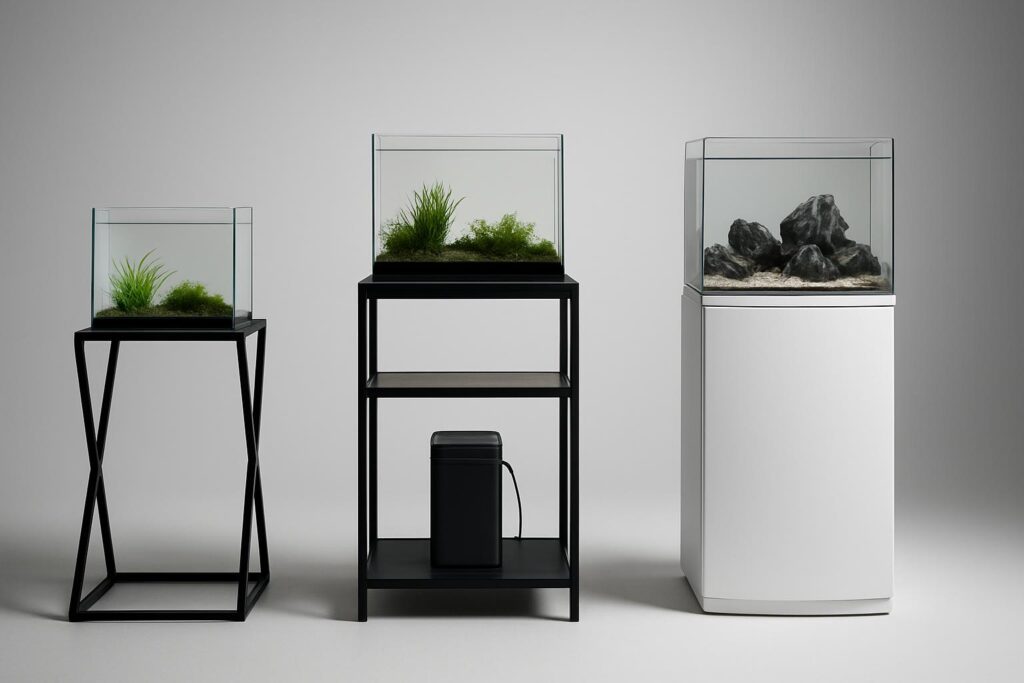
Nano aquariums look light and simple, but a full tank is heavy, sensitive to vibration, and unforgiving of a wobbly surface. A dedicated stand built for your tank’s exact footprint protects the glass, keeps the display level, and gives you cable and equipment access without a mess. For 2026, these are the five nano aquarium stands that combine stability, clean design, and fishkeeper-friendly details.
How to choose a nano aquarium stand
Footprint precision comes first
Match the stand to your tank’s footprint. Standard 10‑gallon glass uses a 20 x 10 inch base. Branded nanos like Fluval Flex or Coralife BioCube need stands shaped for their curved fronts. The tank should sit fully supported with no overhang.
Level and sturdy under real weight
A filled nano holds water, rock, substrate, and gear. That is a lot of mass on a small area. The stand must be solid with zero flex. On uneven floors, consider a thin leveling mat and verify with a bubble level before filling.
Moisture resistance and maintenance access
Salt creep and splashes happen. Powder‑coated steel and sealed panels resist swelling and rust. Doors or open backs make it easier to route cables, hide power strips, and reach filters or ATO reservoirs.
Form and function
Choose a style that fits your space, but do not trade off stability. Extra storage is helpful for food, nets, and test kits. Minimal metal frames are excellent if you already keep gear outside the stand.
The 5 best nano aquarium stands for 2026
1) Aqueon Forge 10/20 Gallon Aquarium Stand
The Forge is a steel frame stand with a smart two‑tier design. The top shelf supports standard 10 or 20 by 10 inch tanks, while the lower shelf can hold a second nano or store gear. Reversible wood accent panels offer a clean look in most rooms.
Why it helps: The steel frame resists wobble, and the dual‑shelf layout saves space. The open back makes cable routing simple. For beginners, the strong frame and obvious footprint fit reduce setup stress.
Best for: Standard 10‑gallon glass tanks or compact 20 by 10 inch setups, freshwater or saltwater. Great in apartments where vertical space matters.
Potential downsides: No enclosed cabinet, so equipment remains visible. The lower shelf clearance can be tight for taller gear.
Setup tip: Place a thin neoprene or yoga‑mat style pad under glass tanks on steel stands to distribute minor surface irregularities.
2) Aquatic Fundamentals 10/20 Gallon Steel X‑Stand
This classic X‑frame stand is minimal, sturdy, and quick to assemble. The top frame supports the aquarium perimeter, while the lower frame works as a shelf for light items. The powder‑coated finish helps resist moisture in daily use.
Why it helps: Simple geometry equals stability. For new hobbyists, fewer panels and hardware mean fewer assembly mistakes. It is also easy to clean around and under the stand.
Best for: Standard 10‑gallon tanks when you want the smallest visual footprint and a budget‑friendly, durable stand.
Potential downsides: No storage or doors, and no integrated cable management. The open design shows gear unless you plan a separate organizer.
Setup tip: Verify the tank frame sits flush on all four sides; shim the stand feet if your floor has a noticeable slope.
3) Fluval Flex 15 Stand
Designed to match the curved front and footprint of the Flex 15, this stand locks in a perfect fit and a tidy presentation. Interior shelves keep food, nets, and power strips hidden. Front‑facing doors keep everything accessible without pulling the tank away from the wall.
Why it helps: A custom‑fit stand for a molded, curved aquarium prevents pressure points and overhang. Cable cutouts and storage reduce clutter, which is critical in compact nano layouts.
Best for: Fluval Flex 15 owners who want a matched display. If you run the Flex with built‑in filtration and light, the cabinet keeps the rest of your gear out of sight.
Potential downsides: The footprint is model‑specific. It is not a good choice for standard rectangular tanks.
Setup tip: Dry‑fit the tank on the stand before final placement to align the curved front and verify door clearance in your room.
4) Coralife BioCube 16 Stand
This cabinet matches the BioCube 16 footprint and style, with a curved front and an open back for cords and tubing. The interior offers room for dosing bottles, food, and test kits. The design supports the cube evenly, which is important for all‑in‑one tanks with molded frames.
Why it helps: Even support and matched shape protect the BioCube’s base. The storage space keeps reef odds and ends contained, helping you maintain a clean display.
Best for: Coralife BioCube 16 reef or freshwater setups, especially in living rooms or offices where a coordinated look matters.
Potential downsides: Only fits the BioCube footprint. Assembly requires attention to panel orientation to maintain the curve alignment.
Setup tip: Route power and airline through the rear cutouts first, then place the tank, so you are not forcing tight cables after filling.
5) Flipper 10/20 Gallon Aquarium Stand with Storage
This cabinet‑style stand supports standard 10 or 20 by 10 inch tanks and provides enclosed shelves for supplies. The modern finish blends into most spaces, and the hidden storage reduces visual clutter around a small aquarium.
Why it helps: Enclosed storage keeps chemicals and tools separate from the display. The full top panel supports the entire tank base, which is friendly for thin glass nanos.
Best for: Beginners who want a tidy, furniture‑like look and a place to hide gear, especially in small rooms.
Potential downsides: Engineered wood needs careful water management. Wipe spills immediately and use a mat to protect the top from drips during maintenance.
Setup tip: Assemble on a flat surface, square the cabinet before tightening all hardware, and recheck for level once placed.
Setup and safety tips
Level before you fill
Place the empty stand where the tank will live. Level it front to back and side to side. Use shims under the stand feet if needed, not between the tank and stand.
Use a thin mat
A thin neoprene or foam mat between tank and stand helps distribute tiny imperfections and protects glass. Do not use a soft, thick cushion that can compress unevenly.
Protect against moisture
Wipe splashes right away. Add a drip tray or shelf liner inside cabinets. For marine systems, manage salt creep with regular cleaning so hinges and finishes last.
Plan cable and hose paths
Route cables through rear cutouts or along the frame, leaving drip loops on every cord. Keep power strips off the floor and secured inside the stand if space allows.
Conclusion
A nano aquarium needs a stand that is exact in footprint, stable under real weight, and friendly to daily maintenance. Aqueon Forge and Aquatic Fundamentals shine for simple strength. Fluval Flex 15 and Coralife BioCube 16 stands deliver perfect matches for their specific tanks with clean cable management. Flipper’s cabinet offers storage for a clutter‑free look. Choose the model that fits your tank’s base and your room, level it carefully, and your nano will run safer and look better for years.
FAQ
Q: How do I make sure a stand fits my nano tank?
A: Match the stand to your tank’s footprint. Standard 10‑gallon glass uses a 20 x 10 inch base, while branded nanos like Fluval Flex or Coralife BioCube need stands shaped for their curved fronts. The tank should sit fully supported with no overhang.
Q: Do I need a mat between the tank and the stand?
A: A thin neoprene or foam mat helps distribute tiny imperfections and protects glass. Do not use a soft, thick cushion that can compress unevenly.
Q: What is the benefit of a cabinet stand over a metal frame?
A: Cabinet stands provide enclosed storage, cable cutouts, and a furniture‑like look that hides gear. Metal frames are minimal, sturdy, and easy to clean but leave equipment visible.
Q: Can I use a regular piece of furniture as a nano stand?
A: Use a dedicated aquarium stand when possible. A stand designed for the exact footprint offers even support, better moisture resistance, and safer cable routing.
Q: How should I level a nano stand on an uneven floor?
A: Level the empty stand front to back and side to side using shims under the stand feet, not between the tank and stand, and verify again after placing the tank.