
We are reader supported. When you purchase through links on our site, we may earn an affiliate commission. Also, as an Amazon affiliate, we earn from qualifying purchases.
Salinity stability decides whether corals thrive or stall. A reliable refractometer is the easiest way to lock in salinity and stop the silent drift that stresses LPS, SPS, and inverts. This guide cuts through the noise with five proven picks for 2026, clear buying criteria, and simple steps that keep your readings consistent week after week.
How to choose a reef-safe refractometer in 2026
Seawater scale beats brine scale
Many hobby refractometers are calibrated to brine or sodium chloride solutions. Reef tanks are true seawater with different ion balance. A seawater scale aligns the optical path to marine ionic content and tightens accuracy around 35 ppt. If the product states seawater or has a 35 ppt calibration point, you are on the right track.
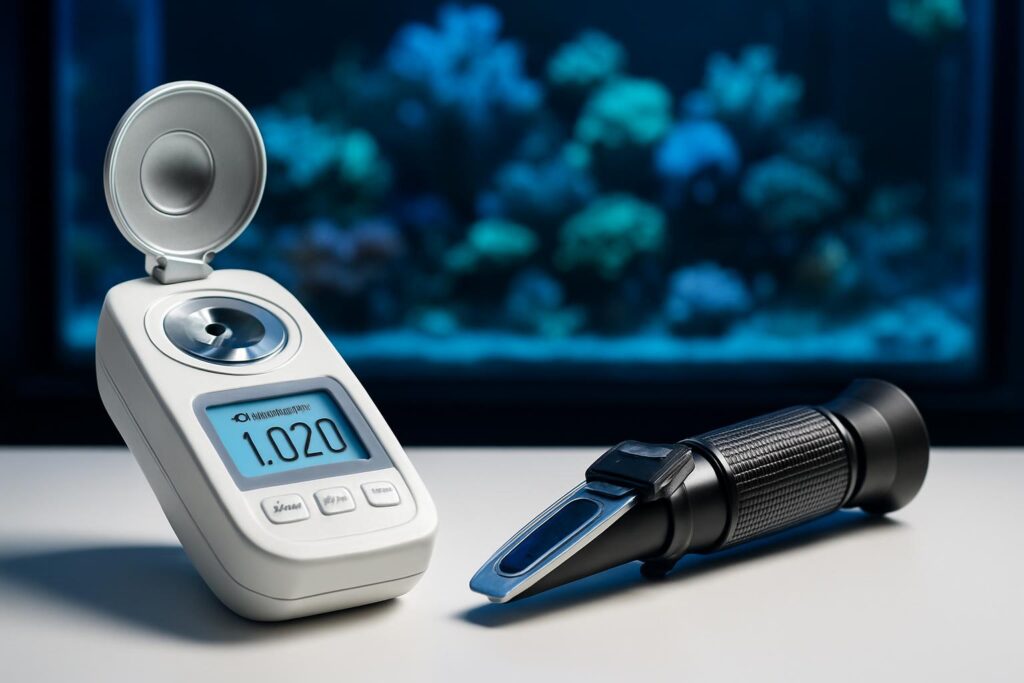
Digital vs optical
- Digital units read a tiny sample at the press of a button. They reduce user error from focusing and ambient light. They cost more but deliver consistent results fast.
- Optical handheld units are durable, do not need batteries, and are great value. They require careful focus, good lighting, and proper technique to avoid bias.
Calibration fluid that matters
Use a 35 ppt reference solution for primary calibration. RO or DI water sets a zero point but can introduce offset in the reef range. For most home systems, a quick 35 ppt check weekly is enough. If temperature or room changes, check more often to stay tight.
Temperature compensation and build
ATC, or automatic temperature compensation, helps align readings taken at room temperature to a standard. Seek clear, stable displays or high-contrast optical prisms, cleanable sample wells, and robust housings that resist salt creep and drops.
The 5 best reef tank refractometers for 2026
Milwaukee Instruments MA887 Digital Seawater Refractometer
Why it helps: Fast, consistent readings on a true seawater scale reduce guesswork and keep salinity anchored near 35 ppt. A clear digital display removes focusing and ambient light errors common in optical units.
Best for: Reef keepers who value one-button consistency, from beginners to advanced coral growers managing tight salinity windows for SPS.
Key features:
- Seawater-specific algorithm designed around 35 ppt
- Simple one-drop sample and quick read
- ATC and easy single-point calibration
Use tips: Rinse the sample well with RO or DI water after each use. Blot dry with a lint-free cloth. Calibrate with a 35 ppt solution weekly, or any time temperature swings or the battery is changed.
Potential downsides: Requires batteries and careful cleaning of the sample well to avoid salt film that can shift readings.
Hanna Instruments HI96822 Digital Seawater Refractometer
Why it helps: Lab-grade optics and temperature control deliver repeatable results in the reef range. It is ideal when you track small adjustments during acclimation, dosing changes, or large water change cycles.
Best for: Advanced reefers who value precision and repeatability during testing sessions and who run multiple systems.
Key features:
- Digital seawater measurement with ATC
- Stable, easy-to-read screen for quick comparisons
- Solid build aimed at frequent testing
Use tips: Let the device equilibrate to room temperature before testing. Calibrate with 35 ppt solution before a batch of tests so you can compare tanks with confidence.
Potential downsides: Higher price than optical tools. As with all digital units, keep the prism and well spotless to avoid light scatter and drift.
Red Sea Seawater Refractometer
Why it helps: Purpose-built for reef aquariums with a seawater calibration point near 35 ppt. The scale is easy to read, and the housing is comfortable and sturdy for routine weekly checks.
Best for: Reefers who prefer optical tools but still want a seawater-accurate scale and clear readability.
Key features:
- Seawater scale optimized around 35 ppt
- ATC for room-temperature testing
- Clear viewfinder and crisp demarcation line
Use tips: Use a bright, consistent light source and keep the prism face clean. Allow the sample to sit for several seconds before reading to let temperature stabilize.
Potential downsides: Like all optical refractometers, readings depend on user technique. Practice a consistent droplet size and reading time to minimize variance.
Vee Gee Scientific STX-3 Salinity Refractometer
Why it helps: Rugged, professional-grade optical design that stands up to heavy use. It provides reliable salinity readings when handled correctly and kept calibrated to a 35 ppt standard.
Best for: Hobbyists who want a durable optical refractometer with consistent performance and a long service life.
Key features:
- Robust body and quality optics
- ATC and stable scale presentation
- Good choice for fish rooms or maintenance routes
Use tips: Recheck calibration weekly and after transport. Take three quick readings and average if you are dialing in a critical parameter for sensitive corals.
Potential downsides: Not seawater-specific on every variant. Confirm the model range and ensure you calibrate with 35 ppt to align with reef targets.
Ade Advanced Optics Salinity Refractometer with ATC
Why it helps: A budget-friendly path to consistent salinity checks. With correct calibration at 35 ppt and careful technique, it keeps a mixed reef within target range without guesswork.
Best for: Beginners and budget-minded reefers who want a reliable starter refractometer and are willing to practice proper use.
Key features:
- Affordable optical body with ATC
- Simple to calibrate and operate
- Includes basic accessories in many kits
Use tips: Do not rely only on RO or DI zeroing. Use a 35 ppt reference solution for accuracy in the reef range. Take repeat readings as you learn your technique and average them.
Potential downsides: Scale clarity and prism quality can vary between units. User technique has a stronger influence on readings than with digital models.
Target salinity and simple workflow
Most reef tanks run best at 35 ppt, about 1.025 to 1.026 specific gravity at 25 C. Stability matters more than chasing decimals. Here is a clean routine that works:
- Calibrate with 35 ppt solution weekly, or after temperature swings
- Rinse the prism or sample well with RO or DI water between tests and after use
- Log readings after water changes and top-off adjustments
- Stick to one tool for consistency rather than switching between devices
Which one should you pick
- Pick a digital unit if you want the fastest, most repeatable results with minimal technique
- Pick an optical unit if you prefer a durable, battery-free tool and are comfortable practicing a consistent reading method
- Always prefer a seawater scale or calibrate at 35 ppt to align with marine ionic content
Conclusion
Salinity is foundational. Choose a refractometer that matches your workflow, calibrate to 35 ppt, and keep it clean. The Milwaukee MA887 and Hanna HI96822 lead for digital precision. The Red Sea Seawater Refractometer and Vee Gee STX-3 deliver optical reliability with solid build quality. Ade Advanced Optics offers dependable performance for a low cost when you follow best practices. With a stable reading and a steady routine, corals settle in, growth becomes predictable, and reefkeeping gets easier.
FAQ
Q: What salinity should a reef tank run at?
A: Most reef tanks run best at 35 ppt, about 1.025 to 1.026 specific gravity at 25 C. Stability matters more than chasing decimals.
Q: Do I need a 35 ppt calibration solution or can I use RO or DI water?
A: Use a 35 ppt reference solution for primary calibration. RO or DI water sets a zero point but can introduce offset in the reef range.
Q: Which is better for beginners, digital or optical?
A: Digital units are faster and reduce user error, so they are often better for beginners. Optical units work well with proper technique and calibration.
Q: How often should I calibrate my refractometer?
A: Calibrate weekly or after temperature swings, and any time the device has been transported or the battery changed.
Q: Why does a seawater scale matter?
A: A seawater scale aligns the measurement to marine ionic content and tightens accuracy around 35 ppt compared to brine scales.