
We are reader supported. When you purchase through links on our site, we may earn an affiliate commission. Also, as an Amazon affiliate, we earn from qualifying purchases.
Keeping a thriving reef tank in 2026 means nailing your water chemistry. Corals and inverts respond fast to changes in alkalinity, calcium, magnesium, nitrate, and phosphate. You do not need every gadget, but you do need reliable test kits you can run consistently. Below is a concise guide to the five best reef test kits right now, what they do well, and how to choose the set that fits your system and routine.
What Matters Most In Reef Water Testing
Core parameters and target ranges
Start with the essentials and build from there.
Alkalinity: 7.5 to 9 dKH for most mixed reefs. Stable alk keeps pH steadier and fuels coral calcification.
Calcium: 400 to 450 ppm. Corals and coralline algae use it constantly.
Magnesium: 1250 to 1350 ppm. Buffers alkalinity and helps keep calcium in solution.
Nitrate: 2 to 10 ppm for most tanks. Ultra low can starve corals, too high fuels algae.
Phosphate: 0.02 to 0.08 ppm. Enough for coral health without inviting nuisance algae.
How to choose a kit
Accuracy and resolution: Can it resolve small changes where it matters, especially for phosphate and alkalinity.
Repeatability: Results should be consistent day to day with the same sample.
Speed and ease: Fast, simple workflows are more likely to be used regularly.
Cost per test: Ongoing reagent cost matters if you test several times per week.
Range: Make sure the kit covers your expected levels for a reef, not just general marine.
The 5 Best Reef Tank Test Kits For 2026
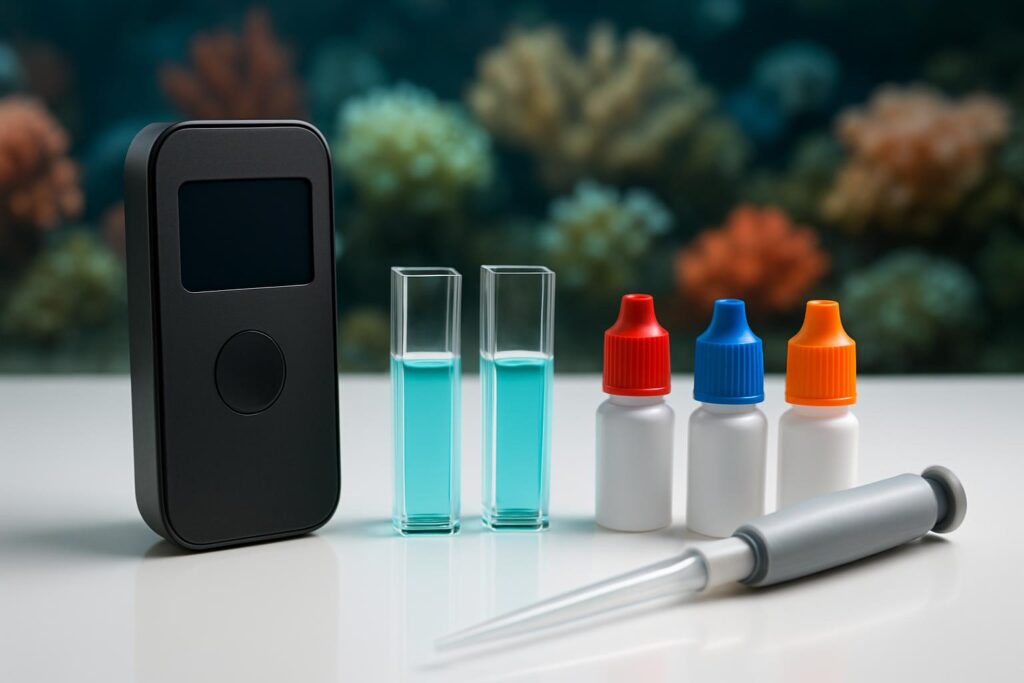
Hanna Instruments Marine Alkalinity dKH Checker HI772
What it tests: Alkalinity in dKH with digital readout.
Why it helps: Alkalinity is the heartbeat of a reef. This handheld colorimeter gives you quick, precise readings so you can hold a stable range and adjust dosing with confidence.
Best for: Reefers who tweak dosing or run kalkwasser and need tight day to day control.
Accuracy and speed: Fine resolution with a result in a couple of minutes. Digital output removes guesswork from color matching.
Ease of use: Simple reagent dropper, zero, add reagent, read. Keep the cuvette clean and free of fingerprints for reliable results.
Potential downsides: Single parameter only. Reagents add ongoing cost. Mishandling the cuvette can skew readings.
Pro tip: Rinse the vial with sample water three times, wipe with a microfiber cloth, and run tests at the same time daily for consistent trends.
Hanna Marine Nitrate Low Range Checker HI781
What it tests: Low range nitrate suited to nutrient-managed reefs.
Why it helps: Many colorimetric kits struggle below 5 ppm. This checker resolves low levels clearly, helping you avoid both coral starvation and algae spikes.
Best for: SPS dominant and nutrient sensitive systems where small nitrate shifts matter.
Accuracy and speed: High sensitivity at reef-relevant lows. Expect a longer run time than alkalinity due to reaction steps.
Ease of use: Follows a blank then sample workflow. Read the steps carefully the first time and set a timer for consistent timing.
Potential downsides: More steps and longer wait than simple titration kits. Plan your testing routine so it does not feel like a chore.
Pro tip: Mix sample thoroughly and let microbubbles dissipate before measuring to avoid optical errors.
Red Sea Reef Foundation Pro Test Kit Ca KH Mg
What it tests: Calcium, alkalinity, magnesium via precise titration.
Why it helps: These three elements drive coral skeleton growth. This kit balances precision with usability and includes solid syringes and clear endpoints.
Best for: Mixed and SPS reefs that dose two part, kalkwasser, or calcium reactors and want tight control with one package.
Accuracy and speed: High precision with fine resolution for Ca and Mg. Titration takes a few minutes per test but delivers repeatable results.
Ease of use: Clear instructions and color changes. After a couple of runs the workflow feels natural.
Potential downsides: Learning curve if you have never titrated. Reagent shelf life means buy fresh and store cool and dry.
Pro tip: Use consistent sample volumes and count drops or plunger marks carefully. Log your dosing changes right after testing.
Salifert Master Reef Test Kit Combo
What it tests: Typically includes alkalinity, calcium, magnesium, nitrate, phosphate, and pH in one bundle.
Why it helps: Broad coverage and dependable chemistry with straightforward procedures. A strong all in one foundation for new and intermediate reefers.
Best for: Hobbyists setting up a new reef or standardizing on one brand for most parameters.
Accuracy and speed: Good precision on the big three and nitrate. Phosphate is usable but can be subtle at very low levels.
Ease of use: Simple titrations and color cards. Written steps are concise; once you learn one, the rest feel familiar.
Potential downsides: Color endpoints on low phosphate and nitrate can be hard to read under warm light. Use bright white light for clarity.
Pro tip: Test phosphate at the same time each day, ideally before feeding, to compare apples to apples.
API Reef Master Test Kit
What it tests: Calcium, carbonate hardness, nitrate, and phosphate.
Why it helps: Budget friendly and accessible. Good for quick checks during cycling, early stocking, or for larger systems where frequent testing would get costly.
Best for: Beginners and budget reefers who want a simple baseline view.
Accuracy and speed: Fast and easy. Resolution is coarser than premium kits, especially on phosphate.
Ease of use: Straightforward drop count or color match workflows. Minimal equipment to keep track of.
Potential downsides: Color cards can be subjective and low range precision is limited. Use it to spot trends, and confirm critical readings with a higher precision kit when needed.
Pro tip: Read test colors against a white background under neutral light to reduce guesswork.
How To Build A Smart Testing Routine
Set a schedule: Test alkalinity every 1 to 2 days while dialing in dosing, then twice weekly when stable. Test calcium and magnesium weekly. Test nitrate and phosphate 2 to 3 times per week until stable, then weekly.
Control the variables: Test at the same time of day, before feeding or dosing, and under the same lighting to read colors consistently.
Log results: Track numbers and changes after water changes, media swaps, or dosing adjustments. Trends teach you more than single snapshots.
Keep reagents fresh: Store cool and dry. Replace kits past expiration or if results start drifting compared to a known standard.
Conclusion
Pick the tools that match how you reef. If you tune dosing frequently, a digital alkalinity checker is essential. If you run a nutrient managed tank, a low range nitrate checker keeps you honest. For balanced chemistry control, a precise Ca KH Mg titration kit is hard to beat. Round it out with a broad combo for routine checks or a budget kit for quick trends. Test consistently, log results, and your reef will repay the effort with steady growth and color.
FAQ
Q: Which parameter should I test most often
A: Test alkalinity most often because it drives coral growth and swings quickly. Calcium and magnesium can be checked weekly once stable.
Q: Do I need both titration kits and digital checkers
A: Not always. Use a digital alkalinity checker for precision and speed, then add a quality titration kit for calcium and magnesium. Choose a nitrate tool that matches your target range.
Q: How often should I test nitrate and phosphate
A: Test nitrate and phosphate two to three times per week until stable, then weekly. Nutrient managed tanks benefit from more frequent checks.
Q: Are budget kits good enough for a reef
A: Budget kits are fine for trend tracking and early stages. For critical adjustments, confirm with higher precision kits, especially for phosphate and alkalinity.
Q: What is the best routine to keep results consistent
A: Test at the same time of day, before feeding or dosing, under neutral light, and log your results. Store reagents cool and dry and replace them when expired.