
We are reader supported. When you purchase through links on our site, we may earn an affiliate commission. Also, as an Amazon affiliate, we earn from qualifying purchases.
Getting your aquarium volume right is not optional. It affects stocking, filtration, medication, dosing, and water changes. Labels on tanks are often rounded or based on external sizes, not the real water inside. In this guide you will learn simple methods to calculate true volume in liters or gallons for any tank shape. You will also learn how to adjust for substrate, rocks, height of the waterline, and equipment like sumps. Follow the steps, run the examples, and you will trust your numbers.
Why your accurate tank volume matters
Volume is the baseline for every decision you make. Medications and fertilizers are dosed per liter or gallon. Salt mix is measured per liter or gallon. Heater wattage and filter sizing are tied to volume. Overstocking and underfiltration usually start with overestimated volume. Fix the volume and you fix the rest.
Units and conversions you actually need
Liters, US gallons, and UK gallons
Most aquarium products use liters or US gallons. Some regions still reference UK gallons. Do not mix them. Pick one system and keep it consistent in your notes.
Quick conversion factors
1 liter equals 0.264172 US gallons. 1 US gallon equals 3.785 liters. 1 UK gallon equals 4.546 liters. If you work in inches, 1 inch equals 2.54 centimeters. If you work in centimeters, divide cubic centimeters by 1000 to get liters. For US gallons from inches, divide cubic inches by 231.
What to measure and how to measure it
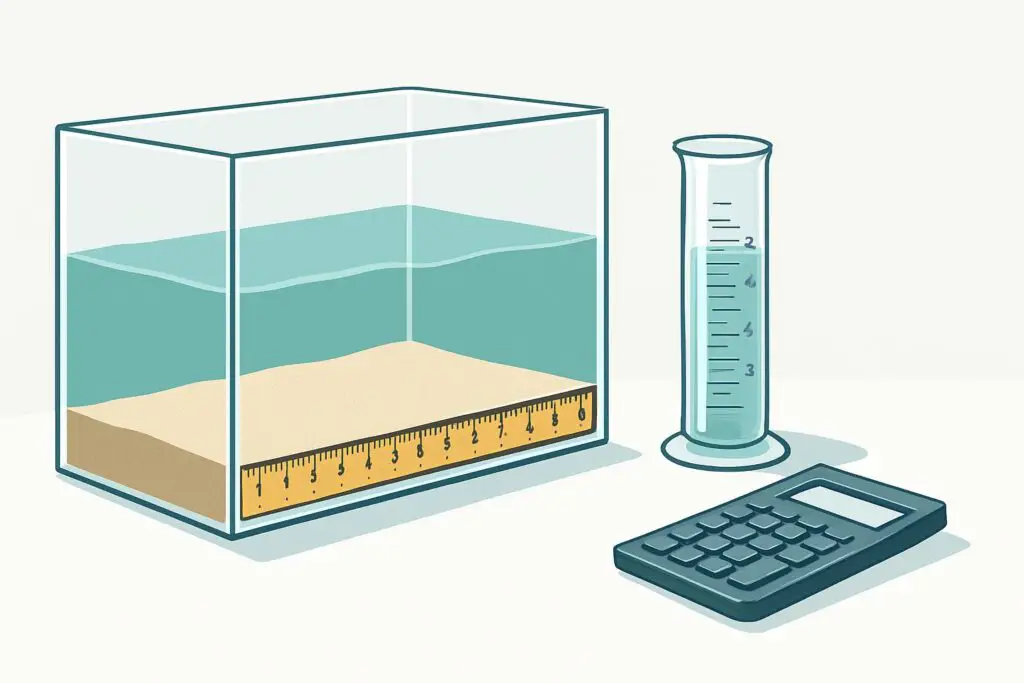
Measure internal length, width, and height. Do not measure the outside of the glass or the frame. Measure the actual water height, not the full glass height. If you run a gap at the top, subtract it. If you have substrate, subtract that depth from the water height at the front where you measured it. If the front is curved, record depth at left, center, and right so you can average it later.
Use a rigid ruler or a tape measure. Measure to the nearest millimeter or the nearest eighth of an inch. Keep the tape flat and parallel to the glass. Take each dimension twice and use the smaller number if there is any doubt.
The core formulas you will use
Rectangular or square tanks
Use internal length times width times water height. In centimeters, liters equal L times W times H divided by 1000. In inches, US gallons equal L times W times H divided by 231. This is the most accurate and fastest method for standard tanks.
Round and cylindrical tanks
Measure internal diameter. Radius is half the diameter. Volume equals pi times radius squared times height. Use 3.1416 for pi. In centimeters, divide by 1000 for liters. In inches, divide by 231 for US gallons. For a horizontal cylinder, the calculation changes with partial fill level, which is not trivial. If you keep a horizontal cylinder, fill it completely or use the displacement method explained later.
Work examples you can mirror
Standard rectangle in metric
You measure 118 cm length, 43 cm width, and 50 cm water height. Multiply 118 by 43 by 50. That equals 253,700 cubic centimeters. Divide by 1000. You get 253.7 liters. Multiply by 0.264172 for US gallons. You get about 67.0 US gallons.
Standard rectangle in inches
You measure 46.5 inches length, 17.0 inches width, and 19.7 inches water height. Multiply 46.5 by 17.0 by 19.7. That equals 15,563 cubic inches. Divide by 231. You get 67.4 US gallons. Multiply by 3.785 for liters. You get about 255 liters. The small difference from the metric example comes from rounding in the measurements.
Vertical cylinder in metric
Internal diameter is 40 cm. Radius is 20 cm. Water height is 60 cm. Area equals pi times radius squared. That is 3.1416 times 20 times 20 equals 1,256.64 square centimeters. Multiply by height 60. That equals 75,398 cubic centimeters. Divide by 1000. You get 75.4 liters. Convert to US gallons by multiplying by 0.264172. You get 19.9 US gallons.
Bowfront tanks simplified
Bowfronts are common and look tricky. Use the average depth method for a fast and reliable estimate. Measure internal length along the back glass. Measure depth at left, center, and right from back glass to the front glass. Average the three depths. Multiply length by the average depth and by water height.
Example. Internal length is 100 cm. Depth at left is 35 cm. Depth at center is 40 cm. Depth at right is 35 cm. Average depth is 36.7 cm. Water height is 50 cm. Volume equals 100 times 36.7 times 50 divided by 1000 equals 183.5 liters. In US gallons this is 48.5. This method usually lands within a few percent of the exact arc calculation without the pain.
If you need a precise number and your bow is a circular arc, measure the straight chord length and the bulge height at center. You can then compute the segment area of the arc and add it to a rectangle. For most hobby needs the average depth result is accurate enough.
Corner and triangular tanks
Many corner tanks are right triangular prisms. Measure the two perpendicular sides of the triangular base along the walls. Multiply by each other and by one half. That gives base area. Multiply by water height. In centimeters, divide by 1000 for liters. In inches, divide by 231 for US gallons.
Example. Sides along the walls are 70 cm and 70 cm. Water height is 50 cm. Base area equals 0.5 times 70 times 70 equals 2,450 square centimeters. Volume equals 2,450 times 50 equals 122,500 cubic centimeters. Divide by 1000. You get 122.5 liters. Convert to US gallons to get 32.4.
Some corner tanks are pentagon style. Split the base into a rectangle and two right triangles. Calculate each part and add them. Simple shapes added together beat one complex formula.
Hexagon tanks
For a regular hexagon, if you measure flat to flat across the widest part, the base area equals 3 times square root of 3 over 8 times that flat to flat distance squared. Multiply by water height for volume. Convert units as usual.
Example. Flat to flat is 50 cm. Water height is 55 cm. Base area equals 3 times 1.7321 over 8 times 50 squared. That equals 0.6495 times 2,500 equals 1,623.8 square centimeters. Volume equals 1,623.8 times 55 equals 89,309 cubic centimeters. Divide by 1000. You get 89.3 liters. In US gallons this is 23.6.
Irregular shapes without stress
If your tank shape does not match any formula, break it into rectangles, triangles, and maybe a circular segment for any bow. Calculate each part with the methods above and sum them. If the curves are not perfect arcs, use the average depth method. If you still feel unsure, use the displacement method next and treat that as your truth.
The displacement method for any tank
This method measures water added, not shapes. It works on any tank and is hard to get wrong. Start with an empty, level tank. Use a marked container with known volume, like a 10 liter bucket or a 2 gallon jug. Fill the tank to your normal waterline, counting how many full and partial containers you poured in. Add the partial amount at the end to your total. The sum is your true operating volume.
If the tank already runs, you can still do this during a deep clean. Drain and measure water out instead of in. Be consistent. Avoid guessing partial amounts. If your container is not marked, weigh it. One liter of fresh water at room temperature weighs about one kilogram. One US gallon weighs about 8.34 pounds. Weigh the filled container and subtract empty weight to get volume by mass. Precision scales help, but a basic bathroom scale can be close enough for a few buckets at a time.
Account for substrate, rocks, and wood
Substrate and decor take space and displace water. If you calculate volume from internal glass sizes but have 5 cm of sand, your water height is not the glass height. Subtract the average substrate depth from the water height before you compute volume. If the substrate slopes, measure depth at front and back and average them.
Example. A 120 by 45 by 50 cm tank has 5 cm sand depth and runs 2 cm below the rim. The water height is 50 minus 5 minus 2 equals 43 cm. Volume equals 120 times 45 times 43 divided by 1000 equals 232.2 liters. The external box might say 270 liters. Your real water is about 232 liters. That difference changes dosing by a lot.
Large rocks and wood can remove 5 to 15 percent of volume in a scape heavy layout. You can estimate this by doing a before and after displacement in a tote. Fill a tote to a marked line. Submerge your decor on a rack so it is fully submerged without touching the tote bottom. Measure how much water spills or how much extra you add to bring it back to the line. Subtract that displacement from your tank total if you want a tight operating volume.
Waterline and headspace always count
Most aquariums are not filled to the brim. Measure to your consistent waterline. If you maintain a 3 cm gap to reduce surface film, that is part of the calculation. Do not ignore braces or rims that sit inside the glass and reduce volume. Measure below them if they force a lower waterline.
Sumps, refugiums, and external filters
Display volume is not system volume. If you run a sump, you have two numbers. One is total system volume used for dosing and medications. The other is display volume used for stocking and aquascape planning. Never assume a sump holds its full geometric volume during operation. The safe working volume is the water level during normal operation. To find it, mark the sump operating waterline, then measure water added by displacement until you hit that line. For total system volume, add display operating volume and sump operating volume. If you want a safety check, turn off the return pump and confirm that the sump can catch all drain down from the display without overflowing. Measure that added height and keep a note of it.
External canister filters hold a small amount compared to the tank. You can add their water volume for medication and salt calculations if you want tight accuracy. Most hobbyists ignore it because it is usually under 5 percent. If your setup is small, like a nano tank with an oversize canister, include it.
US gallon vs UK gallon clarity
Some stock guides, older books, and regional forums use UK gallons. Newer products and most online calculators use US gallons. The numbers differ by about 20 percent. If you follow a dosage in US gallons but your volume estimate is in UK gallons, you overdose. Always convert and label your note with US gal or UK gal or just use liters to avoid the ambiguity.
Check your math with two methods
When in doubt, do one geometric calculation and one displacement measurement. If they match within 5 percent, you are good. If they differ more than that, look for reasons. Internal bracing, thick substrate, bowfront curvature, and incomplete fill are the most common reasons.
Fast reference equations without fluff
Rectangular tank liters equals length times width times water height in centimeters divided by 1000. Rectangular tank US gallons equals length times width times water height in inches divided by 231. Cylindrical tank liters equals 3.1416 times radius squared times height in centimeters divided by 1000. Hexagon tank base area equals 3 times square root of 3 over 8 times flat to flat squared. Bowfront estimate equals length times average depth times water height. Triangular right corner tank base area equals one half times side A times side B. Volume equals base area times water height.
Common mistakes and how to avoid them
Do not trust the marketing size on the box. Do not measure exterior dimensions. Do not use the full glass height if you do not fill to the rim. Do not forget substrate depth. Do not mix US and UK gallons. Do not assume a bowfront is a rectangle. Do not ignore a sump waterline. Avoid rounding early. Keep numbers with at least one decimal until the end.
Use your volume for real tasks
Water changes. If you want to change 30 percent of a 232 liter tank, you change about 70 liters. Mark your bucket or set your pump timer based on flow rate. Medications. If a product says 5 milliliters per 40 liters, a 232 liter tank needs 29 milliliters. Dosing fertilizers. If you dose nitrate at 7 ppm to 232 liters, you need about 1.63 grams of potassium nitrate assuming pure salt and dry dosing. Saltwater mixing. If a salt bag makes 150 liters at 35 ppt, and your tank is 232 liters, you need about 1.55 bags to fill from dry, but for water changes you only mix what you replace.
Fine tune for planted and reef systems
Planted tanks often run deep substrates. Record your front glass visible water height after hardscape and plant growth are set. Recalculate after major rescapes. Reef tanks with heavy rock can lose 10 to 30 percent of display volume to rock displacement. If you dose expensive elements, use displacement to get a tight system volume and save money while improving stability.
Practical rounding and safety margins
For dosing medications with narrow safety ranges, round your volume down by 5 to 10 percent for safety and redose if needed. For dechlorinators with wide safety ranges, rounding is less critical. For salt mix, aim for exactness because salinity targets are tight. For fish stocking, base the plan on display volume, not system volume, and keep a margin for fish growth and territory.
Repeatable measurement workflow
Empty is best, but not always possible. If the tank is new, do the geometric calculation once after the stand is leveled and the tank is placed. Record the numbers with the expected waterline. If the tank is running, plan a large water change day and measure by displacement until you hit your usual waterline. Stick the final volume on a label inside your cabinet. Write the units clearly. Use the same number in every log and calculator you use.
Advanced note on curved or custom glass
If your tank has multiple curves or is custom shaped, take a grid approach. Tape a centimeter grid on the top rim. Measure the internal depth from back to front at several equal points, for example every 10 cm across the length. Average all depths to get an effective depth. Multiply effective depth by length and water height. This smooths bumps and gives a stable estimate without calculus.
Two full worked scenarios
Large planted rectangle with slope and headspace
Internal length 150 cm. Internal width 50 cm. Glass height 60 cm. Substrate depth 7 cm at front and 12 cm at back. Waterline is 2 cm below rim. The effective water height near the front measurement is 60 minus 7 minus 2 equals 51 cm. Volume equals 150 times 50 times 51 divided by 1000 equals 382.5 liters. US gallons equal 101.0. You dose based on 380 to keep it simple and safe. If you later add a large stump and two big rocks and want precision, you can displacement check and update your note.
Reef with bowfront display and sump
Display internal back length 120 cm. Depths left 40 cm, center 46 cm, right 40 cm. Average depth 42 cm. Water height 52 cm. Display volume equals 120 times 42 times 52 divided by 1000 equals 262.1 liters. Sump operating waterline measured by displacement is 65 liters. Total system volume equals 327 liters. When dosing, use 327. When judging fish load and flow, use 262. If you remove 15 percent weekly, change about 49 liters from the display and 10 liters from the sump or just 60 liters total drawn from the system.
Troubleshooting mismatched results
If your geometric math says 300 liters but displacement says 250, pick apart the differences. Check that you used internal measurements. Check that you subtracted substrate. Check that your waterline was measured correctly. Check if your decor displaces more than expected. If your tank has thick curved glass, the internal size can be significantly smaller than the external spec. When numbers still differ, trust displacement for dosing, because it reflects the real water you can treat.
A note on manufacturer stock sizes
Some standard sizes are sold as common names such as 40 breeder or 75 gallon. Glass thickness, rims, and bracing cause internal volume to differ from the nominal size. Never assume the name is your volume. Treat it as a ballpark only.
Keep your notes clean and consistent
Create a simple record. Write display operating volume in liters and US gallons. Write system operating volume if you have a sump. Note the method and date. If you change substrate depth, remove or add large decor, or change your waterline, update your numbers. This habit prevents dosing mistakes months later.
Conclusion
Calculating your aquarium volume is simple when you measure internal sizes, use the right formulas, and adjust for the real waterline and displacement. Start with the shape method that fits your tank. Confirm with displacement if you want a tight number. Convert cleanly between liters and US gallons and avoid UK gallon confusion unless you use it on purpose. Record both display and system volumes if you run a sump. With an accurate volume, your dosing, water changes, and stocking decisions become stable and repeatable. That stability keeps fish healthy, plants and corals thriving, and your maintenance routine predictable.
Take fifteen minutes to measure your tank today. Run the math once, write it down, and enjoy the confidence that comes from knowing your exact water volume.