
We are reader supported. When you purchase through links on our site, we may earn an affiliate commission. Also, as an Amazon affiliate, we earn from qualifying purchases.
Cycling a fish tank is the most important step to a healthy aquarium, yet it is the part new hobbyists often rush. Good news: you can cycle a tank faster without risking your fish. With the right tools and a clear plan, most freshwater tanks can be fully cycled in 7–14 days, sometimes even sooner. This guide explains the nitrogen cycle in simple terms and gives you proven methods to speed it up safely.
What “cycling” really means
Cycling a tank means building a colony of beneficial bacteria that convert toxic fish waste into safer compounds. Fish and leftover food create ammonia. Ammonia burns gills and can kill fish fast. Bacteria turn ammonia into nitrite (also toxic) and then into nitrate (much safer at low levels). When your tank can process a measured dose of ammonia to zero ammonia and zero nitrite within 24 hours, it is cycled.
The bacteria you are growing
There are two main groups you are trying to establish:
1) Ammonia-oxidizing bacteria (AOB): Turn ammonia (NH3/NH4+) into nitrite (NO2-).
2) Nitrite-oxidizing bacteria (NOB): Turn nitrite into nitrate (NO3-).
These bacteria live on surfaces: filter media, sponge, ceramic rings, bio balls, gravel, and even decor. They do not live much in the water itself; this is why “water from an established tank” does not cycle a new tank quickly, but used filter media does.
How you know a tank is cycled
Your tank is cycled when all of these are true:
– You can add a known amount of ammonia (often 2 ppm) and test 24 hours later.
– Ammonia reads 0 ppm and nitrite reads 0 ppm within that 24-hour window.
– Nitrate is present and rising compared to earlier tests.
– Water is clear, and there is no smell of rotten eggs or harsh chemicals.
Why cycling matters
Ammonia and nitrite are invisible but deadly. Even short exposure can stress fish, invite disease, burn gills, and shorten lifespan. A properly cycled tank gives fish stable, safe water and reduces emergency water changes, medication use, and frustration. Cycling first = fewer problems later.
Tools and supplies that make cycling faster
– Liquid test kit: Test ammonia, nitrite, nitrate, and pH. Liquid kits are more accurate than strips.
– Dechlorinator: Use one that neutralizes both chlorine and chloramine. Chlorine kills your bacteria.
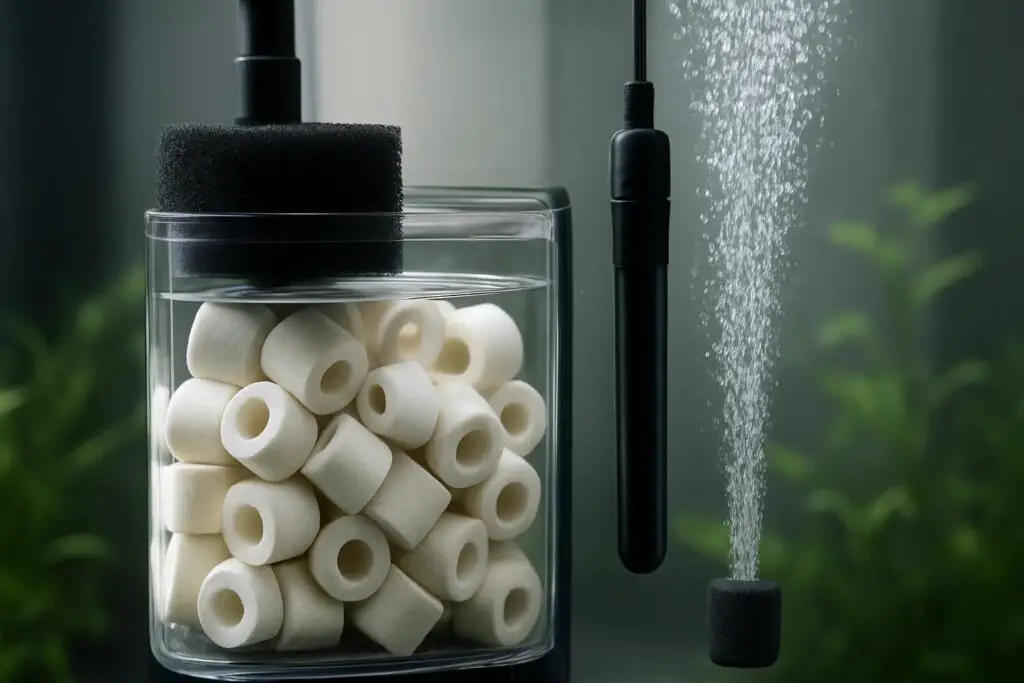
– Filter with good biomedia: Sponge, ceramic rings, or matrix. Larger surface area = more bacteria.
– Pure ammonia (for fishless cycling): Make sure it has no surfactants or scents.
– Bottled bacteria: A high-quality starter culture speeds the process.
– Thermometer and heater: Warmer water (around 80°F/27°C) speeds bacterial growth.
– Air pump and airstone: Extra oxygen helps bacteria thrive.
– Optional: Seeded media or a squeeze from an established, healthy filter.
Faster methods at a glance
1) Seeded media from a healthy tank
This is the fastest and most reliable method. Move sponge, ceramic rings, or a bit of filter floss from a disease-free, mature tank to your new filter. Even a small piece can carry millions of bacteria. Do not let it dry out. Keep it under tank water during transfer and start your filter right away.
2) Bottled bacteria (starter cultures)
Quality bacteria products can reduce cycling time to days. Shake the bottle well, turn off UV sterilizers or ozone if you have them, and dose as directed. For saltwater tanks, also switch off the protein skimmer for 24–48 hours after dosing to avoid stripping bacteria from the water.
3) Fishless cycling with pure ammonia
This is safe and fast when done right. You feed the bacteria directly with pure ammonia, no fish needed. It lets you build a strong bacterial base before any fish arrive, avoiding stress and disease.
4) Live plants and active substrates
Fast-growing plants like hornwort, water sprite, and floating plants absorb ammonia and nitrate. In lightly stocked tanks, plants can run a “silent cycle,” keeping toxins low while bacteria establish. They do not replace the bacteria entirely, but they help a lot.
5) Temperature, oxygen, and pH
– Temperature: 78–82°F (25.5–28°C) speeds bacteria growth. Do not exceed 86°F (30°C).
– Oxygen: Strong surface ripple and an airstone help. Nitrifying bacteria need plenty of oxygen.
– pH and KH: Bacteria slow down when pH drops below ~6.5. Keep KH (carbon hardness) around 3–8 dKH to prevent pH crashes. If your tap water is soft and acidic, consider a small amount of crushed coral in the filter to stabilize pH.
6) Dechlorinate correctly
Always treat new water for chlorine and chloramine before it touches your filter media or tank. Chlorine and chloramine kill beneficial bacteria. Use the full dose of dechlorinator and mix it in the fill bucket or as the water enters the tank.
Step-by-step: a fast fishless cycle plan
The plan below assumes a freshwater tank, a filter with biomedia, a heater set to about 80°F/27°C, an airstone, and one bottle of bacteria starter. It also assumes you have pure ammonia and a liquid test kit.
Day 0: Set up
– Rinse the tank, substrate, and decor in plain water (no soap). Fill and run the filter and heater.
– Dechlorinate the full volume. Aim for light to moderate flow with visible surface agitation.
– If using seeded media, add it now. If using bottled bacteria, shake the bottle and add the full dose once the tank is up to temperature.
– Turn off UV or sterilizers if you use them.
Day 1–3: Feed the bacteria
– Add pure ammonia to reach 2 ppm. Add slowly, test, and adjust. Write down how many drops or milliliters it took.
– Keep the lights low to reduce algae. Plants can stay if you have them.
– Test ammonia and nitrite daily. Early on, ammonia will drop slowly, and nitrite may appear by day 2–3 if you used bacteria or seeded media.
– If ammonia drops below 0.5 ppm before 24 hours, top it back to 2 ppm. You want a steady food supply for the bacteria but do not exceed 2–3 ppm.
Day 4–7: Building momentum
– By now, ammonia should be falling faster, and nitrite should be clearly measurable.
– Keep dosing ammonia back to 2 ppm whenever it falls below 0.5 ppm. Test daily.
– If nitrite climbs very high (off the chart), do a 30–50% water change, dechlorinate, and continue. Extremely high nitrite can slow NOB growth. You will not “wash away” the bacteria because they live on surfaces.
– If using bottled bacteria, you can add a second dose around day 4–5 to speed the nitrite-oxidizers.
Day 8–14: Closing the loop
– You should see nitrite begin to fall while nitrate rises. This is the sign your second bacteria group is catching up.
– Keep dosing ammonia to 2 ppm daily. If the tank can go from 2 ppm ammonia to 0 ammonia and 0 nitrite in 24 hours, you are essentially cycled.
– Once you hit that 24-hour zero/zero mark, stop dosing ammonia and perform a large water change (50–80%) to reduce nitrate below 20–40 ppm before adding fish.
How to confirm you are done
– The “24-hour test”: Dose ammonia to 2 ppm. After 24 hours, test. If both ammonia and nitrite read 0 ppm, the tank is cycled. Nitrate should be present.
– If it takes 36–48 hours, you are close. Keep feeding ammonia lightly and repeat the test the next day.
Fish-in cycling (for when fish are already in the tank)
If you already have fish in an uncycled tank, you can still protect them. This is more work, but it can be done safely with careful testing, water changes, and detoxifiers.
Emergency protocol
– Add bottled bacteria immediately (full dose).
– Use a detoxifying conditioner at the full safe dose. Some bind ammonia and nitrite temporarily (follow the label).
– Increase aeration with an airstone.
– Keep feeding very light (tiny portions once daily, or skip a day).
Daily routine until cycled
– Test ammonia and nitrite morning and evening.
– If ammonia or nitrite are above 0.25–0.50 ppm, do a 25–50% water change and dose detoxifier.
– Repeat daily. Add more bottled bacteria after big water changes for the first few days.
– Once both ammonia and nitrite read 0 ppm several days in a row without detoxifier, you are cycled.
Special cases and tips
Small tanks and betta bowls
Small volumes are unstable, so toxins rise fast. Do not overfeed. Keep an airstone if possible. Use a sponge filter to provide both filtration and a safe home for bacteria. For bowls without heaters or filters, odds of a stable cycle are low; frequent water changes are essential. Consider upgrading to at least a 5-gallon tank with a filter and heater.
Planted “silent cycle”
Heavily planted tanks can “smooth” the cycle. Fast plants consume ammonia and nitrate, keeping levels low while bacteria colonize. Use gentle fish stocking (few fish at first), add plants early, and keep lights moderate. Still test for ammonia and nitrite. The tank is considered stable when ammonia and nitrite stay at 0 ppm without big water changes.
Marine and reef tanks
– Use quality live rock or seeded dry rock for faster results.
– Add bottled marine bacteria and turn off skimmer and UV for 24–48 hours after dosing.
– Aim for 78–80°F (25.5–27°C), strong aeration, and stable salinity.
– Avoid adding hardy fish “to start the cycle”; a fishless cycle is safer and cleaner.
Common mistakes that slow cycling
– Rinsing filter media in tap water: The chlorine kills your bacteria. Always rinse media in tank water during maintenance.
– Replacing all media at once: You throw away the bacteria. If you must replace, do it in stages, or keep the old media in the filter until the new piece is colonized.
– Overdosing ammonia: More is not better. Keep it around 2 ppm. Super high ammonia can stall the cycle.
– Low oxygen: Weak surface movement slows bacterial growth. Add an airstone.
– Low pH/KH crashes: Very soft, acidic water can stall nitrification. Stabilize KH to 3–8 dKH.
– Not dechlorinating: Any untreated tap water can set you back to zero.
– Dirty, dying organics: Rotting food and plants create unstable spikes and foul the tank. Keep the tank clean.
Troubleshooting a stalled cycle
– Ammonia not dropping at all after a week: Check dechlorinator use, raise temperature to ~80°F/27°C, add bottled bacteria, and ensure strong aeration.
– Nitrite is sky-high and never falls: Do a 50% water change, dose bacteria again, maintain oxygen, and keep feeding small amounts of ammonia.
– pH has fallen below 6.5: Add a bit of crushed coral or a KH buffer to raise KH slowly. Keep pH stable rather than chasing a specific number.
– Using chloraminated water: Use a conditioner that handles chloramine. Some products break chloramine into chloride and ammonia; the ammonia will show on tests but is bound temporarily. Continue as normal and let the cycle catch up.
– Filter “too clean”: Do not scrub all media. Lightly swish it in a bucket of old tank water to remove sludge, and put it back.
– Using UV sterilizer during cycle: Turn it off until the tank is cycled, because UV can kill free-floating bacteria before they settle on surfaces.
After the cycle: your first weeks with fish
How to stock safely
– Add fish in small groups rather than all at once, even after a fishless cycle. The bacteria are ready, but a huge sudden load can still spike ammonia.
– Quarantine new fish when possible to avoid bringing in disease.
– Research compatibility and final sizes. Plan for the adult tank, not the baby fish you see at the store.
Feeding and maintenance
– Feed small amounts once or twice per day. Only what they finish in 1–2 minutes.
– Test ammonia and nitrite every few days for the first two weeks after adding fish. Nitrate weekly.
– Change 25–40% of the water weekly to control nitrate. Always dechlorinate.
Filter care the right way
– Do not replace all media. Keep the sponge or ceramic rings as the permanent home for bacteria.
– Rinse media gently in tank water during water changes. Avoid tap rinses.
– Keep good flow through the filter. Clogged filters starve bacteria of oxygen.
Beginner-friendly dosing guide (fishless)
– Choose a target: 2 ppm ammonia.
– Add pure ammonia dropwise, test, and record how much it takes to reach 2 ppm in your tank size. Use this amount each time you “feed” the cycle.
– Dose back to 2 ppm whenever ammonia falls below 0.5 ppm until the tank can process 2 ppm to 0/0 in 24 hours.
– Before adding fish, do a large water change to reduce nitrate below 20–40 ppm.
When you should not speed up
– If you cannot test daily, do not push a fast cycle with high ammonia. Go slower with lower doses or add live plants and be patient.
– If you cannot control temperature and aeration, do not rely on heavy dosing. Keep conditions stable and safe first.
Quick checklist and timeline
– Day 0: Set up tank, filter, heater, and airstone. Dechlorinate. Add bottled bacteria and/or seeded media.
– Day 1: Dose ammonia to 2 ppm.
– Day 2–3: Test ammonia and nitrite daily. Redose ammonia as needed. Expect nitrite to appear.
– Day 4–7: Keep dosing ammonia to 2 ppm. Consider a second bacteria dose. If nitrite is off the chart, do a partial water change.
– Day 8–14: Aim for the 24-hour 0 ammonia/0 nitrite test. Nitrate should be rising.
– When you pass: Stop dosing ammonia. Do a large water change. Add your first small group of fish. Keep testing.
Smart ways to shave more days off the cycle
– Use a larger sponge filter or add extra biomedia to increase surface area.
– Place a second sponge filter in an established tank in advance. Move it over when you set up the new tank.
– Keep the pH stable above 7.0 during the cycle if possible. Buffer soft water gently.
– Keep filters and media constantly wet and oxygenated. Any drying event can kill the colony.
– Avoid heavy cleaning or deep gravel vacuuming during the cycle; leave the bacteria alone to settle and grow.
Myths to ignore
– “You can cycle with just water from an old tank.” False. The bacteria live on surfaces, not in the water.
– “You must wait exactly 4–6 weeks no matter what.” Not true. With seed media and bacteria products, many tanks cycle in under two weeks.
– “A filter cartridge needs monthly replacement.” Replacing cartridges often throws away your bacteria. Keep the cartridge and only replace it when it is falling apart. Add a permanent sponge or ceramic media to be safe.
– “Cloudy water means your tank is cycled.” Not necessarily. Bacterial blooms are common but do not prove the nitrogen cycle is complete. Test to be sure.
Simple testing routine
– During cycling: Test ammonia and nitrite daily, nitrate every few days, pH weekly.
– After cycling: Test ammonia and nitrite weekly for the first month, then monthly or after any change. Test nitrate weekly and aim to keep it under 40 ppm (often lower for sensitive species).
Safety notes when using ammonia
– Use only pure, unscented ammonia with no soaps or surfactants. If it foams when shaken in the bottle, it may contain additives—do not use it.
– Store safely away from children and pets.
– Never mix with chlorine bleach.
Bringing it all together: a practical example
Imagine a 20-gallon freshwater tank with a sponge filter and a small hang-on-back filter filled with ceramic rings. You add dechlorinator, set the heater to 80°F, and drop in an airstone. You squeeze out a mature sponge from your friend’s healthy tank into your filter and place the sponge in your tank. You also add a dose of bottled bacteria. On day 1, you add ammonia to 2 ppm. By day 3, ammonia is dropping and nitrite appears. By day 6, ammonia and nitrite are both near zero within 24 hours of dosing. By day 8, you dose to 2 ppm and both ammonia and nitrite are zero the next day. You do a 70% water change, match temperature, dechlorinate, and add your first small group of fish. You feed lightly and test every other day for the next two weeks. Everything stays at 0/0, and nitrate slowly climbs, which you control with weekly water changes. Fast, safe, and stable.
Conclusion
Cycling fast does not mean cutting corners; it means giving bacteria exactly what they need—stable warmth, oxygen, a steady food source, and plenty of surface area—while protecting them from chlorine and sudden shocks. Use seeded media when possible, add a reputable bottled bacteria product, keep ammonia around 2 ppm during a fishless cycle, and confirm with the 24-hour zero test before stocking. If you already have fish, protect them with frequent testing, water changes, detoxifiers, and light feeding until the cycle completes.
With a clear plan and a few affordable tools, you can build a strong biofilter quickly and enjoy healthy, active fish from day one. Be patient, test often, and let the bacteria do the heavy lifting. The result is a stable aquarium that is easy to maintain and a hobby that stays fun for years to come.