
We are reader supported. When you purchase through links on our site, we may earn an affiliate commission. Also, as an Amazon affiliate, we earn from qualifying purchases.
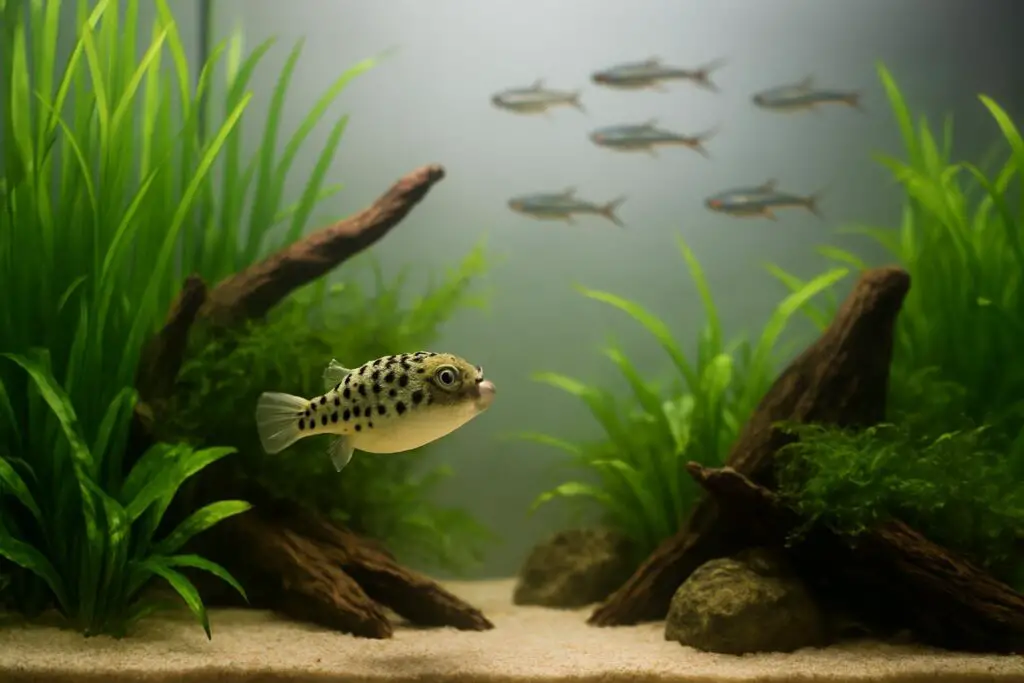
Freshwater puffers are charming, intelligent, and curious. Many hobbyists want one in a peaceful community tank. The hard truth is that most puffers are not community-safe. Some species can work with careful planning, but many will nip fins, bully tankmates, or end up stressed. If you love the idea of a puffer in a shared aquarium, you need a clear plan, strict stocking rules, and a backup tank in case it fails. This guide gives you the facts you need before you try.
Quick truth: are freshwater puffers community-safe
Most freshwater puffers are not reliable community fish. A few species can work with the right tankmates and layout, but success is never guaranteed. The safest path is species-only tanks. If you still want a community, you must pick the right species, overfilter, build strong line-of-sight breaks, avoid slow or long-finned fish, and be ready to separate fish if needed.
Meet the candidates you see in stores
Pea puffer Carinotetraodon travancoricus
Pea puffers are tiny, bold, and often sold as community-safe because of their size. They are highly territorial and can be relentless fin nippers. They reach about 1 inch but act like a much bigger fish. Species-only setups with heavy planting are the most reliable way to keep them long-term. If you try a community, expect problems. They often harass slow or long-finned tankmates, shrimp, and snails.
South American puffer Colomesus asellus
South American puffers, often called SAPs, are the only commonly sold freshwater puffer that sometimes works in a cautious community. They grow to about 3 inches, are fast swimmers, and do best in groups in larger tanks. With fast midwater companions and strong aquascaping that breaks sightlines, many keepers report success. They still nip, especially if crowded or bored, so there is always risk. SAPs need frequent, crunchy foods to manage their teeth and benefit from clean, well-oxygenated water with steady flow.
Red-eye puffer and other Pao species
Red-eye puffers Pao suvattii complex and many related Pao species are small to medium but very aggressive and territorial. They do not belong in community tanks. They prefer species-only conditions and ambush-style setups with dense cover. Even in pairs they can injure each other.
Puffers you should not put in freshwater communities
Fahaka and Mbu puffers grow very large and are strongly predatory. They belong in large, solitary tanks. Green spotted puffers and figure eight puffers are not long-term freshwater fish. They are brackish and need salt as they age, which makes them unsuitable for freshwater community aquariums. Avoid any puffer sold as freshwater if it later requires brackish conditions.
Tank size and layout that reduce problems
Sizes and stocking benchmarks
For pea puffers, species-only works best. A single pea puffer can live in 10 gallons with dense planting and hiding spaces. A small group of 6 to 10 needs 20 gallons or more with complex scaping to manage territories. For SAPs, plan 30 to 40 gallons for a single or pair, and 55 gallons or larger for a group of 4 to 6. Bigger tanks spread aggression and give room for dither fish to escape.
Aquascape for line-of-sight breaks
Use hardscape and plants to block views. Build multiple territories and escape routes. Create clusters of wood, rock, and thick plants. Keep open swimming lanes for fast schooling fish in SAP tanks. Avoid bare, open layouts. When puffers cannot see each other constantly, they fight less and explore more.
Substrate and plants
Fine sand or smooth gravel works. Sand is safest for species that like to root around. Use robust rooted plants like crypts, swords, and vallisneria, plus bushy stems and dense moss. Floating plants help reduce stress by dimming overhead light and breaking sightlines. Add caves and leaf litter where appropriate. Avoid sharp decor that can tear fins or skin.
Filtration, flow, and oxygen
Puffers are messy eaters. Overfilter. Use a canister or a large hang-on-back rated well above tank size. Add a prefilter sponge to catch food bits. Aim for moderate, even flow and strong oxygenation from a spray bar or surface agitation. SAPs handle current well. Pea puffers prefer gentle to moderate flow with calm pockets among plants. Keep the water clean to limit disease and stress nipping.
Water parameters and maintenance
Temperature and pH ranges
Pea puffers do well at 24 to 28 C and a pH around 6.8 to 7.8. South American puffers prefer 24 to 27 C and a pH around 7.0 to 7.6. Aim for stable parameters more than perfect numbers. Moderate hardness is fine for both. Sudden swings trigger stress and aggression.
Cycling, testing, and water change routine
Cycle the tank fully before adding puffers. Keep ammonia and nitrite at 0. Keep nitrate below 20 to 30 ppm. Test weekly. Perform 30 to 50 percent water changes every week. Vacuum lightly to avoid uprooting plants, but remove leftover food quickly. Rinse filter media in tank water, not tap water. Consistent maintenance reduces disease risk and improves behavior.
Handling and acclimation
Dim lights during acclimation. Match temperature and pH as closely as possible. Drip acclimation is gentle and works well. Move puffers in a container of water rather than a net to reduce stress and the chance of gulping air. Avoid provoking inflation. Stable placement and low stress in the first week pay dividends long-term.
Feeding that keeps teeth in check
Core foods
Feed a varied, meaty diet. Use frozen or live foods like bloodworms, blackworms, daphnia, brine shrimp, mysis, krill pieces, and chopped shellfish. Offer pond snails, ramshorn snails, or other crunchy prey to help wear down teeth. Most puffers will not thrive on flakes or standard pellets alone.
Training to frozen and feeding schedule
Target feed with tongs or a feeding stick so food reaches the puffer and not only the fast dithers. Start with live foods, then switch to frozen offerings once the puffer recognizes the tool. Feed small meals once or twice daily. Add one fasting day per week to reduce bloat and keep appetite balanced. Remove uneaten food within minutes.
Dental overgrowth prevention
All puffers have constantly growing teeth. Without crunchy foods, teeth can overgrow and block the mouth. Offer hard-shelled snails or small crustacean pieces regularly. Avoid overreliance on soft foods. Preventing dental issues is far easier and safer than trimming teeth.
Community compatibility rules
Tankmates that sometimes work with SAPs
For South American puffers, choose fast, midwater schooling fish that do not have long fins. Options include larger danios, robust tetras, and rasboras. Keep them in groups so attention is spread out. Add them before or at the same time as the puffers. Provide strong line-of-sight breaks and open lanes. Feed with tongs so SAPs do not compete directly with schooling fish. Even with these steps, monitor closely and be ready to separate fish.
Tankmates to avoid
Avoid long-finned or slow species like bettas, fancy guppies, angelfish, and gouramis. Avoid shrimp and ornamental snails, which will be hunted. Avoid bottom dwellers with long barbels. Avoid other puffers unless you have planned a proper group of the same species and a large tank. For pea puffers, avoid community setups in general.
Stocking plans that actually work
For a 55 gallon SAP community, consider a group of 4 to 6 SAPs with two or three large schools of fast midwater fish like robust tetras or danios, heavy planting, and a canister filter with high turnover. Add the schools first, establish territory with decor, then add SAPs. For a 20 gallon pea puffer setup, run it species-only with 6 to 10 peas, thick plants, caves, and gentle flow. Both plans require disciplined feeding and weekly maintenance.
Health, quarantine, and stress reduction
Parasites and quarantine
Many puffers are wild-caught and arrive with internal parasites. Quarantine new puffers for 4 to 6 weeks in a separate tank. Observe behavior and appetite. Consider deworming with fish-safe treatments as directed by the manufacturer. Only move healthy, stable fish into the display tank.
Medication sensitivity
Puffers lack scales and can be sensitive to certain medications. Always read labels carefully and start at conservative doses if the product warns about use with scaleless fish. Increase oxygenation during treatment. Stable water quality and gentle handling often solve more problems than aggressive medication.
Signs of stress and fixes
Warning signs include constant chasing, clamped fins, glass surfing, loss of appetite, and persistent fin damage on tankmates. Fixes include adding more cover, rearranging decor to reset territories, increasing feeding frequency, reducing light, or moving fish to a separate tank. Do not wait for a problem to resolve on its own.
Realistic paths to success
When to choose species-only
Choose species-only if you are keeping pea puffers, any Pao species, or you cannot provide a large tank with complex scaping and strong filtration. Species-only gives more control over feeding, reduces stress, and avoids constant monitoring for injuries. A well-built species-only puffer tank is engaging and easier to manage.
If you insist on a community, do this
Confirm the species. Do not buy brackish puffers for freshwater. Pick SAPs if you want the best community chance. Go bigger on tank size, filtration, and planting than you think you need. Choose fast schooling fish without long fins. Add schoolers first, then puffers. Target feed. Keep a backup tank ready. Accept that you may need to separate fish at any time.
Common mistakes to avoid
Do not impulse buy puffers labeled community-safe without researching the species. Do not crowd them in small tanks. Do not rely on flake food. Do not skip quarantine. Do not ignore early nipping. Do not add slow or long-finned show fish. Do not believe that brackish species will live long-term in freshwater. Do not move puffers with a dry net. These errors are behind most failed setups.
Behavior tips and enrichment
Puffers are smart. Rotate decor and change plant clusters occasionally to provide novelty. Use a feeding stick and vary prey type and delivery location. Offer puzzle feeding by placing food in a small shell or among plant roots. Provide a photoperiod of 8 to 10 hours and a shaded zone under floaters. Enrichment reduces boredom nipping and makes your fish more confident.
Budget and equipment checklist
Plan for a larger tank, oversized filter, test kits, a quarantine tank, quality frozen foods, and a steady supply of crunchy prey like snails. Add a heater with a reliable thermostat, a timer for lights, and a battery-backed air pump if your area has outages. These items protect your investment and reduce the chance of aggression flare-ups linked to stress.
Introduction to breeding behavior
Community tanks are not the place to attempt breeding puffers. Territorial intensity rises and tankmates can be injured. If you see courting behavior or increased aggression, consider separating the puffers to a dedicated setup. Focus on stable community behavior before anything else.
Conclusion
Freshwater puffers are not the typical community fish. Pea puffers are best in species-only tanks. South American puffers can work in a cautious community when you combine space, speed-matched tankmates, heavy scaping, and disciplined care. Most other freshwater puffers either need to live alone or are not freshwater long-term. If you commit to strong filtration, varied crunchy foods, stable water, and a backup plan, you can keep a puffer successfully. Decide early whether you want a community display or a focused puffer tank, then build the system around that goal.
FAQ
Q: Are freshwater puffers good for community tanks
A: Most freshwater puffers are not reliable community fish. The safest path is species-only tanks. If you still want a community, you must pick the right species, overfilter, build strong line-of-sight breaks, avoid slow or long-finned fish, and be ready to separate fish if needed.
Q: Which freshwater puffer species can work in a community
A: South American puffers are the only commonly sold freshwater puffer that sometimes works in a cautious community. They still nip, especially if crowded or bored, so there is always risk.
Q: Can I keep pea puffers with other fish
A: Species-only setups with heavy planting are the most reliable way to keep pea puffers long-term. If you try a community, expect problems.
Q: What tankmates can work with South American puffers
A: For South American puffers, choose fast, midwater schooling fish that do not have long fins. Options include larger danios, robust tetras, and rasboras. Even with these steps, monitor closely and be ready to separate fish.
Q: Are green spotted puffers or figure eight puffers suitable for freshwater community tanks
A: Green spotted puffers and figure eight puffers are not long-term freshwater fish. They are brackish and need salt as they age, which makes them unsuitable for freshwater community aquariums.