
We are reader supported. When you purchase through links on our site, we may earn an affiliate commission. Also, as an Amazon affiliate, we earn from qualifying purchases.
Clear water does not always mean safe water. If you want healthy fish and stable plants, you must understand water hardness. Two numbers control most of the stability in a freshwater aquarium: GH and KH. Learn what they are, how to test them, how to adjust them, and how to keep them steady. Once you master GH and KH, fish stress drops, algae issues ease, and your tank becomes easier to manage.
Introduction
New aquarists often chase pH and ignore hardness. That leads to unstable water, random crashes, and confused dosing. GH and KH are the foundation that pH and biology sit on. This guide breaks GH and KH down in plain language, gives target ranges for common setups, and shows safe, step-by-step methods to adjust and maintain them. Keep reading, take notes, and apply the steps to your tank this week.
What Exactly Is GH
GH stands for General Hardness. It measures the amount of calcium and magnesium dissolved in the water. These minerals support fish osmoregulation, bone and shell formation, and many plant processes. Shrimp also depend on GH for proper molting. GH does not control pH directly, but it does affect overall mineral content that animals and plants use.
Units you will see include degrees of hardness and parts per million. 1 dGH is roughly equal to 17.9 ppm as CaCO3. Soft water usually falls around 0 to 4 dGH. Moderate water is about 5 to 8 dGH. Hard water often ranges from 9 to 12 dGH. Very hard water is 13 dGH or higher. Fish do not just need any number. They need stability within a sensible range for their species.
What Exactly Is KH
KH stands for Carbonate Hardness. It measures bicarbonate and carbonate ions that buffer acids. KH is the main control for pH stability in freshwater tanks. A steady KH resists sudden pH swings caused by fish waste, plant respiration, or CO2 use in planted tanks.
KH is also measured in degrees and ppm. 1 dKH equals about 17.9 ppm as CaCO3. Low KH is under 3 dKH. Moderate KH is about 4 to 7 dKH. High KH is 8 to 12 dKH. Very high KH is 13 dKH or more. With very low KH, pH changes fast. With a balanced KH, pH stays steady within a narrow band, which reduces stress on fish and microorganisms that run your biological filter.
GH vs KH in One Look
GH is about calcium and magnesium for animal and plant health. KH is about bicarbonates and carbonates that stabilize pH. GH supports life processes. KH protects pH from collapse. You need both in balance for a tank that runs without drama.
Why GH and KH Matter to Fish and Plants
Fish live within tight mineral limits. If GH is too low for a species that prefers harder water, osmoregulation becomes stressful. That stress weakens immunity and invites disease. Shrimp need GH in range to molt and rebuild shells. Plants need calcium and magnesium to build tissues and run enzymes. Without enough GH, plants show twisted growth, pale new leaves, or stalled stems.
KH controls pH stability. When KH is near zero, everyday processes produce acids that drop pH quickly. Beneficial bacteria slow down or crash at low pH. Fish may gasp or hide due to stress. With a sensible KH, pH stays in a stable window. This keeps the filter active and the system predictable.
How to Test GH and KH
Use a liquid drop test kit for the most reliable reading. Strips are fast but less precise, and you can miss small shifts. Digital TDS meters do not measure GH or KH directly. TDS only shows total dissolved solids, which includes many ions beyond hardness minerals. Use TDS for trend tracking, but test GH and KH with drops.
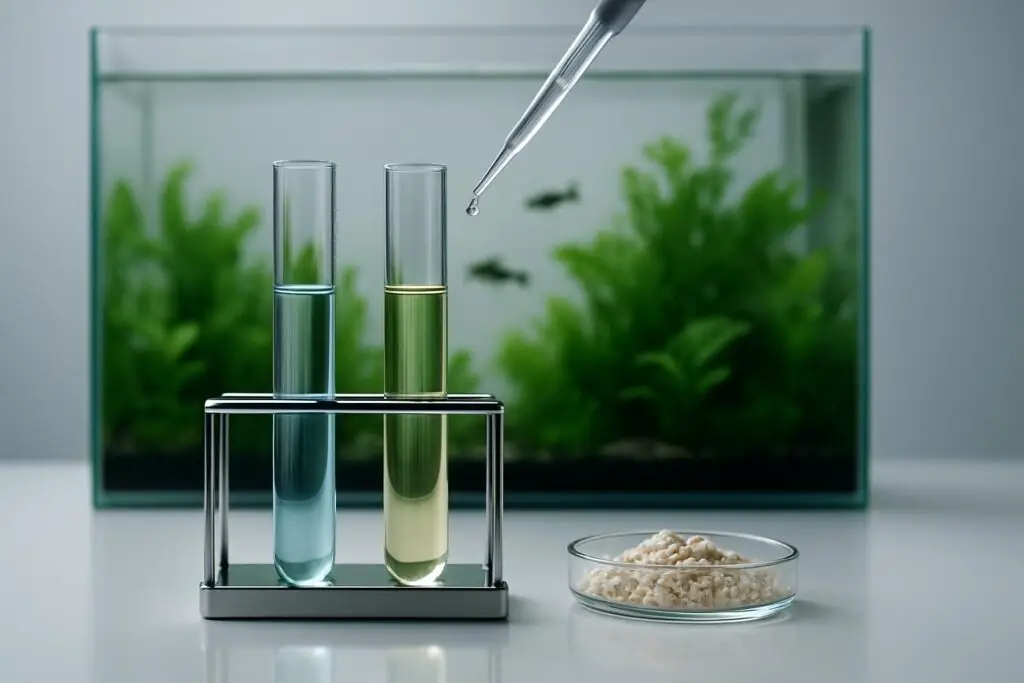
Typical liquid test instructions are simple. Rinse the test tube with tank water. Fill to the marked line. Add reagent drops one by one, swirling after each drop, until the color changes and stays changed. Count the drops. Each drop usually equals 1 degree. Confirm your kit’s manual for the exact conversion.
Test weekly when your tank is new or when you are dialing in a new routine. Test before and after a water change until your method is stable. Record values in a log so you spot trends early. Once stable, you can test every 2 to 4 weeks or when livestock behavior changes.
Beginner-Friendly Target Ranges
These are general ranges that work for many setups. Always check your species needs.
Community freshwater with common tetras, rasboras, livebearers, and a mix of hardy plants: GH 6 to 12 dGH. KH 4 to 8 dKH. This keeps pH typical in the 6.8 to 7.6 area, stable and easy to manage.
Planted aquascape with pressurized CO2: GH 3 to 8 dGH. KH 0 to 4 dKH. Lower KH allows more pH shift with CO2, so monitor pH and watch fish closely. Keep CO2 consistent to avoid swings.
African Rift Lake cichlids: GH 10 to 20 dGH. KH 8 to 15 dKH. Higher mineral content supports their biology and stabilizes an alkaline pH.
Neocaridina shrimp: GH around 6 to 8 dGH. KH around 2 to 4 dKH. Caridina shrimp: GH around 4 to 6 dGH. KH around 0 to 2 dKH. Stable minerals prevent failed molts and deaths after molts.
Betta in a simple setup: GH 3 to 8 dGH. KH 3 to 5 dKH. Keep it steady. Avoid chasing exact numbers.
How to Raise GH Safely
Use minerals, not guesswork. Crushed coral, aragonite sand, and limestone slowly dissolve calcium and magnesium into the water. You can place crushed coral in a filter media bag or use a substrate mix that contains aragonite. This method is slow, stable, and low maintenance.
For direct control, use a GH remineralizer salt. Common ingredients are calcium sulfate, magnesium sulfate, and potassium sulfate. Follow label dosing and test after each dose. You can dissolve the salts in a container of new water before a water change, then add that prepared water to the tank.
Do not raise GH faster than 1 to 2 dGH per day. Fish and shrimp need time to adjust. Large jumps cause stress. Add, test, wait, and repeat until you reach your target.
How to Lower GH Safely
Use reverse osmosis or deionized water. RO or RO/DI removes most minerals and gives you near-zero GH and KH. Then you can blend RO with your tap water to reach the GH you want.
Here is a simple mix method. If your tap GH is 12 dGH and RO is 0 dGH, and you want 6 dGH in the final water, use half tap and half RO. The math is direct. Target GH equals fraction of tap multiplied by tap GH plus fraction of RO multiplied by RO GH. Solve for the tap fraction as target divided by tap. In the example, 6 divided by 12 equals 0.5, which is 50 percent tap and 50 percent RO.
Avoid household water softeners that swap calcium and magnesium for sodium or potassium. The reading may look soft, but the water is not ideal for aquariums. Use RO or RO/DI instead.
How to Raise KH Safely
Crushed coral and aragonite release carbonates that raise KH over time. Place a small bag in the filter or use it as part of the substrate. Test weekly and adjust the amount if KH climbs too high.
Sodium bicarbonate can raise KH fast in a pinch. Dose into new water before a water change, not directly into the tank when possible. Go slow and test. Commercial alkalinity buffers offer more balanced formulas for routine use.
Do not increase KH by more than 1 to 2 dKH per day. Slow changes prevent pH spikes and livestock stress.
How to Lower KH Safely
Use RO or RO/DI water and blend it with your tap to dilute KH. This gives you predictable control over the final KH. Avoid rapid KH cuts that could destabilize pH and the biofilter.
Driftwood and peat may reduce KH a little over time by releasing acids and tannins, but results vary and are hard to predict. Beginners should not rely on these as the main method. Acid buffers can cut KH and pH fast, but they can also cause crashes. Skip acid buffers until you have strong control of your process.
KH, pH, and CO2
KH resists pH change. Low KH means pH moves easily. CO2 lowers pH without changing KH, because CO2 dissolves into carbonic acid. In a planted tank with CO2 injection, keep the CO2 stable from day to day. With very low KH, monitor pH during the photoperiod to avoid large swings that stress fish. If pH swings feel hard to control, raise KH a little and tune CO2 more carefully.
Choosing Substrates and Rocks
Some substrates and rocks dissolve minerals. Aragonite sand, limestone, and some crushed shells raise GH and KH. Inert sands and gravels do not. If you want soft, low KH water, avoid calcareous materials. If you want high GH and KH, include them on purpose. Test your tank water weekly after adding new hardscape to learn how it shifts parameters.
Tap Water Changes Over Time
Municipal water can vary by season and source. Your GH and KH may swing after heavy rain or maintenance. Test your tap monthly. If your tank stability depends on precise ranges, consider moving to RO or RO/DI blending so you control the numbers rather than reacting to surprise changes.
Maintenance Routine That Works
Test GH and KH weekly for the first month or two. Set a water change schedule you can keep. Many tanks do well with 30 to 50 percent weekly. Prepare new water in a separate container. Add dechlorinator. Remineralize or buffer to your target GH and KH. Stir, aerate, and test before adding to the aquarium. Match temperature and try to match GH and KH closely to avoid shocks.
Log every test and dose. When problems occur, your notes show what changed. A stable routine beats constant tweaks. Resist fixing small daily variations. Look for trends across weeks instead.
Common Problems and How to Fix Them
pH Crashes, Fish Gasping, Bacteria Slowdown
Likely cause is very low KH. Test KH. If KH is under 2 dKH, raise it slowly using a buffer or crushed coral. Resume normal feeding only after pH and KH stabilize.
Ghost Shrimp or Dwarf Shrimp Dying After Molt
Often linked to low GH. Test GH. Bring GH into the recommended range for your shrimp using a remineralizer. Make changes slowly across several days.
Plants Show Twisted New Growth
Possible calcium deficiency from low GH. Increase GH with a remineralizer that includes calcium and magnesium. Confirm overall nutrients and CO2 are also balanced.
pH Swings With CO2
KH is likely too low or CO2 is inconsistent. Keep CO2 stable through the photoperiod. If swings continue, raise KH to around 3 to 4 dKH and retune CO2.
Safe Rate of Change
Raise or lower GH by no more than 1 to 2 dGH per day. Raise or lower KH by no more than 1 to 2 dKH per day. When switching from tap to RO blends or changing rock and substrate, plan the shift across several water changes rather than one large jump. For sensitive fish and shrimp, use drip acclimation when parameters differ more than a few degrees.
Do Not Confuse TDS With Hardness
TDS includes every dissolved ion, not just calcium, magnesium, or carbonates. Fertilizer, sodium, potassium, and many other ions raise TDS. You can have high TDS with low GH and KH, or the opposite. Use TDS as a trend tool. Use liquid GH and KH tests to manage hardness precisely.
Avoid These Beginner Traps
Do not use household water softeners as your main source. They replace calcium and magnesium with sodium or potassium and do not produce ideal aquarium water. Do not add baking soda or buffers directly to the tank without testing and a plan. Do not chase pH daily while ignoring KH. Do not rely on peat or driftwood for precise hardness control. Control inputs, test weekly, and adjust in measured steps.
Practical Case Examples
Planted tank with algae and midday fish stress. Tests show KH 0 to 1 dKH, CO2 on a timer, and pH swinging over 1 unit daily. Solution: raise KH to 3 to 4 dKH with a buffer over several days, keep CO2 steady, and retune flow. Result: stable pH, happier fish, and fewer algae triggers.
African cichlid tank with occasional flashing and filter stalls after heavy feeding. KH reads 2 dKH and GH is 6 dGH. Solution: add crushed coral to the filter, raise KH to 8 to 10 dKH and GH to 12 to 16 dGH across a week, maintain regular water changes. Result: steady alkaline pH and calmer fish.
Neocaridina shrimp tank with failed molts. GH reads 3 dGH, KH 1 dKH. Solution: use a shrimp-focused remineralizer to bring GH to 6 to 8 dGH and KH to 2 to 4 dKH slowly. Result: consistent molts and better survival.
Tools and Supplies Checklist
Liquid GH and KH test kits. Reliable dechlorinator. RO or RO/DI unit or a source of RO water if you need control. Remineralizer salts for GH. Alkalinity buffer for KH. Crushed coral or aragonite if you want a slow, stable increase. A clean container for preparing new water. A logbook or app to track results.
How to Build Your Own Remineralized Water
Set your target GH and KH based on your livestock. If your tap water is close but a bit high, blend with RO until you hit the targets using the fraction method explained earlier. If your tap is very far off, use mostly RO and add GH and KH buffers to reach your targets. Prepare water 24 hours before the water change when possible. Stir well, test, and adjust before adding to the tank. Repeat the same recipe every week for consistency.
Tuning Strategy for Stability
Pick reasonable targets for GH and KH. Adjust slowly until you reach them. Keep the same water change schedule and the same remineralization recipe every week. Watch livestock behavior more than test numbers. If fish eat, swim normally, and show strong color, hold steady. If you see stress, test GH, KH, and pH, then adjust with small moves. Stability beats perfection.
Conclusion
GH and KH are the backbone of a healthy freshwater aquarium. GH supplies calcium and magnesium for animals and plants. KH buffers acids and locks down pH stability. Test with liquid kits, adjust with minerals and RO blending, and move in small steps. Choose targets that match your livestock and keep your routine consistent. When hardness is under control, your tank runs smoother, your fish live longer, and maintenance becomes simple.
FAQ
Q: What is the difference between GH and KH
A: GH measures calcium and magnesium that support animal and plant health, while KH measures bicarbonates and carbonates that stabilize pH.
Q: How often should I test GH and KH in a new aquarium
A: Test weekly when your tank is new or when you are dialing in a new routine, and record values in a log.
Q: How can I raise KH safely
A: Use crushed coral or aragonite for a slow increase, or dose a commercial alkalinity buffer into new water before a water change, raising no more than 1 to 2 dKH per day.
Q: Is water from a home water softener good for aquariums
A: No, household water softeners replace calcium and magnesium with sodium or potassium and are not ideal for aquariums.
Q: How do I mix RO water with tap to reach a target GH
A: Use a simple fraction method where the tap fraction equals target GH divided by tap GH, then blend that percentage of tap with RO.