
We are reader supported. When you purchase through links on our site, we may earn an affiliate commission. Also, as an Amazon affiliate, we earn from qualifying purchases.
Quarantining new fish protects your display tank from hidden parasites, bacterial infections, and stress-related losses. It is a simple habit that prevents weeks of frustration, wasted money, and heartbreak. With a small spare tank, a plan, and a few rules, anyone can quarantine new fish successfully at home. This guide shows you everything to do, step by step, in clear and beginner friendly language.
Start now, even if your main tank is new. A basic quarantine setup costs less than a single big mistake. Follow the timeline and checklists below. By the end, you will know how to set up, observe, treat when needed, and move fish safely to your display with confidence.
What quarantine is and why it matters
Quarantine is a separate holding and observation period for new fish before they join your main tank. You keep new arrivals in a bare setup with clean water and stable heat. You watch them daily for disease or stress. You treat only if you see a problem, then you complete the full time period symptom free. This prevents you from bringing pathogens into your established system.
Fish often look fine in the store, yet break down at home due to transport stress. Quarantine reduces stress with quiet space and steady conditions. It also lets you control feeding and treatment without risking your main tank. Skipping quarantine can lead to outbreaks that are hard to remove from planted, reef, or community tanks.
How long to quarantine
Quarantine new fish for at least four weeks. Start the clock on the day they arrive. If you see any illness, treat and then restart the four week clock after the last symptom clears. This gives time for common parasites and bacterial issues to show and be resolved.
For marine fish, four to six weeks is wise due to marine ich and other parasites with longer life cycles. If you add more new fish to the quarantine tank, restart the clock for all fish.
Quick start equipment checklist
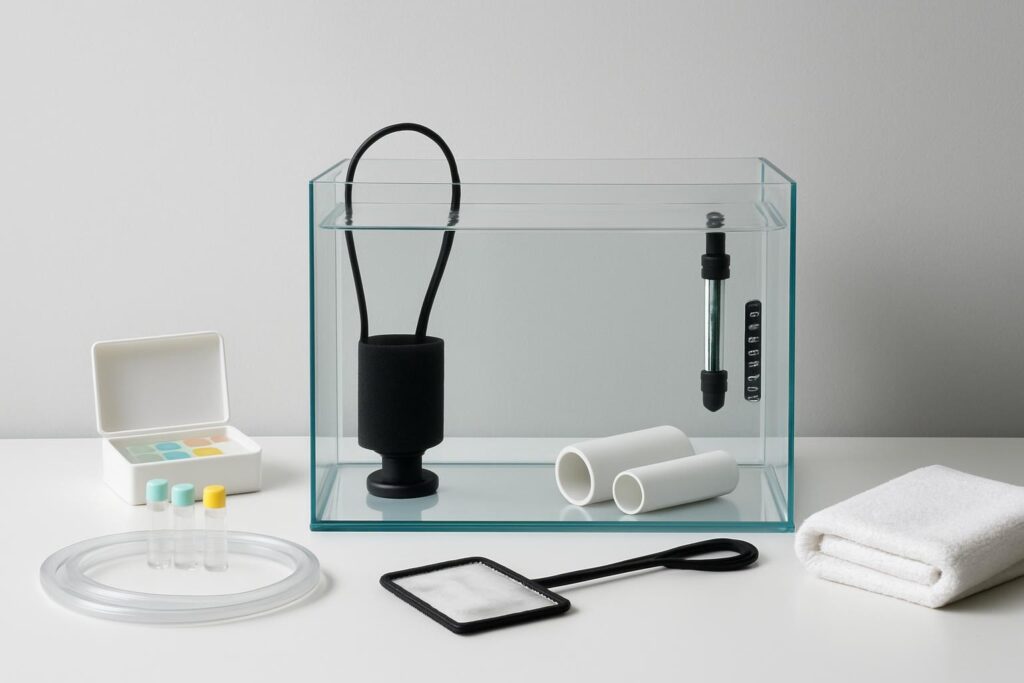
You need a small tank or tote, a lid, a heater, and a simple filter. A sponge filter with an air pump is ideal. Add a thermometer, dechlorinator, water test kit, and a siphon hose. Use a bare bottom for easy cleaning. Add several pieces of PVC pipe or plastic plants as hides. Keep a clean bucket, a net, and towels that are used only for quarantine. Have basic treatments on hand, such as aquarium salt for freshwater, a gentle external parasite medication, and a broad spectrum dewormer. For marine keepers, copper treatment requires a separate copper test kit and careful control, and is best left for when you are confident and have clear need.
Setting up the quarantine tank
Place the tank in a calm area away from drafts and direct sun. Use dechlorinated tap water or your regular source water. Match the general parameters of your display tank. Run the filter and heater for a day to stabilize temperature. Keep the setup simple and easy to clean.
Bare bottom vs minimal substrate
A bare bottom shows waste and uneaten food clearly, so you can keep the water very clean. If a nervous species needs more comfort, add a thin layer of inert sand or a dark mat under the tank to reduce reflection. Avoid gravel that traps debris. Avoid live plants during medication.
Filtration and aeration
A sponge filter provides gentle flow, surface agitation, and a place for beneficial bacteria. If you did not pre seed a sponge, add bottled bacteria and plan extra water changes during the first two weeks. Run an air stone for extra oxygen, especially if you use any medication.
Heating and cover
Use a reliable heater set to a stable temperature suitable for the species. Most tropical freshwater fish do well at 24 to 26 C. Marine fish commonly prefer 24 to 26 C as well. Use a tight lid. Stressed fish jump. Dim the light or use room light only during the first days.
Hiding places and comfort
Provide several simple hides such as PVC elbows and plastic plants. Place them so fish can rest without being cornered. Hides reduce stress, improve appetite, and make observation easier because fish feel secure enough to show normal behavior.
Biosecurity rules that keep disease out
Use dedicated nets, buckets, siphons, and towels for quarantine only. Label them and store them away from display tank tools. Wash and dry your hands between tanks. Do quarantine tasks last. Do not share water, media, plants, or decor between tanks. Allow tools to dry fully between uses, since many pathogens do not survive drying.
Acclimation and the first 24 hours
Turn off the quarantine tank light. Float the sealed bag for 15 to 20 minutes to match temperature. Open the bag and add small amounts of quarantine water every few minutes for 20 to 30 minutes. Net the fish into the tank and discard bag water. Keep the room quiet.
Do not feed right away. After a few hours, offer a small, high quality meal. Remove any uneaten food after five minutes. Observe breathing rate, posture, fin position, and interest in food. Fish often hide the first day. This is normal if breathing is steady and there is no frantic behavior.
Observation protocol
Watch fish at least twice daily. Look for white spots, velvet like dusting, frayed or clamped fins, flashing against objects, gasping at the surface, red streaks, ulcers, excess mucus, bloating or pinched belly, stringy white feces, and loss of appetite. Note behavior changes such as hiding all day, loss of schooling, or sudden aggression. Record notes in a simple log with date, water test results, and any symptoms. A log helps you spot trends and decide when to treat.
Water quality targets during quarantine
Keep ammonia at zero and nitrite at zero. Keep nitrate under 20 to 40 ppm by doing frequent water changes. Keep temperature steady. Keep pH stable and suitable for the species. Test daily for the first week, then at least three times per week. In an uncycled or newly cycled quarantine tank, do small daily water changes and dose dechlorinator that binds ammonia if needed. Clean water is the strongest medicine you can give.
Feeding strategy that supports recovery
Feed small amounts two to three times per day. Use high quality pellets or frozen foods that your species normally eats. For shy fish, start with live or frozen options to trigger feeding, then transition to pellets. Remove uneaten food after five to ten minutes. A varied diet helps the immune system. Overfeeding causes ammonia spikes, so keep portions small during the first week.
Treatment strategy for beginners
There are two common approaches. Some treat all new fish as a precaution. Others observe first and medicate only if they see signs. For beginners, the observe first approach is simpler and safer. It reduces stress and avoids mixing medications by guesswork. Keep basic treatments on hand so you can act fast if needed.
For external parasites in freshwater, a gentle ich medication can be effective. For internal worms, praziquantel is widely used. For internal protozoa, metronidazole is common. For bacterial infections, options include antibiotics such as kanamycin or nitrofurazone. Never mix medications without research. Increase aeration during any treatment. Remove activated carbon from filters while dosing.
For marine fish, copper treatment is effective for marine ich and velvet when used correctly with a reliable copper test kit in a bare quarantine tank. Copper is harmful to invertebrates and should not be used with rock, sand, or biological media that will ever return to a display tank. If you are not yet confident with copper, use observation and targeted treatment and seek detailed guidance before dosing.
Using salt in freshwater quarantine
Freshwater aquarium salt can reduce stress and help with mild external issues at low levels. Start low at about one tablespoon per five gallons, dissolved before adding. Replace salt only for water changed. Do not use with live plants or scaleless fish such as some loaches and some catfish. If in doubt, skip salt and rely on clean water and observation.
A simple day by day timeline
Day 0. Acclimate, dim lights, add fish, and observe. Offer a small meal after a few hours. Test water in the evening.
Days 1 to 3. Test daily. Do a small water change if ammonia or nitrite are above zero or if you fed more than a light meal. Observe for spots, frayed fins, labored breathing, or odd behavior. Keep lights low and feed small amounts.
Days 4 to 7. Continue testing. Increase feeding slightly if fish are active and water quality is stable. If you see symptoms, start targeted treatment and log each dose. Boost aeration during any medication.
Days 8 to 14. Maintain a clean schedule. If symptoms appeared, finish the full course and restart the four week clock after the last visible sign clears. If no symptoms, keep observing and keep the environment steady.
Days 15 to 28. Hold the line. Consistent care, consistent feeding, and consistent testing. Avoid new additions to the quarantine tank. If you must add new fish, restart the clock for all fish.
Ending quarantine and moving fish safely
Move fish to the display tank after at least four full weeks with no symptoms, steady appetite, normal behavior, and stable water parameters. On move day, match temperature and pH between tanks as closely as possible. Turn off display tank lights. Net fish from quarantine and release them into the display. Do not pour quarantine water into the display. Feed lightly after a few hours.
Special cases and notes
Invertebrates and live plants do not tolerate many medications. Quarantine them in a separate container for two to four weeks to watch for hitchhikers such as snails or pests. Do not use copper with invertebrates or media that will return to a display with invertebrates.
Wild caught marine fish and high value reef systems carry higher risk. Many advanced keepers use longer quarantine periods or specialized methods such as copper or tank transfer. If you decide to use these methods, study dosing, test daily, and use dedicated equipment.
Some freshwater fish such as otocinclus, wild caught tetras, and some loaches are sensitive to medications and to large parameter swings. For these, focus on stable water, gentle feeding, and careful observation. Treat only when you are sure of the problem.
Common mistakes to avoid
Do not skip quarantine. Do not rush the timeline. Do not overfeed during the first week. Do not ignore testing. Do not share nets or buckets between tanks. Do not mix medications without a plan. Do not run carbon during treatment. Do not use live rock or substrate in medicated marine quarantine. Do not add new fish to quarantine without restarting the clock. Do not move fish to the display if they are not eating well.
Budget and space tips
A basic quarantine can be a 10 to 20 gallon glass tank or a clean food grade plastic tote. Use a sponge filter with an air pump, a small heater, a lid, and a few PVC pieces for hides. Store the setup dry between batches of fish. Keep a spare seeded sponge filter running in your display tank so it is ready for the next quarantine.
Final checklist before you buy fish
Make sure the quarantine tank is set up, heated, and cycled or supported with bacteria and planned water changes. Confirm you have a test kit, dechlorinator, thermometer, and siphon. Prepare dedicated tools and label them. Set out hides, lid, and light dimming. Stock foods your species will eat. Keep basic medications on hand. Plan the next four weeks in your calendar.
Conclusion
Quarantine is simple, repeatable, and powerful. Set up a small, clean, and calm space. Observe daily. Keep water perfect. Treat only when needed. Complete a full four week period with no symptoms. Move fish carefully and never pour quarantine water into the display. This routine protects your main tank, saves money, and builds confidence. Start with your next purchase and make quarantine your standard practice.
FAQ
Q: How long should I quarantine new fish
A: Quarantine new fish for at least four weeks, and if you see any illness, treat and then restart the four week clock after the last symptom clears.
Q: What size should a quarantine tank be
A: A basic quarantine can be a 10 to 20 gallon tank or a clean plastic tote with a lid, heater, and sponge filter.
Q: Do I need to medicate all new fish
A: For beginners, observe first and medicate only if you see signs, since this is simpler and safer than dosing every new fish by default.
Q: Can I use substrate in a quarantine tank
A: A bare bottom is best for easy cleaning, but you can use a very thin layer of inert sand if a nervous species needs comfort.
Q: How do I prevent cross contamination between tanks
A: Use dedicated nets, buckets, and siphons for quarantine, wash and dry hands between tanks, do quarantine tasks last, and never share water or media.