
We are reader supported. When you purchase through links on our site, we may earn an affiliate commission. Also, as an Amazon affiliate, we earn from qualifying purchases.
Corals are not plants. Light matters, but it is only one part of how corals stay alive and grow. Corals hunt, filter, absorb, and digest a wide range of foods. If you only think about zooxanthellae and photosynthesis, you miss the rest of the feeding strategy that keeps corals healthy in home aquariums. This guide breaks down every major feeding pathway and turns it into clear actions you can use, whether you keep SPS, LPS, soft corals, or azooxanthellate species.
Introduction: Why Feeding Matters Beyond Light
In the wild, coral reefs receive pulses of plankton, marine snow, and dissolved nutrients around the clock. Light delivers energy through symbiotic algae, but most corals also capture prey and absorb dissolved compounds. This mixed diet fuels growth, color, tissue repair, spawning, and resilience to stress.
Even photosynthetic corals benefit from regular feeding. Well-fed corals often show thicker tissue, faster calcification, stronger polyp extension, and improved recovery after stress events like shipping or minor bleaching. Understanding how and what they eat is the first step to feeding them well.
The Coral Holobiont and Its Energy Sources
Zooxanthellae: Helpful, Not Sufficient
Zooxanthellae living inside coral tissue convert light and carbon dioxide into sugars and other compounds the coral can use. Under strong, stable light, this can cover much of a coral’s daily energy needs. But this pathway is limited in nitrogen and phosphorus, the building blocks of proteins and DNA. It cannot keep up with every growth or repair demand, especially in changing conditions.
Heterotrophy: Eating to Grow
Heterotrophy means eating other organisms or particles. Corals do this with tentacles, mucus, and cilia that move food to the mouth. Heterotrophy supplies nitrogen and phosphorus that zooxanthellae alone cannot provide in balanced amounts. It also provides essential fatty acids and amino acids that support coloration, membrane health, and immunity.
Dissolved Uptake: Not All Food Has Shape
Corals absorb dissolved organic carbon and small nutrients directly from water. They take up ammonium, nitrate, and urea for nitrogen, and phosphate for cell function and calcification. They can also ingest dissolved and colloidal organic matter by pinocytosis. This is a low-effort background food source that adds up over time, especially at night.
How Corals Capture and Digest Food
Tentacles and Nematocysts
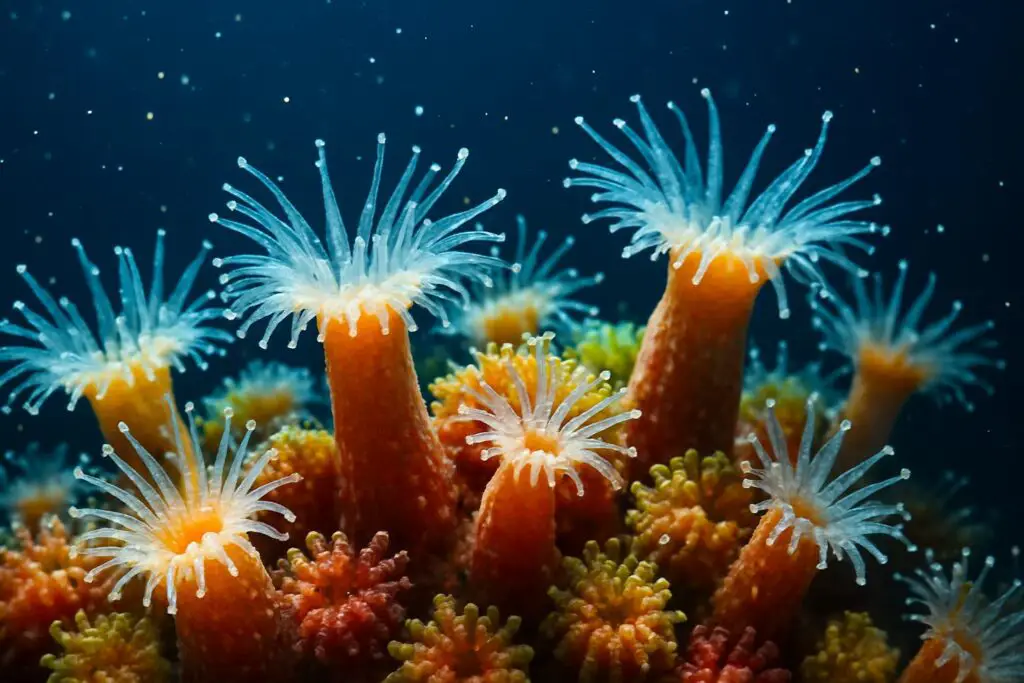
Coral polyps use tentacles lined with stinging cells called nematocysts to stun and grip prey. Once captured, cilia move the prey to the mouth for ingestion. Large-polyp stony corals can grab meaty items. Small-polyp stony corals collect tiny plankton and fine particles suspended in the water column.
Cilia, Mucus Nets, and Particle Traps
Many corals secrete mucus and use ciliary currents to trap and transport particles. This sticky layer collects bacteria, detritus, phytoplankton, and microzooplankton. The coral then reabsorbs the mucus and the trapped food. This process can run for hours and works even in moderate flow.
Mesenterial Filaments and External Digestion
Under stress or during active feeding, some corals extend filaments from the gut to digest food outside the mouth. These filaments release enzymes that break down organic matter on nearby surfaces. In aquariums, this is more common during aggression, but it also reveals how corals maximize every feeding opportunity.
Day Versus Night Behavior
Many corals feed more at night when plankton rises and predation risk drops. Polyps extend further, and sweeper tentacles may appear. Some species remain active by day, especially those adapted to turbid or nutrient-rich water where plankton is always present. Timing your feeding to match natural rhythms improves capture rates.
What Corals Eat: From Microns to Millimeters
Particle Size and Match to Polyp Size
Polyp size predicts prey size. SPS rely on microzooplankton, nanoplankton, bacteria, and fine detritus. LPS handle larger zooplankton and meaty bits. Soft corals vary; many take small suspended particles. Azooxanthellate corals often prefer continuous small prey streams and dissolved or colloidal foods.
Common Foods in the Wild and the Tank
Wild diet: copepods, nauplii, rotifers, larval worms and crustaceans, fish eggs, phytoplankton, bacteria, and marine snow. Aquarium analogs: live or frozen copepods, rotifers, Artemia nauplii, mysis, chopped krill, fish roe, oyster products, powdered reef foods, and fine phytoplankton mixes. Rinse frozen foods to reduce phosphate and fats.
Species and Group Targets
Feed small-polyp SPS with microzooplankton and fine particulate foods in the 20–200 micron range. LPS corals prefer larger, soft items such as mysis, chopped krill, roe, or 1–5 millimeter pellets. Soft corals and gorgonians vary; many respond best to frequent small plankton and bacterioplankton substitutes. Azooxanthellate corals need frequent small meals and stable, nutrient-rich flow; do not rely on light.
Feeding Methods That Work
Broadcast Feeding
Broadcast feeding spreads a cloud of food across the tank. It is efficient for SPS and small-polyp softies. Use a pipette or dosing pump to add dilute food into moderate flow so particles stay suspended long enough for capture. Start with small amounts and watch polyp response.
Target Feeding
Target feeding delivers larger items to LPS and hungry soft corals. Use a turkey baster or feeding pipette to place food near the mouth without blasting tissue. Target feed at night when most polyps extend, using moderate flow to keep food in suspension. Turn off return pumps for 10–20 minutes during target feeding to keep food in the display.
Pulsed and Continuous Strategies
Short pulses of food encourage natural capture behavior and reduce waste. For azooxanthellate or filter-feeding soft corals, consider frequent micro-doses or continuous drips of fine foods, balanced with strong export. Adjust based on nutrient tests and visible feeding responses.
Timing With Light and Flow
Feeding after the display lights dim or near the start of the blue-only period improves polyp extension. Alternate flow patterns help tumble particles across corals from different angles. Avoid intense direct blasts that blow food past tentacles or damage tissue.
How Feeding Fuels Growth and Resilience
Energy and Building Blocks
Heterotrophy supplies amino acids, fatty acids, and micronutrients that complement photosynthetic sugars. This mix supports thicker tissue, more pigments, and better membrane integrity. Well-fed corals lay down skeleton faster because they can allocate light-derived energy to calcification while using prey for proteins.
Nitrogen and Phosphorus Balance
Prey adds nitrogen and phosphorus in forms corals can use. Balanced nutrients prevent starvation in low-nutrient tanks and reduce the risk of pale tissue from chronic deficiency. Feeding can stabilize coloration by supporting pigments linked to nitrogen availability.
Stress Recovery and Bleaching Events
Feeding improves survival during and after stress by providing energy when photosynthesis is impaired. Corals with active prey capture are more likely to regain tissue mass and rebuild symbiont populations after light or heat stress.
Water Quality: Feed the Coral, Not the Algae
Nutrient Targets and Limits
Feeding increases dissolved and particulate waste. Keep nitrate and phosphate in ranges that support corals without fueling nuisance algae. Stop feeding and increase filtration if nitrate rises above 20 ppm or phosphate above 0.2 ppm. If nutrients are near zero and colors are pale, increase feeding slightly or reduce export to avoid starvation.
Filtration and Export to Match Intake
Use a skimmer sized for your bioload, clean it often, and run it during or after feeding as needed. Combine mechanical filtration with refugia, macroalgae, or bacterial methods to balance nitrogen and phosphorus. Observe how fast film grows on glass and how often you clean filter socks; both are quick barometers of loading.
Flow and Oxygenation
Feeding raises respiration, so ensure strong surface agitation and consistent flow. Avoid long pump shutdowns that lower oxygen. If you pause pumps, keep powerheads or airstones running to maintain gas exchange.
Signs of Overfeeding and Underfeeding
Overfeeding signs: persistent film algae, cyano mats, dull water, dino risk in unstable nutrients, retracted polyps from irritation, and spiking test numbers. Underfeeding signs: thin tissue, slow growth, pale colors despite adequate light, poor polyp extension, and little response to feeding attempts.
Matching Foods to Coral Types
SPS Corals
Focus on fine foods and microzooplankton. Short, frequent broadcasts with strong alternating flow maximize capture. Watch for enhanced polyp extension and improved coloration. Avoid large oily foods that add waste but deliver little to small mouths.
LPS Corals
Use soft, appropriately sized pieces that corals can swallow without tearing tissue. Place food gently near the mouth and give time to ingest before fish steal it. Do not overfill; one or two pieces per polyp per session is often enough for many species.
Soft Corals and Gorgonians
Many softies do well with background plankton and bacterioplankton substitutes. Fine powdered blends and live or preserved plankton can work. Nonphotosynthetic gorgonians need consistent small particle delivery and clean but nutrient-rich water.
Azooxanthellate Corals
These species depend entirely on heterotrophy and dissolved uptake. Provide frequent micro-doses or continuous feeding of fine plankton and particulate organics. Maintain high, stable flow that suspends food and prevents sediment buildup. Balance with strong export and careful testing.
Practical Feeding Workflow
Preparation
Thaw frozen foods in tank water, then strain to remove excess oils and phosphates. Mix powdered foods into fine slurries. Rinse tools to avoid cross contamination.
Execution
Dim lights or wait for evening when many corals extend. Begin with a small broadcast to trigger feeding responses. Follow with targeted placement for hungry LPS and select soft corals. Keep moderate, turbulent flow so particles travel across tentacles without blowing away.
Frequency and Adjustment
Start with two to three small feedings per week for mixed reefs and adjust based on nutrient tests and coral response. Increase slightly for heavy SPS systems or add one extra session focused on LPS if growth has stalled. For azoox, plan for daily or near-daily micro-feeding with robust export.
Aftercare
Resume full circulation if you paused return flow. Check skimmer performance. Test nitrate and phosphate a few hours after heavy sessions and again the next day to spot trends. Record changes in polyp extension, feeding speed, and growth tips.
Advanced Notes: Behavior That Guides Your Plan
Polyp Extension as a Signal
Extended, sticky tentacles and visible mouth movement indicate high capture potential. Minimal extension during feeding suggests flow is wrong, food is the wrong size, or the coral is stressed. Adjust slowly and observe.
Flow Tuning
Too little flow lets food settle and rot. Too much flow blasts food away. Aim for alternating, chaotic patterns that keep particles hovering. Redirect a powerhead rather than increasing speed if tissue flutters excessively.
Competition and Aggression
Feeding increases competition. Use feeding guards or temporary cones over slow eaters. Space LPS with sweeper tentacles well away from neighbors, especially on heavy feeding days.
Common Mistakes to Avoid
Oversized Food
Large chunks rot if not swallowed quickly and can tear delicate tissue. Match particle size to polyp size and feeding structures.
Heavy Feeding With Weak Export
High input without matching export leads to algae blooms and stressed corals. Align your skimmer, refugium, and media maintenance with your feeding schedule.
Ignoring Timing
Feeding at bright noon with high, direct flow reduces capture rates. Shift feeding toward dusk or when you see strong extension.
Neglecting Rinse Steps
Rinse frozen foods to reduce phosphate and fats. This simple habit cuts waste and keeps water clearer.
Putting It All Together: A Simple Plan
Step-by-Step
1. Choose foods that match your corals and their polyp sizes. 2. Rinse and prepare fine slurries for SPS and small-polyp softies. 3. Thaw and chop soft meaty foods for LPS. 4. Feed near dusk with alternating flow. 5. Start with a light broadcast, then target feed key colonies. 6. Keep return flow off briefly if needed. 7. Resume full flow, skim actively, and test nutrients. 8. Adjust frequency and volume based on coral behavior and test results.
Conclusion
Light is the engine, but feeding is the steering and the fuel for real-world coral success. Corals are active predators and filter feeders that depend on a mixed diet of particles and dissolved nutrients. When you respect polyp size, time your feedings, manage flow, and balance export, you unlock better color, growth, and resilience. Build your routine around small, consistent inputs, observe carefully, and let the corals show you what works.
Actionable Reference Points
Key Sentences to Guide Your Routine
Even photosynthetic corals benefit from regular feeding. Heterotrophy supplies nitrogen and phosphorus that zooxanthellae alone cannot provide in balanced amounts. Feed small-polyp SPS with microzooplankton and fine particulate foods in the 20–200 micron range. LPS corals prefer larger, soft items such as mysis, chopped krill, roe, or 1–5 millimeter pellets. Azooxanthellate corals need frequent small meals and stable, nutrient-rich flow; do not rely on light. Target feed at night when most polyps extend, using moderate flow to keep food in suspension. Turn off return pumps for 10–20 minutes during target feeding to keep food in the display. Start with two to three small feedings per week for mixed reefs and adjust based on nutrient tests and coral response. Stop feeding and increase filtration if nitrate rises above 20 ppm or phosphate above 0.2 ppm. Rinse frozen foods to reduce phosphate and fats.
FAQ
Do corals need feeding if they have strong lighting
Even photosynthetic corals benefit from regular feeding.
What should I feed SPS and LPS corals
Feed small-polyp SPS with microzooplankton and fine particulate foods in the 20–200 micron range. LPS corals prefer larger, soft items such as mysis, chopped krill, roe, or 1–5 millimeter pellets.
When and how should I target feed
Target feed at night when most polyps extend, using moderate flow to keep food in suspension. Turn off return pumps for 10–20 minutes during target feeding to keep food in the display.
How often should I feed a mixed reef
Start with two to three small feedings per week for mixed reefs and adjust based on nutrient tests and coral response.
When should I stop feeding to protect water quality
Stop feeding and increase filtration if nitrate rises above 20 ppm or phosphate above 0.2 ppm.