
We are reader supported. When you purchase through links on our site, we may earn an affiliate commission. Also, as an Amazon affiliate, we earn from qualifying purchases.
High pH causes stress, fin damage, poor immunity, and can turn harmless ammonium into toxic ammonia. Lowering pH is possible, but fast drops kill fish. The goal is a stable, safe pH that matches your species and your water. This guide shows you how to diagnose high pH, choose the right method, and lower it safely without daily chasing or risky shortcuts.
What pH Means For Your Tank
pH measures how acidic or alkaline water is. The scale runs from 0 to 14. Neutral is 7. Numbers above 7 are alkaline. Numbers below 7 are acidic.
Most community fish live well in a slightly acidic to neutral range from 6.8 to 7.4. Some fish prefer higher pH. African rift lake cichlids thrive at 7.8 to 8.6. Livebearers and many snails like 7.4 to 8.2. Goldfish handle 7.0 to 8.0. Soft-water species such as tetras, rasboras, and dwarf cichlids do best around 6.0 to 7.0.
If your fish are native to hard alkaline water, you may not need to lower pH. If your fish are soft-water species or your pH is above 8.2 and fish show stress, lowering pH helps. Always match pH to the species you keep, not to a generic number.
The Real Boss Is KH
KH is carbonate hardness, also called alkalinity. KH is a buffer. It resists pH change. High KH keeps pH high and stable. Low KH allows pH to move easily, up or down.
To lower pH safely, you must understand your KH. If KH is high, acids and pH-down drops will barely move pH and then bounce back. If KH is low, strong acids can crash pH and harm fish. The key is to set KH in the right zone first, then fine-tune pH.
Test The Right Way
Use reliable tests
Use a liquid pH test or a calibrated pH pen. Test strips are fast but less precise. Test KH with a liquid KH kit. GH is general hardness and affects fish health but not pH buffering directly. Measure it as well so you know your baseline.
Know your tap water behavior
Tap water out of the faucet can read different after 24 hours. Fill a cup, add dechlorinator, aerate, and test pH and KH after a day. CO2 escapes and the pH often rises. Use this degassed number as your real starting point for planning changes.
Track daily swings
If you have strong lighting and plants, pH rises during the day as plants consume CO2, then drops at night as CO2 builds. Measure pH in the morning and evening. Large swings mean your CO2 and aeration balance needs work.
Decide If You Should Lower pH
Confirm three points before you act. First, confirm your fish species and their preferred pH range. Second, confirm that pH is consistently high and not a one-off reading. Third, confirm that KH is not extreme and can be adjusted. If fish are acting normal, eating, and you have no ammonia or nitrite, stability can matter more than the perfect number.
How High pH Happens
Common causes of high pH include alkaline tap water with high KH, substrates or decor made from calcareous materials like crushed coral, aragonite sand, limestone, shells, or certain rocks, chemical pH raisers, vigorous aeration that strips CO2, understocked or very clean tanks that lack organic acids, and intense plant growth coupled with strong surface agitation that keeps CO2 low all day.
Find and remove the source. Otherwise pH will climb back after every water change.
Set Safe Targets
Choose a pH range that suits your fish and that you can maintain without daily dosing. Most mixed community tanks are comfortable at 6.8 to 7.4. Soft-water blackwater setups often aim for 5.5 to 6.8 but need very low KH. Hard-water cichlid tanks run 7.8 to 8.6 and should not be pushed lower for those fish.
Set a safe rate of change. Aim for no more than 0.2 to 0.3 pH units per day. For sensitive species and shrimp, keep drops to 0.1 to 0.2 per day. Stability matters more than speed.
Preparation Before You Lower pH
Remove alkaline sources
Take out crushed coral, aragonite sand, shells, limestone, and unknown rocks that fizz in vinegar. Replace with inert sand, gravel, or planted tank soils appropriate for your setup.
Tune aeration and gas exchange
Strong surface agitation raises pH by expelling CO2. Keep gentle surface movement for oxygen but avoid a roaring boil if you are struggling with high pH. If fish are gasping, raise surface agitation. Oxygen comes first. Adjust pH methods around it.
Set up a conditioning bin
Condition new water in a separate container with a heater and small pump. Treat chlorine and chloramine. Adjust KH and pH in the bin so the water you add already matches your target. This avoids sudden swings in the main tank.
Method 1: Dilute With RO or Distilled Water
Reverse osmosis water has near-zero KH and GH. Mixing RO with tap reduces KH, which allows pH to settle lower. This is the most controllable way to lower pH in most regions with hard tap water.
Find your tap KH. Decide your target KH. For soft-water community fish, 3 to 5 dKH is a practical zone. For blackwater species, 0 to 2 dKH works but needs careful monitoring to prevent pH crashes. Use simple ratios. If your tap is 12 dKH and you want 4 dKH, use one part tap to two parts RO. If your tap is 8 dKH and you want 4 dKH, mix half tap and half RO.
After blending, remineralize GH as needed using a reputable remineralizer. Many fish and plants do poorly if GH is near zero. Aim GH around 4 to 8 dGH for most community setups unless your species needs otherwise.
Always adjust and test in the bin before adding to the tank. Let the water sit with aeration for several hours, then test pH and KH again before use.
Method 2: Add Natural Acids
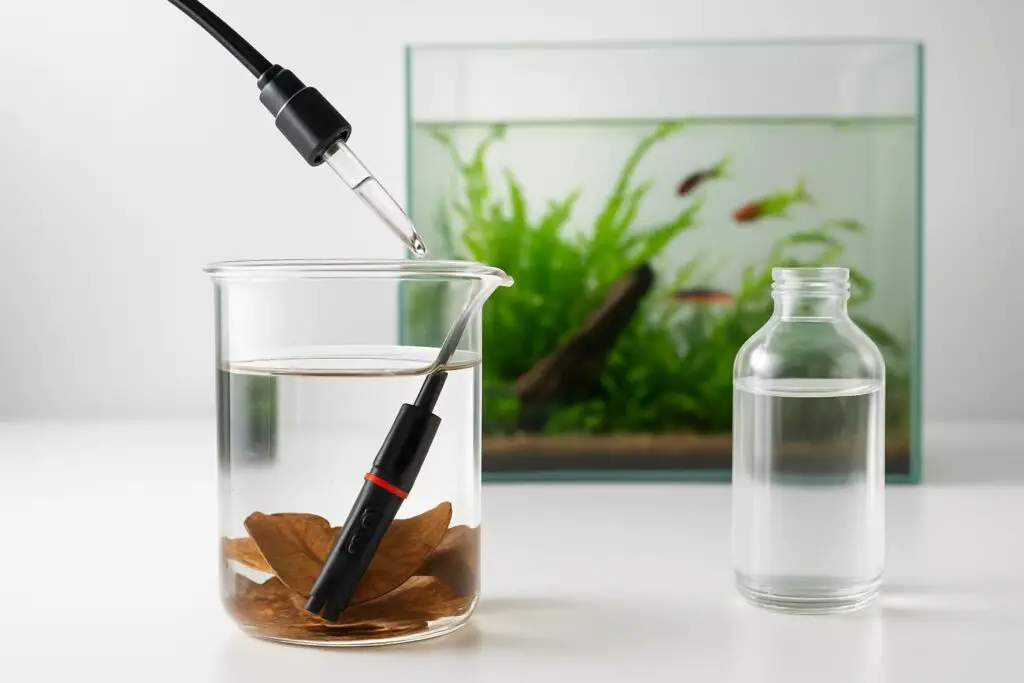
Botanicals release humic and tannic acids that gently lower pH and add beneficial compounds. They also tint the water tea brown, which many soft-water fish prefer.
Indian almond leaves are easy to use. Start with one large leaf per 10 to 15 gallons. Replace as they break down. Alder cones and oak leaves work similarly. Boil or soak to sink them and to remove dust. Driftwood, especially mopani and spider wood, also releases acids. Peat moss in a mesh bag placed in the filter can lower pH and KH by binding carbonates. Start with roughly one cup per 20 gallons, rinse well, and monitor weekly. Natural materials vary in strength, so test regularly. Effects are gradual and stabilize over days, not minutes.
Method 3: Use CO2 for Planted Tanks
CO2 dissolves into water to form carbonic acid, lowering pH during the photoperiod. Properly used, CO2 gives plants carbon, reduces algae, and can set a stable daytime pH a full point below the degassed baseline.
Target 20 to 30 ppm CO2 with a reliable method. Watch fish closely for stress. Keep strong surface movement at night to maintain oxygen. Understand that pH will rise again when CO2 turns off. If you want a certain average pH, combine CO2 with lower KH via RO mixing.
Method 4: Acid Buffers and Commercial pH-Down
Acid buffers can work if you manage KH at the same time. Add acid without reducing KH and the pH will rebound. Many pH-down products are phosphoric acid. They can fuel algae and cause inconsistent results. If you use a buffer system, follow the instructions closely. Lower KH with RO mixing first, then adjust pH. Dose into your conditioning bin, not into the tank. Test KH and pH before use.
Method 5: Active Substrates for Soft Water
Some planted-tank soils lower pH and KH by exchanging ions. They are popular for shrimp and soft-water aquascapes. They work best when you use RO or soft water for changes. They have a lifespan and gradually lose effect. They can be part of a long-term plan if your stock needs low pH.
A Safe Step-by-Step Plan
Step one is testing. Record pH morning and evening for two days. Record KH and GH. Test tap water after 24 hours of aeration.
Step two is set your target pH and KH based on species. For a community tank aiming at 7.0, set KH around 3 to 5 dKH. For soft-water tetras aiming at 6.5, set KH around 2 to 3 dKH. For sensitive blackwater species targeting under 6.0, use 0 to 2 dKH and move slowly.
Step three is remove alkaline materials and reduce extreme surface agitation while keeping good oxygenation.
Step four is prepare new water. Blend RO and tap to hit your target KH. Adjust GH if needed. Let it aerate and stabilize. Confirm pH and KH.
Step five is partial water changes with preconditioned water. Do 20 to 30 percent changes every day or two until the tank approaches the target. Keep daily pH drop under 0.3. Slow down if fish show stress.
Step six is fine-tuning. Add botanicals or peat for gentle acidity if you need an extra push or want blackwater conditions. For planted tanks, optimize CO2 to stabilize daytime pH. If you use acid buffers, dose only into the conditioning bin and retest each time.
Step seven is stabilize. Once you reach the target, keep using the same water blend, the same change schedule, and the same maintenance routine. Consistency keeps pH stable.
Emergency Situations
If pH spikes above 9.0 and fish are distressed, act, but avoid abrupt swings. Check ammonia immediately. At high pH, total ammonia is more toxic. If ammonia is present, add a detoxifier that binds ammonia. Perform a 25 to 40 percent water change with preconditioned lower KH water that is close to tank temperature. Repeat in a few hours if needed. Do not dump strong acids into the tank. Remove any obvious alkaline media at once. Reduce surface agitation slightly to retain CO2 while ensuring fish are not gasping. Add extra aeration back in as soon as fish calm. Resume the step-by-step plan the next day.
Avoid These Common Mistakes
Do not chase pH daily with random doses. Do not ignore KH and try to force pH with acid. Do not use household acids like vinegar. Do not make large pH changes during one water change. Do not lower pH for fish that prefer hard alkaline water. Do not starve the tank of oxygen by eliminating surface movement. Do not rely on test strips alone when making big decisions.
Troubleshooting When pH Will Not Stay Down
pH rebounds after each change
KH is still too high. Increase the RO fraction in your blend. Remove any hidden sources of carbonate such as crushed coral in filter media bags. Test KH in the tank and in your replacement water.
Botanicals barely move pH
Botanicals work best when KH is already low to moderate. Reduce KH with RO blending first. Add more leaves or peat slowly and test every few days. Expect gradual shifts, not instant drops.
Large day-night pH swings
Plants and gas exchange are the cause. Add or regulate CO2 for the photoperiod. Decrease surface agitation during the day, keep firm aeration at night. Keep light duration reasonable. Ensure enough plant mass to use CO2 consistently.
Fish gasp when you reduce agitation
Restore surface movement at once. Oxygen always wins. Use other methods to lower pH such as reducing KH with RO or using botanicals. Never compromise oxygen for pH goals.
Ammonia shows up during pH changes
Filter bacteria may be stressed by changes. Reduce feeding, clean debris gently, and add a bacterial supplement if needed. Use a detoxifier that binds ammonia temporarily. Confirm that your dechlorinator neutralizes chloramine if your water supplier uses it.
How Much To Lower Per Day
For hardy community fish, plan no more than 0.2 to 0.3 pH units per day. For soft-water dwarfs, wild-caught fish, shrimp, and fry, keep it to 0.1 to 0.2. If you need a big overall change, spread it over a week or two. Your fish will thank you with normal behavior and steady appetite.
Water Change Strategy That Works
Make all changes in a conditioning bin. Blend RO and tap until KH tests at your target. Heat and aerate the water. If you need a small pH nudge, add botanicals to the bin or a modest dose of a buffer. Wait a few hours. Re-test. Only then do the water change.
Match temperature within 1 to 2 degrees. Match KH within 1 dKH of the tank. Match pH within 0.2 to 0.3 of the tank. Repeat changes at a steady rhythm, such as 20 to 30 percent every two to three days while lowering, then weekly once stable.
Species Notes So You Do Not Lower pH Unnecessarily
Do not lower pH for African rift lake cichlids, shell dwellers, or brackish species that prefer alkaline conditions. Livebearers like guppies and mollies also enjoy alkaline water. Goldfish do not need soft acidic water and tolerate 7.0 to 8.0 well.
Do lower pH for South American tetras, pencilfish, rasboras, gouramis, Apistogramma, discus, and dwarf cichlids that prefer soft acidic conditions. Shrimp species vary. Neocaridina prefer neutral to slightly alkaline. Caridina often prefer acidic soft water.
How KH, CO2, and pH Interact
CO2 dissolves into water and forms carbonic acid, which releases hydrogen ions and lowers pH. KH is the store of bicarbonate and carbonate that neutralizes acid and holds pH steady. High KH resists pH change from CO2 or acids. Low KH allows larger changes with the same amount of acid. That is why reducing KH to a reasonable level is the foundation of any pH plan.
What About GH
GH is calcium and magnesium levels. Fish use GH for osmoregulation, bone, and muscle function. Plants use calcium and magnesium too. GH does not control pH, but you should not strip GH to near zero unless your species require it and you know how to remineralize. Most community tanks thrive at 4 to 8 dGH.
Keeping pH Stable After You Lower It
Stick to one method and one routine. Use the same RO to tap ratio. Keep the same water change schedule. Keep botanicals topped up as they break down. Maintain the same CO2 setup and light schedule if you run a planted tank. Clean filters regularly so peat or leaves do not clog flow. Test pH and KH weekly at first, then biweekly once you are stable.
Case Example: Hard Tap Water To Soft Community Tank
Tap water reads 8.2 pH and 12 dKH after 24 hours. Goal is 7.0 pH and 4 dKH for a tetra and cory tank. Mix one part tap with two parts RO in the bin. KH tests at 4 dKH. GH is low, so add a remineralizer to reach 6 dGH. Aerate for several hours and test pH. It stabilizes near 7.2. Do 25 percent water changes every other day with this mix. pH falls from 8.2 to 7.2 over a week. Add a few almond leaves and a small piece of driftwood to take it to 7.0 over another week. Maintain weekly 30 percent changes with the same RO blend. The tank stays at 7.0 to 7.1.
Case Example: Planted Tank Using CO2
Degassed pH is 7.8 with KH 6. CO2 brings daytime pH to 6.9. Fish are fine and plants pearl. At night pH rises to 7.5. The swing is acceptable. To lower average pH further, mix 75 percent RO with 25 percent tap to reach KH 2. Daytime pH with CO2 settles near 6.5. Night pH rises to 6.9. The swing is smaller and well tolerated.
Frequently Asked Questions
Can I lower pH without RO
If KH is moderate, botanicals and peat can help. If KH is high, results will be weak and temporary without RO or distilled water. In hard water regions, RO is the most reliable path.
Will pH-down harm fish
It can if used directly in the tank or without KH control. It is safer to precondition water and adjust KH first. Avoid large single doses.
Do water softeners help
Household water softeners exchange calcium for sodium. They reduce GH but not KH. They do not make water acidic or suitable for soft-water fish on their own. Use RO instead if you need soft acidic water.
Why did my pH crash
KH likely fell too low and acids accumulated. Increase KH slightly with a small amount of bicarbonate or by increasing the tap water fraction. Make changes slowly and test daily until stable.
A Simple Checklist
Know your fish pH range. Test pH and KH with reliable kits. Degas tap water for 24 hours and retest. Remove calcareous materials. Set target KH using RO mixing. Precondition and test new water in a bin. Lower pH slowly with steady partial changes. Add botanicals or CO2 if needed. Keep oxygen high. Hold the routine once stable.
Conclusion
Lowering high pH safely is about control, not force. Control KH with RO blending. Control additions by preconditioning water outside the tank. Control the pace so fish never face sudden swings. Natural acids and CO2 can fine-tune pH once KH is set. Test regularly, keep oxygen strong, and stick to one routine. Do this and your pH will settle where your fish are comfortable, and it will stay there without daily struggle.