
We are reader supported. When you purchase through links on our site, we may earn an affiliate commission. Also, as an Amazon affiliate, we earn from qualifying purchases.
High pH can stress fish, mute plant growth, and make your aquarium less stable. The fix is not a quick chemical splash. The fix is to measure, remove the sources driving pH up, reduce buffering safely, and nudge pH down at a controlled pace. This guide shows you how to do it step by step, with methods that keep your fish safe and your tank stable.
Introduction
You want lower pH without risking a crash. That means you need to know why pH is high, how your water resists change, and which tools change it gently. Start with testing. Then correct causes. Then apply slow adjustments. The goal is a stable number that suits your fish, not rapid swings that harm them.
What pH Means and Why It Runs High
pH, KH, and stability
pH measures how acidic or basic water is. Most freshwater aquariums sit between 6.0 and 8.4. Carbonate hardness, also called KH or alkalinity, is the buffer that resists pH change. High KH locks pH in place and makes acid additives bounce off. Low KH allows pH to move, sometimes too easily. To lower pH safely, you often need to lower KH first.
Common reasons pH is high
Your tap water can start high, especially in hard water regions. Calcareous materials in the tank can raise it further. This includes limestone rocks, coral sand, crushed shells, aragonite, and some decorative stones. Strong aeration can also raise pH by driving off carbon dioxide. In planted tanks with no additional CO2, daytime photosynthesis can push pH up. Cleaning or media choices that heavily increase gas exchange may have the same effect.
Confirm the Problem Before Acting
Test correctly and test more than once
Use a reliable liquid test kit for pH and KH. Test in the morning and evening to see your daily swing. Write down the numbers. If you use strips, confirm with a liquid test. If you keep planted tanks, expect pH to be lower in the morning and higher in the evening. Know that range before you plan.
Check your tap water properly
Test your tap water pH and KH right out of the tap. Then fill a cup, aerate gently, and test again after 24 hours. Some tap water reads one number fresh, then changes after gases equilibrate. Always plan your adjustments using the aged result, not the first-minute reading.
Set a Realistic Target and Pace
Decide on a target that suits your fish and plants. For mixed community tanks, a stable range between 6.8 and 7.6 is practical. Sensitive species may need softer, more acidic water. Stability beats perfection. If your fish are healthy and breeding, do not chase a tiny number.
Lower pH slowly. Keep daily change within 0.2 to 0.3 pH units. Slower is safer, especially in low KH. Watch fish behavior. If you see stress, pause and stabilize before trying again.
Remove and Prevent the Sources of High pH
Inspect substrate and decor
Take out limestone, coral rubble, crushed shells, aragonite sand, and decorative rocks that fizz with a drop of acid test solution. Use inert gravel, sand, or aquasoils designed for freshwater. If you like the look of wood and stones, choose inert types such as granite, slate, or manzanita driftwood.
Right-size aeration and surface agitation
Aeration improves oxygen but can raise pH by off-gassing CO2. Keep surface movement moderate, not extreme. Aim for good circulation throughout the tank. Avoid unnecessarily powerful air stones if your fish and filter already get enough oxygen. Never starve the tank of oxygen. Balance is the goal.
Mind your maintenance habits
Overcleaning filter media can reduce beneficial bacteria, which may impact stability. Rinse media in tank water, not tap water, and only as needed. Avoid overfeeding, which can drive organic waste and stress. Stable biofiltration supports a steady environment while you adjust pH.
Lower KH First for Stable Results
If your KH is high, acids will not move pH much. You will dose, see a small drop, and it will rebound. The fix is to reduce KH so pH can shift predictably.
RO or distilled water mixing
Use reverse osmosis or distilled water to dilute KH. Mixing RO with tap water lowers KH proportionally. A half tap and half RO mix cuts KH roughly in half. If your tap KH is 12 dKH and you want about 6 dKH, start with a 50 to 50 mix. Test the result and adjust. You can reach most targets by adjusting this ratio over a few water changes.
Keep a safety buffer
For a general freshwater community, keep KH around 3 to 6 dKH. Lower than 2 dKH can allow sudden pH drops if you add acids or if biological processes change. If you run very soft, acidic tanks, monitor daily at first and move even slower.
Pre-treat new water
Condition, aerate, and heat your mix before water changes. Match temperature and roughly match TDS. Check pH and KH of the new water so the tank does not get sudden differences. This makes each change gentle and predictable.
Gentle, Natural pH-Lowering Tools
Peat moss
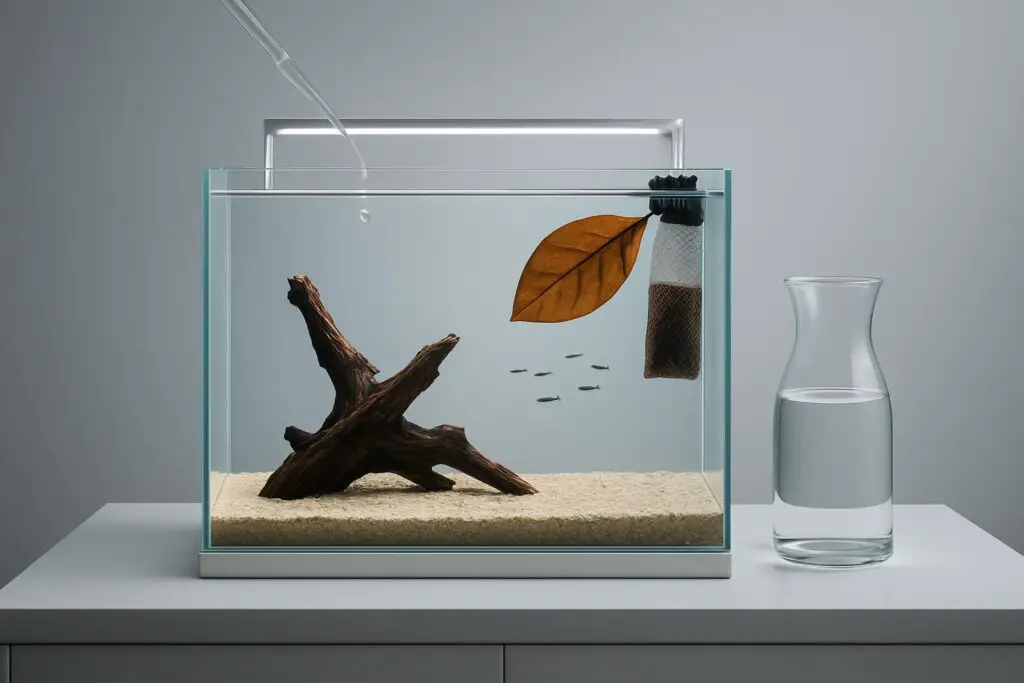
Peat releases weak organic acids and tannins that lower pH and chelate some minerals. Place a small amount in a fine media bag inside your filter or pre-soak in a bucket to make peat tea, then add the filtered water. Start with light dosing. Test pH and KH after 24 hours. Replace or increase only when needed. Expect mild tea coloration.
Indian almond leaves and other botanicals
Catappa leaves and similar botanicals release tannins that gently lower pH in soft water. Add one or two leaves per 20 to 40 liters to start, then wait and test. Replace as they break down. Rinse before use to remove dust. Expect some tint to the water, which is harmless and often beneficial.
Driftwood
True driftwood slowly releases tannins. Soak wood before placing to remove excess. It will have a mild, long-term effect in soft water. In high KH water, the effect is limited. Use it as part of a blended approach with RO mixing.
CO2 in Planted Tanks
CO2 injection forms carbonic acid in water, which lowers pH at a given KH. In planted tanks, this is an effective, controllable method that also fuels plant growth.
Safe CO2 practices
Run CO2 during the photoperiod only, with a reliable timer. Aim for about 20 to 30 ppm CO2 in many planted setups. Use a drop checker or monitor pH change from lights off to lights on as a rough guide. Keep moderate surface movement so oxygen remains adequate. If fish gasp or hang near the surface, reduce CO2 and increase circulation immediately.
When to Use Commercial Buffers and Acids
Commercial pH down products are strong acids. In high KH water, they cause short drops and fast rebounds. This yo-yo harms fish. If you choose to use them, reduce KH first with RO mixing so the product can work at a low dose. Split the dose across several hours or days. Test after each step. Never add household acids such as vinegar. Use aquarium-specific products and follow the label carefully.
Water Change Strategy That Protects Fish
Small, frequent changes are safer than large swings. Pre-treat the new water to the parameters you want in the tank. If you are moving a tank from pH 8.2 to 7.4, plan several changes over one to two weeks. Each time, use a slightly softer, slightly more acidic mix. Confirm pH and KH before the change, and test the tank again a few hours later. Keep a log so you can predict the next move.
Troubleshooting and Safety Checks
Watch your livestock
Early signs of pH stress include rapid gill movement, gasping at the surface, clamped fins, pale coloration, darting, or hiding. If you see these, stop adjustments. Perform a partial change with water that matches the last stable parameters you recorded. Increase aeration slightly. Resume adjustments only when fish are calm and feeding normally.
Measure morning and evening
Daily swings can hide problems. Check pH and KH at lights on and lights off during your adjustment period. This shows the true range your fish live in, not just a single number.
Keep notes
Write down the date, what you did, and the pH and KH results. Include fish behavior. The pattern tells you when to slow down or when a method has reached its limit.
Example Seven Day Plan to Lower pH Safely
Starting point. pH 8.2. KH 10 dKH. Goal. pH 7.4. KH 5 dKH. Your tank size, load, and tap water may differ. Use this as a framework and adjust based on tests.
Day 1. Remove any calcareous decor or substrate. Reduce extreme aeration if present, keeping good circulation. Prepare new water at 50 percent RO and 50 percent tap. Heat and aerate. Confirm new water KH near 5 to 6 dKH and pH near 7.6 to 7.8 after aeration. Change 20 percent of tank volume. Test tank pH and KH in 6 hours and again next morning.
Day 2. If fish look normal, repeat a 20 percent change with the same mix. If KH remains above 6, slightly increase the RO fraction. Keep pH movement within 0.2 to 0.3 per day. Log all numbers.
Day 3. Add one or two Indian almond leaves for a medium tank, or place a small bag of rinsed peat in the filter. Test pH that evening and the next morning. If the shift is greater than 0.3, remove one leaf or reduce peat contact time. If the shift is small, leave it and recheck tomorrow.
Day 4. Perform another 20 percent change with the RO mix that achieved around 5 to 6 dKH in new water. Confirm tank KH is trending toward 5. Keep fish feeding and acting normal.
Day 5. Evaluate. If pH is near 7.6 in the evening and 7.4 to 7.5 in the morning, you are close. Maintain the same change mix. Keep peat or leaves in place if the effect is gentle and stable.
Day 6. Hold steady. Skip additional acid sources today. Retest morning and evening. If the range is stable and within target, you can move to a maintenance routine.
Day 7. Set your long term plan. Keep KH near 4 to 6 dKH with a tap to RO ratio that you now know works. Replace botanicals as they exhaust. Keep water changes small and regular with pre-treated water. Stop changing things if fish are calm and parameters are stable.
Common Mistakes to Avoid
Chasing numbers with quick fixes
Strong acid products in high KH water cause a bounce. It stresses fish and wastes money. Lower KH first, then make small, measured moves.
Making big jumps
Large, fast pH drops can shock and even kill fish. Keep changes at or under 0.2 to 0.3 per day. If in doubt, go slower.
Ignoring KH
KH drives pH stability. If you do not test and control KH, you will fight constant rebound or risk a crash.
Removing too much aeration
Reducing extreme aeration can help, but do not starve the tank of oxygen. Keep steady surface movement and good circulation throughout the tank.
Using household acids
Vinegar or non aquarium acids add risk and offer poor control. Use aquarium safe methods only.
Adding CO2 at night
Run CO2 only when lights are on. Nighttime injection risks low oxygen and fish distress.
Putting It All Together
Start with testing and diagnosis. Remove sources that push pH up. Lower KH with RO or distilled water so pH can move under control. Use gentle acids from botanicals, peat, or CO2 in planted tanks. Make each step small, measure the result, and watch your fish. Pre-treat all new water so the tank never gets a surprise. Aim for stability first, then fine tune as needed.
Conclusion
Lowering high pH safely is a process. Confirm your baseline, adjust buffering with RO mixing, and apply mild, predictable tools. Move slowly, record your results, and stop once your fish are healthy and the tank is stable. A steady, moderate pH suited to your species will deliver better health, clearer water, and a calmer aquarium long term.
FAQ
Q: How fast can I safely lower pH in my aquarium?
A: Keep daily change within 0.2 to 0.3 pH units, and go slower if fish show stress or if KH is very low.
Q: What is the most reliable way to lower high pH safely?
A: Remove calcareous decor, reduce extreme aeration, lower KH by mixing RO or distilled water with tap, then use gentle acids such as peat, botanicals, or CO2 in planted tanks, all in small, measured steps.
Q: Why does pH bounce back after using pH down products?
A: High KH buffers the water and neutralizes acids, causing rebound; reduce KH first with RO or distilled water so pH can move predictably.
Q: Do I need to lower pH, or is stability more important?
A: Stability is more important; many fish adapt to a wider pH if it is stable, so only lower pH when your species require it or when the current level causes stress.
Q: How do I mix RO water with tap to reduce pH safely?
A: Mix RO with tap to reduce KH first, for example half tap and half RO cuts KH roughly in half, then pre-treat and match temperature before water changes and test pH and KH to keep each shift small.