
We are reader supported. When you purchase through links on our site, we may earn an affiliate commission. Also, as an Amazon affiliate, we earn from qualifying purchases.
High pH can stress fish, burn gills, and make ammonia more toxic. Lowering it sounds simple, but doing it wrong can crash your biofilter or shock your fish. The good news is there is a safe, steady path that works. This guide shows you how to find the cause, pick the right method, and lower pH without risking your tank.
Introduction
Many tanks run a pH that is higher than what softwater fish prefer. Some fish do fine near neutral or slightly alkaline, but others need a lower number to thrive. The key is not a magic liquid. The key is understanding pH, buffering, and how your source water behaves. Follow this step-by-step plan and you can bring high pH down in a controlled, predictable way.
Understand pH, KH, and GH
pH in one line
pH measures how acidic or basic water is on a scale from 0 to 14, with 7 as neutral.
KH controls how hard pH is to move
KH is carbonate hardness, also called alkalinity. It is the dissolved carbonates and bicarbonates that resist pH change. High KH keeps pH stable but makes it hard to lower. Low KH makes pH easy to move but also easy to crash. Manage KH first if you want lasting pH control.
GH is about minerals, not pH
GH is general hardness from calcium and magnesium. It affects osmoregulation, plants, and shrimp. It does not set pH directly, but it often travels with KH in tap water.
Typical pH targets
Community fish and many tetras, rasboras, corydoras, and dwarf gouramis do well near 6.5 to 7.5. Livebearers like guppies and mollies prefer 7.2 to 8.2. African rift lake cichlids prefer high pH and high KH. Always check the needs of your species before you plan to lower pH.
Confirm the Problem
Test correctly
Use a liquid drop test kit or a calibrated pH pen. Test strips can be rough estimates. Test at the same time each day. Test both pH and KH so you know how much buffering you have. Replace test kits older than a year, or if reagent colors look faded.
Check source water
Test your tap or well water for pH and KH after letting it sit for 24 hours in a clean cup with light aeration. Some water gains or loses CO2 and the pH can shift after it off-gasses. Knowing your baseline prevents surprises at water change time.
Fix ammonia first
At high pH, ammonia is more toxic. If you have any ammonia or nitrite, stop and fix that before changing pH. Increase aeration, do partial water changes, and ensure your filter is working. Lowering pH should never be used to hide poor water quality.
Safety Rules Before Lowering pH
Stability matters more than a perfect number
Fish adapt to a stable pH far better than to constant swings. Plan slow changes and track results.
Set a safe daily limit
No more than 0.2 to 0.3 pH units in 24 hours, with steady temperature and good aeration.
Protect KH floor
Keep KH above about 2 dKH to avoid sudden crashes. For most community tanks, 3 to 6 dKH works well. Very low KH needs careful monitoring and small, frequent water changes.
Match temperature and oxygen
Warm water holds less oxygen. When making pH adjustments, match temperatures and keep strong surface agitation so fish breathe easily.
Find Why Your pH Is High
Decor or substrate that raises pH
Crushed coral, aragonite sand, limestone, shells, and Texas holey rock release carbonates. They raise KH and push pH up. If your goal is lower pH, remove or replace these materials.
Source water with high KH
Many municipal and well sources come out with high alkalinity. If KH is high, pH will resist change and rebound after water changes.
Excess aeration and low CO2
Strong aeration strips CO2. Less CO2 can nudge pH upward. Balance aeration with your goals and fish load.
Past additives
If baking soda, crushed coral, or buffers were used before, they may still hold pH up. Stop using them before trying to bring pH down.
The Core Strategy: Control KH, Then pH
KH is the volume knob for pH movement. Lower KH in a controlled way and pH becomes easier to set and hold. Ignore KH and pH will bounce back or swing.
Step-by-Step Methods to Safely Lower pH
1. Remove or reduce alkaline materials
Take out crushed coral, coral rubble, aragonite, shells, and limestone decor. Replace with inert sand, gravel, or planted tank substrates that do not raise KH. If you keep species that need low pH, avoid buffers made for African cichlids.
2. Blend RO or distilled water during water changes
This is the most reliable method because it reduces KH directly. Start gradually.
First change: 20 to 30 percent water change using a blend of 25 percent RO or distilled and 75 percent tap. Test KH and pH the next day. If KH remains high, move to a 50 percent RO blend at the next change. Repeat weekly until KH is in the 3 to 6 dKH range or at your target for blackwater species if you keep them.
Do not chase pH daily. Make a change, wait 24 hours, and test. Adjust your blend slowly. Evaporation leaves minerals behind, so topping off with RO does not lower KH. Only water changes remove minerals.
The most reliable way to keep pH lower long term is to reduce KH by diluting with RO or distilled water during water changes, then maintain a stable KH around 3 to 6 dKH.
3. Add natural tannins for fine-tuning
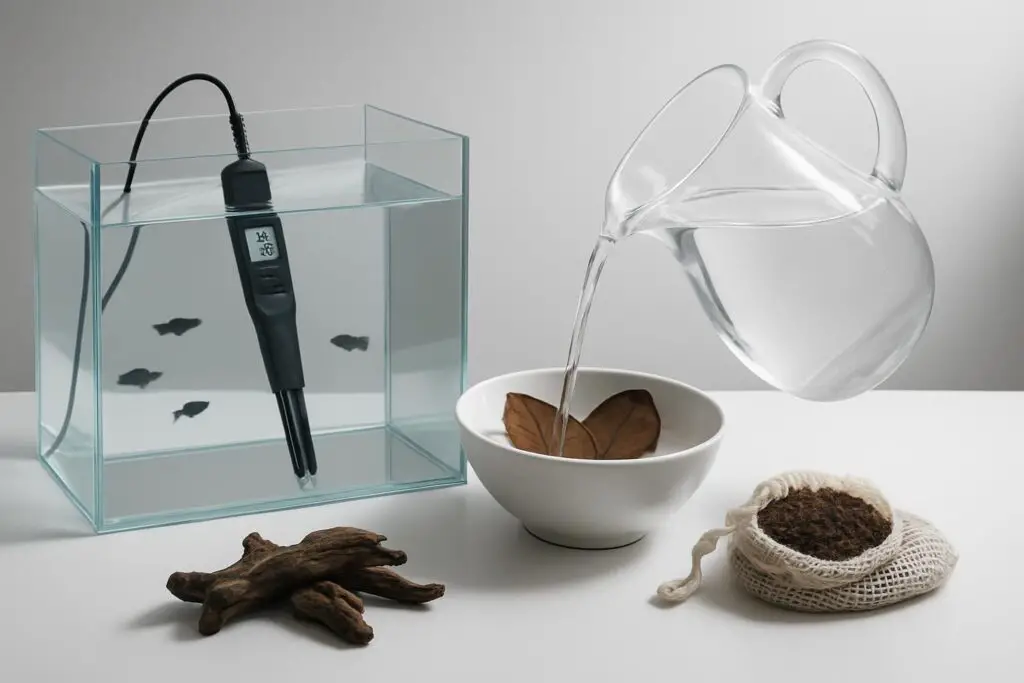
Indian almond leaves, peat granules, and driftwood release weak acids and tannins. These can nudge pH down and add humic substances that some fish prefer. Rinse the materials first. Start with a small dose such as one medium almond leaf per 10 to 15 gallons, or the lowest label dose for peat in a media bag. Expect amber water color. This is normal and safe.
Indian almond leaves and driftwood add tannins that can lower pH. Their effect is limited when KH is high; they work better after KH is reduced.
4. Use CO2 injection in planted tanks
CO2 lowers pH while it runs. Keep injection steady on a timer, and keep surface agitation moderate. Large day-night swings are stressful. If you run CO2, aim for a consistent CO2 level with a drop checker or pH-KH chart, and increase aeration when lights are off if fish show stress.
5. Consider commercial acid buffers with care
Acid buffers can work if KH is already moderate or low. Dose slowly, measure after 24 hours, and never mix different brands or opposing buffers. Your goal is to set KH first with RO blending, then use mild acid buffers only for fine adjustments if needed.
6. Pre-condition change water in a separate container
Treat tap water with dechlorinator, blend with RO, add tannins or buffer if needed, aerate for several hours, and confirm pH and KH before it goes into the tank. This prevents large swings in the aquarium.
How Fast to Lower and How to Monitor
Daily limit and schedule
No more than 0.2 to 0.3 pH units in 24 hours, with steady temperature and good aeration. This limit gives fish time to adjust their internal chemistry. Slower is safer, especially for sensitive species.
Track KH closely
If KH falls below 2 dKH, pH can crash with small inputs of acids from feeding or decay. In very soft setups, do smaller water changes more often and test KH weekly.
Keep a simple log
Write down date, pH, KH, blend ratio, and any additives. Patterns appear within weeks, and you will reach a stable routine faster.
Troubleshooting Common Scenarios
pH bounces back up after water changes
Your source water likely has high KH. Remove alkaline decor and switch to partial RO or distilled water blends for water changes until the tank KH and pH hold steady.
Large day-night pH swings
Plants take in CO2 by day and release it at night. This moves pH. Reduce swings by keeping CO2 injection stable in planted tanks and by maintaining moderate surface agitation. In non-CO2 tanks, stronger surface agitation at night helps stabilize CO2 and pH.
Fish show stress after a change
If fish gasp or clamp fins after a pH adjustment, increase aeration right away and do a small water change with water that matches the previous pH and temperature. Pause further changes for several days and retest ammonia and nitrite.
I keep high pH fish
African cichlids, some livebearers, and some brackish species want high pH and high KH. Do not lower pH in these tanks. Focus on stability and mineral support instead.
Very high pH well water
Pre-condition in a storage barrel. Blend with RO, add tannins if desired, aerate, and test until the blend is stable before it enters the aquarium. Avoid direct acid dosing in the display tank.
Products to Avoid or Use Carefully
Household acids
Do not pour vinegar, lemon juice, or other kitchen acids into the tank. No. Household acids are unpredictable, unbuffered, and can harm fish and biofilter.
Quick fix pH down bottles
These can cause a fast drop and then a rebound when the buffer fights back. Repeated dosing leads to pH swings. Use them only if KH is already controlled and you can measure the effect over 24 hours.
Strong acids for source water
Hydrochloric or phosphoric acid can be used by advanced keepers on storage water with protective gear and exact testing. This is not a beginner method and is unnecessary if you have access to RO or distilled water. If you try it later, never add strong acids to the display tank.
Putting It All Together: A Simple Plan
Step 1. Test and log
Measure pH and KH of tank and source water. Record results. Fix any ammonia or nitrite first.
Step 2. Remove what pushes pH up
Take out coral, shells, aragonite, and limestone. Replace with inert materials.
Step 3. Start RO or distilled blends
Begin with a 20 to 30 percent water change using a 25 percent RO blend. Re-test after 24 hours. Adjust RO ratio at the next change as needed to approach your KH target.
Step 4. Add tannins if desired
Use almond leaves, peat, or driftwood for gentle downward pressure, especially once KH is moderate. Expect amber tint and enjoy the added benefits for softwater species.
Step 5. Fine-tune and hold
Once KH sits where you want it, let the tank settle. If you still need a tiny push down, consider a mild acid buffer according to label, testing after 24 hours. Keep changes slow.
Step 6. Maintain
Use the same blend ratio at each water change. Match temperature, keep aeration steady, and log values weekly. Adjust seasonally if your tap water shifts.
Extra Tips for a Smooth Process
Pre-treat change water
Dechlorinate, blend, aerate, and test pH and KH in a bin before it enters the tank. This prevents surprises and fish stress.
Mind the biofilter
Beneficial bacteria work across a wide pH range but can slow down with fast shifts. Keep the filter clean and oxygenated during the process. Do not overdose with chemicals that could burn the colony.
Feed and stock wisely
Overfeeding raises waste and consumes oxygen. Stable stocking and careful feeding help you avoid compounding stress during pH adjustments.
What Success Looks Like
Your log shows pH moving down by small, controlled steps. KH reaches the target range and holds steady between water changes. Fish eat, breathe, and swim normally. You can predict how a given RO blend will set your next change. When you can predict the outcome, you have control.
Conclusion
Lowering pH safely is not about chasing a number every day. It is about managing KH, making small changes, and verifying results 24 hours later. Remove alkaline sources, blend RO or distilled water to bring KH into range, then use tannins or gentle buffers for fine-tuning. Keep adjustments slow. Keep oxygen high. Track your results. With this approach, high pH becomes a simple parameter you guide rather than fight.
FAQ
Q: How fast can I safely lower pH in my aquarium?
A: No more than 0.2 to 0.3 pH units in 24 hours, with steady temperature and good aeration.
Q: What is the most reliable way to keep pH lower long term?
A: The most reliable way to keep pH lower long term is to reduce KH by diluting with RO or distilled water during water changes, then maintain a stable KH around 3 to 6 dKH.
Q: Will Indian almond leaves or driftwood lower pH if my KH is high?
A: Their effect is limited when KH is high; they work better after KH is reduced.
Q: Should I use household vinegar or lemon juice to lower pH?
A: No. Household acids are unpredictable, unbuffered, and can harm fish and biofilter.
Q: My pH jumps back up after every water change. What should I do?
A: Your source water likely has high KH. Remove alkaline decor and switch to partial RO or distilled water blends for water changes until the tank KH and pH hold steady.