
We are reader supported. When you purchase through links on our site, we may earn an affiliate commission. Also, as an Amazon affiliate, we earn from qualifying purchases.
Nitrate creeps up in almost every aquarium. It looks harmless on a test strip, yet it slowly stresses fish, weakens immunity, and fuels algae. The good news is you can control it with simple steps and a steady routine. This guide shows you how to reduce nitrate fast, prevent it from returning, and keep your fish thriving.
Why Nitrate Matters
The Nitrogen Cycle in Plain Terms
Fish release waste. Uneaten food and plant debris break down. This produces ammonia, which is highly toxic. Beneficial bacteria convert ammonia to nitrite, which is also toxic, and then to nitrate, which is much less toxic but not harmless. Nitrate builds up over time and must be removed or consumed.
Think of nitrate as the endpoint of the cycle. If it accumulates, the system is out of balance. Lowering nitrate means you are managing the entire cycle better.
Safe Nitrate Levels by Aquarium Type
Targets vary by setup. Use these as general guides:
Freshwater community fish: keep nitrate under 20 to 40 ppm, aim for 10 to 20 ppm.
Sensitive freshwater species and breeding tanks: aim under 10 ppm.
Fish-only marine tanks: keep under 20 to 40 ppm, lower is better.
Reef tanks with corals: aim 1 to 10 ppm, adjust based on coral type and nutrient balance.
Planted tanks: plants use nitrate, so aim 5 to 20 ppm to avoid deficiencies.
Symptoms of High Nitrate
Lethargic fish, loss of appetite, color fading, clamped fins, rapid gill movement, frequent surface breathing, or fish hanging near filter outlets. Algae blooms often appear. Long term, fish become more prone to disease and have shorter lifespans.
Test and Track Your Nitrate
Choosing a Test Kit
Use a reliable liquid test kit for nitrate. Strips are fast but less precise. Liquid kits let you track trends. Check expiration dates and store reagents in a cool, dark place.
How and When to Test
Test nitrate weekly in established tanks. Test every 2 to 3 days in new tanks or when troubleshooting. Test at the same time of day for consistent readings. Follow kit steps carefully and shake reagents well. Record results in a log with date, nitrate, ammonia, nitrite, pH, and any changes you made.
Interpreting Results
If nitrate is over your target range, plan immediate water changes and adjust feeding and maintenance. If nitrate climbs each week, you need more export or less input. If nitrate is near zero in a reef and corals look pale, you may need to increase nutrients slightly. For planted tanks, very low nitrate can stall growth and cause yellowing leaves.
Quick Actions to Lower Nitrate
Smart Water Changes
Water changes dilute nitrate directly. The larger the change, the bigger the drop. A 50 percent change cuts nitrate roughly in half. If nitrate is very high, do several moderate changes rather than one massive change to avoid shocking fish.
For example, three 30 to 40 percent changes spaced 24 hours apart can bring nitrate down safely. Match temperature and dechlorinate the new water. Vacuum the substrate during the first change to remove trapped waste.
Emergency Response Plan
When fish show stress from high nitrate, act steadily but not recklessly:
1. Add an airstone to increase oxygen.
2. Do a 25 to 40 percent water change now.
3. Test nitrate again after an hour. If still high, do another 20 to 30 percent change later the same day.
4. Stop feeding for 24 hours, then resume very lightly.
5. Remove decaying leaves, dead fish or snails, and excess detritus.
Add Aeration and Flow
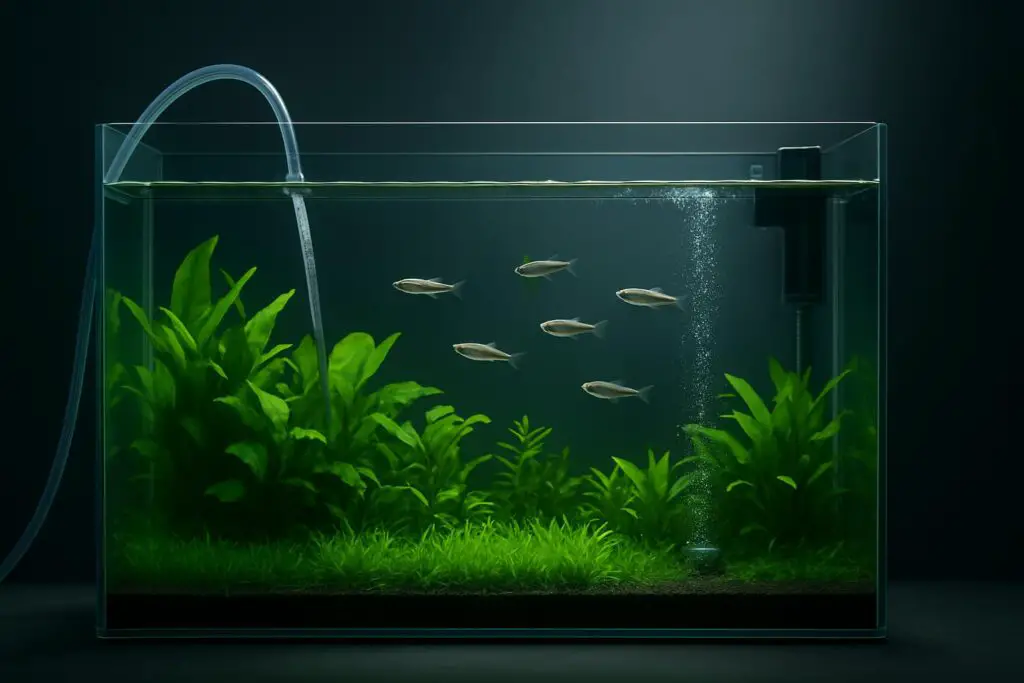
Nitrifying bacteria need oxygen. Strong aeration and good circulation help your filter bacteria process waste efficiently and prevent dead spots where debris accumulates. Use a powerhead or adjust filter output to circulate water through all areas of the tank.
Long-term Fixes That Keep Nitrate Down
Feed Less, Feed Better
Most tanks are overfed. Feed only what fish finish in about 30 seconds for small fish or 2 to 3 minutes for larger fish, once or twice a day. Skip one day per week for adult fish to let the system clear.
Rinse frozen foods in a net to remove nutrient-rich thaw water. Use high quality pellets that hold shape and produce less dust. Feed in small portions and observe fish to ensure food is eaten, not sinking into the substrate.
Reduce Bioload and Stock Smart
Too many fish means too much nitrate. Rehome extras, choose smaller species, and avoid mixing multiple messy species in one tank. Plan stocking based on adult size, behavior, and waste output, not just current size.
Provide adequate tank volume and filtration. Aim for filter turnover of 5 to 10 times the tank volume per hour for most setups. Heavy stock or messy fish may need more.
Improve Filtration and Maintenance
Keep mechanical filtration efficient. Rinse prefilter sponges or floss weekly in old tank water, not tap water, to preserve bacteria. Replace floss before it clogs. Clean impellers and intake strainers monthly to maintain flow.
Do not overclean bio media. Swish gently in tank water only when flow is restricted. Never bleach or wash bio media under chlorinated tap water.
For marine tanks, use an effective protein skimmer to export organics before they become nitrate. Empty and clean the cup regularly and keep the skimmer tuned.
Clean the Substrate the Right Way
Waste trapped in gravel becomes nitrate. Use a gravel vacuum during water changes. In regular tanks, clean about one third to one half of the substrate each week to avoid disturbing too much at once. In tanks with sand, lightly hover the siphon above the surface to lift debris without removing sand.
In planted tanks, avoid deep vacuuming around rooted plants. Clean open areas and surface debris, and manually remove dead leaves. Healthy plants are your best defense against nitrate.
Use Better Source Water
Tap water can contain nitrate. Test your tap. If it reads above 5 to 10 ppm, consider reverse osmosis or deionized water. For freshwater, remineralize RO or DI water with a balanced mineral mix. For marine, always use RO or DI and a quality salt mix.
Store water in clean containers, circulate with a pump, and heat to match tank temperature before water changes.
Biological Nitrate Control
Live Plants for Freshwater
Fast-growing plants are powerful nitrate sinks. Good options include hornwort, water sprite, anacharis, hygrophila, wisteria, and floating plants like frogbit or salvinia. Even pothos can be used with roots in the water and leaves above the tank.
Give plants adequate light and basic nutrients. If plants starve, they melt and add to waste. Dose potassium, traces, and phosphorus as needed. Keep nitrate in the 5 to 20 ppm range so plants have fuel to grow. Trim regularly to remove stored nutrients.
Refugiums and Macroalgae for Marine
A refugium with chaetomorpha or caulerpa absorbs nitrate and phosphate. Light the refugium on a reverse schedule to help stabilize pH. Harvest macroalgae weekly to export nutrients. Keep flow steady and remove detritus from the refugium.
An algae scrubber is another option. It grows algae on a screen under controlled light, which you harvest to remove nutrients from the system.
Deep Media and Denitrification Options
Some systems use deep sand beds, porous rock, or specialized media to host anaerobic bacteria that convert nitrate to nitrogen gas. This requires stable flow and care to avoid clogging. For most beginners, focus on plants or macroalgae first. Advanced denitrators, such as sulfur or coil units, can work but need careful tuning and monitoring.
Chemical and Specialized Tools
Nitrate-removing Media
Resins and media can reduce nitrate as a supplement to good husbandry. Options include specific nitrate resins and general organic removers. Place media in a high flow area and follow replacement or regeneration guidance. Use these to help, not to replace water changes and feeding control.
Carbon Dosing and Advanced Methods
Experienced reef keepers sometimes add a carbon source such as vinegar to feed bacteria that consume nitrate and phosphate. This can work but risks bacterial blooms and oxygen depletion if overdosed. Use only if you understand the method and have strong aeration, stable skimming, and frequent testing. Not recommended for beginners.
Protein Skimmers and Mechanical Export
In marine systems, a properly sized skimmer removes dissolved organics before they convert to nitrate. Pair it with filter socks or rollers to trap particles. Clean socks every few days. In freshwater, skimmers are not effective, but good mechanical filtration and frequent floss changes accomplish the same goal.
Special Scenarios
New Tanks and Cycling
New tanks go through a cycle. Ammonia rises, then nitrite, then nitrate. Once ammonia and nitrite read zero and nitrate rises, the tank is cycled. Nitrate will continue to increase until you remove it. For fish-in cycling, do frequent water changes to keep all toxic compounds low and feed very lightly. Add only a few hardy fish initially and expand slowly.
Planted Tanks That Dose Nitrate
In high tech planted tanks, hobbyists dose nitrate to feed plants. This is normal. The aim is balance. If algae grows or nitrate rises above target, reduce dosing or increase plant mass and maintenance. Strong plant growth will hold nitrate steady or lower over time.
Goldfish, Cichlids, and Messy Fish
Goldfish and many cichlids produce heavy waste. Use larger tanks, high turnover filtration, frequent vacuuming, and bigger weekly water changes. Offer varied but controlled feeding. Consider dual filtration, such as a canister plus a sponge filter, to capture fine debris and maintain robust biofiltration.
When Tap Water Is the Problem
If your tap water contains nitrate above your target, you cannot solve the issue with water changes alone. Switch to RO or DI water, or buy distilled for small tanks. For larger systems, invest in an RO or DI unit. This gives you control over nitrate, hardness, and other contaminants.
Example Weekly Routine That Works
Use this as a starting point and adjust based on your test results and stocking.
Daily
1. Observe fish for normal behavior and appetite.
2. Feed sparingly and only what is eaten quickly.
3. Check temperature and filter flow.
Weekly
1. Test nitrate, ammonia, nitrite, and pH. Record results.
2. Perform a 30 to 50 percent water change. Larger for heavy stock, smaller for light stock.
3. Vacuum one third to one half of the substrate.
4. Rinse prefilter sponges or floss in old tank water. Replace floss if saturated.
5. Trim plants and remove dead leaves.
6. Wipe glass and clean intakes and surface film.
Monthly
1. Deep clean canister or internal filter housing. Preserve bio media by rinsing gently in tank water.
2. Check impellers and hoses for buildup. Restore full flow.
3. Review your log. If nitrate trends upward, expand water changes or reduce feeding.
How Much Water to Change
Each water change reduces nitrate by the percentage of water you remove. If nitrate is 80 ppm and you change 50 percent, it drops to about 40 ppm. Do another 50 percent change later and it drops to about 20 ppm. Use repeated moderate changes to reach your target safely.
If your tank often climbs above target between weekly changes, increase either the percentage changed each week or the frequency. Two smaller changes per week can stabilize a busy tank.
Common Mistakes to Avoid
Overfeeding and Heavy Hands
Extra food becomes nitrate. Cut portions. Feed variety, not volume. Remove leftover food after a few minutes.
Cleaning Bio Media With Tap Water
Chlorine and chloramine kill beneficial bacteria. Always rinse bio media in old tank water. Use water conditioner for the tank and for any rinse if tap water touches anything.
Skipping Mechanical Maintenance
Clogged floss and sponges trap waste that rots into nitrate. Rinse or replace regularly to export physical waste from the system.
Relying on Chemicals Alone
Nitrate removing resins help but cannot replace good husbandry. If nitrate returns quickly after using media, look at feeding, stocking, and maintenance first.
Sudden Massive Changes
Large single changes can shock fish if parameters shift too quickly. When reducing very high nitrate, use several moderate changes over a day or two, matching temperature and conditioning water carefully.
Troubleshooting Checklist
Use this list to find why nitrate is high and fix it fast.
1. Test nitrate before and after water changes. Is your change percentage enough
2. Test tap water for nitrate. Do you need RO or DI
3. Review feeding. Can you cut portions by 20 to 50 percent
4. Check stock levels. Is bioload too high for your tank and filter
5. Inspect filter flow. Is it reduced Do impellers or hoses need cleaning
6. Rinse mechanical media weekly and replace floss often.
7. Vacuum substrate consistently. Are there debris pockets
8. Add or improve plants or macroalgae. Is there enough fast-growing biomass
9. Increase aeration and circulation to support bacteria and prevent dead spots.
10. Consider nitrate-specific media as a helper while you fix root causes.
Practical Tips That Make a Difference
Pre-rinse new filter media to remove dust that can trap waste. Use a feeding ring to keep food out of filter intakes. Angle spray bars or returns to move water across the bottom. In marine systems, clean skimmer necks every few days for steady performance. In planted tanks, stable CO2 and fertilization reduce plant melt and nutrient spikes. Keep a simple log with dates, test results, water change volumes, and notes. Patterns become obvious within a month.
Setting Targets and Holding Them
Pick nitrate targets that suit your tank type and stock. Write them down. Base your routine on hitting those numbers. If you are always above target, increase export. If always below and plants suffer or corals pale, increase input carefully. Test weekly at a minimum and after any major change to your routine.
Conclusion
Nitrate control is not about one trick. It is a system of small, consistent actions. Test regularly. Feed carefully. Remove waste before it breaks down. Use plants or macroalgae to consume what remains. Choose source water you can trust. Maintain strong, clean flow and a healthy biofilter. When numbers rise, respond with steady water changes and better habits, not panic.
With a clear plan and a simple weekly routine, nitrate stays in range, fish stay healthy, and your aquarium becomes easier to enjoy. Start with testing and a right-sized water change today. Adjust feeding and maintenance this week. Add biological helpers over the next month. Hold your targets, watch the trend line flatten, and enjoy a stable, vibrant tank.