
We are reader supported. When you purchase through links on our site, we may earn an affiliate commission. Also, as an Amazon affiliate, we earn from qualifying purchases.
Dropsy scares new and experienced aquarists because it looks dramatic and often appears fast. The good news is that you can catch it early, act with a clear plan, and prevent it in the future. This guide explains what dropsy is, how to identify it with confidence, what to do in the first hour, how to treat it day by day, and how to protect your tank from repeat cases. The language is simple, the steps are direct, and every action has a reason behind it.
What Dropsy Really Is
Dropsy is not a single disease. It is a syndrome where fluid builds up inside the fish due to failed osmoregulation, most often linked to a systemic bacterial infection that stresses the kidneys and other organs. The hallmark is abdominal swelling with scales that stick out, often called pineconing. Without treatment, the internal pressure and organ damage can become fatal.
The bacteria involved are usually opportunistic gram-negative species that are already present in many aquariums. They take hold when the fish is weakened by stress. This is why two fish can live in the same tank and only one gets sick. You fight the infection, but you also fix the stressors that opened the door in the first place.
Common Triggers You Can Control
Most dropsy cases connect back to a handful of stressors. Poor water quality is the major one. Ammonia or nitrite above zero, or nitrate that creeps high over time, pushes the fish’s organs hard. Rapid temperature swings lower immune response. Overcrowding and bullying increase stress and injuries. A monotonous or low-quality diet weakens the gut and immune system. Rough handling during netting or transport adds to risk. Fix these and you remove the fuel that drives dropsy.
How to Identify Dropsy Early
Subtle Signs Before Pineconing
Catch it before it looks obvious. Watch for a fish that eats less or stops eating, hides more, clumps its fins, or breathes faster than normal. Look for a slightly rounded belly that was not present before. Pay attention to whitish or stringy feces. None of these alone confirm dropsy, but together they raise suspicion, especially if your water test strips or liquid tests also show a problem.
Clear Signs You Should Not Ignore
Abdominal swelling that seems taut, not soft, is a warning. Pineconing, where scales lift outward, is the classic sign and usually confirms internal fluid buildup. Eyes may protrude. The fish may hover and struggle to maintain position. At this stage, you must move fast.
Do Not Confuse It With Other Conditions
If the belly is big but scales lie flat, consider constipation, a heavy meal, egg carrying, or egg binding in females. Constipation usually improves with a fasting day and cleaner water, and the fish often remains active. Egg carrying does not cause pineconing. Pineconing is the key difference that points toward dropsy.
Immediate Actions When You Suspect Dropsy
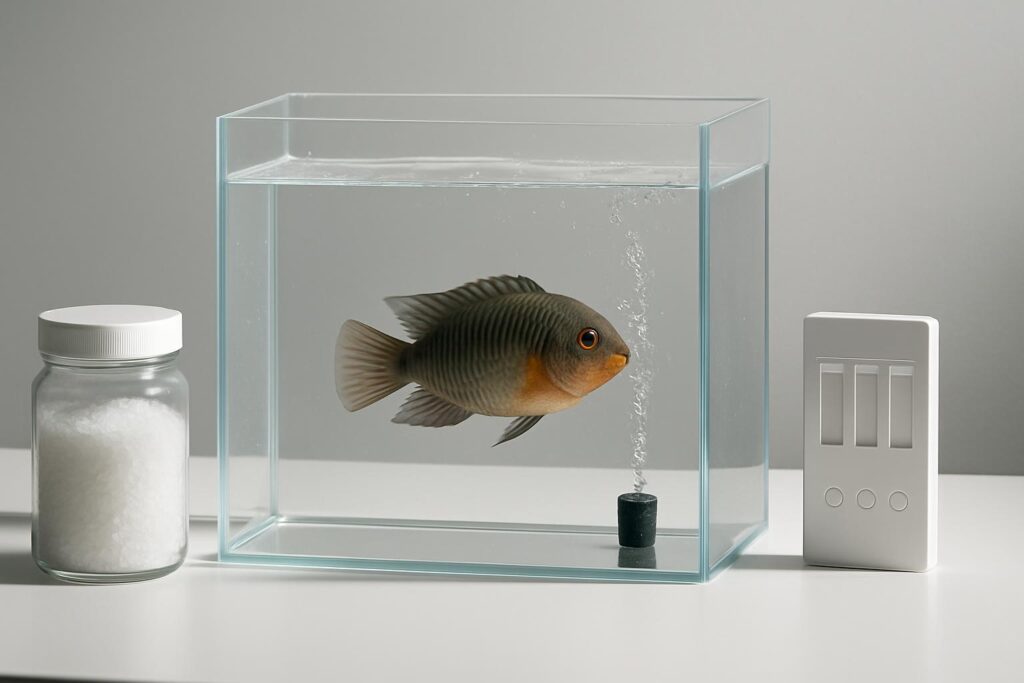
Step one is isolation. Move the fish to a small hospital tank with a heater, filter, and strong aeration. This lowers stress, protects tankmates, and lets you dose medications accurately.
Step two is test every key parameter. Ammonia should be zero. Nitrite should be zero. Nitrate should be kept low. Confirm temperature and pH are stable and appropriate for the species.
Step three is stabilize the main tank. Do a partial water change of 25 to 50 percent, vacuum debris gently, and maintain normal filtration. Do not overclean your filter media. Rinse it only in tank water to protect beneficial bacteria.
Step four is reduce stress. Keep lights dim. Avoid chasing the fish. Increase surface agitation with an airstone to ensure high oxygen levels, because warm water and medication reduce dissolved oxygen.
Step five is consider an Epsom salt bath. Epsom salt is magnesium sulfate. It can draw fluid out osmotically and reduce swelling. Prepare a separate container with clean, dechlorinated water matched to the hospital tank temperature. Dose 1 teaspoon of Epsom salt per gallon. Bathe the fish for 10 to 15 minutes while observing constantly. If the fish shows distress, end the bath early. After the bath, return the fish to the hospital tank. Epsom salt can also be used at low levels in the hospital tank at 1 teaspoon per 5 gallons, but avoid doing both a bath and an in-tank dose on the same day for sensitive species such as scaleless fish.
Core Treatment Plan That Works
You need two things: supportive care and a targeted antibiotic course. Supportive care helps the fish survive long enough for the medication to work. The antibiotic fights the underlying infection.
Supportive Care Basics
Keep temperature stable and appropriate for the species. For many tropical fish, the range around 24 to 26 degrees Celsius is reasonable. Goldfish prefer cooler water and should stay within their normal range. Do not chase numbers. Avoid sudden moves. Stability matters more than a specific number within a safe range.
Maximize oxygen. Run an airstone. Aim your filter return to ripple the surface. As temperature rises and medications enter the water, oxygen availability drops. High oxygen buys you time.
Keep the hospital tank clean. Change 25 to 50 percent of the water before each redose of medication if the product label calls for it. Siphon uneaten food. Remove waste daily.
Antibiotic Use With Intention
Use a broad-spectrum antibiotic labeled for gram-negative internal infections. Options include kanamycin or nitrofurazone among others. Follow the product label for dose and frequency. Treat in the hospital tank only. Remove carbon from the filter so it does not absorb the medication. Aerate strongly. Complete the full course, typically 7 to 10 days. Do not mix multiple medications unless the label instructs it. Partial treatment encourages relapse.
If the Fish Is Still Eating
Feeding medicated food can deliver the antibiotic directly to the gut. Use a medicated food or follow the product’s directions for binding antibiotics to food. Offer small, frequent meals. Do not overfeed. If the fish refuses food, switch to waterborne dosing only and focus on supportive care.
Using Epsom Salt During Treatment
Continue short Epsom salt baths once per day for the first two to three days if the fish tolerates them. Keep the bath concentration at 1 teaspoon per gallon for 10 to 15 minutes with close observation. In the hospital tank, you can maintain 1 teaspoon per 5 gallons of Epsom salt to support osmoregulation, unless the fish is known to be sensitive. Do not use aquarium salt as a substitute for Epsom salt for fluid reduction, since they have different roles.
A Practical 10-Day Schedule
Day 1
Isolate the fish. Test water. Correct water quality in both hospital and main tank. Provide strong aeration. Give one Epsom salt bath. Start the chosen antibiotic in the hospital tank per label.
Day 2 to Day 3
Monitor behavior, appetite, and swelling. Continue daily Epsom salt baths if tolerated. Redose the antibiotic as directed. Keep lights low. Keep water clean. If the fish begins to eat, introduce medicated food in small amounts.
Day 4 to Day 7
Look for stabilization or small improvement. Continue the antibiotic. Maintain hospital tank cleanliness. Do not stop early. If swelling worsens and the fish stops responding, review temperature, oxygen level, and the accuracy of your dosing.
Day 8 to Day 10
Finish the course. If the fish shows steady improvement, plan a gradual return to the main tank after an observation period. If there is no improvement or the fish declines further, the prognosis is poor. Consider welfare and next steps.
When the Prognosis Is Poor
Severe pineconing with no response after several days, inability to swim or feed, and clear distress are signs of advanced organ failure. At this stage, recovery is unlikely. Focus on comfort and humane decisions. If euthanasia is necessary, follow a humane method such as clove oil sedation followed by overdose according to established guidelines. This prevents prolonged suffering.
Water Quality Targets During and After Treatment
Keep ammonia at zero. Keep nitrite at zero. Keep nitrate as low as you can through consistent maintenance. Do steady partial water changes, typically 25 to 50 percent, based on test results and bioload. Clean substrate to remove accumulating waste. Rinse sponges and media in removed tank water to preserve beneficial bacteria. Avoid aggressive filter sterilization during treatment.
Diet That Supports Recovery
Feed a high-quality, varied diet in small portions. Overfeeding worsens water quality and slows recovery. If constipation could be involved and the fish is still eating, a fasting day followed by easy-to-digest foods can help. After recovery, keep variety and portion control as permanent habits.
Preventing Future Dropsy
Quarantine New Fish
Quarantine new arrivals for 4 to 6 weeks. Watch appetite, behavior, and feces. This blocks many pathogens and prevents stress cascades in your display tank.
Test and Track
Use a reliable test kit. Log ammonia, nitrite, nitrate, and temperature weekly. Trends matter more than a single reading. Catch problems early and act before fish show symptoms.
Control Stocking and Aggression
Avoid overcrowding. Provide shelter and sight breaks. Match species that share water parameter needs and temperaments. A calm tank is a healthy tank.
Stability Over Perfection
Stable temperature and pH protect organs and immune function. Avoid large swings from rushed fixes. Make gradual changes.
Smart Maintenance
Do regular water changes, usually weekly. Vacuum debris. Service filters on a schedule. Keep hands and tools clean to avoid cross contamination between tanks.
Common Mistakes to Avoid
Do not treat the whole display tank unless you must. This risks your biofilter and stresses healthy fish. Use a hospital tank whenever possible. Do not stop antibiotics early when the fish looks better. Finish the course. Do not throw multiple medications together hoping for a shortcut. Pick the right tool and use it correctly. Do not ignore oxygen. Many failed treatments are really oxygen failures. Do not rely on salt alone. Epsom salt reduces swelling but does not cure infection by itself.
Species Notes and Sensitivities
Scaleless fish and some soft water species can be sensitive to salts and medications. Start at the low end of the dose range and watch closely. Goldfish and many livebearers tolerate salts better, but you should still observe and adjust based on behavior. Always match temperature to species norms and err on the side of stability.
How to Tell You Are Winning
Improvement often shows first as calmer behavior and slight appetite return. Breathing rate normalizes. The swollen belly may soften and slowly reduce. Scales begin to lie flatter. Feces normalize. Hold the course and do not rush the return to the main tank. Keep the fish under observation in the hospital tank for a few extra days after the last dose.
How to Return the Fish to the Main Tank
When symptoms resolve and the fish is active and eating, do a few days of observation without medication in clean water. Match temperature and pH between the hospital and display tanks to prevent shock. Net and transfer gently. Continue to test the display tank to keep stressors low. Watch the fish closely for a week for any relapse.
Supplies Checklist
Have these on hand before you need them. A small hospital tank with heater and filter. A reliable test kit for ammonia, nitrite, nitrate, and pH. An airstone and air pump. Epsom salt for baths. A broad-spectrum antibiotic labeled for gram-negative internal infections. Quality food for medicated feeding when possible. Dechlorinator. A logbook to track numbers and observations.
Introduction to Root Cause Thinking
Treatment is only half the job. Prevention is a daily habit that starts with measuring and ends with steady, appropriate care. When you see early signs, do not just treat. Ask why. Correcting the root cause protects every fish in the tank, not just the one that showed symptoms.
Conclusion
Dropsy is a serious syndrome, but it is understandable and manageable with a simple plan. Identify the signs early. Isolate the fish. Stabilize water and oxygen. Use Epsom salt support correctly. Run a complete antibiotic course in a hospital tank. Finish by removing the stressors that allowed the infection to take hold. This is how you save fish today and prevent cases tomorrow. Keep your approach calm, measured, and consistent. Your fish will reward you with visible recovery and long-term stability.
FAQ
Q: What is dropsy in aquarium fish
A: Dropsy is not a single disease. It is a syndrome where fluid builds up inside the fish due to failed osmoregulation, most often linked to a systemic bacterial infection. The hallmark signs are abdominal swelling and raised pineconing scales.
Q: How do I act fast when I first see dropsy signs
A: Isolate the fish in a hospital tank, test water, do a partial water change, increase aeration, keep lights dim, and give an Epsom salt bath at 1 teaspoon per gallon for 10 to 15 minutes while observing. Then start a broad-spectrum antibiotic in the hospital tank and complete the full 7 to 10 day course as directed.
Q: Which antibiotics are suitable for dropsy
A: Use a broad-spectrum antibiotic labeled for gram-negative internal infections, such as kanamycin or nitrofurazone, and follow the product label. Treat in a hospital tank, remove carbon from the filter, provide strong aeration, and complete the full course.
Q: How can I tell dropsy from constipation or pregnancy
A: If the belly is swollen but scales lie flat, consider constipation, a heavy meal, egg carrying, or egg binding. Pineconing is the key difference that points toward dropsy.
Q: Can a fish recover from dropsy
A: Early cases can recover with prompt isolation, water quality correction, Epsom salt support, and a full antibiotic course. Advanced pineconing with no response after several days has a poor prognosis, and you should consider welfare and humane decisions.