
We are reader supported. When you purchase through links on our site, we may earn an affiliate commission. Also, as an Amazon affiliate, we earn from qualifying purchases.
Testing your aquarium water is not busywork. It is the only way to see the invisible conditions that decide whether your fish thrive or struggle. Clear water can still be unsafe. Without regular tests you are guessing, and guessing costs fish, plants, corals, and time. This guide shows what to test, how often, how to fix problems, and how to build a simple routine you will keep.
If you are new, start simple. Learn the few numbers that matter most. Build a habit. Use your test results to guide small, steady actions. Stability wins every time.
Water quality is life support
Every fish breathes water the way we breathe air. When water quality slips, stress rises. Stress leads to disease, algae, and deaths. Regular testing gives early warnings before problems show on a fishs fins or a plants leaves.
The invisible nitrogen waste
Fish, food, and decay release ammonia. Beneficial bacteria convert ammonia to nitrite, then to nitrate. Ammonia and nitrite are highly toxic even at low levels. Nitrate is less toxic but still harmful when elevated. This three step process is the nitrogen cycle. In a new tank the cycle is not stable, so testing is essential.
Stability beats perfection
Exact numbers matter less than stable numbers within safe ranges. Fish adapt to stable pH and temperature better than they tolerate swings. Testing tracks trends so you can prevent swings.
What to test and why
Core tests for every aquarium
Ammonia. Should always read zero. Detects filter failure, overfeeding, new tank issues.
Nitrite. Should always read zero. Spikes during cycling and after disruptions.
Nitrate. Build up over time. Keep low with water changes and good maintenance.
pH. Affects fish health and the performance of the biofilter. Aim for stable values appropriate for your species.
KH (carbonate hardness). Measures buffering. Low KH allows pH swings. Healthy KH gives pH stability.
Temperature. Impacts oxygen levels, metabolism, and disease risk. Keep steady.
Chlorine and chloramine. Tap water often contains them. Both harm fish and bacteria. Use a dechlorinator and test if unsure.
Helpful extras for freshwater
GH (general hardness). Measures calcium and magnesium. Important for livebearers, snails, and shrimp shell health.
Phosphate. Fuels algae when high. Often comes from food and tap water.
TDS (total dissolved solids). A quick indicator of overall mineral load. Useful for shrimp and breeding projects.
Planted tank considerations
CO2. Supports plant growth. Too much harms fish. You can infer CO2 through pH and KH. Keep pH swings gentle if you inject CO2.
Saltwater and reef essentials
Salinity. Keep stable with top offs of fresh water to replace evaporation. Use a refractometer or a calibrated digital meter.
Alkalinity. Buffers pH and supports coral skeleton growth.
Calcium and magnesium. Key for coral and coralline algae. Keep in balance with alkalinity.
Nitrate and phosphate. Fuel algae and stress corals when high but should not be zero in mixed reefs.
Copper. Test only in quarantine if you are treating fish. Never run copper in a display with invertebrates.
Target ranges made simple
Freshwater community tanks
Ammonia 0 ppm. Nitrite 0 ppm. Nitrate under 20 to 40 ppm, lower is better. pH stable between 6.5 and 7.8. KH at least 3 to 6 dKH for pH stability. Temperature stable near the needs of your fish, often 24 to 26 C or 75 to 79 F.
Goldfish and high waste fish
Ammonia 0 ppm. Nitrite 0 ppm. Nitrate under 20 to 40 ppm with larger water changes due to heavy waste. pH stable near neutral to slightly alkaline. Strong aeration helps.
Shrimp and snails
Keep ammonia and nitrite at zero. Nitrate under 20 ppm. GH and KH matter for shells and molts. Avoid rapid changes. Stable is key.
Marine fish only
Ammonia 0 ppm. Nitrite 0 ppm. Nitrate kept moderate, often under 40 ppm. Salinity stable around 1.020 to 1.026 depending on species. Temperature near 24 to 26 C or 75 to 79 F.
Reef tanks
Ammonia 0 ppm. Nitrite 0 ppm. Nitrate low but not zero, often 2 to 20 ppm depending on coral mix. Phosphate low but detectable. Salinity about 1.025 to 1.026. Alkalinity, calcium, and magnesium stable in balanced ranges. Stability is the priority.
How often to test
New tanks that are cycling
Test ammonia and nitrite daily. Test nitrate every few days. The cycle is complete when ammonia and nitrite read zero for at least 7 consecutive days while you are adding a consistent ammonia source such as fish food or bottled ammonia. Only then is the biofilter ready for a full fish load.
Established freshwater tanks
Test ammonia, nitrite, and nitrate weekly at first. Once stable, you can test nitrate weekly and ammonia and nitrite every two weeks. Test pH and KH weekly until they prove stable, then monthly. Test chlorine and chloramine when changing water if you are unsure about your water source.
Planted tanks
Follow freshwater guidance plus add weekly pH checks if you inject CO2. Watch for pH swings at lights on and off. Aim for gentle, repeatable patterns.
Marine and reef
Test salinity several times per week until evaporation top off is dialed in, then at least weekly. Test alkalinity, calcium, and magnesium weekly in reefs, more often if dosing. Test nitrate and phosphate weekly. Test ammonia and nitrite anytime livestock is added or a filter is disturbed.
After any change or problem
Test daily for several days after adding many fish, after medication, after a filter clean, or after a power outage. Testing shows if the system remained stable.
How to test correctly
Choose the right tools
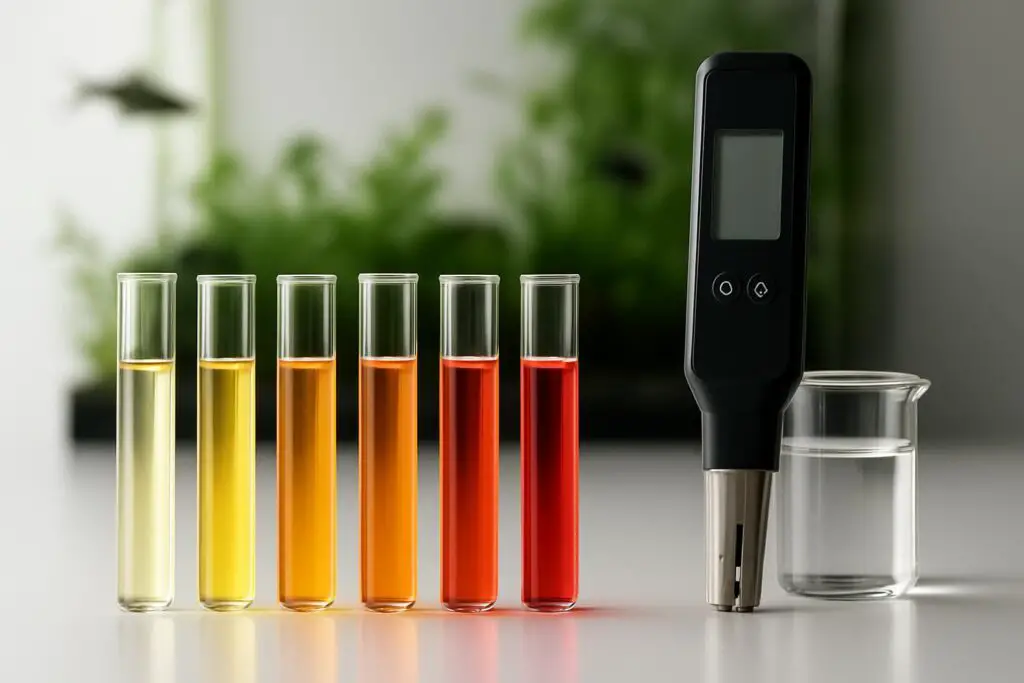
Liquid reagent kits are usually more accurate than strips for ammonia, nitrite, and nitrate. Strips are fine for quick screening and for pH and KH checks. Digital meters shine for pH, TDS, and salinity. Whatever you use, store reagents cool and dry, check expiration dates, and cross check with a second method if a result looks odd.
Sampling matters
Rinse test tubes with tank water before use. Take the sample from mid depth, away from the surface film and away from the filter outflow. Avoid touching the inside of caps or tubes. Cap tightly and mix as instructions say. Time the test reactions with a timer for consistency.
Read colors with care
Hold tubes against the color card in good natural light. Do not read under blue or colored lights. For liquid tests with strong colors, wait the full reaction time. If a color seems between two values, log the midpoint.
Keep a simple log
Write down date, parameters, and notes about feeding, cleaning, dosing, or fish behavior. Patterns jump out when you see a few weeks of data. Trend lines help you prevent problems before they start.
Fixing bad numbers
Ammonia or nitrite above safe levels
Act now if ammonia or nitrite rise above 0.25 ppm. Do an immediate 50 percent water change. Dose a water conditioner that detoxifies ammonia and nitrite if available. Stop feeding for 24 to 48 hours. Increase aeration. Add bottled nitrifying bacteria. Retest in 24 hours and repeat water changes until back to zero.
Nitrate creeping up
Increase the size or frequency of water changes. Siphon detritus from the substrate. Rinse mechanical filter media in removed tank water. Reduce overfeeding. Add more fast growing plants in freshwater or improve export methods in marine systems. Aim for consistent control rather than drastic swings.
pH swings and KH support
If pH is unstable, test KH. Low KH allows pH to bounce. Raise KH with a measured buffer or baking soda solution designed for aquariums. Make changes slowly across several days. Maintain regular partial water changes to keep minerals balanced. For most community freshwater tanks, a KH of 3 to 6 dKH holds pH steady. Some setups like African cichlids and reefs prefer higher KH.
Chlorine and chloramine
Always treat tap water with a conditioner that neutralizes chlorine and chloramine before it enters the tank. If you ever smell chlorine or see fish gasping after a water change, stop the flow and add conditioner immediately. Verify with a chlorine test if needed.
Salinity drift in marine tanks
Evaporation leaves salt behind and raises salinity. Replace evaporated water with fresh, not saltwater. Use an auto top off if possible. Adjust salinity slowly to avoid stress.
Temperature and oxygen
Warm water holds less oxygen. Spikes in temperature can trigger stress fast. Use a reliable heater and a thermometer you trust. Add aeration during hot days, after dosing medications, and during cycling. Test temperature at the same time of day for consistent readings.
Common myths and mistakes
Clear water does not mean safe water. Only tests reveal ammonia, nitrite, and nitrate.
New filters need time. A brand new filter or media has no bacteria. Test daily in new setups.
Do not chase perfect numbers. Stable, acceptable values are better than constant adjustments.
Do not overclean biological media. Rinse gently in removed tank water, never under chlorinated tap water.
Do not add many fish at once. The biofilter needs time to grow. Test more when you add stock.
Do not rely on one test once. Retest to confirm any surprising result before making big changes.
A simple weekly routine you can keep
Test nitrate, pH, and KH at the same time each week. Check temperature daily when you feed. Do a partial water change sized to keep nitrate in range. Siphon debris and rinse only the dirtiest mechanical media in removed water. Log your results and note any changes you made. This routine keeps most tanks stable.
When to test immediately
Fish are gasping, clamped, or hiding. Test ammonia, nitrite, and temperature now.
After a power outage or filter stall. Test ammonia and nitrite.
After a large feeding, a dead fish, or stirred substrate. Test ammonia and nitrite.
Before and after adding many new fish. Test ammonia, nitrite, and nitrate.
In marine tanks after topping off or mixing saltwater. Test salinity and temperature.
Why testing saves money and lives
Testing prevents losses by catching issues early. It guides your maintenance so you do not change too much or too little. It shows whether a product or method works. Over months, test data turn into a map of what your tank needs. That is how you avoid algae blooms, disease outbreaks, and frustrating mysteries.
Build confidence through data
New aquarists often feel unsure. The tank looks fine until suddenly it does not. Regular tests remove that uncertainty. Numbers tell you if the filter is coping, if your feeding is on point, and if your water changes are enough. With a few safe ranges and steady habits, you can keep fish and plants thriving for years.
Conclusion
Testing your aquarium water is not optional. It is the core skill that protects every living thing in your tank. Start with the core parameters, follow a simple schedule, and act on what the tests show. Keep your results stable and your actions measured. Your fish will be healthier, your maintenance will be easier, and your tank will become more predictable with every week of data.
FAQ
Q: How often should I test during cycling
A: Test ammonia and nitrite daily. Test nitrate every few days. The cycle is complete when ammonia and nitrite read zero for at least 7 consecutive days while you are adding a consistent ammonia source.
Q: What are the must test parameters for a beginner freshwater tank
A: Ammonia, nitrite, nitrate, pH, KH, temperature, and chlorine or chloramine.
Q: What should I do if ammonia or nitrite is above 0.25 ppm
A: Do an immediate 50 percent water change, dose a conditioner that detoxifies ammonia and nitrite if available, stop feeding for 24 to 48 hours, increase aeration, add bottled nitrifying bacteria, and retest in 24 hours.
Q: Why does my pH swing and how can I stop it
A: Low KH allows pH to bounce. Raise KH with a measured buffer, make changes slowly, keep regular partial water changes, and aim for a KH of 3 to 6 dKH for most community freshwater tanks.
Q: Should I use test strips or liquid kits
A: Use liquid kits for ammonia, nitrite, and nitrate accuracy. Strips are fine for quick screening and pH or KH checks. Digital meters are best for pH, TDS, and salinity. Store reagents well and check expiration dates.