
We are reader supported. When you purchase through links on our site, we may earn an affiliate commission. Also, as an Amazon affiliate, we earn from qualifying purchases.
High carbonate hardness can lock your aquarium pH, stress softwater fish, block nutrient uptake in plants, and make CO2 injection less effective. Lowering KH safely needs more than water changes. This guide walks you through advanced, reliable methods that work on any setup, with clear steps, calculations, and precautions. You will learn when to lower KH, how to set targets, which techniques suit your tank, and how to keep the gains stable.
What KH Actually Is
KH is the concentration of carbonate and bicarbonate ions in water. It is a buffer that resists downward pH changes by neutralizing acids. In aquariums, KH is often measured in dKH. One dKH equals 17.86 mg per liter as calcium carbonate. You can also express KH as meq per liter. Divide dKH by 2.8 to get meq per liter.
KH vs GH vs pH
GH measures calcium and magnesium and affects osmoregulation and shell growth. KH measures buffering capacity. pH measures acidity. KH influences pH stability but is not the same thing. You can have low GH and high KH, or the reverse. CO2 lowers pH without changing KH. Acid additions reduce KH by consuming alkalinity.
How KH Buffers Acids
Bicarbonate captures hydrogen ions and turns into carbonic acid, which releases CO2. This neutralizes acid and prevents sharp pH drops. If KH is very low, pH becomes unstable. If KH is very high, pH stays high and hard to adjust. Most systems do best in the middle.
When High KH Is a Problem
High KH is a problem if you keep softwater species, if you need to use pH-sensitive medications, if you run a high-tech planted tank that needs an acidic range for nutrient uptake, or if breeding triggers require soft, low-alkalinity water. If your tap water KH is above 6 to 8 dKH, you will likely need intervention for these goals.
Testing and Setting Targets
Do not change KH until you test accurately and define a clear target that matches your livestock and system.
Reliable Testing
Use a titration KH test kit. Count drops until the color shifts and divide by the sample volume per instructions. A pH probe helps observe stability but is not a KH tool. Calibrate pH probes monthly. Track TDS to see overall mineral trend. Confirm the KH of both tank water and source water.
Target KH by Setup
Softwater fish and breeding: 0.5 to 2 dKH. General community: 2 to 4 dKH. CO2 planted tanks: 2 to 4 dKH. African rift lake fish and livebearers are not candidates for lowering KH. Match KH to species before buying livestock.
Strategy Overview: Remove, Neutralize, Prevent
There are three main paths. Remove carbonate input by blending with low-KH water. Neutralize KH with controlled acid treatment outside the tank. Prevent rebound by eliminating carbonate sources and using materials that absorb or exchange alkalinity. Many systems use a combination for stable results.
Eliminate Carbonate Sources
Strip out limestone-based rock, shells, crushed coral, aragonite substrate, and calcareous décor if you need low KH. Replace with inert rock and sand. Check fertilizer lines and top-off water for hidden alkalinity. Test a rock by placing it in vinegar; bubbling suggests carbonates. This step reduces rebound.
Advanced Method 1: RO/DI Blending and Remineralization
Reverse osmosis and deionization remove KH almost completely. You blend RO/DI water with tap water or remineralize it to precise KH and GH. This is the cleanest way to control KH with minimal side effects.
Choosing RO/DI
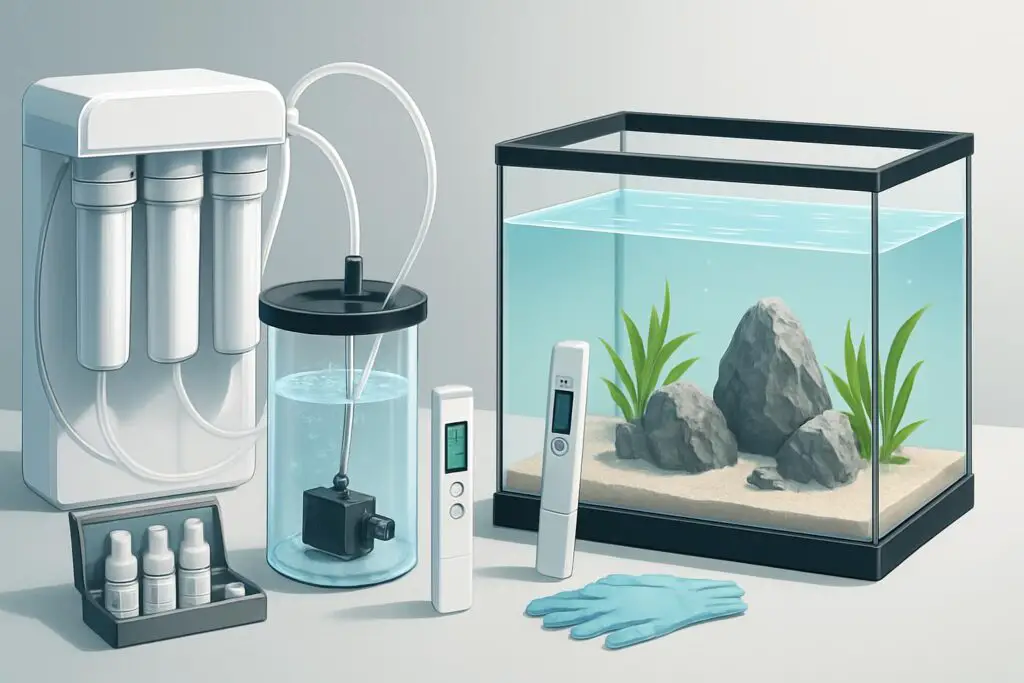
Pick a unit sized to your tank volume and change schedule. A typical 75 GPD system supports weekly changes on tanks up to 250 liters with ease. Add a DI stage if your local water has high TDS or silicates. Use a TDS meter to confirm near-zero output. Replace membranes and cartridges per pressure, rejection rate, and TDS readings.
Blending Calculations
If your tap water is 10 dKH and you want 3 dKH in the new water, blend 30 percent tap with 70 percent RO/DI. Multiply the tap ratio by tap KH to estimate blend KH. Always confirm with a KH test on the mixed water before adding to the tank. Adjust ratios until you hit the target. Keep a log so you can repeat the same blend.
Remineralizing Recipes
For softwater species, many aquarists raise GH while keeping KH near zero. Use a GH-only remineralizer that adds calcium and magnesium without carbonate. If you need some KH, dose potassium bicarbonate or a KH-only buffer to reach 1 to 3 dKH. Avoid heavy sodium dosing when possible, especially in planted tanks. Choose balanced GH products that target a Ca:Mg ratio around 3:1 to 4:1.
Implementation Steps
Produce RO/DI water into a food-grade container. Warm it to match the tank temperature. Add your remineralizer and mix well with a pump or airstone for 30 minutes. Test KH, GH, and TDS. Adjust if needed. Only then add it to the aquarium. For transitions, change 20 to 30 percent weekly and aim to move KH down by no more than 2 dKH per week unless fish are not yet present.
Advanced Method 2: Acid Neutralization in Pre-treated Water
Controlled acid dosing can consume alkalinity before the water enters the tank. This method is fast and cheap but demands precision and safety.
Chemistry and Safety
Acids react with bicarbonate to form CO2 and water while leaving a conjugate base. Strong acids like hydrochloric acid reduce KH and add chloride. The reaction releases CO2, which can drive pH low temporarily. Never add strong acid directly to a stocked aquarium. Handle acids with gloves, eye protection, and ventilation. Use acid only in a mixing container, then aerate well and test before use.
Dose Calculation
Convert KH from dKH to meq per liter by dividing by 2.8. Decide how much KH you want to remove. Multiply the KH to be removed in meq per liter by the volume in liters to get total meq to neutralize. Divide by acid normality to get liters of acid required. Hydrochloric acid at about 31 percent is roughly 10 mol per liter. For a 100 liter batch dropping from 8 dKH to 3 dKH, you must remove 5 dKH, which is 1.79 meq per liter. Multiply by 100 liters for 179 meq. Divide by 10 to get 0.0179 liters or 17.9 milliliters of acid. Always test the mixed water afterward to confirm the result.
Procedure
Fill a mixing barrel with tap water. Add a circulation pump. Measure the acid dose carefully with a chemical-resistant syringe. Add acid slowly to the mixing barrel while the pump runs. Let it mix and vent CO2 for at least one hour. Aerate strongly. Test KH and pH. If KH sits slightly above target, make a small additional dose and repeat mixing. Aim to underdose rather than overshoot. Once stable and at temperature, the water is ready for the aquarium.
Troubleshooting
If pH remains very low after dosing, aerate longer to off-gas CO2. If KH rebounds in the tank, remove carbonate sources and reduce tap water proportion. If fish show stress after a water change, your new water pH or temperature may be too different. Match both closely. Track chloride buildup if you use acid often and have very low water change rates, although normal water change schedules keep it in check.
Advanced Method 3: Peat Filtration and Organic Acids
Peat and humic materials can reduce KH by weak acid exchange and by binding minerals. They are gentle but slower and less predictable than RO/DI or strong acid. They also add tannins and a brown tint that many softwater fish prefer.
How Peat Works
Peat contains weak acids that donate hydrogen ions, consume bicarbonate, and trade cations on its surface. This gradually lowers KH and pH while releasing humic substances. The effect depends on the peat grade, water chemistry, and flow rate. It is stronger in very soft water and weaker in very hard water.
Sizing and Management
Use aquarium-grade peat in a mesh bag inside a canister filter or a separate reactor. Start with 1 to 3 grams of peat per liter of water. Rinse peat before use. Monitor KH and pH daily at first. Replace peat every 3 to 6 weeks or when its effect fades. Pre-treat new water in a separate bin if you want more control and less tint in the display tank.
Side Effects
Expect amber tint, lowered pH, and slight softening of GH. The tint is harmless and often beneficial. Do not mix peat with limestone décor. If you keep sensitive shrimp, ramp changes slowly. Keep a stable CO2 level in planted tanks because peat can increase pH swing potential if KH becomes very low.
Advanced Method 4: Ion Exchange Resins
Specialized resins can reduce alkalinity by exchanging carbonate species or by removing calcium and magnesium in a controlled way. They offer precision if set up correctly.
Types and Regeneration
Weak acid cation resins in the hydrogen form remove hardness and consume alkalinity as they pass water, generating carbonic acid that can off-gas as CO2. Mixed bed resins polish water to near zero ions and are used after RO membranes. Some resins are rechargeable with acid or salt solutions, but regeneration must be done safely and outside the home if possible. Always follow manufacturer instructions.
When to Use Resins
Resins suit advanced users who want inline control without storing large volumes of RO water, or for small aquariums where a mini reactor is practical. They are also useful for targeted treatment of top-off water in systems where evaporation raises alkalinity due to mineral deposits. Keep spare cartridges and monitor output KH with each batch.
Advanced Method 5: Active Substrates and Soils
Active plant substrates can adsorb carbonates and buffer pH downward, often holding KH near zero in the water column for months. They are effective for shrimp and softwater planted tanks.
Lifespan and Monitoring
The buffering capacity declines as the substrate saturates, typically over 6 to 18 months depending on water changes and source water KH. Pair active soil with RO/DI to extend its life. Test KH weekly the first month. Avoid mixing with calcareous sands or rocks that will neutralize its effect. Replace or top up the substrate when KH starts to rise steadily.
Biological Management of KH
Nitrification produces nitric acid, which consumes alkalinity over time. In tanks with heavy biofiltration, KH can drift down between water changes. Plants also remove bicarbonate directly in some conditions. While this can help, it is slow and not a primary tool for setting a target KH. Use it as a background effect and let your chosen method set the baseline.
System Design That Keeps KH Low
Design choices that avoid rebound will save time and reduce risk.
Use a Mixing Barrel
Always prepare low-KH water outside the aquarium. A dedicated barrel with a small pump, heater, and airstone gives stable, repeatable results. Label the container with your target KH, GH, and typical doses. Keep acids and remineralizers stored safely and clearly marked.
Manage Top-Off Water
Evaporation leaves minerals behind. Top off with RO/DI only. If you top off with tap water, KH will creep up. Check TDS weekly. If it rises even with RO/DI top-off, your substrate or décor may be adding minerals.
Common Mistakes and Myths
Avoid pitfalls that undo your effort or stress livestock.
Relying on Leaves and Driftwood to Lower KH
Catappa leaves, cones, and driftwood add tannins and can lower pH slightly, but they do not reliably reduce KH. Use them for fish health and aesthetics, not as your primary KH control.
Adding Acid Directly to the Tank
This can crash pH, flood the tank with CO2, and harm fish. Always pre-treat water. If you must make an in-tank correction during an emergency, move fish first. Do not mix strong acids and dechlorinators in the same container without understanding the reactions.
Chasing pH Instead of KH
Lowering pH with CO2 or weak acids without adjusting KH leads to rebound. Set KH first, then tune pH with CO2 or other methods if needed. Stability beats a specific number.
Using Baking Soda in Softwater Systems
Baking soda raises KH. It is useful when you need buffering, but it can sabotage a softwater plan. Keep it away from shrimp and blackwater projects unless you know exactly why you are adding it.
Worked Examples and Schedules
These examples show realistic paths you can follow and adjust.
Softwater Breeding Tank to 1 dKH
Goal: 60 liter tank for dwarf cichlids. Current tap water is 7 dKH. Target is 1 dKH and GH 3 to 4.
Approach: RO/DI blending with GH-only remineralizer and active soil.
Steps: Set up a 60 liter container for mixing. Produce RO/DI water. Add GH-only salt to reach 3 to 4 GH. Test KH to confirm near zero. Blend 10 percent tap with 90 percent RO/DI if you want exactly 1 dKH in the water change, or keep tap at 0 percent and rely on active soil and remineralizer. Perform three 25 percent water changes over two weeks. Test KH every other day. Remove calcareous décor. Keep top-off as RO/DI only. Maintain with weekly 20 percent RO/DI changes remineralized to GH 3 to 4 and KH 0 to 1. Replace soil sections every 12 months when KH creep appears.
CO2 Planted Tank to 3 dKH
Goal: 200 liter planted tank with CO2 injection. Tap water is 9 dKH. Target is 3 dKH and GH 5 to 7.
Approach: RO/DI blend and optional acid trim for precision.
Steps: Mix 35 percent tap with 65 percent RO/DI to approximate 3 dKH. Confirm with a KH test. If it reads 3.5 dKH, pre-treat the blend with a small dose of acid in the mixing barrel to shave 0.5 dKH. Aerate after dosing. Adjust CO2 for a pH drop of about one unit from degassed pH, now effective at lower KH. Perform weekly 30 percent changes. Keep a log of blend ratio, KH, GH, TDS, and pH. Recalibrate your pH probe monthly and verify CO2 stability to avoid fluctuations when KH drifts.
Practical Calculations You Will Use
Conversion: dKH divided by 2.8 equals meq per liter. Target blend: target KH divided by tap KH equals the fraction of tap in the mix. Acid neutralization: total meq to remove equals desired KH reduction in meq per liter times batch volume in liters. Acid volume equals total meq divided by acid normality. Always verify with tests after mixing because real water has additional buffers.
Smoothing the Transition for Livestock
Rapid drops in KH can cause pH instability and stress. Stage the change with multiple smaller water changes. Match temperature. Match TDS within a reasonable range, especially for shrimp. If you plan a large KH shift for a new biotope, make the change before adding fish. If fish are already in the tank, limit KH drop to about 1 to 2 dKH per week and watch behavior.
Long-Term Stability Plan
Consistency keeps your KH at the target without surprises.
Routine
Test KH weekly at first, then monthly once stable. Test after each new batch of mixed water. Keep KH notes with date, method, and measured results. Replace RO, DI, peat, and resins before they exhaust. Stick to the same remineralizer brand and dose until you have a reason to change. Recheck your tap water seasonally since municipal sources can shift.
Equipment Care
Service your RO membrane and cartridges on schedule. Replace DI resin when output TDS rises. Clean mixing barrels. Store acids in a cool ventilated area away from children and pets. Label everything. Rinse measuring tools after use.
Choosing the Right Method for Your Tank
If you want maximum control and clarity, use RO/DI plus remineralization. If you need a fast, affordable reduction for large water volumes and can handle safety protocols, pre-treat with controlled acid dosing. If you want a natural blackwater look and slow shift, use peat along with RO/DI. If space is tight and you need inline control, consider ion exchange resins. For shrimp and softwater aquascapes, an active substrate paired with RO/DI is ideal. In many cases, blend two methods for both precision and stability.
Frequently Asked Checks Before You Start
Confirm species needs and set a realistic KH target. Inspect the aquarium for calcareous materials and remove them. Decide your method and gather supplies. Prepare a mixing barrel and test kits. Plan a schedule for water changes and monitoring. Back up your system with extra dechlorinator, spare filters, and calibration solutions for pH meters.
Conclusion
Lowering high KH is about control and predictability. Define your target based on livestock. Choose a method that fits your budget, space, and comfort with chemistry. RO/DI blending with careful remineralization remains the gold standard. Pre-treated acid dosing is powerful when done with accurate calculations and strict safety. Peat, resins, and active substrates are useful tools that complement the main approach. Prepare water outside the tank, verify with tests, and make changes in steady steps. With a clear plan and routine, your aquarium will hold the KH you want, keep pH stable, and support healthy fish and plants over the long term.