
We are reader supported. When you purchase through links on our site, we may earn an affiliate commission. Also, as an Amazon affiliate, we earn from qualifying purchases.
Peat moss is a classic tool aquarists use to soften water, lower pH, and add natural tannins. It can unlock better colors, calmer behavior, and higher breeding success for softwater species. It can also create problems if used without a plan. This guide explains how peat moss works, when to use it, when to avoid it, and exactly how to apply it safely. If you want the benefits of blackwater conditions without guesswork, keep reading.
Introduction
Peat moss is partially decomposed plant material harvested from peat bogs. In aquariums, it conditions water by exchanging ions, releasing weak organic acids, and infusing tannins. The result is softer, more acidic water with a gentle amber tint. Many South American and Southeast Asian fish evolved in such conditions.
Despite its benefits, peat is not a magic fix. Its effects vary with your tap water, filtration, bioload, and product choice. It can darken the water more than you expected. It can also destabilize pH if used recklessly. New aquarists can succeed with peat, but need to approach it methodically. This article breaks down the pros and cons and gives a clear path to using peat with confidence.
What Peat Moss Does in Aquarium Water
Softening Through Ion Exchange
Peat has a high cation exchange capacity. It grabs calcium and magnesium ions from the water and releases hydrogen ions. This exchange reduces general hardness. As hardness drops, many softwater fish feel more at home and become more likely to breed. The exact softening strength depends on how much peat you use, how you contain it, and your starting hardness.
Lowering pH and Weak Acid Buffering
Peat leaches humic and fulvic acids. These are weak organic acids that gently lower pH. Unlike strong acid buffers, peat typically changes pH gradually when used correctly. However, if your carbonate hardness is low, peat can push pH down faster than you expect. The effect also diminishes over time as peat exhausts, so monitoring is essential.
Tannins and Humic Substances
Peat releases tannins that create a tea-colored tint. Tannins can chelate metals, bind some toxins, and have mild antimicrobial and antifungal effects. Many fish from blackwater habitats display richer colors, reduced stress, and more natural behavior in tannin-rich water. The tint also diffuses light and can calm skittish species.
Subtle Antimicrobial Support
Humic substances from peat can put gentle pressure on pathogens and fungus. This is not a replacement for quarantine or treatment when disease appears. It is a supportive effect that can improve resilience and egg survival, especially for sensitive species like wild-caught tetras and dwarf cichlids.
When Peat Moss Makes Sense
Species That Benefit
Peat is helpful for many South American and Southeast Asian fish that evolved in soft, acidic, tannin-rich water. Think of cardinal tetras, ember tetras, green neons, wild Betta species, Apistogramma, discus, wild angelfish, chocolate gouramis, and many rasboras. Softwater shrimp and some killifish also benefit.
Goals That Align With Peat Use
Use peat if your goal is to create naturalistic blackwater, encourage spawning of softwater species, reduce mild aggression, enrich color, and include humic substances without synthetic additives. Peat is not necessary for hardy community tanks, but it can still support health and coloration if used conservatively.
Tap Water Scenarios
If your tap water has moderate hardness and carbonate hardness, peat can make a useful difference. If your KH is very high, peat alone may not budge pH or GH in a meaningful way. In high KH regions, peat works best after diluting tap with RO or DI water. If your KH is very low, peat can drop pH quickly. In that case, use smaller amounts and pre-condition water outside the aquarium.
Pros of Using Peat Moss
Natural Softening Without Harsh Chemicals
Peat reduces hardness and lowers pH using natural ion exchange and weak acids. It does not add sodium or use abrupt chemical reactions. This makes it attractive for biotope-style setups and for breeders who want water chemistry that mimics nature.
Gentle pH Modulation
When carbonate hardness is moderate, peat typically nudges pH downward instead of causing sudden swings. For many fish, a gradual shift is safer and less stressful than rapid pH adjustments with acid solutions.
Humic Substances and Tannins
Peat adds more than acidity. It enriches water with humic substances that can act as mild antioxidants, bind heavy metals, and reduce pathogen load. Many keepers report calmer fish, better appetite, and improved color under tannin-rich conditions.
Blackwater Aesthetics
Peat naturally tints water from pale yellow to tea-brown depending on dose. This look suits driftwood, leaf litter, and root tangles. Some aquarists prefer crystal clarity, but for softwater biotopes the tint is part of the appeal and function.
Cost and Accessibility
Plain sphagnum peat moss is inexpensive and widely available in garden stores. A small bale can condition a lot of water. Careful selection is necessary to avoid additives, but the base material is affordable even for large tanks.
Cons and Limitations
Unpredictable Impact
Peat is not standardized. Different brands and bog sources vary in acidity and exchange capacity. The same mass can produce different results depending on your water chemistry, filter flow, and media arrangement. Trial and measurement are required.
Risk of pH Crash With Low KH
If carbonate hardness is low, peat can drop pH fast. Rapid pH changes stress fish and biofilters. This risk is highest when peat is placed directly in a high-flow filter on an aquarium with low KH and low buffering. Pre-conditioning water or adding peat gradually reduces this risk.
Water Tinting
Amber coloration is expected. Some aquarists dislike it or find it obscures viewing. Activated carbon removes tint but also strips humic substances, which defeats part of the purpose. There is a trade-off between clarity and blackwater authenticity.
Mess and Maintenance
Loose peat can shed fine particles that cloud the tank and clog sponges or impellers. This is avoidable with fine mesh bags and proper rinsing, but it adds steps. Peat also exhausts over time and needs replacement, usually every few weeks.
Measuring and Reproducibility
Because peat effects are gradual and variable, repeatable dosing is hard. You need to rely on pH, KH, GH, and TDS measurements, not assumptions. This is manageable with a consistent routine, but it demands discipline.
Environmental Sustainability
Peatlands are important carbon sinks. Harvesting peat releases stored carbon and disturbs habitats. If sustainability is a priority, consider alternatives or use peat sparingly. Some suppliers certify reduced-impact harvesting, but truly low-impact options are better in the long run.
Choosing the Right Peat Product
Sphagnum Peat vs Live Moss
Use sphagnum peat moss, not live sphagnum moss. Live moss is decorative but does not offer the same acidifying or softening performance. Peat is the decomposed material with high exchange capacity.
Avoid Additives
Choose products labeled as 100 percent sphagnum peat moss with no wetting agents, fertilizers, perlite, lime, or mold inhibitors. Wetting agents are common in gardening peat and can harm fish and invertebrates. If in doubt, contact the manufacturer or choose aquarium-branded peat granules.
Granules, Pellets, or Loose Bales
Aquarium-specific peat granules or pellets are cleaner and easier to contain in filter bags. Loose garden peat works but creates more dust and fines. Both can work if prepared well. For beginners, granules are simpler.
Rinse and Pre-Soak
Rinse peat in dechlorinated water to remove dust. Pre-soak for 24 hours to release initial tannins and saturate the material, then rinse again. This reduces floating bits and initial clouding. If you condition water outside the tank, a stronger pre-soak is useful to gauge its effect.
How to Use Peat Safely
In-Filter Method
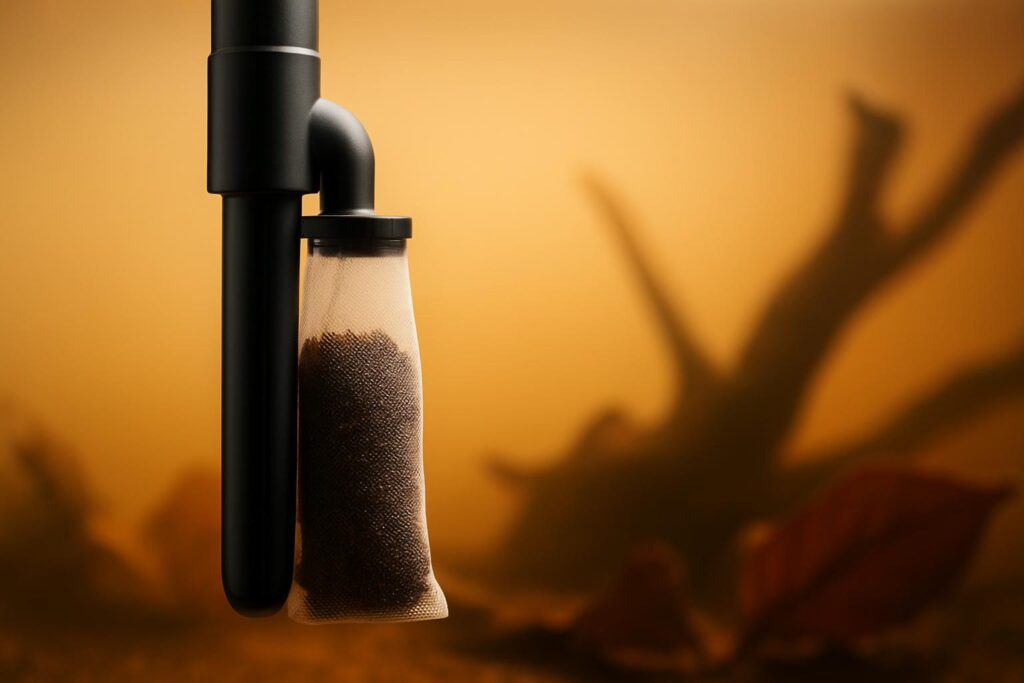
Place peat in a fine mesh bag. Add it to a canister or hang-on-back filter after mechanical media and before biological media, so fines do not clog the biofilter. Ensure water flows through the bag, not around it. Start with a small bag and scale up based on test results.
Peat Tea Method
Steep peat in dechlorinated water for 24 to 48 hours, then strain and add the extract gradually to the tank. This gives more control over tint and acidity. It does not soften as effectively as inline filtration unless you use a lot of peat and time, but it is gentle for small adjustments.
Separate Conditioning Barrel
This is the most controlled approach. Use a barrel or storage bin with a small pump, heater if needed, and a bag of peat. Condition new water for 24 to 72 hours. Test pH, KH, and GH until you reach your target. Then use this prepared water for water changes. This protects the display tank from sudden shifts.
Starting Dosages
For in-filter use, a conservative starting point is 1 cup of rinsed peat per 75 to 100 liters of aquarium water. For granulated aquarium peat, start with the manufacturer’s minimum dosage. For conditioning barrels, begin with 0.5 to 1 gram of dry peat per liter of water and test after 24 hours. Adjust based on measurements, not guesswork.
Testing Schedule
Test pH and KH before adding peat. Test again 12 to 24 hours after introduction, then daily for a week. Track GH and TDS or conductivity every few days to understand how softening progresses. Keep a simple log. This record helps you reproduce results later.
Replacement Frequency
Peat’s effect declines as it exhausts. Replace or refresh every 2 to 4 weeks, or when pH begins to rise and GH stabilizes higher than your target. Do not replace a large mass of peat all at once if your tank relies on it for pH control. Swap portions over a week to avoid sudden chemistry changes.
Combine With RO or DI Water
If your KH is high and pH stubborn, mix tap with RO or DI water to lower KH first. Peat will then be more effective and predictable. Many breeders use a base of RO or DI water re-mineralized lightly, then add peat for tannins and subtle acidity.
Stabilize Carbonate Hardness
Keep KH in a reasonable range for your fish and plants. For stable pH control with peat, aim for a modest KH, not zero. If KH approaches zero, pH can swing. Use a small amount of carbonate source if needed, such as a measured dose of a KH builder, to hold pH steady while still benefiting from humic substances.
Troubleshooting
pH Dropped Too Fast
Remove some peat, add a partial water change with higher KH water, and increase aeration. For future changes, pre-condition water in a barrel, use smaller peat doses, and maintain a modest KH buffer. Monitor pH daily until stability returns.
No Noticeable Change
Your KH may be high or the peat dose too small. Increase the amount of peat gradually or switch to a conditioning barrel. Consider mixing in RO or DI water to reduce KH first. Verify the peat is free of additives and placed in a spot with good flow.
Water Too Dark
Shorten contact time or reduce peat mass. Use partial water changes. Activated carbon or specialized resin can clear tint, but will also remove humics. If you choose carbon, accept that some benefits of peat will be reduced. Another option is peat in a conditioning barrel with shorter steeping, so you control tint before it reaches the tank.
Fish Showing Stress
Look for rapid breathing, darting, clamped fins, or hiding. Test pH, KH, temperature, and ammonia or nitrite. If pH shifted quickly, do a partial water change with matched temperature and moderate KH. Remove some peat and stabilize the system before making further changes.
Filter Clogging or Cloudiness
Rinse peat thoroughly and use a fine mesh bag. Place mechanical filtration before peat to catch fines. If fines persist, pre-soak peat longer or switch to granulated aquarium peat. Clean mechanical media more frequently during the first week.
Biofilter Concerns
Healthy biofilters handle mild acidity. Rapid pH drops, however, can slow nitrification. Keep pH changes gradual. If you suspect a biofilter dip, reduce feeding, increase aeration, and test ammonia and nitrite daily until stable.
Alternatives to Peat
RO or DI Water as a Foundation
Reverse osmosis or deionized water gives precise control. You can re-mineralize to a chosen GH and KH, then add botanicals or humic supplements for tannins. This approach is more predictable and peat becomes optional.
Botanicals
Indian almond leaves, guava leaves, magnolia leaves, alder cones, and driftwood add tannins and mild acidity. They rarely soften water as effectively as peat but can create blackwater conditions without harvesting peat. They are good for aesthetics and gentle conditioning.
Acid Buffers and Mineral Management
Commercial pH reducers and acid buffers are precise but must be used with KH control. Without KH management, pH snaps back. With RO or DI water, these products can hold stable pH for specific species. They lack the humic complexity of peat but offer reproducibility.
Mixed Strategies
Many aquarists mix approaches. A base of RO or DI water for softness, botanicals for tannins, and minimal peat or a humic supplement for organic complexity. Mixing reduces reliance on any single method and improves control.
Peat-Free Blackwater
You can achieve the look and some benefits without peat. Use RO or DI water, humic acid concentrates, and botanicals. This avoids peat harvesting while delivering color and mood. It is a strong option for sustainability-minded aquarists.
Frequently Asked Practical Questions
Can I use garden peat moss?
Yes, if it is pure sphagnum peat moss with no wetting agents, fertilizers, lime, or other additives. Rinse thoroughly and use in a mesh bag. When uncertain, choose aquarium peat granules.
Will peat harm plants?
Most aquatic plants tolerate mild acidity and tannins. Some even prefer it. If KH becomes very low, CO2 stability can change and growth may slow. Aim for stable conditions and adjust lighting if the tint reduces brightness.
How dark will my water become?
Expect a light amber tint at low doses and tea-brown at higher doses. Tint usually lightens with weekly water changes. If appearance matters, condition water in a barrel to a consistent color before adding it to the tank.
Is peat safe for shrimp and snails?
In general, yes, if transitions are gradual. Caridina shrimp often prefer softer, acidic water. Some snails rely on calcium and may struggle if GH drops too low. Provide calcium sources or maintain GH at appropriate levels.
How long does peat last?
Two to four weeks is typical in a filter. The lifespan depends on flow rate, dosage, and water chemistry. Track pH and GH to know when it is spent. Replace incrementally to avoid swings.
Can I overdo peat?
Yes. Excess peat can drop pH fast, overtint water, and add organics that increase biofilm. Start small, test consistently, and scale up slowly. Pre-conditioning water allows safe experimentation without stressing fish.
Step-by-Step Sample Plans for Beginners
Plan A: 75 Liter Community Tank With Moderate KH
Test tap water. Suppose pH is 7.6, KH 6 dKH, GH 8 dGH. Rinse 1 cup of peat granules and place in a fine mesh bag. Put the bag in your filter after mechanical media. Test pH and KH after 24 hours. If pH shifts to about 7.2 and KH to 5, hold steady and observe fish for a week. If you want a little more acidity and tint, add a second half cup. Replace half the peat every 3 weeks. Keep weekly logs of pH, KH, and GH. Adjust by small increments only.
Plan B: Hard Tap Water Region With High KH
Test tap water. Suppose pH is 8.0, KH 12 dKH, GH 15 dGH. Peat alone will have limited impact. Mix 50 percent RO water with 50 percent tap for water changes. New mix tests at KH 6, GH 8. Add a mesh bag with 1 cup peat to your filter. Over a week, pH drops to around 7.2 and GH to around 6 to 7. If pH resists change, raise RO ratio to 70 percent for changes. Always test before and after changes to ensure stability.
Plan C: Breeding Setup for Softwater Species
Set up a separate 40 liter breeding tank. Use 80 to 100 percent RO or DI water re-mineralized to GH 2 to 3 and KH 1 to 2. Condition the water in a barrel with a small peat bag for 24 to 48 hours until pH is 6.0 to 6.5 and the water is lightly tinted. Heat and aerate. Move that water into the breeding tank. Keep a small peat bag in a sponge filter intake to maintain conditions, and test daily during spawning attempts. After the spawn, reduce organics with partial changes and remove or reduce peat to stabilize for raising fry.
Best Practices for Consistent Results
Change One Variable at a Time
Do not add peat, switch substrates, and change lighting in the same week. Keep adjustments isolated so you can track cause and effect.
Record Everything
Keep a simple notebook or spreadsheet with dates, peat amounts, pH, KH, GH, and TDS. Include fish observations. These records let you repeat success and avoid past mistakes.
Pre-Condition for Sensitive Species
Wild-caught softwater fish and fry deserve stable, predictable water. Condition new water outside the tank and match temperature and chemistry before adding it.
Maintain Biological Filtration
Do not allow peat fines to clog your filter. Mechanical media should be before peat. Clean filter pads more often during the first week after adding peat.
Respect the Buffer
Keep some KH in the system unless you specifically target near-zero KH blackwater and know how to manage it. Ultra-low KH demands steady hands and frequent testing.
Environmental Notes and Responsible Use
Use Only What You Need
Peatlands store vast amounts of carbon and support unique ecosystems. If you choose peat, use it strategically and in small amounts. Consider conditioning water in a barrel to stretch each dose further.
Consider Sustainable Alternatives
For many tanks, RO or DI water plus botanicals can achieve the desired outcome. Commercial humic supplements can also add organic complexity without peat. If you keep multiple softwater tanks and rely on peat, look for suppliers with sustainability commitments.
Conclusion
Peat moss is a powerful, natural tool for water conditioning. It softens water, lowers pH, and adds humic substances that many fish recognize from their native habitats. Used well, it encourages natural behavior, color, and breeding. Used carelessly, it can cause instability and stress.
The key is control. Choose pure sphagnum peat. Rinse and contain it properly. Start with conservative doses. Test pH, KH, GH, and TDS on a schedule. Replace peat gradually. When KH is high, pair peat with RO or DI water. When KH is low, move slower and pre-condition.
If sustainability matters to you, limit peat use and explore alternatives like RO or DI water, botanicals, and humic concentrates. Whether you use peat or not, aim for stable parameters that match your fish. With a clear plan and careful monitoring, peat moss can be an asset rather than a gamble, helping you build healthy, beautiful aquariums that thrive over the long term.