
We are reader supported. When you purchase through links on our site, we may earn an affiliate commission. Also, as an Amazon affiliate, we earn from qualifying purchases.
Black beard algae is stubborn. It attaches to leaves and hardscape, keeps growing despite scrubbing, and makes a clean tank look tired. The good news is you can remove it safely without wrecking your plants or harming fish. This guide shows you exactly how, step by step, with simple methods that work and clear limits to keep everything safe.
What Is Black Beard Algae
Black beard algae, often called BBA, is a slow but persistent algae that forms short tufts on plant edges, hardscape, filter outlets, and equipment. It ranges from dark grey to black and can turn red or pink when dying. It thrives in tanks with strong light and unstable CO2 or inconsistent maintenance.
How to Recognize BBA
Use these signs to confirm it is BBA, not hair algae:
– Short, stubbly tufts that look like tiny brushes
– Thick and coarse rather than soft or flowing
– Grows on slow plants like anubias and java fern edges
– Clings strongly to wood, rocks, and filter outputs
– Turns reddish after treatment before it recedes
Why It Appears
BBA usually signals imbalance. Common triggers:
– Strong light with low or unstable CO2
– Irregular fertilization or very low nutrients
– Dirty filters and high organic waste
– Weak flow and dead spots where debris settles
Fixing the cause stops it from returning. Killing it without correcting the cause only buys time.
Core Strategy Overview
Follow three pillars for a clean result.
Remove What You Can Now
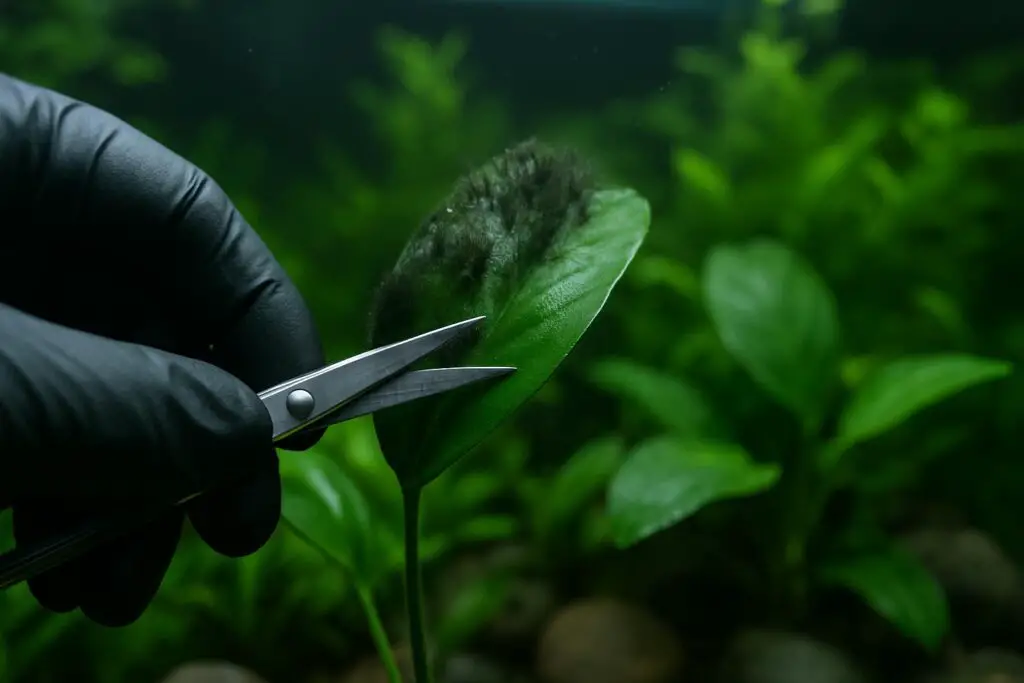
Prune heavy growth. Cut affected leaves rather than trying to save them if algae covers the edges. Scrub hardscape outside the tank when possible. Quick removal weakens the algae population and reduces chemical use.
Kill What Remains Safely
Use spot treatments that target algae while sparing fish and plants. Hydrogen peroxide and liquid carbon are effective when used with careful dosing and good aeration. Bleach dips are a last resort for hardy plants outside the tank.
Fix the Root Causes
Stabilize light, CO2, nutrients, and flow. Keep filters clean and maintenance consistent. When the tank is balanced, BBA loses its foothold.
Step by Step Removal Methods
Manual Pruning and Scrubbing
– Trim leaves with heavy BBA. If a leaf is more algae than plant, remove it.
– For anubias and java fern, cut only the affected leaves and keep the rhizome intact.
– Remove driftwood and rocks if possible and scrub them in tap water with a stiff brush. Rinse well before returning to the tank.
– Vacuum detritus during water changes to reduce organics that feed algae.
Manual removal has no chemical risk and makes other treatments faster and safer.
Hydrogen Peroxide Spot Treatment In Tank
Hydrogen peroxide at 3 percent concentration is effective on BBA when applied directly.
Safe workflow:
– Turn off filters and powerheads to keep peroxide localized.
– Use a syringe to spot apply 3 percent peroxide directly onto BBA clumps. Aim for contact time on the algae rather than letting it drift away.
– Limit total dose to 1 milliliter per gallon of tank water per session. Stay well under this if you keep sensitive shrimp or fish.
– Wait 5 minutes. Restore flow and add fresh aeration if possible.
– Do a 30 to 50 percent water change within 30 minutes after treatment.
What to expect:
– BBA will fade, then turn red or pink over 1 to 3 days.
– Once it weakens, grazers like Amano shrimp and true Siamese algae eaters often finish it off.
– Repeat every 2 to 3 days on stubborn patches, staying within the dosing limit.
Important cautions:
– Never combine peroxide and liquid carbon on the same day.
– Keep good surface agitation during and after treatment.
– If livestock show stress, stop, add fresh water, and increase aeration.
Liquid Carbon Spot Treatment In Tank
Liquid carbon products based on glutaraldehyde or similar polymers also kill BBA on contact when spot dosed.
Safe workflow:
– Turn off filters and powerheads.
– Use a pipette to apply a small amount directly to the algae. Treat a few patches per session.
– Keep total daily dose within the label limit for your tank volume. Do not exceed label guidance.
– Wait a few minutes, then restore flow.
What to expect:
– Algae often turns reddish within days and detaches later.
– Repeat on remaining spots every few days within label limits.
Important cautions:
– Some plants like vallisneria, anacharis, hornwort, and many mosses are sensitive to liquid carbon. Avoid direct contact with these plants.
– Do not use liquid carbon on the same day as peroxide.
Bleach Dip for Plants Outside the Tank
Use this only for hardy plants, and only outside the aquarium.
Safe workflow:
– Mix 1 part unscented household bleach with 19 parts water. Use cool water. Prepare a separate basin of conditioned water with extra dechlorinator for neutralizing afterward.
– Remove the plant. Dip for 30 to 90 seconds. Keep it short for delicate species. Agitate gently so solution reaches the algae.
– Rinse in tap water, then soak in the dechlorinated basin for several minutes. Rinse again before replanting.
Important cautions:
– Do not bleach dip delicate plants like mosses, vallisneria, anacharis, hornwort, liverworts, and floating plants. Many of these will melt.
– Test on one leaf or a small portion first for any plant you are unsure about.
– Never pour bleach into the aquarium. Always neutralize and rinse well before returning plants.
Treating Hardscape and Equipment
– For rocks and wood removed from the tank, pour boiling water slowly over the surfaces or soak with hydrogen peroxide outside the tank. Rinse well before return.
– For filter outlets and pipes, scrub and rinse. Reducing algae on equipment improves flow and reduces spores returning to plants.
Protecting Fish, Shrimp, and Plants During Treatment
Dosing Limits and Safety Checks
– Peroxide limit: do not exceed 1 milliliter of 3 percent peroxide per gallon per session.
– Liquid carbon: never exceed the product label for your tank volume. Spot dose a few patches per session and observe livestock.
– Increase aeration during and after treatments. Strong surface agitation protects fish and shrimp.
– Space treatments by at least 24 hours, and never use peroxide and liquid carbon on the same day.
– After any chemical spot treatment, do a partial water change the same day.
Plants That Do Not Tolerate Dips Well
Be cautious with these:
– Mosses and liverworts like java moss and riccia
– Vallisneria
– Anacharis and hornwort
– Floating plants
Use manual pruning or very light spot treatment around them instead.
Preventing BBA from Returning
Light Control
– Reduce photoperiod to 6 hours during recovery.
– Avoid intense light without matching CO2 and nutrients.
– Raise the light or lower brightness if you see new BBA tufts.
CO2 Stability
– Keep CO2 steady during the full photoperiod. Sudden drops or late CO2 startup often trigger BBA.
– Start CO2 1 to 2 hours before lights on and keep it stable until lights off if you run pressurized CO2.
– In low tech tanks without CO2, keep light moderate and growth slow and steady.
Nutrient Balance and Filter Maintenance
– Dose a complete fertilizer on a regular schedule. Do not starve plants. Healthy plants outcompete algae.
– Perform weekly water changes and gravel vacuuming to export organics.
– Clean filters on a schedule so flow stays strong. Rinse media in old tank water, not tap, to preserve bacteria.
Flow and Dead Spots
– Aim for even circulation so CO2 and nutrients reach every leaf.
– Adjust filter outlets or add a small powerhead to break up dead zones.
– Keep spray bars and lily pipes free of algae buildup.
Clean Up Crew
– Amano shrimp and true Siamese algae eaters often graze weakened BBA after treatment.
– Do not rely on animals alone to cure BBA. They are helpers, not a full solution.
Example 14 Day Action Plan
Day 1
– Big prune of infected leaves. Remove and scrub any removable hardscape.
– Water change 50 percent and clean filter outlets.
Day 2
– Peroxide spot treat up to 1 milliliter per gallon on the worst areas with filters off for 5 minutes. Restore flow and aeration. Water change 30 to 50 percent.
Day 3
– Rest day. Reduce light to 6 hours. Start regular fertilization if not already consistent.
Day 4
– Liquid carbon spot treatment within label limits on remaining patches. No peroxide today. Water change 30 percent.
Day 5
– Rest day. Check flow and clean any clogged intake sponges.
Day 6
– Peroxide spot treatment again on stubborn spots, staying within limits. Water change 30 to 50 percent.
Day 7
– Rest day. Trim any leaves that are clearly failing.
Day 8 to Day 14
– Alternate rest days and light spot treatments every 2 to 3 days as needed, never mixing peroxide and liquid carbon on the same day.
– Keep up with water changes, stable CO2, and controlled light.
– Add or adjust flow if you still see dead zones.
By the end of two weeks, most BBA should be red, receding, or gone. Keep the prevention steps in place so it does not return.
Troubleshooting
BBA Keeps Returning
– Check light intensity and duration. Too much light with weak CO2 is the most common cause.
– Stabilize CO2 timing and distribution. Make sure it is on before the lights and stable through the photoperiod.
– Raise plant health with consistent fertilization. Starved plants invite algae.
– Improve flow. BBA thrives in stagnant spots on the margins of leaves and hardscape.
– Increase frequency of filter maintenance and debris removal.
Plants Melting After Treatment
– Reduce or stop chemical spot dosing near sensitive species listed above.
– Shorten exposure time or lower dose.
– Focus on pruning and manual removal for delicate plants.
– Shift effort to root cause fixes like light control and flow rather than stronger chemicals.
Conclusion
Black beard algae can be removed safely with a clear plan. Prune heavy growth, spot treat with either hydrogen peroxide or liquid carbon within strict limits, and fix the tank conditions that allowed it to spread. Keep light in check, stabilize CO2, feed plants consistently, and maintain good flow and filtration. With these steps, BBA weakens, turns red, and disappears. The tank stays stable, plants recover, and the algae does not return.
FAQ
Q: What causes black beard algae in the first place
A: It usually appears with strong light and unstable CO2, inconsistent fertilization, dirty filters, and weak flow. Fixing these conditions prevents it from returning.
Q: Is hydrogen peroxide safe to use in the aquarium
A: Yes when used carefully. Spot apply 3 percent peroxide with filters off and do not exceed 1 milliliter per gallon per session. Restore flow, increase aeration, and do a 30 to 50 percent water change shortly after.
Q: Can I use liquid carbon and peroxide on the same day
A: No. Use only one method per day and stay within label limits for liquid carbon. Alternate days if you need to use both methods over time.
Q: Which plants should not be bleach dipped
A: Avoid bleach dips for mosses, liverworts, vallisneria, anacharis, hornwort, and floating plants. These are sensitive and often melt.
Q: How long until BBA dies after treatment
A: It often turns red or pink within 1 to 3 days after spot treatment and then weakens. At that point it can be grazed off or trimmed away.