
We are reader supported. When you purchase through links on our site, we may earn an affiliate commission. Also, as an Amazon affiliate, we earn from qualifying purchases.
Tap water is not the same everywhere. Minerals, hardness, pH, and contaminants vary by city and even by season. Sensitive fish, shrimp, and corals often react to those swings. Algae and nuisance organisms thrive on excess nutrients that can be present in tap. Reverse osmosis, commonly called RO, gives you a blank canvas so you can build stable, predictable water for your aquarium. If you want fewer surprises, healthier livestock, and cleaner tanks, RO water is one of the most reliable tools you can use.
What Reverse Osmosis Water Is
Reverse osmosis is a filtration process that pushes water through a semi‑permeable membrane. The membrane rejects most dissolved solids, including calcium, magnesium, heavy metals, nitrates, phosphates, and many other contaminants. The result is low‑TDS water with minimal hardness. Many hobbyists add a DI cartridge after the membrane to polish the water to near zero TDS. RO gives you consistent source water; you then remineralize or mix as needed for your fish, plants, shrimp, or corals.
Why Water Parameters Matter
GH, KH, pH, and TDS in simple terms
GH is general hardness, mainly calcium and magnesium. KH is carbonate hardness, which buffers pH and stabilizes it. TDS is total dissolved solids, a broad measure of all dissolved minerals and substances. pH is the acidity or alkalinity. Fish and invertebrates are adapted to certain ranges. Plants need enough calcium and magnesium to grow. Bacteria and biological filters are more stable with a steady KH. With RO, you control GH and KH instead of taking whatever your tap provides.
Key Benefits of Using RO Water
Consistency and control
RO water removes seasonal and municipal changes from the equation. You set the GH, KH, and TDS to your targets. This stability reduces stress, disease risk, and random crashes caused by parameter swings.
Better outcomes for soft water species
Discus, Apistogramma, rams, wild bettas, and many tetras come from soft, slightly acidic water. RO lets you achieve low GH and low KH safely, which improves coloration, behavior, and breeding success in these species.
Cleaner water for shrimp and sensitive inverts
Crystal red and other Caridina shrimp need very soft, low‑TDS water with near‑zero KH. Neocaridina prefer moderately hard, stable water. RO plus the right shrimp salts allows fine control and reduces molting issues and die‑offs linked to unstable tap water.
Algae and nuisance reduction
RO cuts out many nutrients at the source, especially nitrates, phosphates, and silicates that fuel algae and diatoms. With fewer nutrients in your source water, you only add what your tank needs.
Marine and reef standard
RO or RO/DI is the standard for saltwater aquariums. You add a quality reef salt to RO/DI to reach your target salinity. This avoids algae‑promoting contaminants and trace metals that harm corals and inverts.
Avoiding hidden tap water issues
Chlorine and chloramine are disinfectants in many water systems. Carbon prefilters protect the RO membrane from them. The final RO product water has no chlorine when the unit is functioning correctly and the carbon stages are fresh. RO also reduces heavy metals that can harm shrimp and corals.
When RO Is Needed and When It Is Optional
Use RO if your tap water is very hard, has high nitrates or phosphates, swings seasonally, or causes recurring algae and livestock issues. It is essential for reef tanks and advanced shrimp. If your tap is moderate in hardness and low in contaminants, you may mix RO with tap to reach target parameters. For African cichlids and livebearers that prefer hard, alkaline water, full RO is not mandatory, but mixing helps you control stability and remove unwanted contaminants.
How an RO System Works
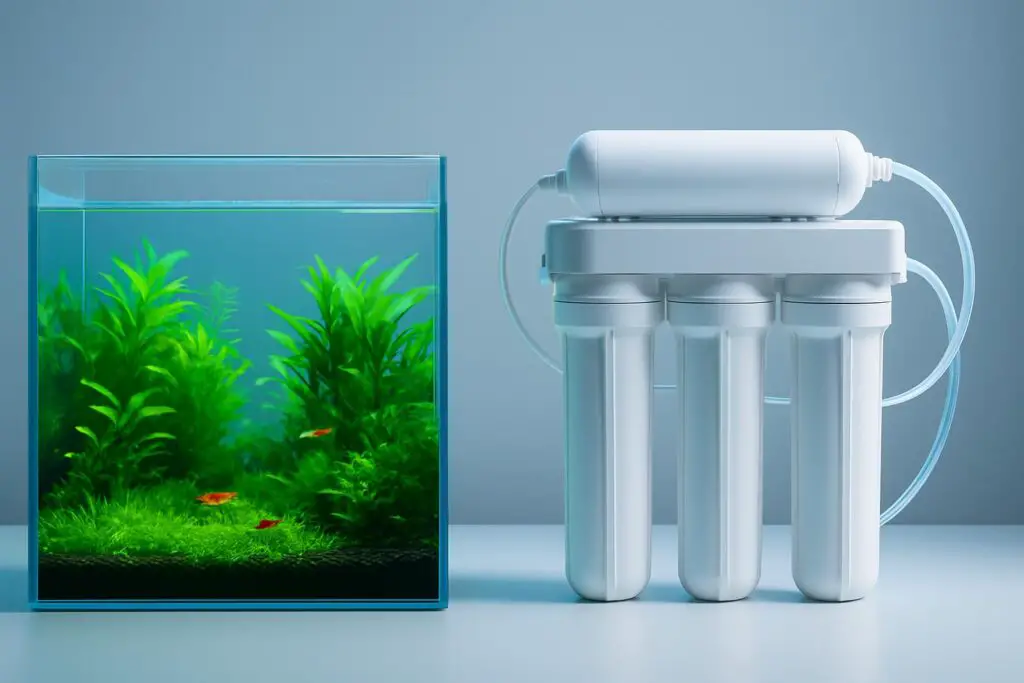
A typical RO system has a sediment filter to catch particles, a carbon block to remove chlorine and reduce chloramine, a membrane that rejects most dissolved solids, and optionally a DI cartridge to polish to near zero TDS. The system also has a flow restrictor and a waste line. It needs adequate water pressure to push water through the membrane. Most units run best around 50 to 80 psi.
Choosing an RO or RO/DI Unit
Capacity and flow
Units are rated by gallons per day. Real output depends on water pressure and temperature. Cold water and low pressure slow production. A booster pump helps if your line pressure is low.
Rejection rate and waste ratio
Look for a high membrane rejection rate. Typical waste ratios range from 1 to 4 parts waste per 1 part product water. You can route waste water to non‑tank uses like watering plants or cleaning to reduce waste.
Prefilters and DI
Sediment and carbon blocks protect the membrane and help remove disinfectants. DI resin after the membrane reduces final TDS to near zero, which is ideal for reef and very sensitive setups.
Setting Up and First Run
Install the unit per the manual. Many systems connect under a sink or to a garden hose using an adapter. Flush the carbon blocks and membrane as directed before collecting water for the tank. Measure your product water with a TDS meter to confirm it is low. Store RO water in clean, food‑safe containers with lids. Keep containers out of sunlight to prevent biofilm growth.
Remineralizing RO Water for Freshwater
Pure RO is too soft and has almost no buffering. Most freshwater tanks need added minerals for fish health, plant growth, and pH stability. Use commercial GH and KH salts or a complete remineralizer designed for aquariums. Always test after mixing and record your recipe.
Targets for community tanks
A good starting point for mixed community tanks is GH 4 to 8 dGH and KH 3 to 6 dKH, with pH around neutral to slightly alkaline. This range suits many tetras, rasboras, barbs, corydoras, gouramis, and hardy livebearers. Adjust based on the needs of your livestock.
Planted tanks
Many planted tanks run well at GH 3 to 6 dGH and KH 0 to 3 dKH. Lower KH improves CO2 pH stability, but keep an eye on buffering. If KH is near zero, pH can swing quickly. Add a small amount of KH buffer or increase water change frequency if you see instability.
Shrimp focused setups
Neocaridina often thrive around GH 6 to 8 dGH and KH 2 to 4 dKH. Caridina often need GH 4 to 6 dGH and KH 0 to 1 dKH. Dedicated shrimp remineralizers make this simple and consistent. Stable TDS helps prevent molting issues.
Soft water specialists
Discus, Apistogramma, and dwarf rams often prefer GH 1 to 4 dGH and KH 0 to 2 dKH with slightly acidic pH. Keep this stable and use frequent small water changes to avoid swings.
Hard water species
African rift lake cichlids and many livebearers prefer hard, alkaline water. Target GH 10 to 20 dGH and KH 8 to 12 dKH. You can achieve this by adding mineral salts to RO or by mixing RO with hard tap water and topping off minerals as needed.
Saltwater and reef
Use RO or RO/DI and add a quality marine salt mix to reach your target salinity. Many reef keepers aim for about 35 ppt or a specific gravity near 1.025 at 25 C. Always mix salt thoroughly with RO/DI, aerate, heat to match the tank, and measure salinity before use.
Mixing RO With Tap Water
Mixing RO with tap is a fast way to hit a target GH and KH while reducing contaminants. The math is simple for GH and KH because they dilute almost linearly. If your tap KH is 8 dKH and you want 2 dKH, use 25 percent tap and 75 percent RO. If your tap GH is 12 dGH and you want 6 dGH, use 50 percent tap and 50 percent RO. Always test your final mix since tap water can vary over time.
Top Offs and Water Changes
Evaporation leaves minerals behind. For freshwater and saltwater, top off with pure RO or RO/DI only, not remineralized or salted water. For water changes, remineralize your RO or mix to match the tank’s GH, KH, and for saltwater match salinity and temperature. Consistency between the tank and new water reduces stress.
Maintenance and Monitoring
Filter changes
Replace sediment and carbon filters every 6 to 12 months depending on use and water quality. Replace the RO membrane every 2 to 5 years when performance drops. If you use DI, replace resin when the product water TDS begins to rise above your normal baseline.
TDS meter use
Use a TDS meter to track product water quality. RO water often reads under 10 ppm TDS. RO/DI targets near zero. If product TDS climbs after prefilters are fresh, the membrane or DI likely needs attention.
Flushing and sanitation
Flush the membrane occasionally to remove buildup if your unit includes a flush valve. Sanitize the system and storage containers periodically to prevent biofilm. Keep all tubing and containers clean and capped.
Pitfalls and Troubleshooting
Do not use pure RO for freshwater long term
Pure RO in a freshwater tank leads to mineral deficiencies and unstable pH. Always remineralize for freshwater tanks except when replacing evaporation.
pH confusion with RO
Pure RO has very low KH so pH measurements can bounce around. Judge pH after you remineralize and after the water equilibrates with air.
KH too low and pH swings
If your tank shows pH swings, increase KH slightly, reduce organic load, and increase water change frequency. Stable KH stabilizes pH.
Plant and shrimp health signals
Twisted new leaves or poor growth can indicate low calcium or magnesium. Shrimp stuck in molts often point to unstable GH or TDS. Adjust remineralization and test again.
TDS creep and contamination
If stored RO water shows rising TDS, check for dirty storage containers or DI resin exhaustion. Use food‑safe containers with lids and keep them out of sunlight.
Cost and Environmental Notes
RO units have an upfront cost and ongoing filter replacements. There is also waste water. Typical waste ratios are 1 to 4 parts waste per 1 part product water. You can reduce impact by collecting waste water for plants, cleaning, or laundry pre‑rinse. A booster pump improves efficiency if your pressure is low. Making water in moderate temperatures increases output compared to very cold water.
Step by Step Plan to Switch to RO
1. Assess your tap water
Test GH, KH, pH, TDS, and check for nitrates and phosphates. Identify the gap between your tap and your target.
2. Pick targets
Choose GH and KH ranges based on your livestock. Community fish often do well at GH 4 to 8 dGH and KH 3 to 6 dKH. Softwater species need less. Hardwater species need more.
3. Choose your method
Decide between full RO with remineralization or mixing RO and tap. For reef, choose RO/DI.
4. Get the right tools
Acquire an RO or RO/DI unit, a TDS meter, GH and KH test kits, and suitable remineralizers. Have food‑safe storage containers ready.
5. Make and test water
Produce RO water, mix salts or tap per your plan, and test GH, KH, pH, and for reef measure salinity. Adjust the recipe until it matches your targets.
6. Transition gradually
Use your new water for regular water changes. Replace parameters slowly over several weeks to avoid shocking livestock. Top off with pure RO or RO/DI only.
7. Log and stabilize
Write down your mixing ratios, test results, and livestock observations. Keep the routine steady once you hit your targets.
Conclusion
RO water gives aquarists control. It strips source water down to a stable baseline so you can add back exactly what your animals and plants need. That control reduces algae, improves health, and prevents many common problems caused by tap water variability. For freshwater, always remineralize to appropriate GH and KH or mix with tap to hit your goals. For reef, use RO/DI with a quality salt mix. Maintain your RO system, measure with a TDS meter, and store water cleanly. With these habits, you gain stable water, predictable results, and a more enjoyable aquarium.
FAQ
Q: Do I need to remineralize RO water for freshwater tanks
A: Pure RO in a freshwater tank leads to mineral deficiencies and unstable pH. Always remineralize for freshwater tanks except when replacing evaporation.
Q: What TDS should RO or RO/DI water read
A: RO water often reads under 10 ppm TDS. RO/DI targets near zero.
Q: Can I mix RO with tap water to reach my target hardness
A: Yes. GH and KH dilute almost linearly. If your tap KH is 8 dKH and you want 2 dKH, use 25 percent tap and 75 percent RO. If your tap GH is 12 dGH and you want 6 dGH, use 50 percent tap and 50 percent RO.
Q: Is RO or RO/DI better for a reef tank
A: RO or RO/DI is the standard for saltwater aquariums. RO/DI targets near zero TDS, and you add a quality reef salt to reach your target salinity.
Q: How often should I replace RO filters and the membrane
A: Replace sediment and carbon filters every 6 to 12 months depending on use and water quality. Replace the RO membrane every 2 to 5 years when performance drops.