
We are reader supported. When you purchase through links on our site, we may earn an affiliate commission. Also, as an Amazon affiliate, we earn from qualifying purchases.
Fast fish can turn a simple catch into a stressful chase. With the right plan, gear, and technique, you can net even the quickest swimmers without harm. This guide gives you clear, repeatable steps that keep fish calm, protect fins and scales, and preserve your aquascape. Follow it start to finish, or jump to the sections that fit your tank and species.
Why Safe Catching Matters
Every chase raises stress hormones, weakens the immune system, and can lead to injury or disease. Rough nets remove slime coat and snag fins. Stirred substrate can spike ammonia. Stress spreads to the whole tank. Safe, controlled catching protects the fish, your cycle, and your layout. It also saves you time because calm fish are easier to guide into a net.
Tools and Gear You Need
Nets: Size and Material
Use the softest net you can find. Rubber or silicone coated nets protect slime coats and reduce snags. Pick mesh size that keeps fins and barbs from catching. Small fish need fine mesh. Larger fish need a stronger frame and a medium mesh to move water smoothly.
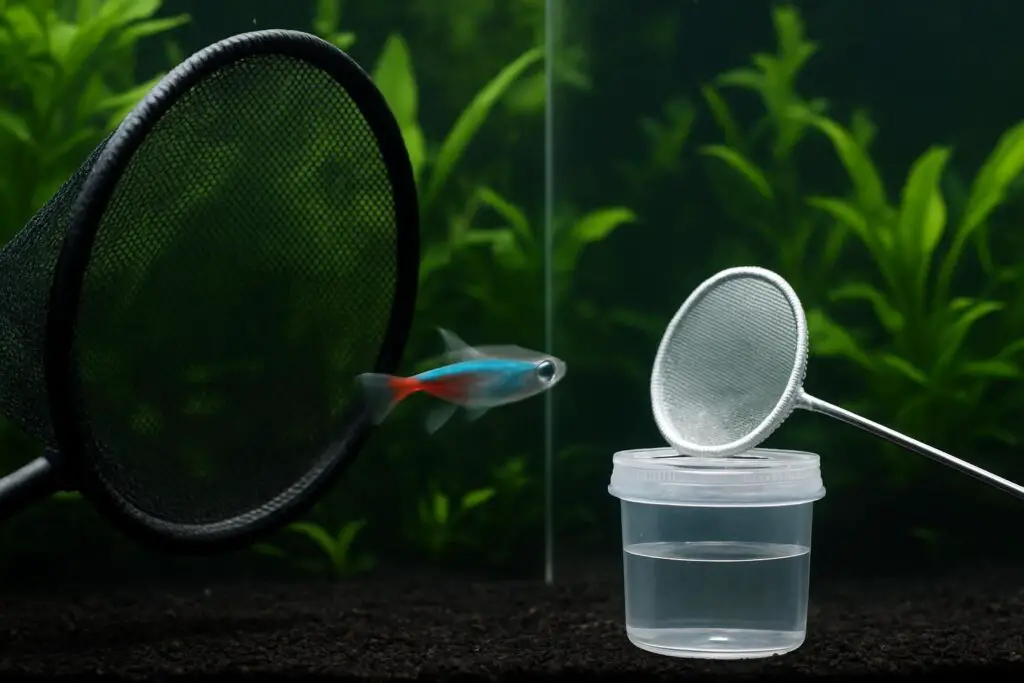
Have two nets. One larger herding net and one smaller capture net work well. A triangular or square net helps pin fish against glass. A round net is gentle for final scoops.
Specimen Containers and Cups
A clear plastic specimen container or wide cup is often safer than a net. Fish swim into it easily. It never snags spines or fins. A container is essential for catfish, loaches, puffers, and long-finned fish. Keep one inside the tank while catching to make transfers without air exposure.
Barriers and Traps
Use a thin acrylic sheet or mesh panel to partition the tank and reduce the fish’s swimming area. Simple bottle traps or acrylic fish traps work using food lure. These help when plants or rock make netting impractical.
Support Gear
Have a clean bucket with tank water for holding fish. Add a lid or cover to prevent jumps. Use an air stone if holding longer than 10 minutes. Keep a dark towel to reduce stress. Use water conditioner ready for refilling the tank. Keep a small flashlight to spot hiding fish. Have long aquascaping tweezers to move small items without uprooting plants.
Prepare the Tank and the Fish
Timing and Fasting
Fast fish for 12 to 24 hours. They are lighter, foul less water, and respond better to food lures. Catch in the early morning or shortly after lights come on, when fish are calmer. Avoid catching right after a big water change that can make fish hyperactive.
Lighting Control
Dim room lights and reduce tank light. Use a shorter photoperiod or a blue setting. Sudden darkness can startle some species, so step down the light in stages. Calmer fish make fewer explosive sprints.
Lower Water Level Safely
Remove 30 to 60 percent of the water into a clean bucket. This keeps fish in less space without drying plants. Unplug heaters before lowering the level to prevent cracking. Keep filters and powerheads off during capture to reduce current and hazards. Put a lid or plastic wrap on part of the top to deter jumpers.
Remove Obstacles and Plan Routes
Take out a few easy decorations to open a path. Leave complex hardscape in place if removing it would uproot plants or collapse caves. Visualize a funnel: guide fish from open water into a corner or against glass where your net waits. Place your herding net and barrier before you start.
Disease Safety Between Tanks
Use separate nets for each tank, or disinfect after each use. A simple method is a 1 to 20 bleach dip for 10 minutes, rinse well, then dechlorinate and air dry completely. Drying nets fully between tanks reduces parasite transfer.
Core Netting Principles
Move Slow, Herd Not Chase
Keep the capture net still and low. Use the herding net to guide fish calmly. Fish flee from approaching objects, so approach from behind and below. Do not stab or scoop wildly. Steady pressure is more effective than speed.
Two-Net Method
Hold the larger net as a barrier. Gently push the fish toward the smaller net. When close, stop moving the small net and let the fish swim into it. Lift with water in the net to support the fish.
Corner and Wall Capture
Guide the fish along the glass. Slide the net opening along the wall so there is no escape gap. Use the glass as the fourth side of the trap. Raise the net slightly to cut off downward darts.
Container Scoop Method
For fish with spines or delicate fins, sink a specimen container at an angle. Herd the fish into the opening. Tilt upright to trap water and fish. Transfer without exposing the fish to air. This method is safer than netting for many species.
Food Lure and Trap
Place a small pinch of favorite food inside a container or trap. Wait until the target fish enters. Block the exit with your hand or a net. This works well for shy or fast fish in planted tanks.
Step-by-Step Workflows
Lightly Planted Community Tank
1. Fast fish 12 to 24 hours. Dim lights. Unplug heater before lowering water. Remove 40 percent of water to a bucket for later use.
2. Place a large net as a barrier near a corner. Keep a small net or specimen container ready.
3. Gently herd the target fish along the glass toward the corner. Keep movements smooth and predictable.
4. When the fish reaches the corner, hold the small net still with the opening facing the fish. Use the large net to nudge it forward.
5. Lift the fish with water in the net, or tilt a specimen container upright to secure it. Transfer to a holding bucket with tank water.
6. Repeat for additional fish. Allow short breaks if the group becomes agitated.
Heavily Planted Aquascape
1. Avoid tearing plants. Lower water by 30 percent. Keep plants wet by misting if exposed.
2. Place an acrylic sheet to partition the tank, reducing the swimming zone to the front glass.
3. Use a specimen container with a wide opening. Add a tiny food lure inside the container.
4. Guide the fish gently toward the opening. Wait rather than chase. Close exits with the partition or a second net.
5. If netting is still needed, use a soft rubber net and slide it along the glass to prevent dives into plants.
6. After capture, remove the partition and refill with conditioned, temperature-matched water.
Rocky or Cichlid Tank
1. Identify the fish’s territory and escape routes. Many cichlids dive into caves.
2. If safe, lift one or two loose rocks to remove the most secure hide. Do not destabilize the entire structure.
3. Use a pot, cave, or PVC section as a trap. Bait it lightly. Once the fish enters, cover the opening and lift the whole cave underwater into a specimen container.
4. If netting, block caves with a barrier, herd along glass, and use the two-net method. Avoid sharp rock edges that can tear fins.
Shrimp or Fry Tank
1. Use a very fine mesh net or a shrimp net with a shallow pocket. Better yet, use a specimen container.
2. Herd gently with a plant-safe partition. Move slow to avoid scattering fry into plants or filter intakes.
3. Turn off flow. Cover intakes to prevent fry being drawn in.
4. Transfer underwater directly into a breeder box or holding container with an air stone.
Species-Specific Tips
Tetras, Rasboras, Danios, Rainbowfish
These school and react predictably. Guide the group, then peel off the target fish near a corner. Use a larger barrier net and a small capture net. Dim light reduces sudden dashes. Keep a lid on the tank since these species jump.
Barbs and Fish with Spines
Barbs can have stiff rays that snag fine mesh. Use a rubber coated net or a specimen container. Do not yank if snagged. Lower the net underwater and back the fish out calmly. Avoid nets with loose threads.
Bettas and Long-Finned Fish
Use a cup or container, not a mesh net. Long fins tear easily. Bettas often approach a container out of curiosity. Scoop slowly from below. Keep surfaces smooth and clean.
Catfish, Plecos, Loaches, Corydoras
Many have spines that lock into net mesh. Use a specimen container or a plastic bag submerged in the tank. Guide them in and lift without air exposure. For plecos, gently peel them off glass by placing the container over them and sliding a card behind to close the opening. Corydoras have sharp pectoral spines; never force them through a net.
Puffers and Sensitive Species
Never expose puffers to air. Move them only in a submerged container or bag. Avoid long chases that lead to inflation. Keep them underwater during transfers. The same rule helps delicate gouramis and labyrinth fish; keep transfers gentle and brief.
Goldfish and Livebearers
Use a large soft net or a container. Goldfish are bulky and produce heavy waste; hold them in clean, oxygenated water if the process takes time. Livebearers startle easily; dim light and gentle herding work best. For fry, move parents first, then collect fry with a fine mesh or container.
Minimizing Stress During and After Capture
Handling and Transfer
Keep fish underwater as much as possible. If you must lift a net, keep water in the net to cradle the fish. Do not squeeze or pinch the net. Move steadily to a container. Cover the container to block jumps and reduce light.
Holding and Transport
Use tank water in the holding bucket. Add an air stone for holds longer than 10 minutes. Keep the container dark and covered. For trips, match temperature and insulate. Do not overcrowd. Change water if fish were not fasted and fouling occurs.
Acclimation at Destination
Float the bag or container to match temperature for 15 to 30 minutes. Use a drip line to adjust to new water if parameters differ. Avoid long acclimation in dirty water. Move fish gently with a container rather than pouring them through a net if fins are delicate.
Aftercare and Observation
Watch breathing rate, posture, and fin position for the next 24 hours. Look for torn fins, missing scales, or red streaks. Consider a small dose of a conditioner that supports slime coat during water refills. Keep lights dim for the rest of the day. Do not feed heavily right away.
Troubleshooting
Fish Keep Escaping Nets
Lower the water more. Use the glass as a barrier. Switch to the two-net method. Slow down and keep the capture net still. Make the opening face the fish and use the second net to nudge it inside. Try a larger net that matches the fish’s size and speed.
Fish Hides in Plants or Caves
Use a partition to shrink the fish’s area. Remove one or two easy hides. Try a food lure in a container. For caves, lift the entire cave underwater into a specimen container rather than chasing the fish out.
Fish Injured or Breathing Fast
End the session and let the fish recover. Increase aeration. Add clean, conditioned water. Dim lights. Observe closely. Do not resume catching for at least 30 to 60 minutes. Address rough gear or rushed technique before trying again.
Net Snags or Damage
If a fish catches on the mesh, submerge the net and reverse it slowly. Never pull forcefully. Replace old nets with rubber coated or soft silicone models. Trim loose fibers. For spiny species, switch to container capture only.
Common Mistakes to Avoid
– Chasing for more than a few minutes. Take breaks to lower stress.
– Using a single stiff net. Two soft nets are better than one large hard net.
– Scooping from above. Approach from below and behind.
– Leaving heater on while lowering water. Unplug before the level drops.
– Stirring substrate into a cloud. Lower water gently and avoid digging into the bed.
– Catching all fish at once in a stocked tank. Work in small groups to keep stress lower.
– Transferring dry. Keep fish in water during moves when possible.
– Cross-contaminating tanks with wet nets. Disinfect or maintain dedicated gear.
Pro Tips for Faster Success
– Train fish to follow a feeding stick or to enter a net for food. Later captures go faster.
– Use current to your advantage. Turn flow back on briefly to push fish toward your barrier, then off again.
– Angle nets slightly upward. Many fish dive when pressured. Cutting off the downward path helps.
– Use a black net if fish avoid bright colors. Black blends into the background and spooks less.
– Keep a small mirror or reflective panel ready. For territorial fish, a brief distraction can draw them away from a cave so you can block it safely.
Reset the Tank After Catching
Refill with conditioned, temperature-matched water. Plug in equipment and confirm filters are primed and flowing. Wipe glass, replace removed decor, and replant gently. Keep lights dim for a few hours to let remaining fish settle. Feed lightly the next day.
Safety Notes and Ethics
Do not sedate fish without proper training. Avoid excessive chasing or repeated attempts in one session. If a layout prevents safe capture, reconsider the approach and use traps or partitions instead of force. Plan moves and rehomes ahead so the process is quick and calm.
Checklist You Can Follow Each Time
– Fast fish 12 to 24 hours
– Dim lights and reduce flow
– Lower water 30 to 60 percent and unplug heater
– Set barrier net or partition
– Choose method: two-net, container scoop, or trap with food
– Keep transfers underwater when possible
– Hold fish briefly in clean, aerated tank water
– Acclimate at destination and observe
– Disinfect gear and reset the tank
Conclusion
Safe capture is about control, not speed. Prepare the tank, pick the right tools, and guide rather than chase. Use soft nets or containers, reduce the swimming area, and let calm technique do the work. With a clear plan and species-aware methods, even the fastest fish can be moved without injury. The result is a smooth transfer, a stable tank, and fish that resume normal behavior quickly.