
We are reader supported. When you purchase through links on our site, we may earn an affiliate commission. Also, as an Amazon affiliate, we earn from qualifying purchases.
Sponge filters and hang-on-back filters are two of the most common choices for freshwater aquariums. Both can keep fish healthy and water safe, but they work differently and fit different goals. If you pick based on habit or hype, you may end up with cloudy water, stressed fish, or high maintenance. Choose with intention and your tank becomes calmer to run and easier to enjoy. This guide compares sponge filters and hang-on-back filters across function, performance, noise, cost, safety, and reliability, then gives clear use cases to help you decide.
What Each Filter Type Is
Sponge filter basics
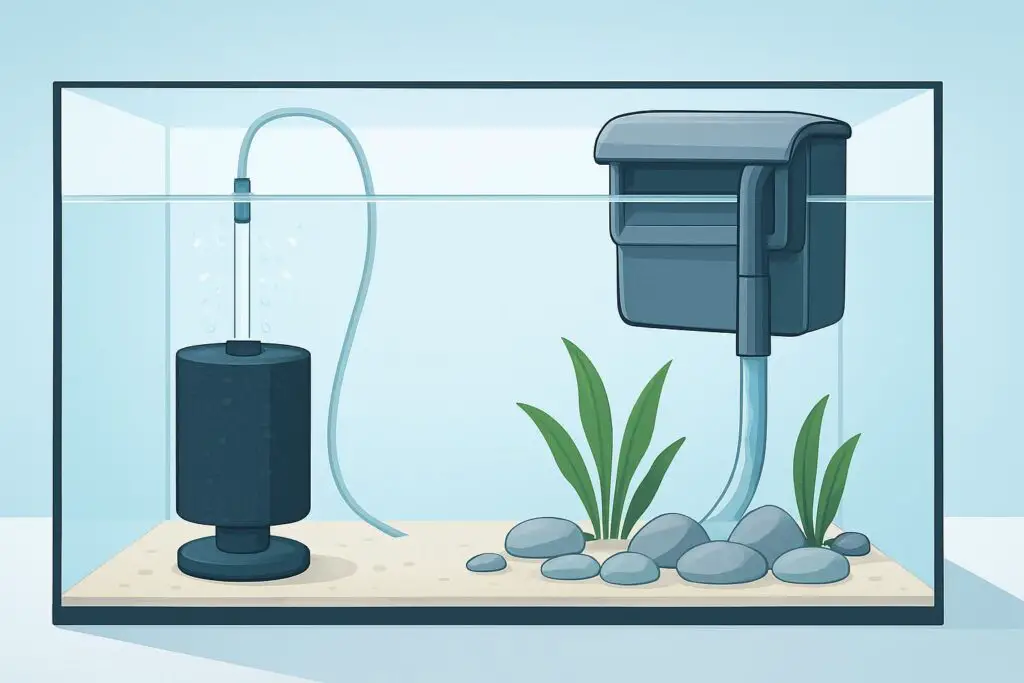
A sponge filter is a block or cylinder of foam inside the tank. An air pump pushes air through airline tubing to the sponge filter’s lift tube. Rising bubbles pull water through the sponge, trapping debris and feeding bacteria with oxygen. It runs on air, not electricity in the tank, so the only powered device is the external air pump. The sponge provides mechanical and biological filtration. There is no chemical media unless you add a separate device.
Hang-on-back filter basics
A hang-on-back filter, often called HOB, sits on the rim of the aquarium. A pump pulls water from an intake tube, pushes it through media in a chamber, and pours it back. HOB filters can hold sponges, floss, ceramic media, and chemical media such as carbon or resins. They provide mechanical, biological, and optional chemical filtration. They need electricity at the tank and must be primed to start.
How Filtration Works and Why It Matters
Mechanical filtration
Mechanical filtration removes visible particles from the water. Sponge filters catch debris in the pores of the foam. They handle light to moderate waste well, especially in small tanks. HOB filters can use layered media from coarse to fine, and even polishing pads that catch very small particles. If you value crystal clarity, a HOB with fine floss will generally outperform a sponge.
Biological filtration
Biological filtration converts toxic ammonia to nitrite and then to nitrate using beneficial bacteria. Both sponge filters and HOB filters can grow large bacterial colonies. Sponge filters shine here because they offer high oxygen exposure and stable surfaces for bacteria. HOB filters also support strong colonies, but their media volume can be limited in compact models. For stability, both are good when sized and maintained correctly.
Chemical filtration
Chemical filtration uses media such as carbon or specialized resins to remove dissolved substances, odors, tannins, or specific toxins. HOB filters make this easy because you can add or remove chemical media as needed. Sponge filters do not have space for chemical media unless you add a separate inline reactor or bag in a high-flow area. If you plan to use chemical media regularly, a HOB is more convenient.
Performance in Common Aquarium Scenarios
Small tanks and nano shrimp
In tanks under 10 gallons, sponge filters are often best. They are gentle, safe for baby shrimp, and create stable biofiltration with minimal current. Maintenance is simple, and the risk of shrimp getting pulled into an intake is low. HOB filters can work if flow is adjustable and an intake prefilter sponge is added, but they can be too strong for nano setups.
Betta and low-flow species
Bettas, pea puffers, and some dwarf cichlids dislike strong currents. Sponge filters deliver gentle flow, good oxygenation, and stable bacteria without buffeting the fish. A HOB can be used if flow is reduced and the output is baffled, but sponge filters typically make life easier for soft-current species.
Community tanks from 10 to 40 gallons
For typical community tanks with tetras, rasboras, and small catfish, both options work. A properly sized sponge provides reliable biofiltration and decent clarity. A mid-size HOB improves clarity and flexibility, especially if you want to run carbon after a medication or use polishing floss before a photo session. If you like polished water, lean HOB. If you prefer simplicity and low maintenance cost, lean sponge.
Heavily stocked or messy fish
Goldfish, cichlids, and large livebearer colonies produce more waste. A HOB filter with high turnover and multiple media stages handles the solids and turbidity better. Many aquarists pair a HOB for mechanical polish with an internal sponge for extra biofiltration and safety. A sponge alone can work if you use oversized sponges or multiple units, but clarity can lag without frequent cleaning.
Planted tanks and injected CO2
Planted tanks benefit from stable CO2 levels. Excess surface agitation drives off CO2. Sponge filters create vertical bubble columns that can increase gas exchange more than needed for a CO2 injected tank. HOB filters can also off-gas CO2, especially if the water falls a long drop. In CO2 tanks, keep the water level high to minimize waterfall effect, and tune flow. Both can work, but a canister is often preferred in high-tech setups. If choosing between sponge and HOB for planted tanks, select the one with controllable flow and use a lily pipe style return or surface skimmer as needed.
Breeding and fry rearing
Sponge filters are the standard for breeding tanks. Fry do not get sucked in, infusoria and microfauna grow on the sponge, and the current is gentle. You can move a seeded sponge quickly to a new tank to provide instant biofiltration. HOB filters can be made fry safe with a prefilter sponge, but they still risk pulling tiny fry if the prefilter is too coarse.
Setup and Installation
Sponge filter setup
Place the sponge in a corner, connect an air line, add a check valve above the water line, and hook to an air pump. Adjust air flow with a valve to set bubble rate. Position the sponge so the lift tube is vertical. The water level should cover the sponge fully. Start the pump and confirm steady bubbles. The filter is running as soon as air flows.
HOB filter setup
Hang the unit on the rim, level it, install media, and fill the chamber with water to prime. Adjust the intake height to sit a few inches above the substrate. Plug in and confirm the impeller spins and water starts circulating. If it struggles, add more water to the chamber. Set flow to an appropriate level for your fish and aquascape.
Priming and start-up reliability
Sponge filters always restart as soon as the air pump resumes after a power cut. HOB filters may lose siphon if water evaporates or the intake draws air. Some HOBs are self-priming, but many are not. Consider an uninterrupted power supply or ensure frequent water top-offs to reduce restart failures in HOB systems.
Noise, Vibration, and Aesthetics
Noise sources
Sponge filters produce air pump hum and bubbling. Using a quality, quiet air pump, soft tubing, and placing the pump on foam reduces noise. Coarse bubbles are louder; use a fine diffuser or adjust flow to quiet them. HOB filters produce pump hum and waterfall noise. Keeping the tank water level high minimizes splash, and cleaning the impeller often reduces hum. Both can be quiet if set up well. Poor setup makes either loud.
Visual impact and space
Sponge filters sit inside the tank and are visible. Black sponges are less noticeable against dark backgrounds. HOB filters sit outside the tank and keep the interior cleaner, but the intake tube is visible. For minimalist aquascapes, HOBs usually look cleaner inside the display.
Maintenance Routines
Cleaning frequency
Rinse sponge filters in a bucket of tank water every one to three weeks depending on stocking and feeding. Do not use tap water, since chlorine can damage bacteria. For HOB filters, rinse sponges and floss in tank water weekly to monthly. Replace polishing floss as it clogs, which could be weekly in messy tanks.
Media care and avoiding cycle crashes
Never replace all media at once in a HOB. Keep at least one established sponge or ceramic basket in use, and stagger changes. With sponge filters, keep at least half of the sponge undisturbed during heavy cleanings. Too much scrubbing can remove bacteria and cause ammonia spikes. Clean lightly and often rather than rarely and aggressively.
Impeller and flow path upkeep
HOB filters need periodic impeller and intake tube cleaning to maintain flow and reduce noise. Slime buildup reduces efficiency. For sponge filters, inspect the lift tube and air stone or diffuser every few months. Replace stretched airline tubing and clogged check valves when flow drops.
Flow and Oxygenation
Turnover guidelines
Community tanks typically do well with total flow of 4 to 8 times the tank volume per hour. Bettas and slow swimmers prefer 2 to 4 times. Messy fish may need 8 to 10 times with strong mechanical filtration. Sponge filters add circulation but are limited by air lift. HOB filters can deliver more precise and higher flow rates.
Surface agitation and CO2 balance
Gas exchange happens at the surface. Sponge filters increase agitation through bubble rise. HOB outputs disturb the surface as water returns. For CO2 tanks, reduce agitation to retain CO2 while keeping enough movement to avoid surface film. For low-tech tanks, more agitation helps oxygenation and fish health.
Dead spots and circulation
Place filter outputs to avoid dead spots behind hardscape and plants. A single sponge in a large tank may leave corners stagnant. Two smaller sponges on opposite sides give better coverage. HOB return flow can push debris toward the intake if positioned well. Adjust placement until debris drifts toward the filter rather than settling on the substrate.
Cost of Ownership
Upfront cost
Sponge filters and a small air pump are inexpensive. One pump can drive multiple sponges with a manifold, which is economical for fish rooms or multiple tanks. HOB filters cost more up front for each tank.
Electricity and running cost
Air pumps draw little power and are efficient when split among tanks. HOB filters draw more power per tank but are still modest in absolute terms. If you run many tanks, a central air pump with sponges can reduce the total wattage compared to multiple HOBs.
Consumables and media
Sponges last years with simple rinsing. HOB filters may need replacement floss and optional chemical media. You can minimize recurring cost by using reusable sponges and ceramic media in HOBs and reserving polishing floss for short bursts when needed.
Lifespan
Quality sponge filters are durable. Air pumps last for years but may need diaphragm replacement. HOB filters can last many years with impeller replacements and careful cleaning. Both are long-lived with routine care.
Reliability and Risk
Power outages
In outages, sponge filters resume instantly when air returns. Pairing them with a battery-backed air pump provides strong resilience. HOB filters may fail to restart if they lose siphon or if the impeller sticks. Test restart behavior before relying on a HOB in critical setups.
Leaks and overflows
Sponge filters are inside the tank and cannot leak onto the floor. HOB filters can overflow if severely clogged, misleveled, or if the outlet weir is obstructed. Keep them clean and level. Inspect housings for cracks and avoid overpacking media that restricts flow.
Failure modes
Sponge filter failure usually means reduced airflow from a clogged diffuser or kinked airline. HOB failure often involves seized impellers, air-locked intakes, or siphon loss. The consequence of a HOB failure can be greater because both filtration and circulation stop at once. With sponges, partial airflow often continues, keeping some biofiltration alive.
Water Clarity and Polishing
Micro debris and everyday clarity
For daily glass-clear water, HOB filters with layered mechanical media are strong. Use coarse sponge to catch large debris, medium sponge for fines, and a thin layer of floss for polish. Replace the floss as it clogs. Sponge filters can keep water clear in lightly stocked tanks, but fine particulates may linger without occasional manual siphoning or added polishing floss elsewhere.
Color removal and special cases
If you need to remove tannins from driftwood or odors, a HOB with carbon is convenient. For algae blooms suspended in water, a UV sterilizer is more effective than either filter type. Use chemical resins for phosphate or ammonia spikes as a short-term fix, again easiest in a HOB.
Safety for Livestock
Shrimp, fry, and snails
Sponge filters are safe for shrimp, tiny fry, and small snails. HOB intakes can pull in small animals unless you add a prefilter sponge. Keep the prefilter pore size fine enough and clean it often to prevent flow reduction.
Bettas and long-finned fish
Bettas and long-finned guppies can get pinned to strong intakes. A sponge filter avoids this entirely. If using a HOB, reduce flow and add a soft prefilter to protect fins.
Medications and carbon
When treating fish with medication, remove carbon or chemical resins from a HOB, or they will strip the medicine. Sponge filters do not contain chemical media, so they are safe to run during treatment. This is one reason many aquarists keep a spare seeded sponge for hospital tanks.
When to Choose Each Filter
Choose a sponge filter if
You keep nano tanks, shrimp, bettas, or fry. You value simplicity, safety, low cost, and quiet running with a good air pump. You want strong biofiltration with minimal maintenance. You want reliable restarts after power loss. You run multiple tanks and prefer a central air system.
Choose a HOB filter if
You want top-tier water clarity. You need chemical media flexibility. You keep messy fish or a display tank where fine particles are distracting. You prefer media customization and adjustable flow. You want to polish water before events or photos.
Combine both for best results
Many aquarists run a HOB for mechanical and chemical filtration plus a sponge for biofiltration and backup. The sponge also acts as a pre-seeded filter you can move to a quarantine tank when needed. This hybrid approach is robust and flexible.
Model Sizing and Flow Planning
Sponge filter sizing
Use a sponge rated for at least the tank size, often double for heavy stocking. Large pore sponges reduce clogging but catch fewer fines. Two medium sponges give better coverage than one large unit in wider tanks. Power the sponge with an air pump that provides a steady stream of small bubbles without blasting the surface.
HOB sizing
Choose a HOB that achieves 4 to 8 times turnover per hour for community tanks, with adjustable flow to fine tune. For messy tanks, target the higher end and use layered mechanical media. Confirm the unit fits your tank rim and allows lids or lights to sit correctly.
Media configuration
In HOBs, run coarse sponge first, then ceramic or bio media, then floss for polish. Use carbon only when needed. In sponge setups, consider adding a small internal polishing filter for short periods if you want extra clarity after maintenance or rescapes.
Troubleshooting Quick Guide
Sponge filter issues
If bubbles slow, check the air pump output, airline kinks, and the check valve orientation. Clean or replace the air stone or diffuser if present. If the sponge floats, squeeze out trapped air underwater and ensure the base is seated.
HOB filter issues
If the HOB will not start, fill the chamber fully and ensure the intake is submerged. Clean the impeller and shaft. Check for trapped air in the intake tube and remove any blockages. If flow is weak, rinse mechanical media and the intake strainer. If it is noisy, level the unit, raise the tank water line, and clean the impeller well.
Common Myths and Realities
Myth: sponge filters are only for tiny tanks
Reality: multiple or oversized sponges can run medium and even large tanks, especially with modest stocking. Clarity will not match a HOB with fine floss, but biological stability can be excellent.
Myth: HOB filters always cause too much current
Reality: many HOBs have adjustable flow and simple baffling tricks. With correct sizing and placement, they can be gentle enough for most community fish.
Myth: replacing cartridges is required monthly
Reality: you can ditch disposable cartridges. Use reusable sponge and ceramic media. Replace only polishing floss as needed and keep some old media in place to preserve bacteria.
Myth: smaller bubbles always mean more oxygen
Reality: surface agitation drives oxygenation more than bubble size alone. Proper circulation and surface movement matter most. Both sponges and HOBs can provide enough oxygen if tuned well.
Practical Setup Tips That Pay Off
For sponge filters
Use a good check valve to prevent back siphon. Place the air pump above the tank or use a high-quality valve if below. Split one strong pump to multiple tanks with a manifold and valves. Clean the sponge whenever flow drops or the surface collects mulm.
For HOB filters
Pre-filter the intake with a sponge to protect shrimp and boost bio capacity. Rinse the prefilter weekly to keep flow strong. Keep spare impellers and O-rings if parts are available. Mark a reminder to clean the impeller every month or two.
Environmental and Space Considerations
Room temperature and evaporation
HOB filters can increase evaporation due to surface disturbance. In dry rooms, this means more top offs. Sponge filters may evaporate less but can raise humidity slightly with constant bubbling. Match your choice to your room conditions.
Power access and cable routing
If outlets are limited, a single air pump driving several sponges reduces cord clutter. HOB filters require one outlet per tank. Place drip loops on all cords and keep power strips above floor level to reduce risk.
Case Study Examples
Low-tech planted 20 gallon community
A mid-size HOB with coarse sponge, bio media, and a thin floss layer delivers clear water without blasting plants. Keep water level high to limit CO2 loss. Add a small sponge filter if you want redundancy and an emergency seeded filter.
10 gallon shrimp colony
A double-sponge filter provides safe, gentle flow and a grazing surface. An air pump with adjustable output keeps noise down. Add a fine prefilter to any secondary pump to protect shrimplets if you run additional circulation.
Breeding setup with multiple small tanks
Run a central air pump to power a sponge in each tank. Maintenance is fast, cost is low, and every tank has a seeded filter ready for new spawns. Keep spare sponges running in a main tank for quarantine needs.
Decision Checklist
If you prioritize clarity and flexibility
Pick a HOB with adjustable flow and customizable media. Use floss for polish only when needed to reduce cost and maintenance. Keep carbon on hand for post-medication cleanup or tannin removal.
If you prioritize safety, simplicity, and reliability
Pick a sponge filter sized for your tank and stock. Use a quiet air pump and maintain steady airflow. Consider adding a second sponge for redundancy in tanks over 20 gallons.
If you want the best of both
Run both. The HOB manages debris and optional chemical media, the sponge stabilizes biology and protects small livestock. If one stops, the other keeps the tank safe until you fix the issue.
Conclusion
Sponge filters and hang-on-back filters both keep fish healthy when properly sized and maintained. Sponge filters offer gentle flow, high biological stability, low cost, and reliable restarts, making them ideal for small tanks, shrimp, bettas, fry, and multi-tank setups. HOB filters bring stronger mechanical performance, better water polish, and easy chemical media use, making them excellent for display tanks, messy fish, and flexible maintenance routines.
Match the filter to your livestock, tank size, and goals. For clarity and media versatility, choose a HOB. For safety, simplicity, and low running cost, choose a sponge. For resilience and peak performance, run both. Decide with intent, tune your flow, clean consistently, and your tank will reward you with stable parameters, clear water, and relaxed fish.