
We are reader supported. When you purchase through links on our site, we may earn an affiliate commission. Also, as an Amazon affiliate, we earn from qualifying purchases.
Filtration decides if your aquarium thrives or struggles. New keepers often pick between a sponge filter and a hang-on-back filter. Both can keep fish healthy. Each excels in different tasks. This guide will help you choose with confidence, set things up right, and avoid common mistakes. Keep reading to match your filter to your tank size, stocking, and goals.
What Is a Sponge Filter
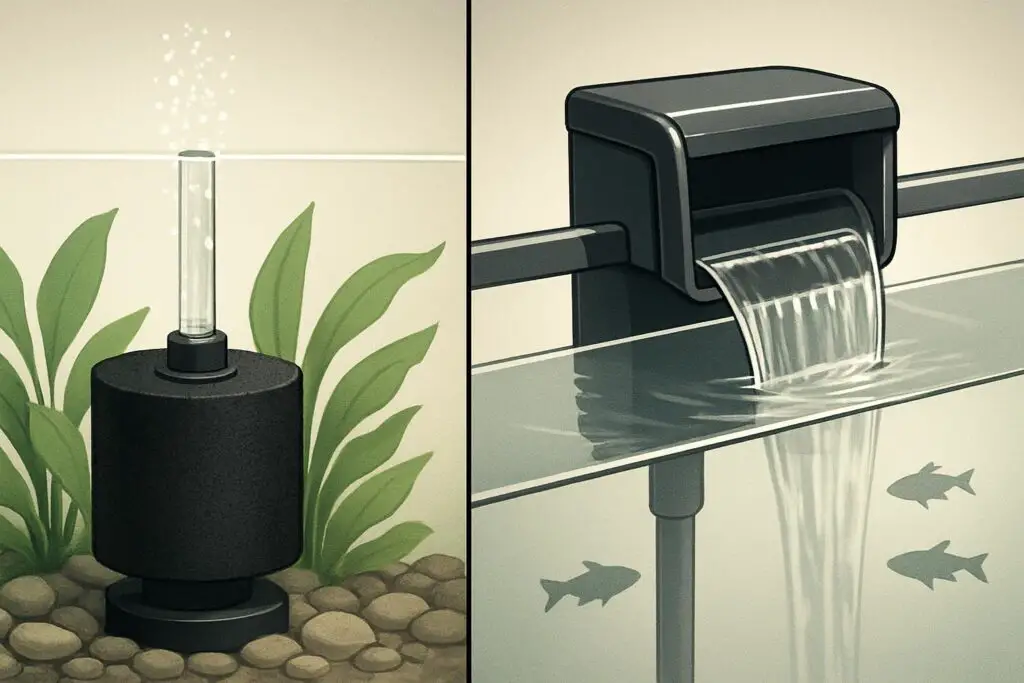
A sponge filter is an air-driven filter. Air from a pump rises through an uplift tube. Water is pulled through a porous sponge. The sponge traps debris and hosts beneficial bacteria. There are no impellers to break. It is simple, cheap, and gentle.
What Is a Hang-on-Back Filter
A hang-on-back filter, often called a HOB, hangs on the rim of the tank. An electric motor pulls water up through an intake tube. Water passes through media for mechanical, biological, and optional chemical filtration. The cleaned water returns in a waterfall. It is a compact all-in-one device with stronger flow than most sponge setups.
Filtration Types and How Each Performs
Biological Filtration
Both options support nitrifying bacteria that convert toxic ammonia and nitrite to nitrate. Sponge filters dedicate almost all their media volume to biofilm. They are excellent at stable biofiltration once mature. HOB filters can also carry strong bio media. Use a permanent sponge or ceramic media basket in a HOB to match or exceed sponge capacity. Do not rely only on thin disposable cartridges for biofiltration.
Mechanical Filtration
Mechanical filtration traps floating debris. HOB filters have the edge here because you can pack fine floss for water polishing and stage media from coarse to fine. Sponge filters trap debris too but have coarser pores. You can choose finer sponges, but they clog faster and reduce flow if you delay cleaning. For crystal clarity, a HOB is usually better.
Chemical Filtration
HOB filters allow easy use of chemical media like activated carbon, phosphate removers, or resins. This helps remove odors, meds after treatment, or specific contaminants. Sponge filters do not have chemical media by default. You can add a small bag of carbon near the sponge or in the uplift flow, but space is limited and results vary. If you need chemical control often, a HOB is more convenient.
Flow, Aeration, and Gas Exchange
Oxygenation
Sponge filters shine at aeration. Rising bubbles move water and increase gas exchange. This helps at night in planted tanks and in warm tanks where oxygen is lower. HOB filters also oxygenate by agitating the surface. Keep the water level slightly below the return lip for more surface movement, but not so low that noise and splash become a problem.
Current Control
Some fish dislike strong flow. Betta, fancy guppies, dwarf gourami, and small fry prefer gentle current. Sponge filters are easy to tune with an air valve. Many HOBs have adjustable flow, but even at low settings, the output can be too strong for delicate species in small tanks. Baffling the return or adding an intake sponge can help reduce current and protect fish.
Noise and Appearance
Noise Sources
Sponge filters depend on the air pump. A good pump is quiet, but cheap pumps can hum. Place the pump on a soft pad to reduce vibration. Use quality airline and a check valve. HOB filters have motor and waterfall noise. Most are quiet when primed and filled to the right level. As water evaporates, the waterfall can get louder. Top off the tank to keep noise down.
Visual Impact
Sponge filters sit inside the aquarium. A black sponge blends well with dark backgrounds and plants. In small display tanks, the sponge may still feel bulky. HOB filters hang on the back and keep the main view cleaner. You still see the intake tube and return lip. Choose based on what you want to see inside the tank.
Setup and Maintenance
How to Set Up a Sponge Filter
Rinse the sponge in tank water to remove dust. Assemble the sponge, uplift tube, and air stone inside the sponge if included. Connect airline to a check valve above the water line, then to the pump. Place the filter near a back corner. Start the air pump. Adjust the valve until you see steady, fine bubbles and gentle circulation. For larger tanks, run two sponge filters on opposite sides.
How to Set Up a Hang-on-Back Filter
Assemble the intake tube and media basket. Rinse all media. Do not use soap. Fill the HOB body with tank water to help priming. Hang it level on the back glass. Start the motor. Adjust the flow. Keep permanent sponge or bio media in place. Do not depend only on a thin cartridge for long-term biofiltration.
Maintenance Frequency and Method
Clean both filters every 2 to 4 weeks, or when the flow drops. Rinse media gently in removed tank water during a water change. Do not use tap water directly on bio media. For a sponge filter, squeeze and release the sponge several times until the water runs less brown. For a HOB, swish sponges and floss in tank water. Replace carbon only when you need chemical polishing or after medication removal. Never replace all media at once.
Protecting the Cycle During Cleaning
Beneficial bacteria live on media surfaces. Heavy scrubbing or complete media swaps can crash the cycle. To stay safe, clean one piece of media at a time. Keep at least half the established bio media untouched during any service. If you must replace a worn sponge, run the new sponge together with old media for a few weeks.
Costs and Long-Term Value
Sponge filters cost less up front. An air pump can power several sponges at once, which is budget friendly for multiple tanks. Sponges have almost no media replacement cost. HOB filters cost more initially and may need periodic media replacements. Many HOBs also use more power than an air pump, especially larger models. Over time, the lowest cost path is often a sponge filter or a HOB modified to use reusable sponges and ceramic media instead of disposable cartridges.
Reliability and Safety
Sponge filters have few failure points. If the air pump runs, water moves. A raised check valve prevents back-siphon. HOB filters depend on impellers and a primed intake. After a power outage or water change, some HOBs may fail to prime. Learn your model and test restart behavior. Both filter types can run for years with proper care.
Fry and Shrimp Safety
Sponge filters are safe for shrimp and fry. There is no strong intake to trap tiny animals. HOB intakes can suck in small shrimp and fry. Add an intake sponge prefilter to protect them and add extra bio media.
Tank Size and Stocking Level Guide
Small Tanks up to 10 gallons
A single sponge filter usually covers community fish and shrimp. Use a double-sponge unit for extra stability if stocking is moderate. A small HOB also works, but control the flow and shield the intake if you keep shrimp or fry.
Medium Tanks 15 to 40 gallons
Both options are viable. For gentle species and breeding setups, run two sponge filters or a large double-sponge with a strong air pump. For display tanks where clarity matters, a mid-size HOB with sponge and floss gives cleaner water. Adjust flow to match fish comfort.
Large Tanks 55 gallons and up
HOB filters scale better for larger tanks because of stronger mechanical capacity and higher turnover. You can also pair a HOB with one or two sponge filters for redundancy and bio support. If you keep heavy stock or messy fish, use a high-capacity HOB or two units, plus prefilters. Sponge-only setups become bulky at this size unless stocking is light.
Light vs Heavy Bioload
Light bioload tanks with small community fish, shrimp, or fry do well with sponges. Heavy bioload tanks with goldfish, cichlids, or big eaters benefit from a HOB for stronger mechanical and higher turnover. You can still use a sponge for extra bio and aeration.
Special Setups and Use Cases
Shrimp and Fry Tanks
Pick a sponge filter. It is intake safe and gentle. Add moss or fine plants for cover. Feed lightly to avoid clogging and keep maintenance simple.
Betta and Low-Flow Species
A sponge filter gives quiet, gentle circulation. If you prefer a HOB for clarity, pick a small adjustable model, baffle the return, and add an intake sponge.
Planted Tanks and CO2
Strong surface agitation can off-gas CO2. With pressurized CO2, keep surface movement moderate. A HOB on low flow with the water level close to the return lip limits gas loss. A sponge filter also agitates the surface due to bubbles. Tune the air rate to balance CO2 retention and oxygenation. In non-CO2 tanks, either option works well.
Quarantine and Hospital Tanks
Sponge filters are ideal. They are cheap, fast to set up, easy to disinfect, and safe for stressed fish. Keep a sponge filter running in a main tank or sump to seed it. Move it to the hospital tank when needed. After treatment, sterilize or retire that sponge.
Messy Fish and Overfeeding Risk
HOB filters handle visible waste and fines better. Use coarse sponge followed by fine floss. Rinse often to maintain flow. Add an intake sponge to stop large debris from clogging the impeller.
Water Clarity Expectations
Sponge filters maintain stable biological filtration but are limited at polishing fine particles. You can improve results using a finer pore sponge and keeping up with cleanings. For sparkle and very clear water, a HOB with staged mechanical media and optional carbon has a clear advantage. If you like ultra-clear displays, lean toward a HOB or run both.
Tuning and Upgrades
Improving a Sponge Filter
Use a quality air pump and an air control valve. Add a fine-bubble air stone inside the uplift for more lift and quieter operation. Choose sponge pore size based on your goals. Coarse for lower maintenance, fine for better clarity. Run two sponges in larger tanks for even flow and easy seeding.
Improving a Hang-on-Back
Replace disposable cartridges with a permanent sponge block and a layer of fine floss. Keep a bag of ceramic media in the basket for robust biofiltration. Add an intake sponge. Adjust the return level to reduce splash. If flow is too strong, baffle the output or use the built-in flow control.
Running Both Filters Together
Combining a sponge filter and a HOB gives you the best of both. The HOB provides stronger mechanical and optional chemical filtration. The sponge adds stable bio capacity and strong aeration. This setup adds redundancy. If one unit fails, the other keeps the tank safe while you fix the issue. It also gives you a seeded sponge on demand for a new tank or quarantine.
When running both, size total turnover to your fish. For a typical community tank, aim for 4 to 8 times tank volume per hour in total flow. Reduce HOB flow if fish show stress, torn fins, or if they hide from current. Use the sponge to maintain oxygenation while you tune the HOB for comfort and clarity.
Power Outages and Restarts
During outages, both filters stop moving water. The sponge retains moisture and protects bacteria longer because it is submerged. A HOB body can dry partly if the water drains down. When power returns, some HOBs need manual priming. Keep the intake strainer underwater, fill the filter box with tank water, and restart the motor. Check both filters for trapped debris or air locks after a restart.
Common Mistakes to Avoid
Do not overclean media or wash it under hot tap water. Do not throw away all HOB media at once. Do not run a HOB with only a thin cartridge if you rely on it for biofiltration. Do not run a sponge filter without a check valve if the pump sits below the water line. Do not ignore noise changes or flow drops. These are early warnings that service is due.
Quick Decision Guide
Choose a Sponge Filter If
You keep shrimp, fry, or low-flow species. You want the lowest cost, highest reliability, and easy seeding for new tanks. You prefer simple maintenance and do not need ultra-clear polishing.
Choose a Hang-on-Back If
You want clearer water with strong mechanical filtration. You plan to use chemical media when needed. Your tank is medium to large, or your fish are messy. You can manage flow to match your fish.
Choose Both If
You want redundancy, better oxygenation, and easy seeding while keeping display clarity. This combo covers most community tanks.
Realistic Expectations Over Time
The best filter is the one you will maintain on schedule. A well-kept sponge filter can keep fish healthy and stable for years. A well-tuned HOB can deliver both health and clear water. Match your filter to your tank, keep stocking reasonable, feed modestly, and change water regularly. Stability beats gadget chasing.
Conclusion
Both sponge filters and hang-on-back filters can run a healthy aquarium. Sponge filters deliver reliability, safety for small inhabitants, and strong biological stability at a low cost. HOB filters deliver better water clarity, flexible media choices, and stronger flow for larger or messier setups. Pick based on your fish, tank size, and your tolerance for flow, noise, and maintenance. If in doubt, run both. You will gain clarity, oxygenation, and a backup plan in a single step.
FAQ
Which is better for a shrimp or fry tank
A sponge filter is better because it has a safe intake, gentle flow, and strong biological filtration without the risk of trapping tiny animals.
How often should I clean a sponge filter and a Hang-on-Back
Clean both every 2 to 4 weeks or when flow drops. Rinse media in removed tank water, not under the tap. Replace carbon only when needed and never replace all media at once.
Will a Hang-on-Back outcompete a sponge filter for water clarity
Yes. A HOB usually wins on fine mechanical filtration and optional chemical media. You can improve a sponge with finer pores and frequent cleaning, but a HOB still has the clarity advantage.
Can I run both a sponge filter and a Hang-on-Back at the same time
Yes. Running both adds redundancy, better oxygenation, stronger bio capacity, and easy seeding. Keep total turnover around 4 to 8 times tank volume per hour and reduce HOB flow if fish show stress.
Do sponge filters work without an air pump or powerhead
No. A sponge filter needs an air pump or a powerhead to move water through the sponge. It will not work by itself.