
We are reader supported. When you purchase through links on our site, we may earn an affiliate commission. Also, as an Amazon affiliate, we earn from qualifying purchases.
A stable aquarium depends on stable water chemistry, and hardness is a core part of that stability. Two values control it day to day. GH tells you how much calcium and magnesium are in the water. KH tells you how much carbonate and bicarbonate are available to buffer pH. When you understand GH and KH, testing and adjusting your water becomes predictable. This guide shows you what these numbers mean, how to test them correctly, how to read the results, and how to adjust them without risking livestock.
Introduction
Many aquarists chase pH and still see fish stress, algae swings, or plant issues. The reason is simple. You can only control pH if you first control KH. You can only support fish bones, shells, and healthy osmoregulation if you match GH to their needs. The good news is that hardness is easy to measure and manage with the right routine. Keep reading to build a clear testing plan, a safe adjustment plan, and a maintenance plan that keeps GH and KH steady week after week.
GH and KH explained
What is GH
GH stands for general hardness. It measures the concentration of calcium and magnesium ions in the water. These minerals are essential for fish nerve function, bone growth, and for invertebrates to build shells. GH does not directly buffer pH, but it sets the mineral background of your tank. GH is reported in degrees of hardness dGH or in parts per million ppm as calcium carbonate. The conversion is simple. 1 dGH equals 17.9 ppm as CaCO3.
What is KH
KH stands for carbonate hardness, also called alkalinity. It measures carbonate and bicarbonate that neutralize acids and resist pH swings. A higher KH means more buffering capacity and more stable pH. KH is reported as dKH or ppm as CaCO3. The same conversion applies. 1 dKH equals 17.9 ppm as CaCO3.
Where GH and KH come from
Tap water hardness comes from local geology. Limestone and dolomite add both GH and KH. Granite areas tend to yield soft water with low GH and KH. Inside the tank, crushed coral and aragonite raise KH and GH slowly. Active plant soils often lower KH and hold pH lower. Driftwood and leaf litter add tannins that soften the feel of the water but do not meaningfully lower GH or KH.
Why GH and KH matter
Fish health and osmoregulation
Fish constantly balance salts and water across their gills and skin. If GH is far from what a species evolved in, they spend extra energy maintaining balance. That shows up as stress, poor color, and disease risk. Livebearers and African rift lake cichlids prefer higher GH. Many tetras and wild-caught dwarf cichlids prefer lower GH.
pH stability and KH
Biological filtration produces acids that slowly consume KH. If KH is low, pH can crash. A crash often looks like gasping fish in the morning and beneficial bacteria stress. With adequate KH, pH holds steady even as acids are produced. That reduces stress on everything in the tank.
Plants and invertebrates
Plants use calcium and magnesium as secondary nutrients. Shrimp and snails need steady calcium to build exoskeletons and shells. Too little GH can cause molting issues or shell pitting. The right GH and KH support steady growth and predictable breeding.
How to test GH and KH
Choose your test method
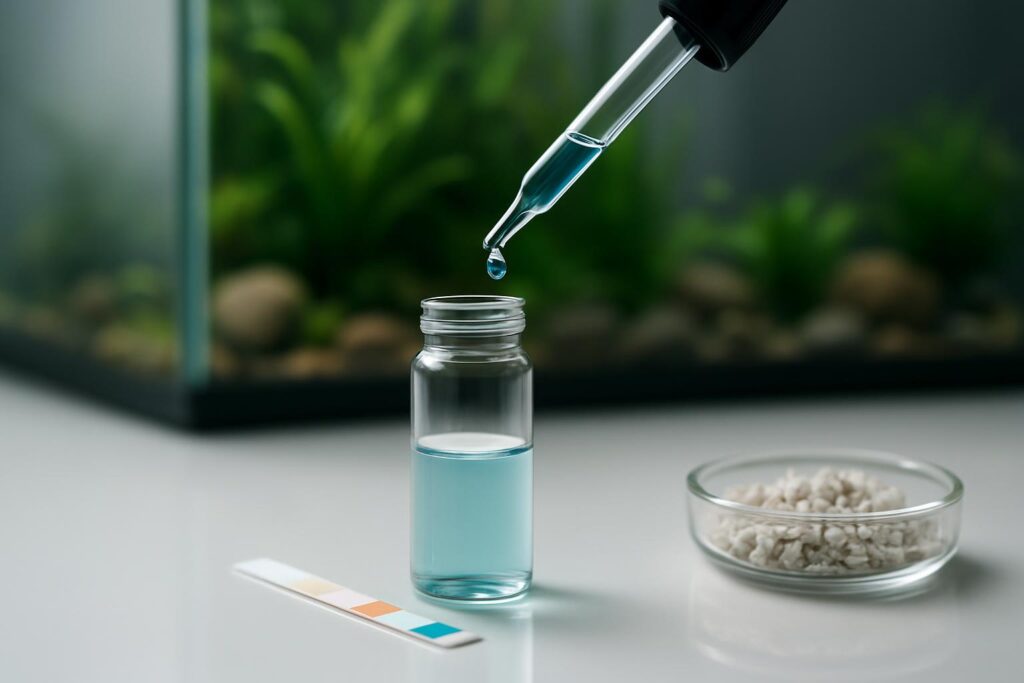
Liquid titration kits are the gold standard for home aquariums. You fill a test vial to a marked line, add reagent drops, and count the drops until the color changes. The number of drops equals dGH or dKH. These kits are inexpensive and precise to 1 dKH or 1 dGH.
Test strips are fast and convenient but less precise. They are fine for a quick check and for spotting trends, but verify important decisions with a liquid kit.
Digital TDS or conductivity meters measure total ions in the water. They do not report GH or KH specifically. Use them to track overall mineral load, but still run GH and KH tests for targets.
Step by step with a liquid GH kit
Rinse the vial with tank water. Fill to the line, usually 5 milliliters. Add 1 drop of GH reagent, cap, and swirl. Repeat one drop at a time, swirling after each drop, until the color shifts and stays shifted. Count the drops. 1 drop equals 1 dGH. Multiply by 17.9 for ppm as CaCO3 if needed. Record the result.
Step by step with a liquid KH kit
Rinse the vial with tank water. Fill to the line. Add 1 drop of KH reagent, cap, and swirl. Continue adding and swirling until the color holds at the final color. Count the drops. 1 drop equals 1 dKH. Record the result.
Using test strips correctly
Dip once for the time stated on the label. Hold the strip flat and wait the full development time. Read under good light and compare to the color scale. Strips vary by brand. Follow the specific timing printed on the package to avoid errors.
What and when to test
Test your tap or source water so you know the baseline. Test your tank water weekly for new setups or when you are making changes. Once the tank is stable, test monthly and always before and after large water changes, adding buffers, or adding hardscape that can change hardness. Keep notes. A simple log avoids guesswork and shows trends clearly.
Understanding your results
Units and conversions
Use dGH and dKH for daily work. If a product lists ppm as CaCO3, divide by 17.9 to get degrees. If your kit reports in drops, each drop with a 5 milliliter sample equals 1 degree.
Target ranges by aquarium type
Community fish from mixed backgrounds do well at GH 4 to 10 dGH and KH 3 to 8 dKH. Livebearers such as guppies, platies, and mollies prefer GH 8 to 15 dGH and KH 5 to 12 dKH. African rift lake cichlids prefer high values, often GH 12 to 20 dGH and KH 10 to 18 dKH. Softwater species such as many tetras, rasboras, and apistogramma often thrive at GH 2 to 6 dGH and KH 1 to 4 dKH. Neocaridina shrimp do well around GH 6 to 12 dGH and KH 3 to 8 dKH, while Caridina often prefer lower GH and KH with specific remineralization. Planted tanks generally like moderate GH and KH, with CO2 and nutrient supply balanced against buffering.
Match targets to your livestock, and avoid sudden changes. Many bred-in-captivity fish are flexible within reason, but wild-caught fish do better with closer matches.
Reading drift and trends
KH often declines slowly between water changes because biological filtration consumes alkalinity. GH may climb over time if you top off evaporation with tap water. Always top off evaporation with RO or distilled water to avoid hardness creep. If you see a trend, correct it gradually rather than making a large one-time adjustment.
How GH and KH interact with pH
KH buffers pH
KH controls resistance to pH change. Higher KH means pH resists swings from acids produced by the system. Lower KH means pH will move more with the same acid load. This is why a tank with low KH can swing between day and night as CO2 and oxygen levels change.
CO2 and pH
CO2 injection lowers pH by forming carbonic acid, but it does not change KH. When CO2 shuts off, pH rises back. The alkalinity stays the same unless you add or remove buffers. For that reason, judge CO2 by a drop checker or pH drop relative to degassed water, not by a perceived KH change.
Active soils and buffering
Some planted tank soils exchange ions to hold pH lower and soften the water. They tend to reduce KH and can slightly reduce GH. This effect is strongest at the start and weakens over months. Plan your targets with this in mind and test more often during the first months after setup.
How to raise GH and KH safely
Principles for safe adjustments
Change hardness slowly. Aim to move no more than 1 to 2 dGH or dKH per day. Dose, mix thoroughly, wait 30 minutes, test again, and repeat if needed. Make most adjustments in new water before it enters the tank. Consistency beats speed.
Raising GH
Use a commercial GH booster or remineralizer for predictable results. These products provide calcium and magnesium in a known ratio. Dose per label, then test and fine-tune.
For DIY adjustments, use calcium sulfate or calcium chloride for calcium, and magnesium sulfate for magnesium. A Ca to Mg ratio between 3 to 1 and 4 to 1 by ppm works well for most freshwater fish and plants. Measure powders with a scale, dissolve in water, add to a bucket of change water, and test GH. Adjust in small steps.
Crushed coral and aragonite add both GH and KH slowly. Place a small amount in a media bag in the filter and test weekly. Increase the amount gradually if needed. This is a gentle option for systems that need a steady buffer without frequent dosing.
Raising KH
Sodium bicarbonate baking soda is effective and immediate. For a measured approach, 1 gram of baking soda added to 10 US gallons about 38 liters of water raises KH by roughly 0.9 dKH. Dissolve it fully in a container of water before adding. Mix well and retest. Dose in steps.
Crushed coral or aragonite also increases KH gradually as water flows over it. This is useful for ongoing support rather than quick fixes. Commercial alkalinity buffers are another option. Use them in new water and confirm with a KH test.
How to lower GH and KH safely
Use dilution, not rapid chemicals
The safest way to lower GH and KH is to mix your tap water with RO, DI, or distilled water. RO and distilled water contain almost no minerals, so they dilute hardness without surprise reactions. You can plan the mix with a simple formula.
Fraction of tap water needed equals target hardness divided by tap hardness. For example, to reach 6 dGH from tap at 12 dGH, use half tap and half RO. Apply the same approach to KH. Always test the mixed water before it goes into the tank.
Avoid rapid acid-based reducers. They can burn KH quickly and cause a pH crash. If you must use a chemical buffer to aim for a specific pH, raise KH first to a stable level, then adjust gently and test often.
Softening effects from materials
Peat and active soils can lower KH and slightly lower GH by ion exchange. These methods are variable and fade over time. If you use them, test more frequently, and be ready to adjust with small water changes and measured remineralization.
Practical testing routine
Weekly checks for new or changing tanks
Test GH and KH once per week. Log the results. If KH falls by more than 1 dKH per week, add a small buffer to your new water before each change. If GH drifts upward over time, switch top offs to RO or distilled and match your change water to your target.
Monthly checks for stable tanks
When livestock and plants are healthy and parameters hold steady, test GH and KH monthly. Also test any time you change feeding, add new hardscape, upgrade filtration, or change substrate. Seasonal shifts in tap water are common. A quick tap test once per month avoids surprises.
Before and after maintenance
Test source water before big water changes. Test the tank again after the change settles for 30 minutes. This confirms that your mixing plan works and prevents creeping parameter drift.
Troubleshooting common problems
KH keeps dropping and pH swings
Nitrifying bacteria use up KH over time. Increase the KH of your change water slightly. Consider a small bag of crushed coral in the filter. Clean detritus, avoid overfeeding, and keep regular water changes to control the acid load.
GH climbs over months
Stop topping off with tap water. Only top off evaporation with RO or distilled water. During water changes, match the target GH by mixing in some RO. Test plants and invertebrates for mineral needs and avoid overshooting GH with unmeasured additives.
Test results are inconsistent
Check expiration dates on reagents. Store kits cool and dark. Rinse vials with test water before each use. Swirl after every drop. Follow timing on strips. If in doubt, cross-check with a second kit or a reference solution. Avoid cross contamination by using clean droppers and not mixing caps between bottles.
TDS is high but GH and KH are moderate
Fertilizers and other salts add to TDS without adding GH or KH. That is normal in planted tanks. Rely on GH and KH tests for hardness targets. Use TDS only to track overall mineral load trends.
Real world examples
Raising KH for a livebearer tank
Your tank reads GH 9 dGH and KH 2 dKH. You want KH 6 dKH for better stability. Prepare a 20 gallon change. Dissolve 9 grams of baking soda into the new water to raise its KH by about 4 dKH based on 1 gram per 10 gallons equals 0.9 dKH. Mix well and test. If it reads 4 dKH above your tap baseline, proceed with the change. Recheck the tank after 30 minutes. Fine-tune in small steps over a few changes.
Softening water for wild tetras
Your tap is GH 10 dGH and KH 6 dKH. You target GH 5 dGH and KH 2 dKH. Mix equal parts tap and RO to yield around GH 5 and KH 3. Test and adjust with a little more RO to reach KH 2. Keep KH changes under 2 dKH per day. Transition over two or three water changes to reduce stress.
Buffering a planted, CO2 injected tank
Your KH sits at 1 dKH and pH bounces. You want 3 dKH for steadier pH. Add a small bag of crushed coral to the filter and raise KH in new change water by 2 dKH using baking soda. Monitor weekly. The crushed coral will help maintain KH between changes without abrupt jumps.
Key safety reminders
Change slowly
Do not adjust more than 1 to 2 dGH or dKH per day. Fish and invertebrates handle stable parameters better than perfect numbers that swing.
Pre-mix adjustments
Whenever possible, adjust hardness in a separate container. Test and confirm. Add to the tank after temperature and dechlorination match.
Test, record, repeat
Write down what you added, when you added it, and the before and after readings. Repeatable habits remove guesswork and prevent mistakes.
Conclusion
GH sets the mineral foundation. KH sets the pH buffer. Together they define how stable and healthy your water will be. Test them with a reliable kit, interpret them in degrees, and adjust them in measured steps. Use RO mixing to lower, remineralizers or gentle buffers to raise, and steady routines to hold the line. When GH and KH are under control, fish settle in, plants grow consistently, and maintenance takes less time. Start with a baseline test today, set clear targets for your livestock, and build a simple routine that keeps hardness right where you want it.
FAQ
Q: What is the difference between GH and KH
A: GH measures calcium and magnesium hardness. KH measures carbonate and bicarbonate alkalinity that buffers pH.
Q: How often should I test GH and KH
A: Test weekly on new or changing tanks. Once stable, test monthly and always before and after large water changes or buffering.
Q: What is the safest way to lower KH
A: Dilute with RO or distilled water and recheck. Avoid rapid acid-based reducers. Aim to change no more than 1 to 2 dKH per day.
Q: Does CO2 injection change KH
A: No. CO2 can lower pH temporarily but it does not add or remove alkalinity. KH stays the same unless you add or remove buffers.
Q: Can a TDS meter replace GH and KH tests
A: No. TDS shows total dissolved solids, not the split between calcium, magnesium, and alkalinity. Use GH and KH tests for targets.