
We are reader supported. When you purchase through links on our site, we may earn an affiliate commission. Also, as an Amazon affiliate, we earn from qualifying purchases.
RO water confuses many aquarists because it sounds technical, yet it solves everyday water problems. If you want stable parameters, fewer algae triggers, and healthier fish, reverse osmosis is a practical tool. In this guide, you will learn what RO water is, why and when to use it, how to remineralize it, and how to avoid common mistakes.
Introduction to RO Water in Aquariums
Reverse osmosis, often called RO, is a way to purify water by forcing it through a semi-permeable membrane. The membrane allows water molecules through but rejects most dissolved salts and contaminants. The result is very pure water with near-zero minerals.
Aquarists use RO because it gives control. Tap water varies by city and season. RO water is consistent. You can add back the exact minerals your fish or corals need. That consistency protects animals that react to small changes and keeps systems stable over time.
What RO Water Is and Is Not
RO water is purified by a reverse osmosis membrane that removes most dissolved solids, leaving near-zero TDS, GH, and KH. It is not the same as distilled water, which is boiled and condensed, or deionized water, which is purified by ion exchange resin. Many reef keepers use RODI, which means reverse osmosis followed by deionization, for even lower TDS.
How Reverse Osmosis Works
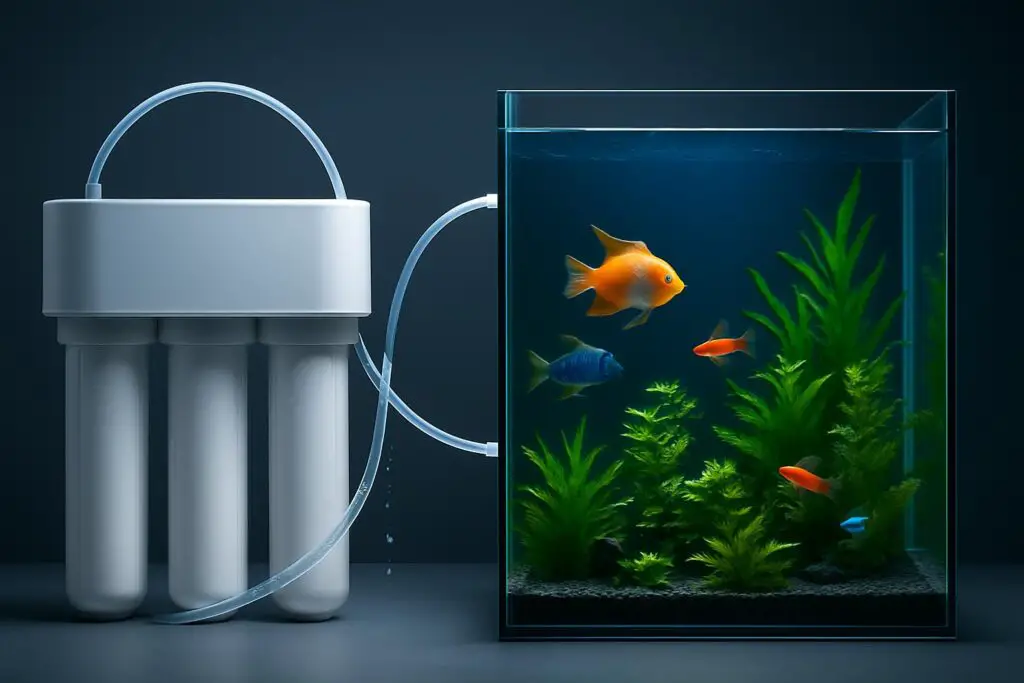
An RO system has three main parts. First, prefilters remove sediment and chlorine or chloramine with a sediment cartridge and a carbon block. Second, the RO membrane rejects most dissolved ions, heavy metals, nitrates, and other contaminants. Third, an optional DI stage polishes the water to near zero TDS for reef use.
Most home units produce a mix of purified water and waste water. Expect a waste ratio around 1 to 3 parts waste for each part of RO water, depending on pressure, temperature, and membrane type. Use the waste water on houseplants, gardens, or cleaning to reduce waste.
What RO Changes in Your Water
RO drops TDS, GH, and KH to very low levels. Without KH buffering, pH can swing easily in pure RO water. This is why remineralization is essential for aquarium use. RO removes many problem substances from tap water, including chlorine, chloramine, heavy metals, nitrate, phosphate, and silicate.
Key Benefits of RO Water for Fish and Aquariums
Consistency and Control
Consistency is the main gain. With near-zero base water, you are in control of hardness, alkalinity, and pH. You can repeat a recipe for every water change. The fish get stable conditions week after week.
Cleaner Base Water
RO reduces chlorine, chloramine, heavy metals, nitrate, phosphate, and silicate. Lower nitrate and phosphate help reduce algae fuel in freshwater and reef tanks. Fewer metals means less stress on sensitive invertebrates like shrimp and coral.
Better Breeding and Health for Soft Water Species
Fish from soft, acidic habitats often struggle in hard tap water. RO lets you set low GH and KH safely. Many soft-water species show better color, spawn more easily, and raise fry more reliably when the water matches their natural hardness and pH range.
Stable Marine and Reef Systems
Reef tanks depend on clean, consistent water. Start with RO or RODI and add a quality marine salt. This avoids silicates and phosphates that often cause diatom blooms and nuisance algae. It also avoids trace metals that can irritate corals and invertebrates.
Planted Tank Benefits
Plants thrive when nutrients are present and carbonate hardness is controlled. Low to moderate KH lets CO2 drop pH predictably for better CO2 uptake. RO also avoids unwanted calcium or carbonate buildup that can inhibit certain plants and reduce leaf pearling.
Shrimp Keeping
Caridina shrimp prefer soft, low KH water with a defined GH. RO plus a shrimp-specific remineralizer makes this easy. Neocaridina prefer a bit more GH and KH. Both respond well to consistent, clean water made from RO.
Do You Need RO Water
You may not need RO if your tap water already matches your target parameters and your livestock is hardy and thriving. Many community fish tolerate a wide range of hardness and pH if kept stable. If your water is extreme, inconsistent, or contaminated, RO helps.
Signs You Will Benefit
- Very hard or very soft tap water that does not fit your species
- High nitrate or phosphate in tap water
- Reef tanks or sensitive invertebrates
- Breeding soft-water fish or keeping Caridina shrimp
- Algae issues linked to tap water nutrients or silicates
When Tap Water Can Work
- Hardy fish with wide tolerance
- Tap parameters already near your target
- Reliable municipal water without problematic contaminants
Remineralization Is Mandatory
Never use pure RO water for fish or shrimp; always remineralize it to the target GH and KH before use. Pure RO lacks calcium and magnesium for osmoregulation and growth, and it has almost no buffering to hold pH steady.
Freshwater Targets and Products
Use a freshwater remineralizer to set GH and KH. Some products increase GH only, some increase both GH and KH, and some are shrimp specific. Add according to directions, then test and adjust.
- Community tank starting point: For a typical community freshwater tank, a good starting point is GH 4–8 dGH and KH 3–6 dKH with pH 6.5–7.5.
- Soft-water species: GH 1–4 dGH, KH 0–2 dKH, pH in the 5.5–7.0 range depending on species
- Neocaridina shrimp: GH 6–8 dGH, KH 2–4 dKH
- Caridina shrimp: GH 4–6 dGH, KH 0–1 dKH using a GH-only shrimp mineral
- African rift cichlids: GH 10–20 dGH, KH 8–12 dKH using buffer salts
Marine and Reef Targets
For reef aquariums, always start with RO or RODI water and then mix a quality marine salt to 35 ppt salinity. Good salt mixes also establish baseline alkalinity, calcium, and magnesium. After mixing, heat and aerate, then match temperature and salinity to the tank before changes.
Mixing RO with Tap Water
You can blend RO with tap water to reach a target hardness; GH and KH blend roughly linearly by ratio. This works when your tap water is clean but a bit too hard.
Simple Ratio Method
Test your tap GH and KH. Decide your target. The share of RO you add lowers both GH and KH proportionally.
Example: Tap GH 12 dGH and target GH 6 dGH. Mix half RO and half tap to get near 6 dGH. Always test the mix before using it.
Setting Up an RO Unit
Stages and Options
- Three-stage: sediment, carbon, RO membrane for freshwater
- Four or five-stage: adds extra carbon or a DI stage for very low TDS
- Reef use: RODI is preferred for near-zero TDS
Installation Basics
Units connect to a kitchen faucet, laundry tap, or under-sink feed. Mount vertically to keep the membrane wet. Use food-grade tubing and a clean storage container. A handheld TDS meter is essential to check output quality.
Production Rate and Waste
RO membranes are rated in gallons per day, but real output depends on water pressure and temperature. Colder water and low pressure reduce production. Expect a waste ratio from 1:1 to 3:1. If your unit has a flush valve, flush the membrane for a minute before and after use to extend its life.
Maintenance and Monitoring
Filter Changes
- Sediment and carbon: replace on schedule or when pressure drops
- RO membrane: replace when rejection drops or product TDS rises
- DI resin: replace when resin is exhausted and product TDS rises above zero
Chloramine in tap water requires strong carbon blocks or dual carbon stages. Check your local water report to choose the right carbon filter.
TDS and Rejection
Use a TDS meter to track three points. Tap water TDS, RO water TDS, and if used, post-DI TDS. Healthy membranes reject the vast majority of TDS. When RO TDS rises significantly, check prefilters, flush the membrane, and consider replacement.
Step-by-Step Workflow for RO Water Changes
1. Test and Plan
- Measure tap GH, KH, pH, and TDS
- Pick targets based on livestock
- Decide to use pure remineralized RO or RO blended with tap
2. Produce RO Water
- Flush the system briefly
- Collect RO in a clean food-grade container
- Measure product TDS to confirm quality
3. Remineralize
- Add remineralizer according to your target
- Stir, heat, and aerate the water
- Test GH, KH, and for marine, salinity
4. Match and Change
- Match temperature to the tank
- Match salinity for marine or GH and KH for freshwater
- Perform the water change steadily to avoid sudden swings
Common Mistakes to Avoid
Using Pure RO in the Tank
This is the most serious mistake. Pure RO causes osmotic stress and pH instability. Always remineralize before use.
Chasing pH Instead of KH
pH stability follows KH. Set the right KH for your fish, then let pH settle. Avoid constant pH adjusters without addressing alkalinity.
Inconsistent Mixing
Use the same measuring tools and process every time. Weigh powders if possible. Test the result before changes.
Not Matching New Water to the Tank
Large mismatches in temperature, GH, KH, or salinity stress animals. Match first, then change water.
Ignoring Source Water Nutrients
If tap water brings in nitrate, phosphate, or silicate, you may fight algae. RO removes these inputs so you can control nutrients with feeding and filtration.
Troubleshooting With RO
pH Crashes
If pH falls fast, KH is too low. Increase KH slightly during remineralization. Keep maintenance regular to avoid organic acid buildup.
TDS Drift Over Time
Evaporation leaves minerals behind and raises TDS. Top off with pure RO, not remineralized water, so salinity or hardness does not creep up.
Algae Persists After Switching
RO reduces nutrients coming in, but you still need good export. Improve filtration, reduce feeding, increase water change volume, and manage light duration.
Fish Stress After Switching
Large parameter shifts can shock fish. Move toward targets over several small water changes rather than one big jump.
Shrimp Molting Problems
Check GH, KH, and TDS. Shrimp need stable calcium and magnesium. Use shrimp-specific minerals and keep parameters consistent.
Cost and Practical Tips
Buying RO Water vs Making Your Own
Stores often sell RO or RODI water. This is fine for small tanks or occasional use. For larger aquariums or reef systems, owning a unit saves time and money long term.
Storage
Store RO and mixed saltwater in sealed, food-safe containers. Use circulation and heat for mixed saltwater. Label containers to avoid cross-use.
Use Waste Water Wisely
Collect waste water for plants, cleaning patios, or flushing drains. Avoid using it for drinking or aquariums.
Conclusion
RO water gives you control, consistency, and a clean starting point. It removes many tap water variables and lets you set exact hardness and alkalinity. This benefits freshwater community tanks, soft-water breeders, shrimp, and especially reef aquariums. The key is simple. Produce quality RO, remineralize to clear targets, match parameters to the tank, and keep a steady routine.
FAQ
Q: What is RO water in simple terms
A: RO water is purified by a reverse osmosis membrane that removes most dissolved solids, leaving near-zero TDS, GH, and KH.
Q: Do I always need RO water for my aquarium
A: You may not need RO if your tap water already matches your target parameters and your livestock is hardy and thriving.
Q: Can I mix RO water with tap water
A: You can blend RO with tap water to reach a target hardness; GH and KH blend roughly linearly by ratio.
Q: What are safe starting parameters for a community freshwater tank
A: For a typical community freshwater tank, a good starting point is GH 4–8 dGH and KH 3–6 dKH with pH 6.5–7.5.
Q: Is RO mandatory for reef tanks
A: For reef aquariums, always start with RO or RODI water and then mix a quality marine salt to 35 ppt salinity.