
We are reader supported. When you purchase through links on our site, we may earn an affiliate commission. Also, as an Amazon affiliate, we earn from qualifying purchases.
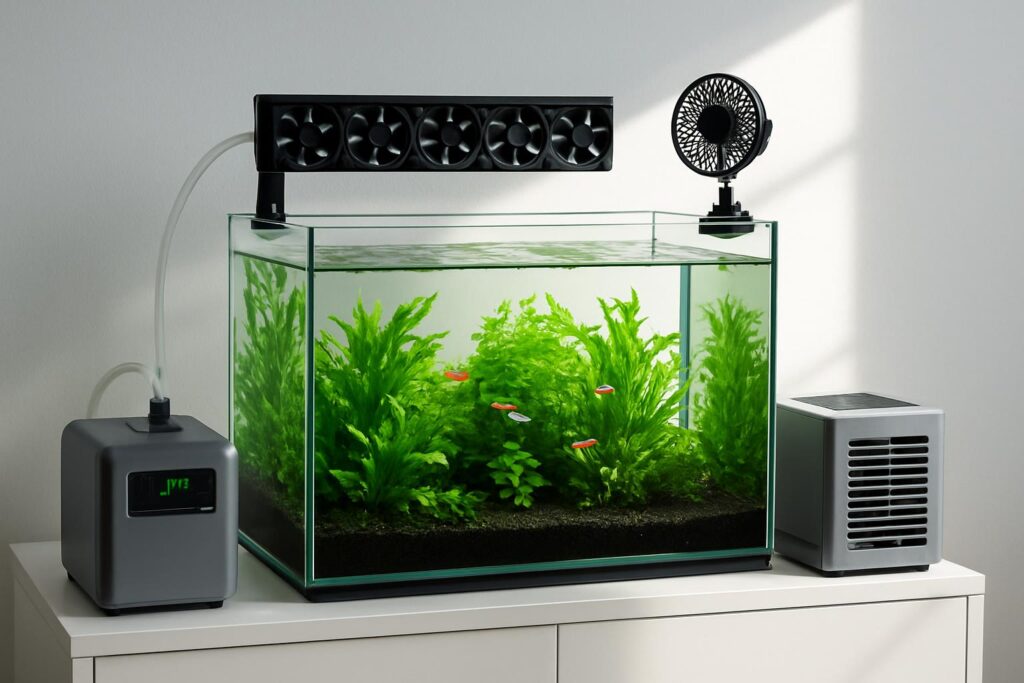
Summer heat pushes aquariums past safe limits fast. Warm water holds less oxygen, accelerates metabolism, and stresses livestock. Sensitive species go downhill quickly when temperatures creep above target. The good news is you can control heat with the right cooling system matched to your tank size, room conditions, and budget. This guide breaks down the four most effective cooling options, explains how each one works, and shows you how to set up for stable temperatures all season.
Why hot weather is risky for aquariums
Fish and corals rely on consistent temperature. Short spikes can cause appetite loss, labored breathing, and opportunistic infections. Extended heat leads to algae blooms, coral bleaching in reefs, and die-offs in planted tanks due to oxygen crashes at night. Action before the heat wave is the best insurance.
Clear signs your tank is overheating
Surface gasping or fish hanging near flow outputs. Lethargy during daytime that improves after lights out. Unexpected algae bursts. Coral tissue paling. Temperature swings greater than 2 F within a day. If you see these, move quickly to stabilize.
Two proven ways to cool water
Evaporative cooling uses fans to blow air across the surface. As water evaporates, it removes heat from the tank. This is efficient for small to mid-size tanks but increases evaporation rate and room humidity.
Active chilling removes heat using a chiller. Thermoelectric models suit nanos and small systems. Compressor chillers handle larger volumes and big temperature drops. They cost more but deliver stable control regardless of room humidity.
How to choose a cooling system that fits
Match tank size and target temperature drop
Aim for the smallest tool that reliably holds your setpoint. Fans can shave 2 to 4 F on most nanos and mid-size tanks, more in dry climates. Thermoelectric chillers handle 2 to 8 F drops on small volumes. Compressor chillers are the right call when you need 5 to 15 F drops on medium to large systems or when your room is very warm.
Account for livestock and salinity
Reef tanks and cool-water species need tight control. Saltwater sprays corrode cheap metals, so look for titanium or plastics in any component that contacts water. Fans work well on rimmed or rimless tanks but keep salt creep in check with regular wiping.
Noise, power, and placement
Fans are quiet and sip power. Thermoelectric chillers are near silent. Compressor chillers hum like a mini fridge and need ventilation space to dump heat. Place chillers outside cabinets if airflow is restricted. Ensure safe cord management and drip loops.
The 4 best aquarium cooling systems for summer heat
1. NICREW Aquarium Cooling Fan
The NICREW fan bar is a simple and effective evaporative cooler for nano to mid-size aquariums. It clamps to the rim and angles airflow across the surface. Available in multi-fan configurations, it can cut a few degrees quickly without complex plumbing.
Why it helps
Strong surface airflow accelerates evaporation and heat loss. This stabilizes temperature during peak daylight and prevents afternoon spikes.
Best for
Nano to about 30 gallons. Freshwater, planted, and reef pico tanks that need a 2 to 4 F reduction. Apartment setups where a full chiller is overkill.
Key specs
Cooling method: Evaporative fan bar
Typical drop: 2 to 4 F depending on room humidity
Noise: Low fan whir
Controls: Manual on and off; pair with an external temperature controller for automation
Maintenance: Wipe blades and grill, check screws, clear salt creep
Setup tips
Angle fans to skim the surface, not blast the water directly. Leave some lid opening or use mesh tops. Use an auto top-off to handle evaporation. Combine with a digital thermostat to cycle the fan based on temperature for steady results.
Potential downsides
Increases evaporation and room humidity. Temperature control is not precise without a controller. Salt creep can build up around the mount and needs wiping.
2. Zoo Med Aqua Cool Aquarium Cooling Fan
The Zoo Med Aqua Cool is a compact, targeted fan with a flexible neck. It is easy to aim directly at hot spots like the light splash zone or high-flow surface areas. It delivers quick evaporative cooling for nanos and desktops.
Why it helps
Focused airflow improves efficiency on small tanks where space is tight. The gooseneck lets you dial in the angle for maximum evaporation.
Best for
Nano tanks up to about 20 gallons. Shrimp tanks, betta setups, small reefs. Users who want a discreet fan that mounts cleanly without long bars.
Key specs
Cooling method: Single-fan evaporative cooling
Typical drop: 2 to 3 F on small systems, more in dry rooms
Noise: Low
Controls: Simple on and off, works well with plug-in thermostats
Mounting: Rim or stand mount with adjustable neck
Setup tips
Position near the hottest zone, usually under the light. Keep at least half the surface open for air exchange. Combine with a mesh lid or slide the glass lid back slightly during heat waves.
Potential downsides
Limited capacity for tanks above 20 gallons. Still adds evaporation that must be replaced to keep salinity stable in reef tanks.
3. IceProbe Thermoelectric Aquarium Chiller
The IceProbe is a compact thermoelectric chiller that uses a Peltier element to pull heat from the water. It shines on nanos and small tanks where fans are not enough but a compressor chiller is too much. Installation options include bulkhead mounting to a sump, hang-on filters, or inline with small canisters.
Why it helps
Active chilling does not rely on evaporation or room humidity. It delivers steady temperature reductions with almost silent operation.
Best for
Tanks up to about 10 gallons for 5 to 8 F drops. Up to about 20 gallons for modest 2 to 4 F reductions. Office and bedroom setups where low noise is critical.
Key specs
Cooling method: Thermoelectric Peltier module with heatsink and fan
Typical drop: 2 to 8 F depending on volume and heat load
Noise: Very low hum from the small fan
Controls: Add an external temperature controller for automation
Plumbing: Bulkhead mount through a panel, or adapt to small filters or sumps
Setup tips
Plan the mounting point where water flows well. Use thermal paste as directed for efficient heat transfer. Ventilate the heatsink side and keep lint off the fan. Wire to a temperature controller for accurate cycling.
Potential downsides
Limited capacity for mid-size tanks. Requires careful installation for leak-free bulkhead mounting. Best performance comes with a controller, which is an added cost.
4. JBJ Arctica Aquarium Chiller 1/10 HP
For reliable, precise cooling on medium systems, the JBJ Arctica 1/10 HP is a proven compressor chiller. It uses a titanium heat exchanger that is safe for saltwater and provides strong BTU capacity with a built-in digital thermostat. It handles tough heat loads and holds a stable setpoint even in hot rooms.
Why it helps
Compressor chillers remove heat regardless of humidity and can deliver large temperature drops with accuracy. The integrated controller simplifies setup and daily use.
Best for
Roughly 30 to 75 gallon systems depending on heat load, lighting, and desired drop. Reef tanks, planted tanks with strong lights, and axolotl systems that demand cool, stable water.
Key specs
Cooling method: Compressor chiller with titanium coil
Typical drop: 5 to 15 F depending on tank and load
Noise: Comparable to a mini fridge
Controls: Built-in digital thermostat and display
Plumbing: Requires a feed pump and return line with recommended flow range
Setup tips
Place in a well-ventilated area with clearance for exhaust. Use the manufacturer flow range, often a few hundred gallons per hour. Keep prefilters clean so the chiller sees consistent flow. Set the thermostat differential small enough to avoid swings but large enough to prevent short cycling.
Potential downsides
Higher initial cost. Requires plumbing and a dedicated pump or a tee from your return line. Generates warm air that must be vented from the stand or room.
How to get more cooling from any system
Control the room
Drop ambient temperature a few degrees with AC or a portable unit. Even small room reductions ease the load on fans and chillers.
Open the surface
Slide lids back slightly or switch to mesh tops to improve airflow. Leave splash guards under lights to protect them, but keep the main water surface open.
Increase surface agitation
Angle a nozzle up to ripple the surface. This boosts gas exchange and makes fans more effective.
Add a temperature controller
Plug fans or thermoelectric units into a digital thermostat. Set your desired temperature and a small differential to maintain stability automatically.
Automate top-off
Evaporation rises with fans. An auto top-off keeps salinity and water level steady, which protects pumps and livestock.
Common pitfalls to avoid
Sealing the tank
Fully covered tanks block evaporation and trap heat. Make room for air exchange when using fans.
Poor chiller ventilation
A chiller in a closed cabinet recirculates hot exhaust air and loses efficiency. Provide clear intake and exhaust paths.
Ignoring flow rates
Too little or too much flow through a chiller reduces performance. Stay within the recommended range.
Letting salt creep build
Salt on fan grills and mounts restricts airflow and corrodes metal. Wipe weekly during peak season.
Putting it all together
Pick a cooling solution that matches your tank volume and the temperature drop you actually need. For nanos and desktops, a focused fan like the Zoo Med Aqua Cool or a multi-fan bar like the NICREW solves most summer spikes with minimal cost and setup. If you need quiet, steady reductions without relying on dry air, the IceProbe delivers active chilling for small tanks. For medium tanks and demanding livestock, the JBJ Arctica 1/10 HP provides precise control and large cooling capacity. Add a temperature controller, improve surface airflow, and manage top-off. Do this now and summer heat becomes a non-issue instead of a crisis.
FAQ
Q: How much can a clip-on aquarium fan lower temperature
A: Expect about 2 to 4 F drops on small to mid-size tanks, with better results in dry rooms and when the water surface is open.
Q: When should I choose a compressor chiller instead of fans
A: Choose a compressor chiller when you need 5 to 15 F reductions, run medium to large tanks, have very warm rooms, or require precise and stable control for sensitive species.
Q: Can a thermoelectric chiller like the IceProbe handle a 20 gallon tank
A: It can provide modest 2 to 4 F reductions on about 20 gallons and larger 5 to 8 F drops on tanks around 10 gallons.
Q: How do I prevent temperature swings when using fans
A: Use a digital temperature controller to cycle the fan, keep the surface open for steady evaporation, and increase surface agitation for consistent gas exchange.
Q: What maintenance do cooling systems need during summer
A: Wipe salt creep from fans and mounts, keep chiller intakes and prefilters clean, ensure good ventilation around chillers, and automate top-off to handle increased evaporation.