
We are reader supported. When you purchase through links on our site, we may earn an affiliate commission. Also, as an Amazon affiliate, we earn from qualifying purchases.
Axolotls are hardy once their environment is right, but small mistakes in setup can cause big problems. This guide gives you a clear plan to create a stable, cool, and safe aquarium that meets an axolotl’s needs from day one. Follow the steps in order, test your water, and keep your maintenance simple and consistent.
Introduction
Axolotls are aquatic salamanders that thrive in cool, clean, and calm water with plenty of floor space and hiding spots. They do not need fancy gear, but they do need a setup tailored to them. You will learn the tank size to choose, how to cycle the aquarium, how to keep water cold and stable, what filtration works, what to feed, and how to maintain everything with minimal stress. The goal is a reliable, low-drama home where your axolotl can grow and show natural behavior.
Understand the Axolotl
Coldwater amphibian basics
Axolotls are not fish. They are amphibians that keep their external gills for life and breathe mostly through those feathery filaments and their skin. They do best in cool temperatures and low light. Warm, fast, or dirty water strains their gills and weakens their immune system. Stable parameters matter more than chasing perfect numbers day to day.
Behavior and needs
Axolotls are most active in low light. They rest often, prefer gentle water movement, and like to sit on the bottom. They are opportunistic predators, so small tankmates can become food and nippy fish can damage their gills. Provide hides and plants to help them feel secure. A calm environment produces better appetite, healing, and growth.
Plan the Tank
Tank size and footprint
One adult axolotl needs at least a 20-gallon long tank with ample floor space. Wider and longer tanks beat tall tanks because axolotls are bottom dwellers. Add more volume if you plan to keep more than one, and only house axolotls of similar size together. A secure lid helps keep out dust and pets, limits evaporation, and holds a fan if you need extra cooling.
Good placement
Set the tank in a cool room away from direct sunlight and heat sources. Avoid windows, radiators, and electronics that produce heat. Keep the stand level and strong. Make sure you have nearby power, easy access for water changes, and room for a canister filter or air pump.
Water Parameters That Keep Axolotls Healthy
Temperature targets
Ideal temperature is 16–18°C. Acceptable range is 10–20°C. Avoid temperatures above 22°C. Sustained warmth reduces oxygen, increases metabolic waste, and invites disease. If your room runs warm in summer, plan cooling methods in advance.
pH and hardness
A stable, slightly alkaline pH between 7.2 and 8.0 works well. Moderate hardness (both GH and KH) supports stable pH and healthy osmoregulation. Most tap water is fine once treated with a dechlorinator that handles chlorine and chloramine. Always condition new water before it touches the tank.
Ammonia, nitrite, nitrate
Ammonia must be 0 ppm. Nitrite must be 0 ppm. Nitrate should stay below 20–40 ppm, and lower is better if you can maintain it with water changes and plants. Use a reliable liquid test kit. Test weekly once the tank is stable, and more often during the first months.
Cycle the Aquarium Before Adding an Axolotl
What cycling means
Cycling grows beneficial bacteria that convert toxic ammonia into nitrite and then into less toxic nitrate. Without a complete cycle, waste burns gills and stresses your axolotl. Cycling takes patience but pays off with a stable tank.
Fishless cycle steps
Set up the tank with dechlorinated water, filter, and aeration running. Add a pinch of fish food or pure household ammonia to reach about 2–3 ppm ammonia. Test daily. When ammonia begins to drop and nitrite rises, keep dosing small amounts of ammonia to feed the bacteria. When both ammonia and nitrite reach 0 ppm within 24 hours after dosing, and nitrate rises, your cycle is complete. Do a large water change to reduce nitrate before adding your axolotl.
Speeding it up
Use seeded media from a healthy, disease-free, mature filter to jumpstart bacteria. You can also use a reputable bottled starter with actual nitrifying strains. Even with help, expect 3–6 weeks total. Do not add an axolotl before the cycle is complete.
Filtration and Water Flow
Filter types that work
Axolotls need strong biological filtration with gentle flow. A large sponge filter powered by an air pump is reliable and easy to clean. A canister filter with a spray bar is effective for bigger tanks, as long as you diffuse the return. Many hang-on-back filters create too much current unless you baffle the outflow.
Managing flow
Keep flow gentle across the entire tank. Use a spray bar pointed at the glass, a pre-filter sponge on intakes, and a baffle on returns. If your axolotl avoids certain areas, hugs the bottom under the current, or has forward-leaning gills, the flow is likely too strong.
Media setup
Use a coarse pre-filter for mechanical debris and high-surface-area sponge or ceramic media for biological bacteria. Carbon is optional and not needed full-time unless you are removing medication or tannins. Rinse filter media in removed tank water, never under tap, to preserve bacteria.
Substrate and Decor
Safe substrate choices
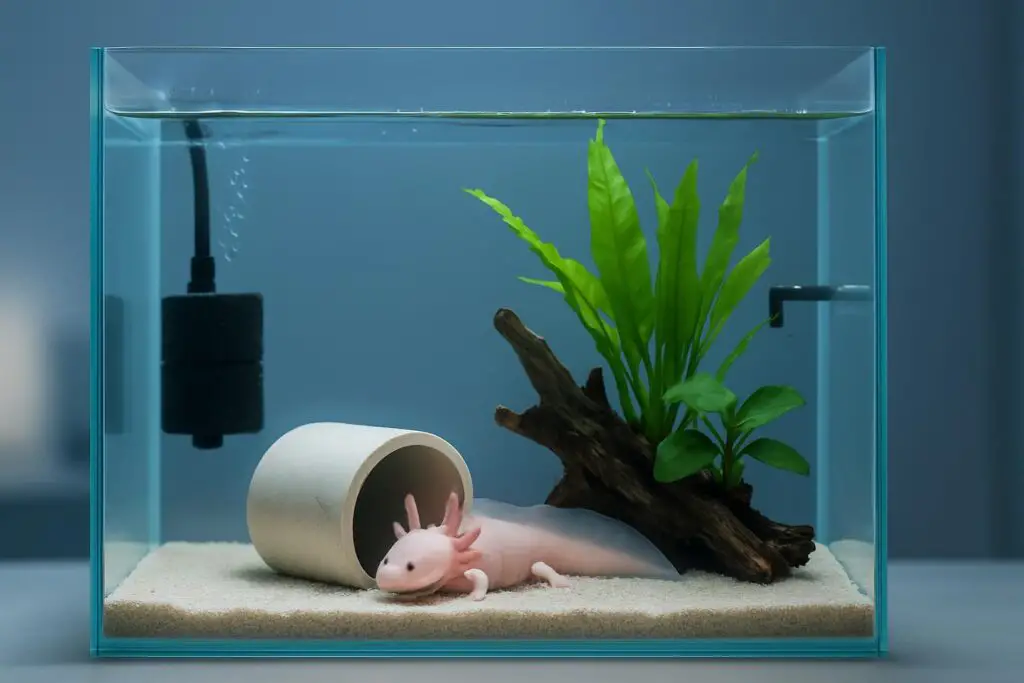
Bare bottom and fine sand are the safest options. Bare bottom is easy to clean and reduces impaction risk. Fine sand in the 0.5–1 mm range looks natural and allows normal foraging behavior while minimizing ingestion problems. Avoid gravel and pebbles because axolotls can swallow them and suffer impaction.
Hides and structure
Provide at least two hides per axolotl. Use smooth PVC elbows, ceramic caves, or driftwood without sharp edges. Ensure they can enter and exit easily without scraping gills. Mix open areas and sheltered corners so your axolotl can choose where to rest.
Plants that tolerate cool water
Java fern, Anubias, hornwort, najas, and cold-tolerant mosses are good options. Attach epiphytes like java fern and Anubias to wood or rock rather than burying roots. If you prefer artificial plants, choose soft silk plants and avoid rough plastic that can tear skin.
Lighting and Photoperiod
Keep it dim and simple
Axolotls do not need strong light. Use adjustable LEDs and start with a short photoperiod. If you keep live plants, 6–8 hours is enough. Floaters or tall plants can break up light and provide shade. A day-night rhythm is helpful, but avoid bright, harsh lighting.
Temperature Control
Passive and active cooling
Keep the room cool and the tank away from sun. Remove lids partially for evaporation and aim a fan across the water surface for evaporative cooling. Frozen water bottles in a filter sock can provide short-term relief in heat waves, but check temperature often to avoid swings. If your climate is hot, a dedicated aquarium chiller is the most reliable long-term solution.
Feeding Basics
Staple foods that work
Earthworms or nightcrawlers are an excellent staple for adults due to balanced protein and fat. High-quality sinking axolotl or salmon pellets are convenient and clean. Juveniles do well with chopped earthworms and bloodworms. Avoid feeder fish and wild-caught bugs due to parasites and thiaminase risk, and avoid insects with hard shells that are hard to digest.
How often and how much
Juveniles eat daily. Adults eat 2–3 times per week. Offer portions that create a slight curve to the belly without bulging. Remove uneaten food within 15 minutes to protect water quality. Adjust frequency during cooler months when metabolism slows.
Clean feeding habits
Use feeding tongs to offer worms directly near the mouth. A shallow feeding dish helps contain pellets and makes cleanup easy. Target feeding reduces the chance of swallowing sand and keeps the tank cleaner.
Tankmates and Handling
Best kept alone
Axolotls are safest when housed alone. Fish nip at gills, and many small species become food. If you must house more than one axolotl together, choose similar sizes, provide multiple hides, and monitor for nips. Separate individuals if you notice persistent aggression or missing limbs.
Minimal handling
Avoid handling unless necessary. Wet your hands and fully support the body if you must move your axolotl. Do not lift by the tail or gills. A soft, water-filled tub is the safest way to transfer.
Routine Maintenance
Weekly tasks
Test ammonia, nitrite, nitrate, and pH. Change 20–30 percent of the water with dechlorinated water that matches temperature within about 1–2°C. Vacuum debris from the bottom. Wipe the glass and remove waste. Trim plants as needed. Check that the filter runs smoothly and that the flow is still gentle.
Monthly care
Rinse sponges and filter media in removed tank water to preserve bacteria. Clean the impeller and intake of your filter. Replace mechanical media when it falls apart, but never replace all media at once. Stagger changes to avoid a cycle crash.
Track and adjust
Keep a simple log of test results, temperature, feeding, and maintenance. Note any appetite changes, floating, or fin damage. Patterns help you catch small problems early and adjust your schedule.
Quarantine and Acclimation
Quarantine new arrivals
Quarantine new axolotls for 30 days in a simple, bare setup with a cycled sponge filter. Observe appetite, skin, gills, and stool. Never share nets or tools between tanks without disinfecting. Quarantine protects your established system.
Acclimate with care
Dim the lights and float the transport container to match temperature. Add small amounts of tank water over 20–30 minutes. Net or cup the axolotl gently into the tank without adding bag water. Keep the first day quiet and dark to reduce stress.
Troubleshooting and Health
Stress signs
Watch for a persistently curled tail tip, forward-leaning gills, rapid gill movement, dull or blotchy color changes, reduced appetite, frantic surfacing, or frequent floating. These are early warnings to check temperature, flow, and water parameters.
Common problems and quick checks
High temperature is the most common problem. Confirm it and cool the water. If ammonia or nitrite is above 0, increase water changes and check if your filter is clogged or if you overfed. If flow is too strong, add baffles and redirect returns. Floating can be trapped air from gulping or gas; review feeding, reduce flow, and ensure no gravel was swallowed.
When to seek a vet
Get veterinary help for persistent floating, open lesions, cottony fungus, ongoing weight loss, or severe trauma. Stabilize the environment first by verifying temperature and nitrogen cycle are correct, then consult a professional.
Budget and Checklist
Essential gear
Tank with lid, stand, dechlorinator, liquid test kit, thermometer, filter with gentle flow, sponge or ceramic media, siphon and bucket, fine sand or bare bottom, hides, soft plants, feeding tongs, and a fan or chiller if your room runs warm.
Ongoing costs
Water conditioner, test reagents, replacement filter sponges, quality pellets, earthworms, and electricity for filtration and cooling. Plan for seasonal cooling needs well before summer.
Conclusion
A perfect axolotl home is cool, stable, and simple. Choose a wide tank with gentle filtration, cycle it fully, and keep temperatures between 16–18°C whenever possible. Use safe substrate, provide multiple hides, feed clean staples on a steady schedule, and maintain the tank with small, regular tasks. When you keep the environment right, your axolotl does the rest.
FAQ
Q: What tank size does an adult axolotl need?
A: One adult axolotl needs at least a 20-gallon long tank with ample floor space.
Q: What water temperature is ideal for axolotls?
A: Ideal temperature is 16–18°C. Acceptable range is 10–20°C. Avoid temperatures above 22°C.
Q: How should I cycle the tank before adding an axolotl?
A: Set up the tank with dechlorinated water, filter, and aeration running. Add a pinch of fish food or pure household ammonia to reach about 2–3 ppm ammonia. Test daily. When ammonia begins to drop and nitrite rises, keep dosing small amounts of ammonia to feed the bacteria. When both ammonia and nitrite reach 0 ppm within 24 hours after dosing, and nitrate rises, your cycle is complete. Do a large water change to reduce nitrate before adding your axolotl.
Q: What substrate is safest for axolotls?
A: Bare bottom and fine sand in the 0.5–1 mm range are the safest options. Avoid gravel and pebbles.
Q: How often should I feed my axolotl?
A: Juveniles eat daily. Adults eat 2–3 times per week. Remove uneaten food within 15 minutes.