
We are reader supported. When you purchase through links on our site, we may earn an affiliate commission. Also, as an Amazon affiliate, we earn from qualifying purchases.
Removing a single fish from a planted or reef tank without tearing down hardscape is hard. Nets spook fish, aquascapes snag, and the fish you want somehow always dodges you. A well-designed fish trap changes the equation. It works with fish behavior, not against it, and lets you catch the target animal with far less stress for both of you. Below are four proven traps that cover most home aquarium needs in 2026, plus a quick guide to picking and using them effectively.
Why use a fish trap instead of a net
Fish learn fast. After one bad chase with a net, many will bolt every time a hand approaches the water. Traps shift the dynamic. You pre-bait, the fish enters calmly, and you close the door without commotion. That keeps your aquascape intact, reduces injuries, and limits stress hormones that can weaken immunity. Traps also allow selective removal, which is essential if you need to extract one aggressive fish while leaving the rest undisturbed.
Quick buying guide
Match trap style to the job
Box traps with a sliding door are the most versatile for community and reef setups. Funnel traps excel for small, skittish fish and in tight aquascapes. Floating magnetic traps are ideal in reefs because they avoid disturbing corals and rockwork.
Door mechanism and control
Look for a door you can close via line or external slider so you do not have to put your hand in the tank at the critical moment. Smooth, silent closures prevent last-second escapes.
Mounting and stability
Magnets hold best on thicker glass and allow flexible positioning. Suction cups are fine on clean glass but may slip if you overfill or bump the trap. Some floating traps rise to the surface once triggered, which makes removal safer around delicate corals.
Size, transparency, and finish
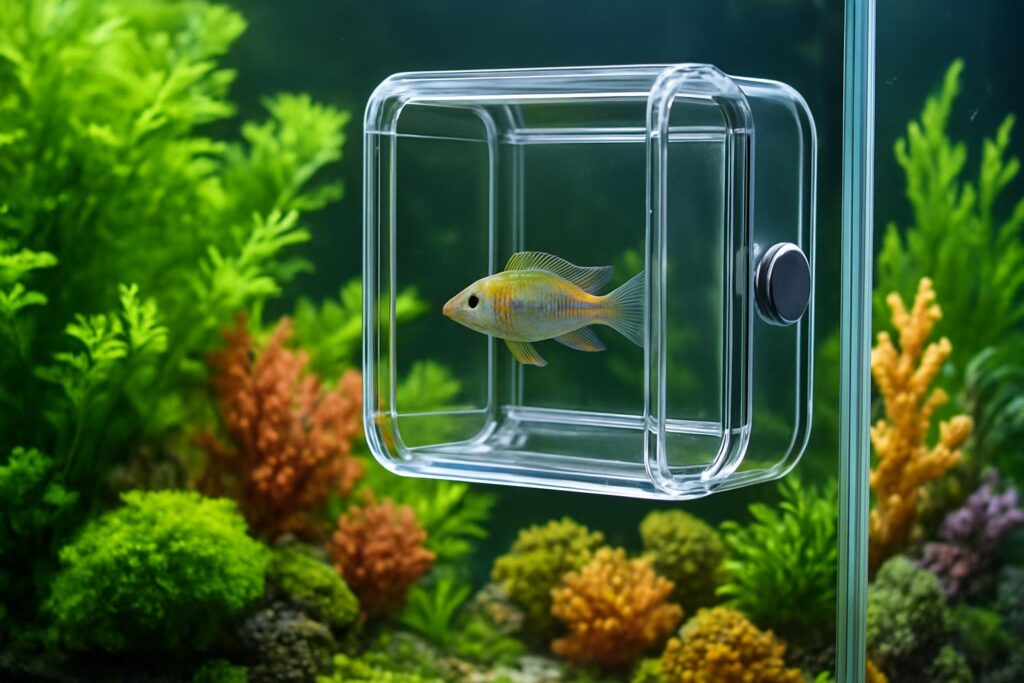
Clear acrylic edges, rounded corners, and minimal hardware help fish feel safe entering. Size the trap so the target fish can fully turn around inside without rubbing the door. Oversized traps can be harder to place, undersized traps cause spook-outs.
Reef and plant safety
For reefs, prefer magnet-mounted or floating traps that avoid resting on corals. In planted tanks, smooth edges and gentle placement prevent plant uprooting.
Maintenance and cleaning
Removable doors and flat internal panels make rinsing simple. Residual food or biofilm can repel cautious fish, so easy cleaning is a real advantage.
The 4 best aquarium fish traps for 2026
NYOS Floating Fish Trap
The NYOS Floating Fish Trap is a favorite among reef keepers for one main reason: control. It mounts with a strong magnet, has a wide, clear entrance, and when you release the safety it gently floats to the surface for clean removal. You can pre-bait through the feeding tube and close the door from outside the tank with minimal movement. The clear acrylic does not alarm fish, and the floating action avoids dragging the trap across corals and rockwork.
Why it helps: Minimal disturbance, smooth door action, and a float-up exit make it ideal for complex reef aquascapes.
Best for: Reef tanks, shy wrasses, tangs that patrol the water column, and any setup where you cannot risk bumping coral.
Notable features: Magnetic mount, feeding tube, floating body for safe retrieval.
Potential downsides: Premium pricing; the magnet’s effective glass thickness has limits, so confirm compatibility with very thick panels.
Aqua Medic Fish Trap 2
The Aqua Medic Fish Trap 2 is a robust box trap with a front door you close via a pull line. The design focuses on simplicity: clear walls, ample interior space, and a reliable door glide that does not slam. It fits well against glass and can be positioned near a feeding spot. Many aquarists report success with fast, territorial fish that will not tolerate a hand in the tank.
Why it helps: Straightforward operation and a silent closing action reduce last-second startles.
Best for: Saltwater and freshwater community tanks, dwarf cichlids, dottybacks, damsels, and angelfish that are bold feeders.
Notable features: Generous interior volume, external pull cord, stable stance when placed on substrate or rock ledges.
Potential downsides: Heavier acrylic means you need careful placement in tight scapes; relies on stable positioning rather than floating removal.
Tom Aquarium Fish Trap by Tom Aquatics
For budget-conscious hobbyists, the Tom Aquarium Fish Trap has been a go-to for years. It is a compact, lightweight box with a sliding door you control manually or with a light line. The transparency and small footprint make it easy to tuck into a planted tank without uprooting stems. It shines for removing one problem fish from a small community tank.
Why it helps: Small size, low weight, and clear panels encourage quick entries from curious fish.
Best for: Freshwater community tanks, livebearers, gouramis, and medium tetras that investigate bait readily.
Notable features: Simple mechanism, easy cleaning, fits in nano to mid-size tanks.
Potential downsides: Not ideal for larger, powerful fish that can jolt the door; suction cups may need a clean surface for best hold.
SM SunniMix Acrylic Funnel Fish Trap
This funnel-style trap targets small, wary fish that hesitate to cross a visible door line. The inward funnel guides fish in for food and makes exit more difficult without slamming parts or sudden moves. It works well in planted and nano reef tanks where netting is impractical and you need passive capture over time.
Why it helps: Funnel geometry exploits natural foraging behavior and reduces spook-outs from moving doors.
Best for: Small gobies, damsels, nano wrasses, livebearer fry, and cautious fish that ignore typical box traps.
Notable features: Low-profile footprint, removable funnel for cleaning, clear acrylic build.
Potential downsides: Not suitable for larger fish; capture can take longer because there is no active door closure.
How to set up and use a fish trap effectively
Pre-bait and build trust
Feed lightly for a day, then place a small amount of the usual food inside the trap with the door tied open. Repeat until the target fish enters without hesitation. Consistency matters more than large bait piles.
Timing and patience
Set the trap near the usual feeding time, then wait. Typical capture windows run 30 to 90 minutes. If nothing happens, remove the trap, feed normally, and try again later. Do not leave a baited trap overnight unless you can supervise to prevent overfeeding or unintended captures.
Placement and orientation
Position the entrance along a natural patrol route or just off the main feeding lane. In planted tanks, hover a box trap just above the substrate to avoid uprooting. In reefs, use magnets or floating designs to avoid resting on corals.
Reduce stress signals
Keep hands out of the tank while waiting. Dim room lights slightly so reflections on the acrylic are minimal. Close doors smoothly without a snap. Once captured, move the fish promptly to a prepared holding container with matching temperature and salinity.
Clean between attempts
Rinse off food residue and biofilm. A clean, odor-free trap draws more confident entries, especially from cautious species.
Conclusion
A fish trap turns a frustrating chase into a controlled, humane process. The NYOS Floating Fish Trap excels in complex reefs. The Aqua Medic Fish Trap 2 offers quiet reliability in mixed tanks. The Tom Aquarium Fish Trap is a small, affordable workhorse for community setups. The SM SunniMix Acrylic Funnel Fish Trap wins with timid, smaller fish that ignore standard doors. Match the trap to your tank and species, pre-bait patiently, and you will remove the right fish without tearing down your aquascape.
FAQ
Q: Which fish trap is best for reef tanks?
A: The NYOS Floating Fish Trap is ideal for reefs because it mounts magnetically, closes smoothly, and floats to the surface for removal without disturbing corals.
Q: How long should I leave a trap in the tank?
A: Typical capture windows run 30 to 90 minutes, and you should not leave a baited trap overnight unless you can supervise.
Q: How do I avoid catching the wrong fish?
A: Pre-bait with the door tied open, set the trap at the usual feeding time, and close the door only when the target fish is fully inside.
Q: What size trap do I need?
A: Choose a trap that allows the target fish to turn around fully without rubbing the door, and avoid oversized traps that are hard to place in tight scapes.
Q: Do fish traps stress fish?
A: Traps reduce stress compared to nets because you pre-bait, use clear acrylic, avoid hand movements, and close the door smoothly without a snap.