
We are reader supported. When you purchase through links on our site, we may earn an affiliate commission. Also, as an Amazon affiliate, we earn from qualifying purchases.
Male bettas build bubble nests when they feel secure. The right accessories make nests easier to start and harder to destroy. In 2026, you have many choices, but only a few directly improve nest success. This guide highlights five proven accessories that create calm surface water, offer secure anchors, add tannins, and keep the air above the water warm and humid. You will know what each item does, how to place it, and what to expect day to day.
What Makes a Good Betta Bubble Nest Accessory
Calm surface and stable bubbles
Strong filtration and splashing break nests. Aim for barely moving surface water. Accessories that block current or spread flow help nests last longer.
Overhead cover and anchor points
Bettas prefer to nest under a leaf, a log, or near floating plants. Solid anchors keep bubbles from drifting apart.
Tannins and comfort
Indian almond leaves release tannins that can help males settle and start nesting. The slight amber tint is normal and harmless to fish and plants.
Warm, humid air layer
A proper lid traps humidity and steady warmth above the surface. This prevents quick bubble collapse and helps the male tend eggs if spawning occurs.
5 Best Betta Bubble Nest Accessories for 2026
1) SunGrow Indian Almond Leaves Catappa Leaves
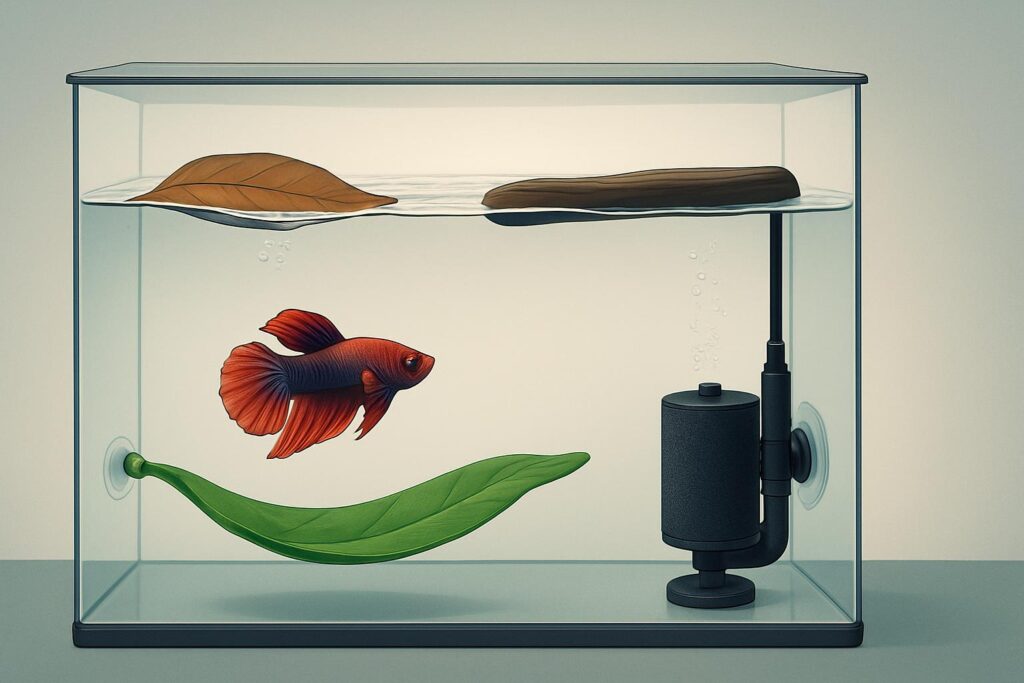
Why it helps: Indian almond leaves release tannins that can calm fish and support a nesting mood. A single leaf can also serve as a natural roof and anchor point right at the surface. As it softens, it forms a gentle platform where bubbles cling together.
Best for: Bettas that hesitate to start a nest, blackwater setups, and first-time breeders who want a natural solution.
How to use: Rinse, then pre-soak in dechlorinated water to help it sink slowly and avoid debris. Start with 1 leaf per 5 gallons and adjust. Place it where the surface is calm so a male can build under the leaf edge.
Potential downsides: Water turns amber. This is cosmetic and harmless to fish and plants. Replace the leaf every 3 to 4 weeks or when it fully breaks down.
2) Zoo Med Floating Betta Log
Why it helps: This floating log creates shade and a hard surface that grabs bubbles. Many males choose the underside of the log as a nest site. Its stable float reduces the impact of small ripples, so nests are less likely to break apart.
Best for: Tanks from 2.5 to 10 gallons, especially bare-top or sparsely planted setups that need a solid, movable anchor.
Setup tips: Let the log fill slightly with water so it sits level. Position it away from the filter return. If flow is strong, baffle the output or lower the water line under the outflow to protect the surface near the log.
Potential downsides: Inspect edges and rinse before first use to remove any residue. It takes some surface space in nano tanks, so plan placement to leave a calm pocket for the nest.
3) Zoo Med Betta Bed Leaf Hammock
Why it helps: The silicone leaf mounts with a suction cup and sits just under the surface. It gives the male a fixed, shallow platform for resting and nesting. Bubbles cling to the leaf edge, and the betta can work in a stable spot even with very light current.
Best for: Owners who want precise placement. You can choose a quiet corner, under the heater, or near a floating plant to stack cover and calm water.
Placement: Set the leaf 0.5 inch to 1 inch below the surface. Angle it slightly upward so bubbles collect at the highest edge. Avoid placing directly under a filter return or air stone.
Potential downsides: Suction cups can loosen over time. Clean the cup and glass, then reattach. Wipe biofilm from the leaf during water changes to keep the edge tacky for bubbles.
4) XY-2831 Style Nano Sponge Filter
Why it helps: Gentle filtration is essential for nests. A small sponge filter powered by an air pump offers biofiltration while keeping the surface nearly still. With an air control valve, you can fine-tune airflow so the surface barely ripples and bubbles stay intact.
Best for: 2 to 10 gallon betta tanks, breeding setups, and anyone who struggles with hang-on-back filters breaking nests.
Setup tips: Use an inline check valve and an air control valve to dial airflow low. Position the outlet under the surface or face it against the glass to diffuse bubbles. Clean the sponge by squeezing it in tank water every 2 to 4 weeks.
Potential downsides: Takes up space inside the tank and is visible. Flow must be adjusted correctly; too much air breaks the surface and disrupts nests.
5) Aqueon Versa-Top Glass Aquarium Lid
Why it helps: A tight-fitting glass lid holds a warm, humid air layer above the water. Bubbles last longer when the air is still and moist. The lid cuts drafts, slows evaporation, and helps keep temperature stable, all of which support nest building and maintenance.
Best for: Open-top tanks or kits with loose plastic covers. A proper lid also prevents jumping without blasting the surface with fans or open-room airflow.
Fit and care: Measure your tank frame and choose the matching size. Leave a small gap for gas exchange if your tank is densely stocked. Wipe the underside weekly so condensation does not drip and disturb the nest area.
Potential downsides: If fully sealed with no ventilation, gas exchange can drop. Keep at least a small opening or use the included hinge gap to balance humidity and oxygen.
Quick Setup Recipe for Reliable Nests
Dial in water conditions first
Keep temperature steady at 78 to 80 F. Use a reliable heater and a thermometer you check daily. Stable temperature supports consistent nest building.
Calm the surface
Run a nano sponge filter with minimal airflow. The goal is a barely moving surface, not active bubbling. Aim filter outputs downward or against glass.
Add a natural anchor
Use one Indian almond leaf near a quiet corner. Combine it with a hammock leaf or a floating log to stack multiple anchor points.
Cover and humidity
Install a fitted glass lid to trap warm, humid air. This reduces evaporation and helps nests hold longer between maintenance days.
Placement strategy
Place the hammock 0.5 inch to 1 inch below the surface and the floating log away from any return flow. Keep a clear, calm pocket where the male can work uninterrupted.
Maintenance rhythm
Do small weekly water changes. Clean sponge filters gently and wipe the underside of the lid. Replace almond leaves monthly or as they break down.
Observe and adjust
If nests keep breaking, lower flow, move the anchor farther from the return, or raise water level to reduce splashing. If the male ignores a spot, shift the anchor to a shaded corner.
Conclusion
You do not need every accessory to see strong, lasting bubble nests. Combine two or three that solve your specific problems. Use a gentle sponge filter to protect the surface. Add an Indian almond leaf and either a floating log or a hammock for a reliable anchor. Finish with a fitted glass lid to hold humidity. With this simple stack, most males will nest more often and keep their bubbles intact longer.
FAQ
Q: Do I need all five accessories to get good bubble nests?
A: You do not need every accessory to see strong, lasting bubble nests. Combine two or three that solve your specific problems.
Q: Will Indian almond leaves stain my water?
A: Water turns amber. This is cosmetic and harmless to fish and plants.
Q: How strong should filtration be for nests?
A: The goal is a barely moving surface, not active bubbling. Use a nano sponge filter with minimal airflow.
Q: Where should I place a betta hammock?
A: Place the hammock 0.5 inch to 1 inch below the surface and keep it away from the filter return.
Q: Why does a lid help bubble nests last longer?
A: A tight-fitting glass lid holds a warm, humid air layer above the water and cuts drafts, which helps bubbles last longer.