
We are reader supported. When you purchase through links on our site, we may earn an affiliate commission. Also, as an Amazon affiliate, we earn from qualifying purchases.
Corals are not plants. They are animals that host microscopic algae for energy, yet they also hunt, trap, and absorb food. If you only think about light and zooxanthellae, you miss half the story. Feeding shapes growth, color, and resilience. This guide explains how corals eat beyond photosynthesis and how you can feed them correctly in a reef tank.
Photosynthesis is only half the story
Zooxanthellae are algae living inside coral tissue. Under good light, they share sugars and other products with their host. This autotrophic energy is powerful, but it is not enough for many corals all the time. Light varies with depth, shading, turbidity, and seasonal change. Bleaching or low nutrients can reduce algal productivity. Feeding fills the gaps and often drives better growth and recovery.
Think of most reef corals as mixotrophs. They combine photosynthesis from symbionts with active feeding. The balance shifts with light, flow, food availability, and coral species. In bright shallow water, photosynthesis may dominate. In deeper or turbid water, heterotrophy can carry more weight. In captivity, the right mix of light and food creates stable, colorful colonies.
Heterotrophy: corals as predators and scavengers
Nematocysts and tentacles
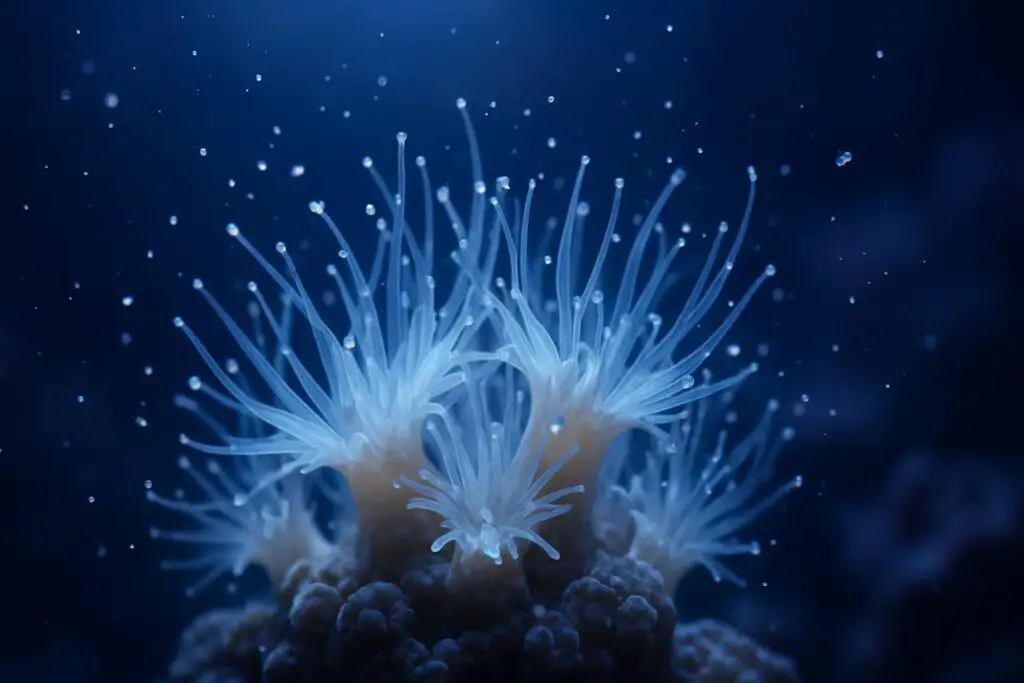
Coral polyps have stinging cells called nematocysts. These cells fire microscopic harpoons that stick or inject toxins into prey. Tentacles then move food to the mouth. Many corals extend tentacles more at night when plankton rises and fish are less active. Some corals show feeding sweeper tentacles that reach farther to intercept particles.
Cilia, mucus nets, and mesenterial filaments
Corals do not only stab prey. Cilia on their surfaces create microcurrents that direct fine particles toward the mouth. Many corals secrete mucus that traps suspended food and detritus. They then re-ingest this mucus like a conveyor belt. When needed, corals can deploy mesenterial filaments. These are internal digestive strands extruded to digest food or competitors on contact. It is a form of external digestion and nutrient capture.
What corals eat in practice
Diet is broader than many assume. Corals capture zooplankton such as copepods, rotifers, nauplii, and small worms. They take suspended particulate organic matter like fine detritus and fish eggs. Many corals ingest bacteria and absorb dissolved organic compounds and amino acids directly from water. Prey size must match polyp size. Small polyp stony corals tend to favor very small suspended particles and micro zooplankton. Large polyp stony corals can take larger meaty items.
Day and night feeding rhythms
Light and flow shape feeding windows. Many corals feed best around dusk or in the first hour of darkness when polyps extend and plankton density rises. In bright light, fish pick food faster and some corals remain contracted. In aquaria, a dusk feeding routine often improves capture and reduces theft by tankmates.
Why feeding matters for growth and resilience
Feeding provides nitrogen, phosphorus, essential fatty acids, and amino acids that photosynthesis does not supply in sufficient quantity. These building blocks are needed for tissue growth, skeletal deposition, pigments, and repair. Regular feeding often increases calcification, boosts tissue thickness, and deepens coloration by supporting chromoproteins and fluorescent proteins.
Heterotrophy also improves resilience. When light is low or when corals are stressed, food intake can compensate for reduced photosynthetic output. During bleaching or after fragging, fed corals generally recover faster. Stable intake of fine particles and appropriate prey supports the microbiome on coral surfaces, which further protects tissue.
Match feeding to coral types
SPS small-polyp stony corals
Examples include Acropora, Montipora, and Pocillopora. These corals have small mouths and short tentacles. They target nanoplankton to micro zooplankton and fine particulates. Offer a mix of 10 to 200 micrometer particles such as rotifers, copepod nauplii, oyster eggs, and specialized powdered coral foods. Frequent small feedings are more effective than rare heavy ones. Strong, turbulent flow helps keep fine food suspended for capture without blasting tissue.
LPS large-polyp stony corals
Examples include Euphyllia, Acanthastrea, Trachyphyllia, Lobophyllia, and Scolymia. These corals accept larger prey. Offer finely chopped mysis, enriched brine shrimp, small clam or fish flesh pieces, fish eggs, and larger zooplankton. Target feeding one or two small pieces per polyp once or twice a week supports growth without overloading nutrients. Allow time for tentacles and mouths to close around food. Moderate, indirect flow prevents food from being ripped out.
Soft corals and zoanthids
Examples include Sinularia, Sarcophyton, Xenia, and Zoanthus. Many soft corals rely heavily on photosynthesis but still benefit from fine particulate feeding. Broadcast very small particles like rotifers, marine snow type foods, and powdered blends. Zoanthids respond to very fine foods and dissolved amino acids, with occasional tiny meaty specks if polyp size allows. Keep portions light and consistent.
Nonphotosynthetic corals
Examples include Dendronephthya, Scleronephthya, many gorgonians, sun corals, and chili corals. These species rely on feeding, not light. They require frequent small meals of appropriate particle sizes and stable flow that keeps food drifting past. They are advanced to keep. Provide multiple small feedings per day, stable nutrients, and clean high-oxygen water.
Food choices that work
Fine zooplankton foods are the backbone for SPS and small-polyp feeders. Rotifers, copepod nauplii, and oyster eggs match particle sizes that polyps can grab and swallow. Quality powdered coral foods supply a spectrum of particles plus lipids, proteins, and micronutrients. Rehydrate powders with tank water before dosing to avoid clumping.
For LPS, use small mysis shrimp, enriched Artemia nauplii, chopped krill, clam, or fish flesh. Fish eggs are excellent when not oversized. Rinse thawed frozen foods with saltwater to remove excess juices that elevate nutrients. If pieces bounce off or are spit out, reduce size.
Live foods stimulate stronger feeding responses and add movement that helps capture. Live copepods, rotifers, and Artemia nauplii are useful. Bivalve egg suspensions can be very effective for polyp extension and consumption.
Phytoplankton is primarily food for filter feeders and zooplankton rather than most stony corals. It can still help the system indirectly by boosting microfauna that corals then consume. Dose modestly to avoid green water and film algae outbreaks.
Some aquarists blend a homemade reef mix from seafood with a small amount of nori, fish eggs, and a quality powdered coral food. Blend to a paste, then sieve to separate particle sizes. Label and freeze in thin sheets for easy portioning.
How to feed step by step
Prepare the food
Thaw frozen foods in a cup of tank water and rinse if the pack is nutrient rich. Rehydrate powdered foods for 5 to 10 minutes. Aim for a cloudy slurry rather than dense paste for broadcast feeding. Keep tools clean to avoid contamination.
Manage flow
Put pumps in feed mode or reduce speed for 10 to 20 minutes. You want enough flow to suspend food and deliver it across colonies, but not so much that food blows past instantly. For target feeding LPS, reduce flow further to help tentacles hold on.
Time the feeding
Feed at dusk or within one hour after lights start dimming. Many corals extend polyps more at that time, and fish are less aggressive. You can also pulse blue light only to encourage extension while minimizing fish activity.
Broadcast or target
For SPS and soft corals, broadcast the fine slurry into areas of turbulent flow to distribute particles through the whole colony. For LPS, target feed using a pipette or turkey baster, placing a small piece gently on the polyp. Hold the tip near the polyp without poking. If cleaner shrimp steal food, briefly shield the polyp with a cut-off bottle top or a mesh guard until it closes.
Train a feeding response
Feed at consistent times. Some corals learn to extend polyps when pumps slow and food hits the water. Regular routines increase capture rates and reduce waste.
How much and how often
Start small and observe. For photosynthetic corals, 2 to 4 light feedings per week is a good baseline. Use a volume that creates a light cloud for 10 to 15 minutes without covering surfaces in uneaten food. For LPS, one or two small meaty items per polyp once or twice weekly supports growth. For nonphotosynthetic corals, plan multiple small daily feedings matched to their particle needs.
Adjust with your observations. If polyps extend quickly and food is consumed within a few minutes, you can slightly increase next time. If food settles or fish gorge while corals ignore it, reduce the amount or change particle size. Stable progress is better than big swings.
Nutrients, water quality, and export
Feeding adds nutrients, which your reef needs but in balance. Aim for nitrate in the low single digits to around ten parts per million. Aim for phosphate around 0.02 to 0.1 parts per million. Avoid zero for both, as corals and their symbionts need available nitrogen and phosphorus. Avoid spikes that drive nuisance algae.
Use export tools that match your feeding plan. A properly sized protein skimmer removes dissolved organics and fine particulates. A refugium with macroalgae steadily uptakes nitrate and phosphate. Periodic activated carbon use helps polish water and remove yellowing compounds from coral mucus and foods.
During feeding, turn off the skimmer and mechanical filters for 20 to 30 minutes to keep food in suspension. Resume filtration after the feeding window. Rinse frozen foods to reduce phosphate. Clean detritus regularly to avoid slow nutrient creep.
Flow and lighting interplay
Flow determines whether particles enter the coral boundary layer where cilia can move them to the mouth. Aim for randomized, pulsing, or gyre flow that keeps particles bouncing around the colony without blasting tissue. In general, SPS like stronger, more turbulent flow. LPS prefer moderate indirect flow with gentle polyp movement.
Lighting drives photosynthesis but also influences feeding rhythms. Stable light schedules with gradual ramping help corals predict dusk feeding. Do not try to replace food with extreme light. Balance is the goal.
Troubleshooting common issues
Corals ignore food. Try smaller particles, reduce flow slightly, and feed at dusk. Ensure food matches polyp size. Use live or more enticing items like fish eggs or rotifers to trigger response.
Fish and shrimp steal everything. Feed fish a small portion first, then target feed corals. Use a feeding guard over LPS until the polyp closes. Dim lights to reduce fish aggression.
Food blows away. Place pumps in feed mode. Angle powerheads to create eddies where particles linger around colonies.
Water quality drifts. Reduce portions, increase export, and rinse frozen foods. Do not increase feeding frequency until nutrients stabilize in your target range.
Tissue recession after feeding. Check that food pieces are not too large or abrasive. Avoid physical poking. Maintain clean water and good oxygenation, and ensure no pests are stinging at night.
Ethical and ecological context
In the wild, corals experience pulses of plankton tied to tides, moon, and seasons. They are flexible and respond to what the environment offers. In a tank, you must build a small version of that pulse with safe frequency and portion control. Responsible feeding supports long-term health without forcing unnatural extremes. Sustainable choices in foods and livestock protect reefs while letting you enjoy and learn from them.
Conclusion
Corals are not passive sunlight collectors. They hunt, they trap, and they absorb. Photosynthesis powers a lot, but feeding fills essential nutritional gaps, stabilizes growth, and improves resilience. Match particle size to polyp size. Feed at the right time with the right flow. Keep portions modest and export steady. When you get this mix right, corals extend fuller, color up, calcify faster, and recover better from stress. Go beyond zooxanthellae and feed with intention.
FAQ
Q: Do photosynthetic corals still need feeding
A: Yes. Photosynthesis supplies energy, but feeding provides nitrogen, phosphorus, fatty acids, and amino acids needed for growth, pigments, and repair. Regular feeding often increases calcification, tissue thickness, and coloration.
Q: What should I feed SPS versus LPS
A: SPS prefer fine particles and micro zooplankton such as rotifers, copepod nauplii, oyster eggs, and quality powdered coral foods. LPS accept larger prey like small mysis, enriched brine shrimp, chopped clam or fish flesh, and fish eggs in sizes they can swallow.
Q: When is the best time to feed corals
A: Around dusk or within one hour after lights begin to dim. Many corals extend polyps more then, plankton-like foods drift well, and fish are less aggressive.
Q: How often and how much should I feed
A: For photosynthetic corals, start with 2 to 4 light feedings per week that create a gentle food cloud for 10 to 15 minutes. For LPS, offer one or two small meaty items per polyp once or twice weekly. For nonphotosynthetic corals, provide multiple small daily feedings matched to their particle needs.
Q: How do I keep nutrients stable while feeding
A: Target nitrate in the low single digits to around ten and phosphate around 0.02 to 0.1. Turn off skimmer and filters for 20 to 30 minutes during feeding, then resume. Rinse frozen foods, maintain a skimmer and refugium, and keep portions modest.