
We are reader supported. When you purchase through links on our site, we may earn an affiliate commission. Also, as an Amazon affiliate, we earn from qualifying purchases.
Crystal clear water is not the main goal of water changes. The true goal is stability. Clean water keeps toxins low, minerals balanced, and fish healthy. If you get the schedule right, fish eat better, colors improve, and problems become rare. This guide shows exactly how often to change water, why it matters, and how to build a routine that fits your tank rather than guessing.
Why Water Changes Matter
Waste You Cannot See
Fish release ammonia from gills and waste. Uneaten food and plant debris also break down into ammonia. Your filter bacteria convert ammonia to nitrite, then to nitrate. Ammonia and nitrite must always be zero in a cycled tank. Nitrate builds up over time and stresses fish when it gets too high. Water changes remove nitrate and dissolved organics that filters cannot eliminate.
Minerals and pH Drift
As fish and plants use minerals, water chemistry slowly changes. Carbonate hardness buffers pH. Without fresh water, buffers drop and pH can crash. Regular water changes restore minerals, keep KH and GH stable, and prevent sudden pH drops that harm fish and shrimp.
Algae Control and Clarity
Excess nutrients and organics feed algae and cause cloudy water. Water changes lower nutrients and keep water oxygen rich, which helps your filter bacteria work efficiently. This is a stable way to reduce algae pressure without harsh chemicals.
The Simple Answer First
Most freshwater community tanks do best with 20 to 30 percent water changed every week. This suits beginner stocking levels, typical feeding, and standard filters.
Smaller tanks need more frequent changes. Nanos under 10 gallons often need 20 to 30 percent twice per week because waste builds up fast.
Heavily stocked tanks or messy fish need 30 to 50 percent weekly, sometimes more. Lightly stocked, heavily planted tanks can often do 15 to 25 percent weekly or every 10 to 14 days, guided by test results.
Saltwater systems vary more. Fish only saltwater tanks often do 15 to 25 percent every 2 weeks. Reef tanks can work with 10 to 15 percent weekly or every 2 weeks, but some modern systems succeed with smaller or less frequent changes due to nutrient export methods. Testing is the key.
What Determines Your Schedule
Tank Size and Shape
Small volume means less room for error. The smaller the tank, the faster waste accumulates and the quicker pH and temperature shift. Tall narrow tanks may have less surface area, which can reduce gas exchange and influence how much water you change to keep oxygen stable.
Stocking Level and Species
More fish equals more waste. Goldfish, cichlids, and large predatory fish produce heavy waste loads. Tiny rasboras produce much less. If your fish are messy eaters, expect bigger or more frequent changes.
Feeding and Bioload
Feeding more than fish can consume in 30 to 60 seconds raises waste sharply. High protein foods tend to raise nitrate faster. If you feed heavily for growth or breeding, increase water change volume or frequency.
Filtration and Flow
Good filtration supports beneficial bacteria and keeps solids suspended for removal. However, no filter removes nitrate. Even the best filter still needs water changes. Stronger aeration can help bacteria process waste fully, but final nitrate removal still relies on water changes or plants.
Plants and Algae
Healthy plants use ammonia and nitrate, which can reduce how often you need changes. This only applies when plant growth is strong and balanced with light and nutrients. Algae consuming nutrients does not replace water changes because dissolved organics still rise.
Freshwater, Brackish, Saltwater
Freshwater depends on water changes for nitrate control and mineral balance. Brackish tanks need changes that also maintain salinity and alkalinity. Saltwater tanks are sensitive to salinity, alkalinity, calcium, and magnesium. Your schedule must protect these parameters while controlling nitrate and phosphate.
The Test Based Approach
Targets to Aim For
Ammonia 0 ppm in any established tank.
Nitrite 0 ppm in any established tank.
Nitrate under 20 to 30 ppm for most community fish. Under 10 to 20 ppm for shrimp and sensitive fish. Goldfish and cichlids often do fine under 40 ppm but lower is still safer. For reef tanks, nitrate often lands between 2 and 15 ppm depending on coral type and nutrient strategy.
Phosphate near 0.02 to 0.1 ppm for reef corals. For freshwater, phosphate control helps with algae but is less critical for fish health when nitrate is controlled.
How to Test Well
Use a reliable liquid test kit for ammonia, nitrite, nitrate, and pH. For freshwater, add GH and KH. For saltwater, include alkalinity, calcium, magnesium, nitrate, and phosphate. Log your results weekly at first, then biweekly when stable. Test before water changes to see the true trend.
Trigger Points for a Change
Any reading of ammonia or nitrite above zero in a cycled tank demands an immediate partial change and a check of filter media and feeding practices.
If nitrate rises above your target range, increase the size or frequency of your changes. If KH drops and pH drifts down, do a change and consider remineralizing if your tap water is very soft.
How Much Water to Change
A water change dilutes pollutants. Example: if nitrate is 60 ppm and your tap is near 0 ppm nitrate, a 50 percent change cuts it to about 30 ppm. To reach 20 ppm from 60 ppm in one change, about 67 percent is needed. If your tap has some nitrate, you will need either a larger change or more frequent changes.
Recommended Schedules by Setup
Nano Tanks and Bettas
Nanos under 10 gallons swing fast. For a single betta with a gentle filter, aim for 20 to 30 percent twice per week, or 30 to 40 percent weekly if the tank is planted and lightly fed. Test nitrate weekly. Keep temperature matched closely to avoid stress.
Freshwater Community Tanks
For tanks with tetras, rasboras, corydoras, and similar fish, 20 to 30 percent weekly is a reliable baseline. If you have moderate plants and light feeding, 20 percent weekly often holds nitrate under control. If nitrate rises above 30 ppm by week end, increase to 30 or 40 percent.
Goldfish and Large Messy Fish
Goldfish produce lots of waste and prefer high oxygen and stable minerals. Do 40 to 50 percent weekly. For overstocked tanks, split into two changes per week or increase to 60 percent weekly. Strong mechanical filtration and regular prefilter rinsing in tank water help reduce debris.
African Cichlids and Hard Water Fish
These fish do best with high alkalinity and hardness. Do 30 to 50 percent weekly to keep nitrate low and minerals steady. Use a buffer or compatible tap water to maintain KH and pH. Avoid letting nitrate creep above 40 ppm.
Discus and Sensitive Species
Juvenile discus grow best with heavy feeding and heavy water changes. Do 50 percent 2 to 3 times per week. Adults can shift to 30 to 50 percent weekly, guided by nitrate. Keep nitrate under 10 to 20 ppm. Temperature must match closely.
Low Tech Planted Tanks
With moderate light and no CO2 injection, plants can help control nitrate. Many low tech tanks run well on 25 to 30 percent weekly or every 10 days. Test nitrate and watch KH. If algae appears or nitrate drifts high, return to weekly changes.
High Tech CO2 Planted Tanks
These setups use strong light, pressurized CO2, and fertilizers. Consistent water changes reset nutrients and prevent imbalances. Do 30 to 50 percent weekly. Many aquascapers prefer 50 percent weekly to keep growth predictable and stable.
Shrimp Colonies
Caridina often need very soft, low TDS water with minimal swings. Do small, frequent changes such as 10 to 15 percent weekly using remineralized RO water. Neocaridina are more forgiving and can handle 20 percent weekly using conditioned tap water if stable. Match temperature and TDS closely.
Brackish Tanks
Keep salinity consistent and alkalinity stable. Do 20 to 30 percent weekly or every two weeks, and top off with freshwater to replace evaporation. Always mix brackish water fully before adding to the tank. Test salinity with a refractometer for accuracy.
Saltwater Fish Only Systems
Do 15 to 25 percent every 1 to 2 weeks. This manages nitrate and maintains salinity and alkalinity when using a quality salt mix. If nitrate creeps above 30 to 40 ppm, increase change size or frequency and review feeding and mechanical filtration.
Reef Tanks
Corals benefit from stable alkalinity, calcium, magnesium, and trace elements. Many reef keepers succeed with 10 to 15 percent weekly or 15 to 25 percent every 2 weeks. If you run strong nutrient export like refugium, skimming, and dosing, you may reduce changes, but only if tests are stable and corals are thriving. Keep nitrate and phosphate within your target range for the coral types you keep.
How to Do a Water Change the Right Way
Before You Start
Test ammonia, nitrite, nitrate, and pH. Log results. This shows whether your current schedule works.
Prepare replacement water. Dechlorinate tap water fully. Match temperature within 1 to 2 degrees. For soft water tanks or shrimp, also match GH and KH. For saltwater and brackish, mix and aerate the water with correct salinity for several hours.
Unplug heaters and powerheads if water will drop below their safe line. Keep the filter running if the intake remains submerged. If not, unplug the filter during the drain and re-prime after refilling.
During the Change
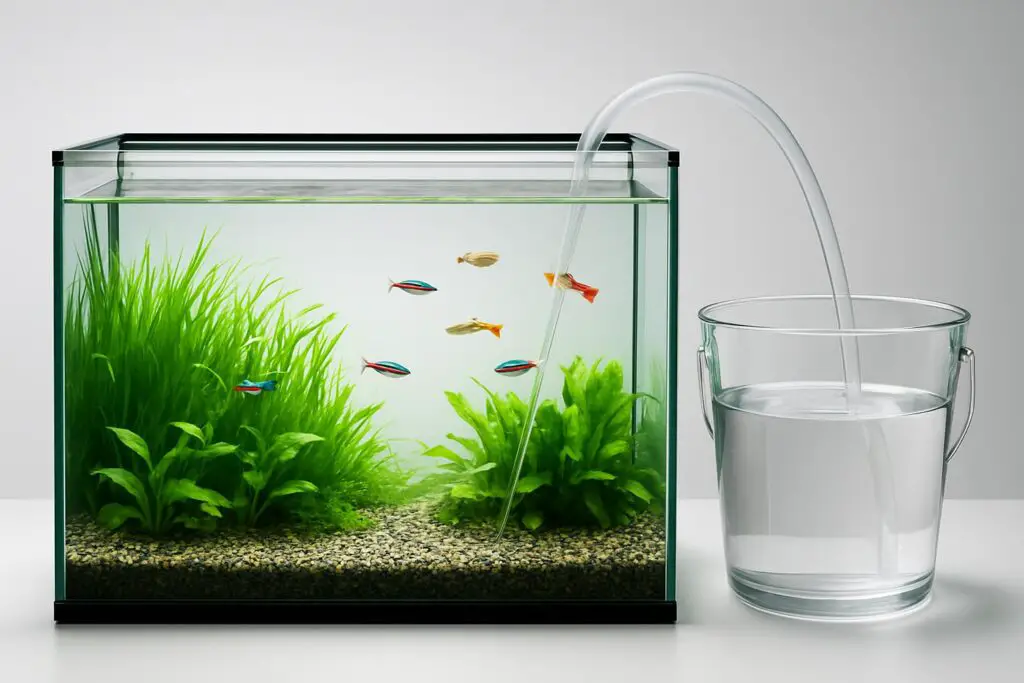
Use a gravel vacuum to remove debris from the top layer of substrate. Focus on open areas and keep vacuuming gentle near plant roots. For sand, hover above the surface and let debris lift without taking sand into the hose.
Remove the planned volume, usually 20 to 50 percent depending on your schedule. For very dirty tanks, split large changes into two sessions a few hours apart to reduce stress.
Clean filter prefilters or sponges in removed tank water. Do not scrub all media at once. Rinse lightly to preserve beneficial bacteria.
After the Change
Slowly refill to avoid stirring the substrate. Confirm temperature and, for marine systems, salinity. Restart equipment. Prime and restart filters that were powered off. Check flow and make sure aeration is adequate.
Test again within a few hours if you made a large change. Observe fish for signs of stress like clamped fins or heavy breathing. Adjust your next change size based on test results and fish behavior.
Common Mistakes to Avoid
Overcleaning Filter Media
Beneficial bacteria live on your media. If you replace all media at once or rinse it under chlorinated tap water, you risk a cycle crash. Clean gently in tank water and stagger media replacement over weeks if needed.
Skipping Water Conditioner
Chlorine and chloramine in tap water harm fish and bacteria. Always neutralize them with a conditioner at the correct dose. Dose for the full volume of new water, not the tank size, unless the product directs otherwise.
Large Cold Water Swings
Sudden temperature drops cause stress and disease outbreaks. Match replacement water within a couple degrees. In winter, prewarm water. In summer, avoid large hot water spikes.
Vacuuming Planted Substrates Too Deep
Rooted plants need an undisturbed root zone. Vacuum lightly around stems and leave dense root areas alone. Remove only surface debris.
Chasing Numbers Daily
Consistency is safer than constant tweaks. Set a weekly testing routine, adjust changes gradually, and watch trends rather than reacting to one reading.
Adapting to Your Water Source
High Nitrate Tap Water
If your tap water has nitrate above 10 ppm, standard changes will not lower tank nitrate enough. Options include mixing reverse osmosis water with tap, using nitrate removing media, increasing plant mass, or getting water from a different source. Test your tap monthly because municipal water can vary.
Very Soft Water and Buffering
Soft water can lead to unstable pH. If KH is under 2 dKH, consider adding a remineralizer or a small amount of crushed coral in the filter to maintain stable KH. Match these levels at each change to avoid swings.
Hard Water Considerations
Hard water is stable and good for many livebearers and African cichlids. It can cause mineral deposits on glass and equipment. Regular water changes still matter because nitrate and dissolved organics still rise even when pH is stable.
Well Water and Contaminants
Well water can have gases, heavy metals, or unstable pH. Aerate and test it before use. If in doubt, run it through carbon and consider RO mixing. Always condition water to be safe.
Using RO or Distilled Water
Pure RO or distilled water lacks minerals. For freshwater, always remineralize to a target GH and KH. For saltwater, use RO or distilled water with a quality salt mix to set salinity and alkalinity. Keep the mineral profile consistent across changes.
Troubleshooting After Water Changes
Cloudy Water
Cloudiness after a change often comes from disturbed substrate, a bacterial bloom, or dissolved air. It usually clears in 24 to 72 hours. Reduce disturbance next time, ensure adequate filtration and aeration, and avoid overfeeding. If milk white and fish are gasping, test for ammonia and nitrite and change more water.
pH Crash
A sudden pH drop points to low KH or heavy organic load. Test KH. If low, increase change size and add a buffer or remineralizer. Clean excess waste, reduce feeding, and maintain a consistent change schedule.
Fish Stress After Changes
Stress shows as darting, clamped fins, hiding, or heavy breathing. Causes include temperature mismatch, chloramine not fully neutralized, or too large a change at once. Match temperature carefully, use a full dose of conditioner, and split large changes into two smaller ones.
Algae Despite Regular Changes
Water changes help, but lighting and nutrients must be balanced. Reduce photoperiod, improve flow, remove excess organics, and verify fertilizer dosing in planted tanks. In reef tanks, confirm nitrate and phosphate are in a usable range, not zero, and maintain stable alkalinity.
Special Notes for New Tanks
During Cycling
In the first weeks, your filter bacteria are maturing. Keep ammonia and nitrite near zero with small, frequent changes such as 10 to 20 percent as needed. Do not overclean the filter. Feed lightly and test daily or every other day.
After Cycling
When ammonia and nitrite stay at zero for a week after normal feeding, shift to your steady schedule. Start with 25 to 30 percent weekly, then refine based on nitrate and fish behavior.
Quick Answers to Common Questions
Is it possible to change water too often
Yes, if changes cause large swings in temperature, pH, salinity, or TDS. Small, frequent changes with matched water are safe and sometimes ideal. The problem is not frequency but instability.
Can I skip water changes if I have many plants
Strong plant growth reduces the load, but dissolved organics and mineral drift still occur. Most planted tanks still benefit from weekly changes. Test nitrate and KH to decide.
Do I need to vacuum the substrate every time
In fish only or lightly planted tanks, a light vacuum each change is helpful. In densely planted tanks, vacuum open areas and remove visible debris only.
How long should a change take
For most tanks, 15 to 45 minutes. Rinse prefilters, vacuum debris, replace water slowly, and restart equipment with care.
What if I miss a week
Test first. If nitrate is high, do a larger change, such as 40 to 50 percent, and return to your routine. Avoid massive single changes unless parameters are emergency level.
Build Your Custom Schedule
Step 1 Test and Observe
For two weeks, test before each planned change. Log ammonia, nitrite, nitrate, pH, KH, and temperature. Note feeding and any fish stress.
Step 2 Set a Baseline
Start with 25 to 30 percent weekly for freshwater, 15 to 25 percent every 1 to 2 weeks for saltwater. Keep feeding moderate and avoid overstocking.
Step 3 Adjust by Results
If nitrate is above your target at week end, increase the change size by 10 percent or add a midweek change. If nitrate stays low and fish are thriving, you can try reducing slightly, but only if parameters stay stable.
Step 4 Keep It Consistent
Pick a day and time you can maintain. Consistency helps fish and prevents parameter swings. A calendar reminder and a simple log keep you on track.
Examples That Work
A 20 Gallon Community Tank
Stocked with small tetras and corydoras, light feeding, sponge and hang on back filter. Schedule 25 percent weekly. Nitrate stays under 20 ppm. KH stable at 4 to 6 dKH. Water clear and fish active.
A 55 Gallon Goldfish Tank
Two fancy goldfish, heavy waste production, strong canister filter and prefilter sponge. Schedule 50 percent weekly plus prefilter rinse. Nitrate under 30 ppm. Fish appetite strong and fins full.
A High Tech 40 Gallon Planted Tank
Pressurized CO2, high light, full fertilization. Schedule 50 percent weekly. This resets nutrients, prevents algae cycles, and keeps growth predictable.
A 75 Gallon Reef Tank
Skimmer, refugium, moderate coral load. Schedule 15 percent every 2 weeks. Nitrate 5 to 10 ppm, phosphate 0.05 ppm, alkalinity stable with dosing. Corals extend and color well.
Safety Tips That Protect Your Fish
Always Dechlorinate
Chlorine and chloramine are harmful even in small amounts. Dose conditioner for the volume of new water, mix well, and wait the contact time recommended by the product.
Match Temperature and Salinity
Use a thermometer for freshwater and a refractometer for marine or brackish. Small differences are fine, but avoid big swings. Stability prevents stress.
Do Not Replace All Filter Media at Once
Stagger changes over weeks. Keep at least half of the old media wet and alive at all times to protect your biological filter.
Power and Equipment Checks
After refilling, confirm heaters cycle correctly and filters have full flow. Prime canisters and ensure no air locks. Verify aeration in heavily stocked tanks.
When to Do Extra Changes
After Heavy Feeding or a Party of Fish
If you overfeed or add many new fish, do an extra 20 to 30 percent within 24 hours. This lowers risk during the adjustment period.
After Medication
Most treatments stress bacteria and fish. Follow the instructions, then do a partial change and run fresh carbon if allowed to clear residue.
During Heat Waves
Warm water holds less oxygen. Smaller, more frequent changes with slightly cooler water can help, but avoid big swings. Increase surface agitation.
Introduction Checklist for Beginners
Start With These Basics
Cycle the tank before full stocking. Test weekly. Change 25 to 30 percent of the water every week for typical freshwater setups. Feed small amounts. Clean the filter gently in tank water. Keep notes and adjust slowly.
Recognize Warning Signs
Gasping at the surface, clamped fins, sudden hiding, or off food can mean water quality issues. Test immediately. If ammonia or nitrite is present, change water right away and reduce feeding.
Conclusion
The right water change schedule is simple to build and powerful in effect. Test first, set a weekly baseline, and then adjust by nitrate, KH, and fish behavior. Most freshwater tanks thrive on 20 to 30 percent weekly. Nanos need more frequent care, messy fish need larger changes, and planted or reef systems require schedules tuned to their biology.
Keep changes consistent, match new water carefully, protect your filter bacteria, and log results. With this routine, your tank stays stable, your fish stay healthy, and your maintenance becomes predictable and easy to keep. Stability is the goal, and regular water changes are the most reliable path to get there.