
We are reader supported. When you purchase through links on our site, we may earn an affiliate commission. Also, as an Amazon affiliate, we earn from qualifying purchases.
Getting the pond liner size right is the easiest way to save money, prevent leaks, and finish your build without stress. The good news is you do not need advanced math. There is one simple formula, a short measuring routine, and a few practical checks. Follow this guide and you will order the correct liner on the first try.
Introduction
A pond liner is a rectangle that must cover your pond’s longest length, the widest width, and the full drop to the deepest point, plus extra material at the edges to anchor the liner. If you skip even one of those parts, you risk coming up short. This guide breaks the task into small steps. You will learn the easy formula, how to measure depth on shelves or slopes, how much edge overlap to allow, and how to round your order to real-world sizes. Examples in both feet and meters are included.
The Easy Formula
Use this formula for most garden ponds, including rectangles, ovals, and organic shapes.
Define four values before you start:
Max length L: the longest measurement across the pond at ground level.
Max width W: the widest measurement across the pond at ground level.
Max depth D: the greatest distance from the rim to the bottom along the ground contour. This means you follow shelves and slopes with your tape, not just a vertical drop.
Overlap per side O: the extra liner you want on each edge for anchoring and a clean, secure finish. Most builds need 12 to 18 inches per side, which is 30 to 45 centimeters per side.
Now calculate liner size:
Liner length = L plus two times D plus two times O
Liner width = W plus two times D plus two times O
In short, add twice the maximum depth and twice the chosen edge overlap to both the length and the width.
Why this formula works
The liner must travel down one wall, across the bottom, and up the opposite wall. That is where the two times depth comes from. The liner also needs enough extra on both ends to fold over the rim and sit in an anchor trench or under coping stones. That is where the two times overlap comes from. The liner is a rectangle, so you apply the same logic to the width direction.
Choose your overlap per side O
Pick a per-side overlap that fits your edge style and site conditions:
Use 12 inches or 30 centimeters per side for small ponds with a neat anchor trench and some coping stones.
Use 18 inches or 45 centimeters per side if you want a wider planting shelf at the rim, soft or loose soils, windy sites, or generous rock edges.
If any side of the pond is raised above ground with a wall, add that vertical height to the nearest side as extra depth, or increase the overlap on that side by the same amount.
Accounting for shelves and slopes
Do not only measure a vertical depth on a tape or stick. The liner follows the ground, not an imaginary straight drop. To capture that correctly, measure from the finished rim down to the bottom along the actual slope. If you have planting shelves, lay a flexible tape along the shelf tread, then down to the next step, and finally to the bottom. The longest such rim-to-bottom path you find is your D value. This approach builds enough liner for real contours without complicated geometry.
Step-by-Step Measuring Guide
Follow these steps in order. Each step prevents a common mistake.
Step 1: Finalize your outline and rim
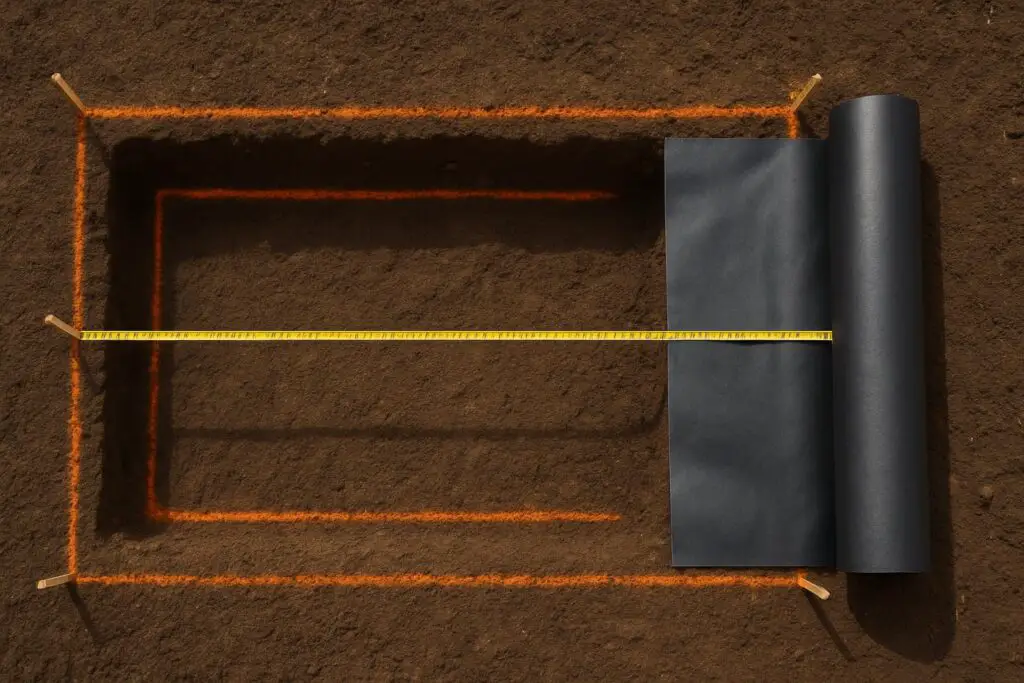
Mark the exact pond outline on the ground with paint or a garden hose. Decide the finished rim height and location of the anchor trench. The rim choice affects both depth and overlap. Measure from this final rim, not from the current soil edge if you still plan to cut or raise it.
Step 2: Choose your overlap per side O
Decide on 12 to 18 inches per side, which is 30 to 45 centimeters per side. Use the higher number if unsure. Consistency helps during installation and reduces stress around curves.
Step 3: Measure the maximum length L and width W
Stretch a tape across the longest part of the outline at ground level to get L. Repeat across the widest part to get W. These are straight-line measurements across the hole, not around the perimeter.
Step 4: Measure the maximum depth D along the contour
At three to five spots around the pond, place one end of a soft tape at the finished rim and run it down the actual slope to the deepest bottom point. If you have shelves, lay the tape along each step and down to the floor. Record the largest value you find. This is your D. Measuring along the contour captures real-world liner travel and keeps the calculation simple.
Step 5: Apply the formula
Liner length = L plus two times D plus two times O
Liner width = W plus two times D plus two times O
Work in one unit system only. Do not mix feet and meters. Convert before adding if needed.
Step 6: Add a safety buffer
Add 5 to 10 percent to both dimensions if your pond has many curves, large boulders, or an uneven floor. The buffer covers small survey errors, wrinkles, and real-world settling. If your final number lands close to a supplier’s roll cut, round up, not down.
Step 7: Match to a real liner size
Liners are sold in standard widths and cut lengths. After you compute your required rectangle, pick the closest size that is greater than or equal to your numbers in both directions. Consider how you will orient the liner in the hole to use the material efficiently.
Worked Examples
Example 1: Simple backyard rectangle
Outline: about 10 feet by 6 feet. The slope is modest and drops to a floor 2 and a half feet below the rim when measured along the ground. Choose an overlap O of 1 foot per side because the edge will use an anchor trench and coping stones.
Given: L equals 10 feet, W equals 6 feet, D equals 2.5 feet, O equals 1 foot.
Liner length = 10 plus 2 times 2.5 plus 2 times 1 = 10 plus 5 plus 2 = 17 feet.
Liner width = 6 plus 2 times 2.5 plus 2 times 1 = 6 plus 5 plus 2 = 13 feet.
Add a light safety buffer and round to supplier sizes. Order 18 by 14 feet if available. This gives room for minor adjustments and easy folding.
Example 2: Kidney shape with shelves
Outline: about 14 feet by 10 feet. The pond has a planting shelf at 12 inches depth around half the rim, then a step to a deeper floor. Measuring along the contour from rim to bottom gives a maximum D of 4 feet. Choose O of 1 and a half feet per side because you want a generous overlap for a rock edge.
Given: L equals 14 feet, W equals 10 feet, D equals 4 feet, O equals 1.5 feet.
Liner length = 14 plus 8 plus 3 = 25 feet.
Liner width = 10 plus 8 plus 3 = 21 feet.
Round up to whole-foot sizes and allow a small buffer. Order 26 by 22 feet. The extra space handles curves and boulder pockets without stress.
Example 3: Metric compact wildlife pond
Outline: 3.5 meters by 2.2 meters. The deepest contour from rim to bottom measures 0.9 meter. Choose O of 0.3 meter per side for a small trench and light coping.
Given: L equals 3.5 meters, W equals 2.2 meters, D equals 0.9 meter, O equals 0.3 meter.
Liner length = 3.5 plus 1.8 plus 0.6 = 5.9 meters.
Liner width = 2.2 plus 1.8 plus 0.6 = 4.6 meters.
Round to common sizes. Order 6.0 by 5.0 meters. This gives a reasonable buffer for folds and a clean edge.
Edge and Anchoring Choices That Change Overlap
Your overlap per side O is not fixed. It depends on how you plan to finish the rim.
Anchor trench
This is the most common edge. Dig a shallow trench 6 to 12 inches back from the rim, fold the liner over the rim, drop it into the trench, and backfill. Use at least 12 inches or 30 centimeters per side for O. Increase to 18 inches or 45 centimeters if soils are loose or your trench sits farther back from the waterline.
Rock-on-shelf edge
If you lay rocks on a shelf just below the waterline, you may want more overhang to fold and hide the liner. Choose O at 18 inches or 45 centimeters per side so you can form tidy folds behind stones without stretching.
Raised side or wall
What About Waterfalls and Streams
Waterfalls and streams usually need their own liner runs because they travel away from the main pond and have different contours. Measure and order these separately using the same approach. For a single-piece design, extend the main liner and include enough length to run up the waterfall face, across the spill area, and into the first pooling zone. The same formula logic applies, but treat the path as a separate run with its own maximum depth and its own overlap needs.
Material and Thickness Tips
The size you order is one decision. The liner material is another. Choose a material that matches your site and budget.
EPDM rubber
EPDM at common pond thickness is flexible and easy to shape around shelves and curves. It is a strong choice for most home ponds.
RPE reinforced polyethylene
RPE is lightweight, tough, and has low fold memory. It is a good fit where weight and handling matter.
PVC
PVC can be economical. Use a pond-grade product with UV resistance. Handle carefully to avoid punctures.
Underlayment
Always plan an underlayment layer beneath the liner to protect against rocks and roots. Geotextile underlayment or a bed of fine sand helps the liner last longer. Underlayment does not change the size formula, but it improves durability and tolerance for small irregularities.
Common Mistakes and How to Avoid Them
Measuring to the wrong reference
Do not measure to the current soil edge if you plan to trim or raise the rim. Always measure from the finished rim and anchor trench position. This keeps your depth and overlap accurate.
Ignoring the contour
Do not use a straight vertical depth if your sides are sloped or have shelves. Measure along the actual ground path from rim to bottom. This prevents coming up short by several inches or centimeters on each side.
Forgetting the safety buffer
Real ponds rarely match the drawing exactly. Soil collapses during digging, rocks force small detours, and curves eat liner. Add 5 to 10 percent to both dimensions when in doubt.
Mixing units
Work in one unit system from start to finish. If you start in feet, keep everything in feet. If you start in meters, keep everything in meters. Convert once at the end if the supplier lists sizes in a different system, and then round up.
Ordering before the shape is final
Mark your outline, confirm the rim, and dig at least one test section before ordering. Small changes in shape or depth add up quickly in the liner size.
Quick Reference Summary
Define L as the longest length at ground level and W as the widest width at ground level. Find D by measuring the longest rim-to-bottom path along the actual slope or shelves. Choose O of 12 to 18 inches per side, which is 30 to 45 centimeters per side. Calculate liner length as L plus two times D plus two times O. Calculate liner width as W plus two times D plus two times O. Add a 5 to 10 percent buffer for irregular shapes and round up to real roll sizes.
Conclusion
The right liner size comes from clear measurements and a simple formula. Measure the real contour depth, not a guess. Add twice the depth and twice the overlap to both the length and the width. Include a small buffer and round up to the next available size. With this method, you buy once, install once, and avoid delays caused by a liner that barely reaches the rim. Simple math, careful measuring, and a short checklist are all you need.
FAQ
Q: What is the simple formula for pond liner size
A: Liner length equals max length plus two times max depth plus two times overlap per side, and liner width equals max width plus two times max depth plus two times overlap per side.
Q: How much edge overlap should I allow on each side
A: Use 12 to 18 inches per side, which is 30 to 45 centimeters per side, and choose the higher number if soils are loose, winds are strong, or you want generous rock edges.
Q: How do I measure depth when the pond has shelves or sloped sides
A: Measure from the finished rim down to the bottom along the actual ground contour, following each shelf and slope with a flexible tape, and use the longest path you find as your maximum depth.
Q: Should I add a safety buffer to my liner size
A: Yes, add 5 to 10 percent to both dimensions for curves, rocks, and small survey errors, and round up to the next available size.
Q: What if part of my pond has a raised wall above ground
A: Add the height of the raised section as extra depth on that side, or increase the overlap on that side by the same amount, so the liner can climb the wall.