
We are reader supported. When you purchase through links on our site, we may earn an affiliate commission. Also, as an Amazon affiliate, we earn from qualifying purchases.
Starting a new aquarium is exciting, but nothing matters more than cycling the tank fast and safely. Cycling grows the good bacteria that protect fish from toxic waste. Skip it, and fish suffer. Do it right, and your tank runs smooth from day one. This guide shows you how to cycle a new fish tank faster, what to prepare, exact steps to follow, mistakes to avoid, and when to add fish with confidence.
Introduction
Cycling is the foundation of every healthy aquarium. It is not complicated, but you need a clear plan. You will learn what cycling is, how long it really takes, and the fastest methods that work. You will also get daily targets and step by step instructions you can follow today. Keep it simple, test daily, and do not rush fish in until the cycle is complete.
What Cycling Means and Why It Matters
Fish release waste that turns into ammonia. Ammonia is highly toxic even at low levels. During cycling, two groups of nitrifying bacteria colonize your filter and surfaces. The first group converts ammonia to nitrite. Nitrite is also toxic. The second group converts nitrite to nitrate. Nitrate is far less harmful and can be controlled with water changes and plants.
Once established, these bacteria remove ammonia and nitrite as your fish produce them. Your goal is simple. Build strong bacteria colonies before adding a full fish load, or add fish very slowly once the cycle is proven stable.
How Fast Can You Cycle
Without help, a cycle takes 4 to 6 weeks. With bottled bacteria and good conditions, many tanks complete in 7 to 14 days. With seeded filter media from an established aquarium, it can finish in 3 to 7 days. Your speed depends on seeding quality, stable water chemistry, high oxygen, and consistent testing.
Tools and Supplies You Need
Liquid test kit for ammonia, nitrite, nitrate, and pH. Strips are faster but less precise. A liquid kit is best for cycling.
Dechlorinator that neutralizes chlorine and chloramine. Chlorine kills beneficial bacteria quickly.
Bottled nitrifying bacteria from a trusted source. Fresh stock helps the most.
A pure ammonia source for fishless cycling, or fish food if ammonia is not available. Do not use scented cleaning ammonia or products with surfactants.
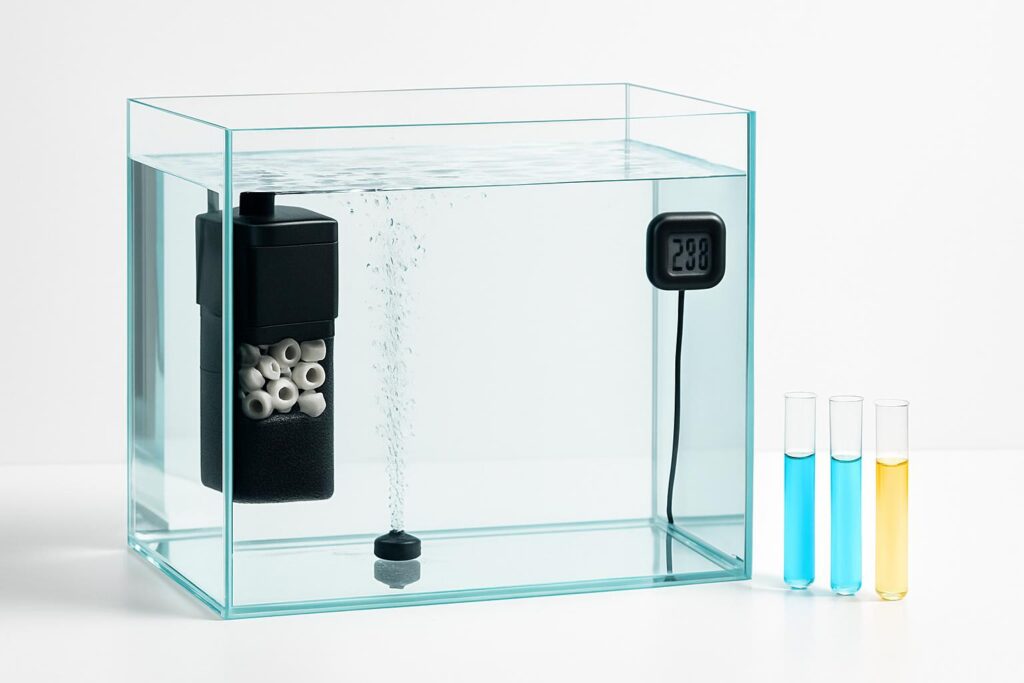
A filter with real biomedia such as ceramic rings, sponge, or sintered glass. Cartridges alone have limited surface area.
A heater to hold a stable temperature. Bacteria grow faster when warm within reason.
An air pump and air stone if your filter does not create strong surface agitation. Bacteria need oxygen.
Optional but powerful. Seeded media or a used sponge from a healthy established tank. Fast growing live plants help too.
Prepare the Tank for a Fast Cycle
Dechlorinate First
Fill the tank, add dechlorinator at the full tank dose, and let it mix for a few minutes. If your water supplier uses chloramine, always treat every new water addition. Never add bacteria before dechlorinating.
Set Temperature
Keep 26 to 29 C or 79 to 84 F during cycling. Warm water speeds bacterial growth. Avoid temperatures above 30 C or 86 F for long periods.
Maximize Oxygen and Flow
Point the filter outlet to ripple the surface. Add an air stone if needed. Strong oxygen helps both ammonia and nitrite oxidizers thrive.
Use High Surface Area Biomedia
Pack your filter with sponge and ceramic media. Do not rely only on carbon or disposable cartridges. Thicker sponge holds more bacteria and can be squeezed gently in tank water when dirty.
Stabilize pH and KH
Bacteria slow down in low pH. Aim for pH 7.0 to 8.0 if possible. If your water is very soft and pH drops during the cycle, add a small amount of crushed coral in a media bag or do partial water changes to restore KH and hold pH steady.
Clean Substrate and Hardscape
Rinse sand or gravel before use to remove dust. Rinse rocks and wood. Do not use soap or chemicals. This keeps the water clear and avoids clogging the filter.
The Fastest Ways to Seed Bacteria
Seeded Filter Media
This is the fastest method. From a healthy, disease free aquarium, move some used sponge, ceramic rings, or a pre seeded sponge filter to your new tank. Keep the media wet in tank water during transfer. Place it directly into your new filter. Try to move at least 25 to 50 percent of the media volume that the new tank needs. Do not rinse it in tap water. Dechlorinate the new tank before you add the media.
Bottled Nitrifying Bacteria
Choose a product designed for cycling. Shake well. Dose according to the label into a fully dechlorinated tank. For quicker results, add the full dose on day 0 and a top up dose after large water changes during the first week. Keep the bottle cool and use before the expiration date.
Live Plants as a Booster
Fast growing stem plants and floating plants can absorb ammonia and provide surface area for bacteria. They do not replace the cycle, but they ease the load and increase stability. Keep the light moderate and avoid algae by not overfeeding.
Combine Methods
The fastest path is seeded media plus bottled bacteria plus warm, oxygenated water. This combination often finishes a cycle in under two weeks, sometimes in a single week.
Fishless Cycling Step by Step
Fishless cycling protects fish completely and lets you build a strong biofilter before adding livestock.
Step 1. Set up the tank, dechlorinate, heat to 79 to 84 F, and start the filter and air stone.
Step 2. Add bottled bacteria at the full dose.
Step 3. Dose pure ammonia to 1.5 to 2.0 ppm. If using food, add a very small pinch daily until you can test measurable ammonia, but pure ammonia is easier to control.
Step 4. Test daily for ammonia and nitrite. Keep notes. When nitrite first appears, the first group of bacteria is working.
Step 5. After nitrite appears, lower your target ammonia to about 1.0 ppm per day. Do not let ammonia stay at 3 ppm or more. High ammonia can stall bacteria.
Step 6. Keep oxygen high and pH stable. If pH drops below 6.5, do a partial water change to restore it.
Step 7. When nitrite begins to fall and nitrate rises, you are close. Continue dosing ammonia to 1.0 ppm daily until the tank can process a 2.0 ppm dose of ammonia to 0 ammonia and 0 nitrite within 24 hours.
Step 8. Do a large water change, 50 to 80 percent, to lower nitrate before adding fish. Match temperature and dechlorinate the new water.
Step 9. Add fish gradually over several days or weeks. Keep testing to confirm stability as you increase the bio load.
Targets and End of Cycle Criteria
End of cycle means the tank can convert 2.0 ppm ammonia to 0 ammonia and 0 nitrite in 24 hours, with nitrate present and a stable pH. Do not add a full fish load until you meet this.
Fish In Cycling When You Cannot Wait
Fish in cycling is not ideal, but it can be done carefully. Start with a very small number of hardy fish. Feed lightly once per day or every other day at first. Add bottled bacteria on day 0 and after large water changes. Test ammonia and nitrite daily.
Keep ammonia and nitrite below 0.25 ppm at all times. Do partial water changes as soon as either rises. Use a conditioner that detoxifies ammonia and nitrite during spikes, but still do the water change. Maintain strong aeration. Add more fish only after several days of stable 0 ammonia and 0 nitrite readings.
Daily Schedule and Testing Plan
Without Seeded Media
Day 0. Set temperature, dechlorinate, start filter and air stone, add bottled bacteria, dose ammonia to 1.5 to 2.0 ppm.
Days 1 to 3. Test ammonia and nitrite daily. Keep ammonia at about 1.5 to 2.0 ppm. Add top up ammonia as needed. Maintain temperature and aeration.
Days 4 to 7. You should see nitrite. Reduce daily ammonia dosing to around 1.0 ppm. Keep pH above 7.0 if you can. Add a second dose of bottled bacteria after a partial water change if nitrite climbs very high.
Week 2. Nitrite should begin to drop and nitrate should rise. Keep dosing 1.0 ppm ammonia once per day. When the tank clears a 2.0 ppm dose to 0 ammonia and 0 nitrite in 24 hours, perform a large water change to lower nitrate.
With Seeded Media
Day 0. Move seeded media, dechlorinate, start filter and air stone, add bottled bacteria, dose ammonia to 1.0 to 1.5 ppm.
Days 1 to 3. Test daily. You may see quick ammonia and nitrite drops. Keep pH stable. If the tank can clear 1.0 to 2.0 ppm ammonia to 0 and 0 within 24 hours by day 3 to 5, you are nearly done. Do a large water change and begin adding fish slowly.
Speed Boosters That Work
Maintain 79 to 84 F. Avoid swings.
Hold pH near 7.0 to 8.0. Prevent pH crash by keeping KH adequate.
Maximize oxygen with strong surface ripple or an air stone.
Use a filter packed with sponge and ceramic media. More surface area equals faster colonization.
Do not run UV sterilizers during cycling. Do not use antibacterial meds.
Do not overfeed if cycling with fish. Fewer organics means steadier water.
Habits That Slow or Crash Your Cycle
Forgetting dechlorinator when adding water. Chlorine or chloramine will kill bacteria.
Rinsing filter media in tap water. Always squeeze or rinse sponges in old tank water during a water change.
Turning off the filter for hours. Bacteria need oxygen rich flow. Keep it running 24 or 7.
Replacing cartridges too often. Keep old media. Add new media next to old and wait weeks before removing anything.
Letting pH drop too low. Very low pH slows or stops nitrification.
Adding antibiotics or harsh chemicals. They can wipe out bacteria.
Troubleshooting Common Stalls
Ammonia Does Not Drop
Check dechlorinator use. Verify you dosed pure ammonia, not a cleaner with additives. Raise temperature to 79 to 84 F. Increase aeration. Add bottled bacteria again. Confirm pH is not below 6.5. If pH is low, do a partial water change to restore KH and pH.
Nitrite Skyrockets and Stays High
Large nitrite spikes can starve oxygen and slow the second bacterial group. Do a 30 to 50 percent water change, re dose bacteria, and keep ammonia dosing lower at about 1.0 ppm until nitrite starts to fall. Keep aeration strong.
No Nitrate After Two Weeks
Recheck test kit steps. Some kits need shaking and waiting. If still zero, add fresh bottled bacteria and confirm temperature and pH. Consider adding a piece of seeded media or live plants to jump start.
Bacterial Bloom Cloudy Water
Cloudiness is common and not harmful. Keep oxygen high and avoid overfeeding. It will clear as the system balances.
pH Keeps Dropping
Low KH allows acid from the cycle to drop pH. Do partial water changes, add a small bag of crushed coral to the filter, and avoid over dosing ammonia. Keep pH above 7.0 if possible during cycling.
When the Cycle Is Done
Confirm the tank can process a 2.0 ppm ammonia dose to 0 ammonia and 0 nitrite in 24 hours. Nitrate should be present. Do a large water change to lower nitrate. Match temperature and dechlorinate. Add a small group of fish first, then increase stock over time. Keep testing for the first two weeks to verify stability. Feed moderately and maintain regular filter care without replacing all the media at once.
Sample 7 Day Rapid Cycle Plan
Day 0
Set up the tank, dechlorinate, heat to 80 to 82 F, start filter and air stone. Add a full dose of bottled bacteria. If you have seeded media, install it now. Dose ammonia to 1.5 ppm.
Day 1
Test ammonia and nitrite. If ammonia is below 0.5 ppm, top up to 1.0 ppm. Keep strong surface ripple.
Day 2
Nitrite may appear already with seeded media. If nitrite is present, keep daily ammonia to 1.0 ppm. If not, keep at 1.5 ppm.
Day 3
Test all. If ammonia and nitrite both hit 0 within 24 hours after a 1.0 to 1.5 ppm dose, challenge with a 2.0 ppm dose today. If not, continue the 1.0 ppm daily dose.
Day 4
If the 2.0 ppm challenge went to 0 and 0 in 24 hours, do a 50 to 80 percent water change to lower nitrate. Then add the first small group of fish. If not yet there, add another dose of bottled bacteria and keep dosing 1.0 ppm ammonia daily.
Day 5 to 7
Repeat tests and keep conditions warm, oxygenated, and stable. Most seeded setups finish by day 5 to 7. Unseeded tanks with bottled bacteria may finish in 1 to 2 weeks. When complete, water change, add fish slowly, and keep testing.
Maintenance After Cycling
Test weekly for the first month with fish added. Do regular water changes to keep nitrate in check. Clean the filter sponge in old tank water monthly or when flow slows. Do not replace all media at once. Feed moderately to avoid waste spikes.
Conclusion
Cycling fast and safely is about preparation, seeding, and consistency. Dechlorinate, warm the water, oxygenate strongly, and give bacteria plenty of surface area. Seed with used media if you can, or add bottled bacteria. For fishless cycling, dose ammonia smartly and meet the 24 hour processing test before adding a full fish load. For fish in cycling, keep ammonia and nitrite below 0.25 ppm with testing, water changes, and careful feeding. Avoid chlorine, filter downtime, and harsh chemicals. Follow the steps, and you will build a stable biofilter quickly and protect your fish from day one.
FAQ
Q. How long does a fast cycle take
A. With seeded media it often finishes in 3 to 7 days. With bottled bacteria and good conditions it usually takes 7 to 14 days. Without any aids it can take 4 to 6 weeks.
Q. What numbers show the cycle is complete
A. The tank must process a 2.0 ppm dose of ammonia to 0 ammonia and 0 nitrite within 24 hours, nitrate should be present, and pH should be stable.
Q. How much ammonia should I dose in fishless cycling
A. Start at 1.5 to 2.0 ppm. After nitrite appears, keep daily dosing around 1.0 ppm until the tank can clear a 2.0 ppm challenge in 24 hours.
Q. Can I cycle with fish
A. Yes, but go slowly. Start with a small number of hardy fish, feed lightly, test daily, keep ammonia and nitrite below 0.25 ppm, do frequent water changes, and use a conditioner that detoxifies spikes.
Q. What can crash or stall my cycle
A. Chlorine or chloramine from untreated tap water, rinsing media in tap water, turning off the filter, antibacterial medications, very low pH, and low oxygen will slow or kill bacteria.