
We are reader supported. When you purchase through links on our site, we may earn an affiliate commission. Also, as an Amazon affiliate, we earn from qualifying purchases.
Raising KH without shocking your fish is possible if you move slowly, test often, and use the right tools. KH, also called carbonate hardness or alkalinity, buffers acids and stabilizes pH. Low KH makes pH unstable. Stable pH protects fish, plants, and biofilter. Here is a clear plan that works for beginners and experienced keepers alike.
What KH Is And Why It Matters
KH measures the bicarbonates and carbonates in your water. Higher KH resists pH drops. Lower KH allows pH to swing with every feeding, waste spike, or CO2 change. GH is different; it is about calcium and magnesium. You can have soft water with good KH, or high GH with weak KH. Focus on KH when pH is bouncing.
Target ranges are simple. Most community freshwater tanks do well at 3–6 dKH. Livebearers and African cichlids prefer higher KH, often 8–12 dKH. Planted tanks using CO2 usually keep 2–5 dKH to balance CO2 and stability. Do not chase an exact number. Aim for a stable range.
Diagnose Before You Dose
Test your KH and pH at the same time each day for three days. Write the results down. If pH drifts more than 0.3 in 24 hours, your buffer is low.
Measure true water volume. Tank length × width × height in inches, divided by 231, gives US gallons. In centimeters, length × width × height divided by 1000 gives liters. Subtract displacement from rocks and substrate if you know it.
Find the cause of low KH. Common reasons include soft tap water, heavy plant growth with CO2 injection, lots of driftwood and botanicals, peat use, and use of RO or distilled water without remineralizing.
Set a safe pace. Raise KH no more than 1–2 dKH per 24 hours. Slower is safer. Match the KH of new water to the tank before every water change. That single habit prevents most pH swings.
Safe Ways To Raise KH
Use a freshwater KH buffer
Commercial KH buffers are predictable and easy to dose. Pre-dissolve in water, add to a high-flow area, wait 1–2 hours, then retest. Repeat in small steps until you gain 1 dKH. Log the dose that gave you 1 dKH for your tank. Use that record for future adjustments.
Add slow-release media
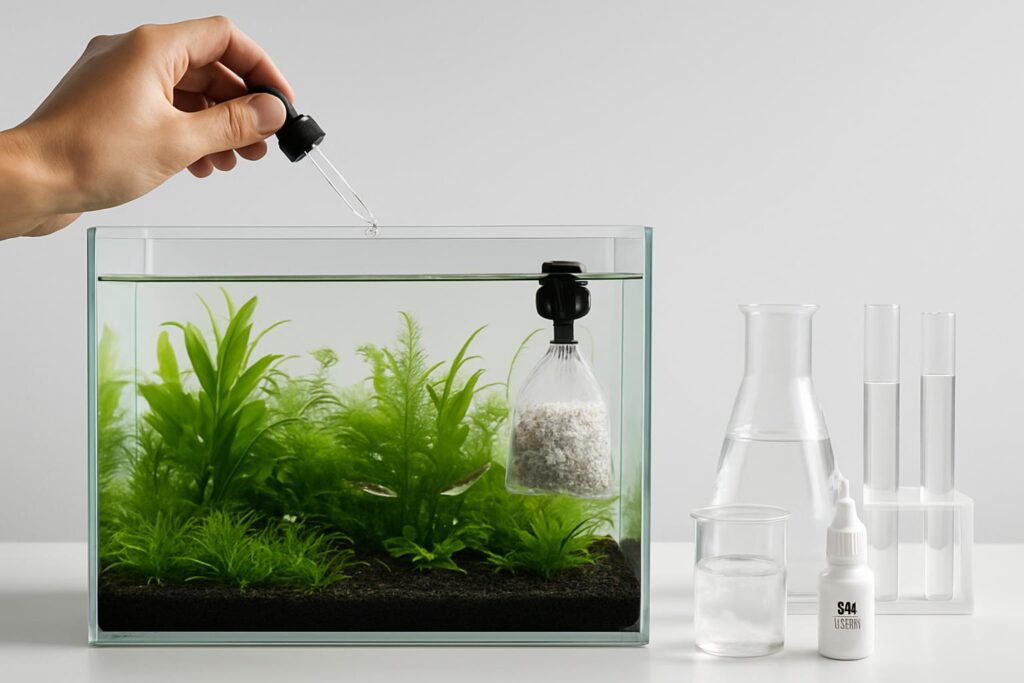
Crushed coral or aragonite in a filter bag rises KH gradually over days to weeks. Rinse well, place in the filter, and start with a small amount. Check KH weekly and adjust the amount until you hold a steady target. This is the most forgiving method and reduces routine dosing.
Remineralize new water
If your tap or RO water is soft, add KH to the new water in a bucket or barrel before it enters the tank. Match temperature, dechlorinate, buffer to your target KH, and then change the water. The tank never sees a shock.
Baking soda or potassium bicarbonate
Food-grade sodium bicarbonate raises KH quickly and predictably. Potassium bicarbonate is an alternative for planted tanks that want to limit sodium. Make a small stock solution, add a little at a time, and test. Stop when you gain 1 dKH. Record the volume used for your system. Do not exceed 1–2 dKH per day.
Product Reviews And How To Use Them
API GH and KH Test Kit
Why it helps: Accurate KH and GH readings are the foundation of stable pH. This kit uses simple drop titration so you can see each dKH step clearly and stop right at your target.
Best for: Any freshwater keeper, from beginners to advanced aquascapers. Essential if you are adjusting KH or using RO water.
How to use: Follow the instructions for KH. Count drops until the color changes and record the number as dKH. Test before dosing, one to two hours after dosing, and at the same time daily for tracking.
Potential downsides: Requires a bit of patience and careful drop counting. Store reagents properly for consistent results.
Seachem Alkaline Buffer
Why it helps: Designed for freshwater, this buffer raises KH and pushes pH upward in a controlled way. It is reliable, mixes clear, and includes clear dosing guidance.
Best for: Community tanks and non-CO2 planted tanks that need a stable pH in the neutral to slightly alkaline range.
How to use: Pre-dissolve the measured dose in a cup of tank water. Add to a high-flow area. Wait 1–2 hours and test KH and pH. Increase slowly, not more than 1–2 dKH per day. For fine control of pH, it can be paired carefully with acid buffer, but most freshwater tanks only need the alkaline side.
Potential downsides: Can raise pH faster than you expect if overdosed. Always test between small additions.
CaribSea Crushed Coral
Why it helps: Provides a slow, steady source of carbonates that dissolves as acids build. This naturally stabilizes KH and pH over time.
Best for: Tanks with soft water, livebearers, African cichlids, or anyone who wants a low-maintenance buffer. Useful in hang-on-back filters and canisters.
How to use: Rinse thoroughly. Place a small amount, such as 0.5–1 cup per 10 gallons, in a media bag in your filter. Test weekly and adjust the amount to hold your target KH. Replace or rinse the media when it clogs or dissolves down.
Potential downsides: Works slowly and can nudge pH upward. Not ideal if you want soft, mildly acidic water for sensitive species.
Brightwell Aquatics Florin Delta KH+
Why it helps: Formulated for freshwater and planted aquaria, this buffer raises alkalinity without adding phosphates and is friendly to plant-focused systems.
Best for: Planted tanks that run CO2 and want moderate KH for pH stability while avoiding sodium buildup.
How to use: Dose per label based on true water volume. Pre-dissolve, add to high flow, then wait and test. Increase in small steps, track KH daily, and tune your CO2 after KH stabilizes.
Potential downsides: Higher cost than baking soda. Still requires patience and testing to avoid overshooting.
Arm and Hammer Pure Baking Soda
Why it helps: Food-grade sodium bicarbonate is a straightforward KH booster that is easy to control with testing.
Best for: Budget-friendly KH adjustments, emergency stabilization, and routine matching of new water KH.
How to use: Make a small stock solution by dissolving baking soda in dechlorinated water. Add a little at a time into high flow. Test after 30–60 minutes. Stop when you gain 1 dKH. Do not exceed 1–2 dKH per day. Record the volume used so you can repeat it consistently.
Potential downsides: Raises sodium in the water, which some plants may dislike in high amounts. Can spike pH if you dump in too much at once.
A Simple Step-by-Step Plan
Day 0: Baseline
Test KH and pH in the tank and in your tap or source water. Decide on a target KH appropriate for your fish and plants.
Day 1: Small Increase
Pick one method: buffer, baking soda, or crushed coral. If using a buffer or baking soda, pre-dissolve, add a small dose, wait 1–2 hours, and retest. Aim for a 1 dKH increase. Stop there for the day.
Day 2–3: Hold and Verify
Test at the same time each day. If KH drifts down, repeat a small dose to regain 1 dKH per day until you reach target. Watch fish behavior. If anything looks off, pause and allow the system to settle.
Day 4–7: Stabilize
Once you reach target KH, keep it steady. If using crushed coral, adjust the amount in the filter until KH holds between water changes. If dosing, note the weekly maintenance dose that keeps KH constant.
Every Water Change
Pre-treat new water. Dechlorinate, add KH buffer to match the tank, and confirm with a quick test. Temperature match, then change water. This prevents pH swings from dilution.
Preventing Sudden pH Swings
Increase KH gradually. Keep daily changes within 1–2 dKH. Always pre-dissolve powders and add to high flow. Aerate well, especially if using CO2. Recheck CO2 levels after KH changes because pH will shift at the same CO2 dose. Avoid large corrections. Small, repeated adjustments are safer than one big dose.
Troubleshooting And Safety
If pH jumps unexpectedly, do an immediate partial water change with dechlorinated water that matches your prior KH. Increase aeration. Pause dosing and retest after an hour. Confirm test kit freshness and method.
Test ammonia before adjusting pH, especially in new tanks. Higher pH makes ammonia more toxic. If ammonia is not zero, solve that first with water changes and filter care. Resume KH adjustments once ammonia is under control.
For sensitive shrimp and fish, cut the daily KH increase in half. Patience prevents stress and losses.
Conclusion
Stable KH is the backbone of stable pH. Test, plan, and adjust slowly. Choose a method that fits your tank and maintenance style. Buffer new water before it touches the tank. With steady habits, you can raise KH safely and keep pH locked in a healthy range long term.
FAQ
Q: How fast can I raise KH without stressing fish?
A: Increase KH by no more than 1–2 dKH per 24 hours. Slower is safer, especially for sensitive species.
Q: Is crushed coral better than liquid buffers?
A: Crushed coral raises KH slowly and steadily with low effort, while liquid buffers give faster, precise control. Choose coral for set-and-forget stability and buffers for quick, measured adjustments.
Q: Should I buffer new water before water changes?
A: Yes. Dechlorinate and raise KH in the new water to match the tank before adding it. This prevents dilution shocks and pH swings.
Q: Will raising KH affect my planted tank with CO2?
A: Yes. As KH rises, pH at a given CO2 level will change. Adjust CO2 after KH stabilizes, and consider potassium bicarbonate or plant-friendly buffers to avoid excess sodium.
Q: What should I do if pH spikes after a dose?
A: Do a partial water change with water that matches your prior KH, increase aeration, pause dosing, and retest after an hour. Confirm your test method and reagent freshness.