
We are reader supported. When you purchase through links on our site, we may earn an affiliate commission. Also, as an Amazon affiliate, we earn from qualifying purchases.
Seeing pH slide downward by morning can be frustrating, especially when your fish looked fine the night before. Because pH stability is an important part of overall aquarium water quality, repeated overnight drops are worth investigating. This guide explains what drives overnight pH drops, how to confirm the cause in your tank, and the best ways to stabilize pH without guesswork.
Why your aquarium pH drops overnight
CO2 buildup after lights out
When lights go off, plants and algae stop most photosynthesis and switch to respiration, consuming oxygen and releasing CO2. Fish and bacteria also respire. CO2 in water forms carbonic acid, which lowers pH. In tanks with injected CO2, the effect is larger if the gas is not shut off at night or if surface agitation is weak.
Low KH and exhausted buffers
KH, or carbonate hardness, is the buffering capacity that resists pH swings. When KH is low, even normal nightly CO2 rise or acids from biological activity can drop pH fast. Tanks run with RO or rainwater are especially prone if not remineralized.
Excess dissolved organics and nitrification acids
Uneaten food, mulm, and decaying plant matter release organic acids. Nitrifying bacteria convert ammonia to nitrate and produce acid in the process. These acids accumulate more noticeably in poorly maintained tanks or with clogged filters, making overnight dips more likely.
Weak gas exchange
Calm water traps CO2. If your filter return is submerged and you do not run an airstone, night-time CO2 clearance is limited. Oxygen drops, CO2 rises, and pH follows.
Acidic substrates and tannins
Active planted substrates and new driftwood release acids and tannins. This pushes pH down and can amplify nightly swings when KH is low.
RO or very soft water without remineralization
Very low mineral content means little buffering. If you use RO or distilled water and do not add KH and GH back, pH can become unstable from day to night.
How to confirm the cause
Test at night and morning
Measure pH one hour after lights out and again right before lights on. A swing over 0.3 indicates low buffering or excess CO2. Record values for several days to spot a pattern.
Check KH
Test KH. For most community freshwater tanks, a target of 3 to 6 dKH keeps pH more stable. KH below 2 dKH often allows fast pH shifts.
Review CO2 and surface agitation
If you inject CO2, confirm it shuts off at night with a solenoid. Look at surface agitation. Aim for a gentle ripple that breaks surface tension. Consider a drop checker or pH controller data to verify CO2 is not lingering overnight.
Inspect organics and filter maintenance
Yellow tint, film on the surface, mulm in the substrate, and a sluggish filter indicate organic buildup. High nitrate with steady ammonia at zero suggests long-term accumulation of acids.
Consider substrate, wood, and water source
Active soils and new driftwood lower pH. RO or rainwater without remineralization removes buffering. Note these factors as they guide your fix.
What to do to stop overnight pH drops
Stabilize KH carefully
Raise KH slowly to a stable range.
- Increase no more than 1 dKH per day to reduce stress.
- Use a dedicated alkaline buffer designed for freshwater. Follow label dosing, test KH after each adjustment, and aim for consistency.
- Add a small bag of crushed coral in the filter for a slow, steady KH boost. Rinse coral first and monitor KH weekly.
Keep species needs in mind. Soft-water fish can still live in moderate KH if changes are gradual.
Control CO2 and improve gas exchange
- Shut off CO2 at night with a reliable solenoid and timer.
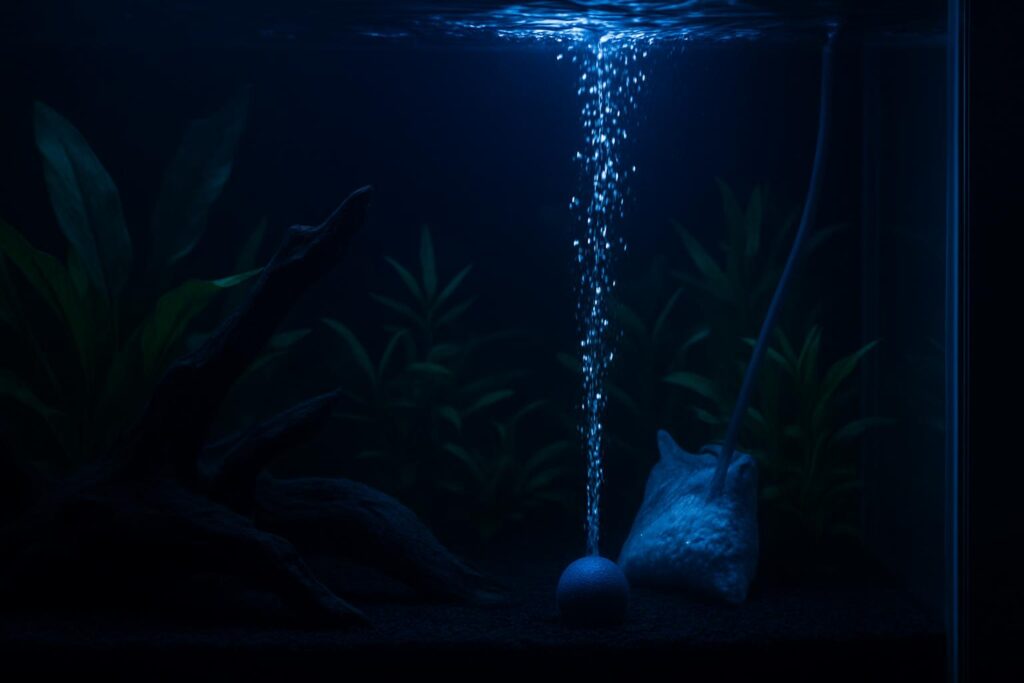
- Run an airstone or increase filter surface ripple at night. This clears CO2 and brings in oxygen.
- In high-light planted tanks, lower CO2 bubble rate slightly if daytime pH is already near your lower limit.
Even small increases in aeration can prevent the nightly pH slide caused by CO2 accumulation.
Reduce dissolved organics
- Gravel-vac the substrate weekly until debris is minimal.
- Rinse mechanical media in old tank water to restore flow.
- Avoid overfeeding. Feed what fish finish in 30 to 60 seconds.
- Use chemical media like synthetic polymer resins or high-grade carbon to remove dissolved organics if water is tea-colored or has an earthy odor.
Re-mineralize RO or very soft water
If you use RO, add back KH and GH on every water change. Combine a KH buffer with a GH mineral supplement. Stabilize KH in the target range for your stock, then keep it there with consistent dosing. This prevents big day-night pH drift.
Work with, not against, active soils
Active planted substrates are designed to lower pH. If you use them, accept a mildly acidic pH and guard against swings with moderate KH and strong, consistent maintenance. Extra aeration at night and careful CO2 control are important here.
Targets and safe rates of change
- Aim for KH 3 to 6 dKH for most community tanks. Higher for African cichlids and brackish, lower for delicate soft-water setups managed by experienced keepers.
- Do not raise KH more than 1 dKH per day. Small steps prevent stress.
- Keep daily pH swing under 0.3 whenever possible.
Product picks that make this easier
API KH GH Test Kit
Accurate KH readings are the backbone of pH stability. This simple titration kit shows KH in dKH so you can dial in buffering and stop guessing.
Why it helps: Confirms whether low buffering is the root cause and verifies progress after adjustments.
Best for: Freshwater tanks using RO, planted tanks, new setups, and anyone chasing pH swings.
Potential downsides: Requires counting drops carefully. Replace reagents as they age.
Seachem Alkaline Buffer
A straightforward way to raise and stabilize KH in freshwater without adding sodium at harsh levels when used as directed.
Why it helps: Builds buffering capacity so nightly CO2 and acids cannot push pH down sharply.
Best for: RO users and soft municipal water where KH is below 2 dKH.
Potential downsides: Overdosing can overshoot pH. Increase KH slowly and test between doses.
Tetra Whisper Air Pump with air stone
Reliable aeration that improves gas exchange and clears CO2 overnight.
Why it helps: Increases oxygen, drives off excess CO2, and stabilizes pH when lights are off.
Best for: Planted tanks with CO2, stocked community tanks, and any setup with calm surface water.
Potential downsides: Adds a bit of noise and surface ripple. Use a check valve and place the pump above waterline.
Simple action plan
- Test pH at night and morning for three days and measure KH.
- If KH is under 3 dKH, raise it gradually with a buffer or add a small bag of crushed coral to the filter.
- Shut off CO2 at night and add an airstone or increase surface agitation.
- Vacuum substrate, service filter flow, and reduce feeding.
- If you use RO, remineralize every water change with KH and GH supplements.
Conclusion
Overnight pH drops come from predictable sources: CO2 buildup, weak buffering, and excess acids from organics or specialized substrates. Diagnose with a simple night and morning test and a KH check. Then stabilize KH, improve gas exchange, and cut organics. Small, consistent steps will flatten the pH curve and keep fish and plants steady across the night.
FAQ
Q: Why does my aquarium pH drop overnight
A: CO2 builds up after lights out as plants, fish, and bacteria respire, forming carbonic acid. If KH is low or organics are high, pH falls more. Weak surface agitation and acidic substrates or tannins can amplify the drop.
Q: How can I stop overnight pH swings quickly
A: Shut off CO2 at night, run an airstone or increase surface ripple, and raise KH gradually to 3 to 6 dKH. Clean substrate and filters to reduce dissolved organics.
Q: What KH should I aim for to stabilize pH
A: For most community freshwater tanks, target 3 to 6 dKH. Increase no more than 1 dKH per day.
Q: Should I run an air pump at night in a CO2-injected tank
A: Yes. Extra aeration at night helps clear CO2, raises oxygen, and prevents the typical night-time pH dip.
Q: Can driftwood or active soil cause night pH drops
A: Yes. Both release acids that lower pH, which is more noticeable when KH is low. Stabilize KH and improve aeration to limit swings.