
We are reader supported. When you purchase through links on our site, we may earn an affiliate commission. Also, as an Amazon affiliate, we earn from qualifying purchases.
Testing your aquarium water at home is one of the simplest ways to maintain good aquarium water quality and prevent problems before they turn into emergencies.. Good water quality means much more than clear-looking water. Ammonia and nitrite should remain at safe levels, nitrate should be controlled, pH and hardness should be appropriate and stable, temperature should suit the species, and the water should contain enough dissolved oxygen.
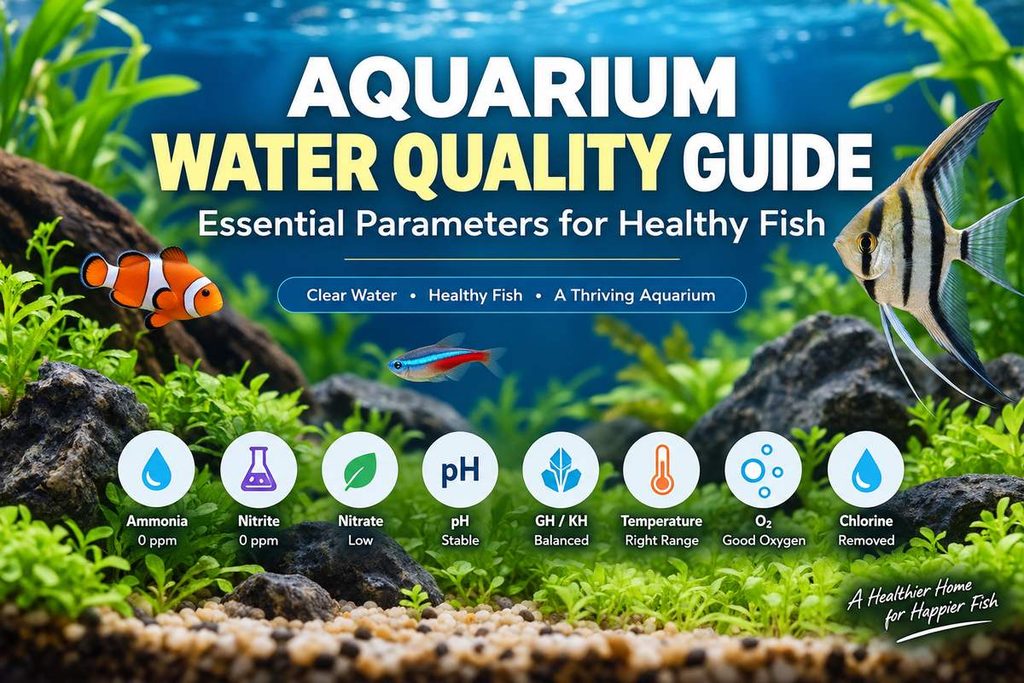
For most freshwater aquariums, the basic goals are:
- Ammonia: 0 ppm
- Nitrite: 0 ppm
- Nitrate: kept low and appropriate for the species
- pH: stable and suitable for the livestock
- Temperature: stable and species-appropriate
- Chlorine/chloramine: removed before tap water enters the aquarium
The exact numbers vary by species. A betta, goldfish, African cichlid, and dwarf shrimp do not necessarily thrive in the same water chemistry.
This guide explains the major aquarium water parameters, how they interact, what you should test, and what to do when water quality begins to deteriorate.
What Is Aquarium Water Quality?
Aquarium water quality describes whether the water provides a safe and stable environment for aquatic life.
Important factors include:
| Parameter | Why It Matters |
|---|---|
| Ammonia | Toxic waste produced by fish and decomposing organic matter |
| Nitrite | Toxic intermediate produced during the nitrogen cycle |
| Nitrate | End product of biological filtration that gradually accumulates |
| pH | Measures how acidic or alkaline the water is |
| GH | Measures dissolved calcium and magnesium |
| KH | Helps buffer pH against sudden changes |
| Temperature | Affects fish metabolism and dissolved oxygen |
| Dissolved oxygen | Required by fish and aerobic microorganisms |
| TDS | Indicates the concentration of dissolved substances |
| Chlorine/chloramine | Tap-water disinfectants that can harm aquatic life |
An aquarium can therefore look perfectly clear while still having poor water quality.
Clear water is not necessarily safe water. Testing is the most reliable way to understand what is happening chemically inside your aquarium.
How Aquarium Water Quality Works
A fish tank is a small biological system.
Fish produce waste. Uneaten food, dead plant material, and other organic matter decompose. Microorganisms process some of this waste, while filtration and water changes help prevent unwanted substances from accumulating.
One of the most important processes involved is the aquarium nitrogen cycle.
Ammonia
Fish release nitrogenous waste, while decomposing food, plants, and other organic material can also contribute ammonia.
In an established aquarium, ammonia should normally be undetectable.
Detectable ammonia may indicate:
- an immature aquarium
- excessive feeding
- overcrowding
- dead livestock or decomposing material
- damaged biological filtration
- major disruption of filter media
Nitrite
Nitrifying microorganisms oxidize ammonia into nitrite.
Nitrite is also toxic to fish and should normally remain undetectable in a properly established freshwater aquarium.
A nitrite reading in an established tank is therefore a warning that the biological system may not be processing waste effectively.
Nitrate
Other nitrifying microorganisms oxidize nitrite into nitrate.
Nitrate is generally much less acutely toxic than ammonia or nitrite, but it gradually accumulates in many aquariums.
Water changes, plant growth, feeding, stocking levels, and maintenance all influence nitrate concentration.
If nitrate keeps climbing between water changes, there are several ways to reduce nitrate levels in an aquarium without destabilizing the tank.
The Nitrogen Cycle and Your Biofilter
The biological portion of an aquarium filter provides surfaces where nitrifying microorganisms can colonize.
This is why biological filter media should not routinely be sterilized or replaced all at once.
A newly established aquarium may take several weeks to develop sufficient biological filtration. During this period, ammonia and nitrite should be monitored closely.
Seeded filter media from a healthy established aquarium can accelerate colonization, and commercial bacterial products may also be useful, but testing remains important.
Understanding how aquarium filtration works also makes it easier to diagnose ammonia or nitrite problems when they appear.
The Most Important Aquarium Water Parameters
Ammonia
General target: 0 ppm
Detectable ammonia deserves immediate attention.
Check for:
- dead fish or decaying material
- overfeeding
- sudden increases in livestock
- reduced filter flow
- recently replaced or heavily cleaned biological media
- an aquarium that has not completed cycling
If livestock are present and ammonia is elevated, partial water changes are one of the fastest ways to reduce the concentration while you identify the cause.
Nitrite
General target: 0 ppm
Nitrite should also remain undetectable in an established aquarium.
If nitrite appears, investigate biological filtration and reduce the immediate concentration through appropriate water changes.
Persistent ammonia or nitrite should not simply be masked with additives. The underlying biological or husbandry problem needs to be identified.
Nitrate
Unlike ammonia and nitrite, some nitrate is expected in many established aquariums.
There is no single ideal nitrate number for every aquarium because tolerance and husbandry goals vary among species and systems.
As a practical principle, keep nitrate consistently low enough for the livestock you keep and investigate unexplained upward trends.
If nitrate remains high despite regular maintenance, test the source water as well. Tap water itself can contain nitrate.
pH
pH measures how acidic or alkaline the water is.
Different species have different preferred ranges, so there is no universal “perfect aquarium pH.”
For many commonly kept freshwater community fish, moderately acidic to moderately alkaline water can work well.
More important than constantly adjusting pH toward an arbitrary number is avoiding sudden changes.
If your aquarium pH keeps dropping, KH should be investigated because inadequate buffering can contribute to recurring pH instability.
KH
KH, or carbonate hardness, describes part of the water’s buffering capacity.
Adequate buffering helps resist rapid changes in pH.
Very low-KH aquariums require closer monitoring because biological processes can gradually consume alkalinity and contribute to falling pH.
GH
GH, or general hardness, primarily reflects dissolved calcium and magnesium.
These minerals matter to fish and invertebrates, but appropriate GH varies considerably among species.
A Neocaridina shrimp aquarium, for example, may require different mineral management from an aquarium designed for soft-water fish.
Understanding GH and KH together is useful when you need to diagnose hardness or pH stability problems.
Temperature
Temperature affects metabolism, oxygen availability, feeding, immune function, and biological activity.
There is no single correct aquarium temperature.
| Aquarium | Typical Range |
|---|---|
| Betta | 26–28°C |
| Tropical community | approximately 24–26°C |
| Goldfish | approximately 18–22°C |
| African rift-lake cichlids | approximately 24–27°C |
| Neocaridina shrimp | approximately 20–24°C |
These are general starting points rather than universal requirements. Always check the needs of the exact species being kept.
Dissolved Oxygen
Fish, nitrifying microorganisms, and many other aquarium organisms depend on dissolved oxygen.
Gas exchange primarily occurs at the water’s surface. Good circulation and surface agitation help oxygen enter the water and carbon dioxide leave it.
Low oxygen becomes more likely when:
- water temperature is high
- the aquarium is heavily stocked
- circulation is poor
- organic waste is excessive
- equipment stops during a power outage
Fish gathering at the surface and breathing rapidly can be a warning sign, although similar behavior can have other causes.
TDS
Total dissolved solids, or TDS, estimates the concentration of dissolved substances in water.
A TDS meter does not tell you exactly what those substances are, so TDS should not replace tests for ammonia, nitrite, nitrate, GH, KH, or other relevant parameters.
It is particularly useful for observing changes and maintaining consistency in systems such as shrimp aquariums.
If you keep shrimp or use RO water, understanding TDS in aquariums can help you recognize potentially stressful changes in dissolved mineral concentrations.
How to Test Aquarium Water
For most freshwater aquarium owners, a basic testing routine should include:
Ammonia + Nitrite + Nitrate + pH
Depending on the aquarium, you may also need:
GH + KH + TDS + source-water testing
Testing is especially important when:
- cycling a new aquarium
- adding livestock
- fish behave abnormally
- fish die unexpectedly
- changing water sources
- adjusting hardness or pH
- troubleshooting water-quality problems
Learning how to test your aquarium water correctly is more useful than testing frequently without understanding what the results mean.
Liquid Tests vs Test Strips
Both can be useful.
Liquid reagent kits are commonly used when more detailed testing is required, particularly for ammonia, nitrite, and nitrate.
Test strips are convenient for routine screening and monitoring trends.
The important thing is not simply which format you use, but whether the test measures the parameter you actually need and whether you follow its instructions correctly.
If you use strips, make sure you know how to read aquarium test strips and interpret parameters such as GH, KH, pH, nitrite, and nitrate.
Aquarium Water Quality and Filtration
Filtration plays an important role in water quality, but a filter does not eliminate the need for testing and water changes.
Aquarium filtration can perform three different functions:
Mechanical filtration removes suspended particles.
Biological filtration provides surfaces for microorganisms involved in processing nitrogenous waste.
Chemical filtration uses media such as activated carbon or specialized resins to remove particular dissolved substances.
Biological filtration is especially important for maintaining stable ammonia and nitrite levels.
Different types of media perform different jobs, so understanding aquarium filter media can help you decide what actually belongs inside your filter rather than adding media unnecessarily.
Water Changes and Water Quality
Water changes dilute substances that accumulate in aquarium water and replenish some dissolved minerals.
There is no universal rule that every aquarium must receive exactly the same percentage on exactly the same schedule.
Water-change requirements depend on factors including:
- stocking density
- feeding
- nitrate accumulation
- aquarium volume
- plant growth
- source-water chemistry
- species sensitivity
A moderate weekly partial water change is a practical starting point for many freshwater aquariums, but test results should help determine the appropriate schedule.
If you’re unsure about frequency, use your nitrate trend, stocking level, and source-water chemistry to determine how often to change aquarium water.
Tap Water, Chlorine, and Chloramine
Municipal tap water may contain chlorine or chloramine used for disinfection.
Untreated chlorinated water can harm aquatic organisms and microorganisms involved in biological filtration.
Use an aquarium water conditioner appropriate for the disinfectant used by your water supplier.
It is also useful to know the chemistry of your source water. Test its:
- pH
- GH
- KH
- nitrate
This gives you a baseline before you begin trying to alter aquarium chemistry.
Because the treatment required depends on the disinfectant used by your water supplier, it is useful to understand the difference between chlorine and chloramine in aquarium water.
RO Water
Reverse-osmosis water contains much lower concentrations of many dissolved substances than typical tap water.
That makes it useful when aquarists need greater control over water chemistry.
However, very low-mineral RO water should not automatically be treated as “better water.” Many fish and invertebrates require appropriate concentrations of minerals and electrolytes.
RO water may therefore need to be remineralized or blended with other water depending on the aquarium.
Common Aquarium Water Problems
Cloudy Water
Cloudy aquarium water can have several causes.
A white or milky appearance in a new aquarium may be associated with a bacterial bloom, while suspended debris, algae, substrate dust, or other factors can produce different types of cloudiness.
Do not diagnose cloudy water by appearance alone.
Start by testing ammonia and nitrite and observing when the cloudiness appeared. Identifying the cause of cloudy aquarium water is more important than simply trying to make the tank look clear again.
Green Water
Green aquarium water is usually caused by suspended microscopic algae.
Light availability and nutrient conditions influence these blooms.
Reducing excessive lighting and correcting the conditions supporting algae growth are more useful long-term strategies than repeatedly treating the appearance alone.
Falling pH
If pH continually falls rather than remaining stable, test KH.
Low buffering capacity can allow acids produced by biological processes to push pH downward over time.
Avoid repeatedly adding pH-adjusting chemicals without first determining why the pH is changing.
High Nitrate
When nitrate continually rises:
- Test the aquarium.
- Test the source water.
- Review feeding.
- Review stocking.
- Remove accumulated organic waste.
- Adjust the water-change schedule if necessary.
Do not assume filtration alone will solve nitrate accumulation.
Ammonia or Nitrite
Detectable ammonia or nitrite in an established aquarium deserves prompt attention.
Perform an appropriate partial water change and investigate:
- biological filtration
- dead organic matter
- overfeeding
- recent filter cleaning
- increased stocking
- interrupted filter operation
Treat the cause rather than only the test result.
A Simple Aquarium Water Quality Routine
You do not need to test every possible parameter every day.
For an established, stable freshwater aquarium, a practical routine is:
Weekly
Observe fish behavior and appetite.
Check temperature and equipment.
Test nitrate and other parameters relevant to your aquarium.
Perform an appropriate partial water change.
Remove accumulated waste.
After Major Changes
Test more frequently after:
- adding fish
- replacing or cleaning significant filter media
- changing the water source
- medication
- unexplained fish illness or death
- major aquascaping changes
- a prolonged power outage
New Aquariums
New aquariums require closer ammonia and nitrite monitoring until biological filtration is established.
The appropriate testing frequency should be based on how the aquarium is being cycled and whether livestock are present.
Water Quality Targets by Aquarium Type
These ranges are general references, not substitutes for researching individual species.
| Aquarium Type | Temperature | pH | Important Considerations |
|---|---|---|---|
| Betta | 26–28°C | ~6.8–7.5 | Warm, stable water; gentle flow |
| Tropical community | 24–26°C | ~6.5–7.8 | Depends heavily on species |
| Goldfish | 18–22°C | ~7.0–8.0 | High waste production; strong oxygenation |
| African rift-lake cichlids | 24–27°C | ~7.8–8.6 | Higher GH/KH usually required |
| Neocaridina shrimp | 20–24°C | ~6.8–7.8 | Stable GH/KH/TDS especially important |
The most important principle is:
Match the water to the livestock rather than trying to force every aquarium into one universal set of numbers.
Aquarium Water Quality Myths
Clear Water Means Healthy Water
False.
Ammonia, nitrite, nitrate, and other dissolved substances may be invisible.
Water Changes Remove Beneficial Bacteria
Most nitrifying microorganisms are associated with surfaces such as filter media, substrate, and other submerged material rather than freely suspended in the water column.
Routine water changes do not normally destroy an established biological filter.
More Chemicals Mean Better Water
Not necessarily.
Repeatedly adding products to chase pH or other numbers can make an aquarium less stable.
Understand why a parameter is changing before trying to alter it.
A Filter Means I Don’t Need Water Changes
False.
Filtration processes and captures waste, but many dissolved substances still accumulate. Filters and water changes perform different jobs.
Emergency Water Quality Checklist
If fish suddenly gasp, become lethargic, or die unexpectedly:
- Test ammonia and nitrite.
- Check temperature.
- Check whether the filter and circulation are operating.
- Increase aeration if oxygen may be low.
- Check for dead fish, excess food, or decaying material.
- Consider possible chemical contamination.
- Perform an appropriate water change when water chemistry or contamination is suspected.
Do not add several treatments at once without identifying the likely problem. Doing so can make diagnosis more difficult and may create additional stress.
FAQ
What are the most important aquarium water parameters?
For most freshwater aquariums, start with ammonia, nitrite, nitrate, pH, and temperature. GH and KH become particularly important when water hardness and pH stability matter for the species being kept.
What should ammonia and nitrite be in an aquarium?
In an established freshwater aquarium, both should normally be undetectable on standard hobby test kits.
How often should aquarium water be tested?
New aquariums and tanks experiencing problems should be tested more frequently. Stable established aquariums generally require less frequent testing, although nitrate and species-specific parameters should still be monitored as part of routine maintenance.
Is clear aquarium water always healthy?
No. Water can look crystal clear while containing harmful concentrations of ammonia, nitrite, nitrate, or other dissolved substances.
Does an aquarium filter keep the water safe by itself?
No. Filtration is one part of water-quality management. Appropriate stocking, feeding, testing, water changes, source-water treatment, and maintenance all contribute.
Is stable pH more important than a perfect pH?
For many commonly kept fish, avoiding rapid pH fluctuations is more useful than constantly using chemicals to force the water toward a particular number. However, the water still needs to remain within a range appropriate for the species.
Conclusion
Good aquarium water quality is not about keeping every number at one universal “perfect” value.
It means creating water that is safe, appropriate, and stable for the animals you keep.
Start with the fundamentals:
Keep ammonia and nitrite undetectable. Monitor nitrate. Understand pH, GH, and KH. Maintain an appropriate temperature. Treat tap water when necessary. Support biological filtration. Perform water changes based on the needs of the aquarium.
Most importantly, use testing to understand what is happening rather than judging water quality by appearance alone.
Once these fundamentals are stable, aquarium maintenance becomes much easier, and problems become easier to identify before they threaten your fish.