
We are reader supported. When you purchase through links on our site, we may earn an affiliate commission. Also, as an Amazon affiliate, we earn from qualifying purchases.
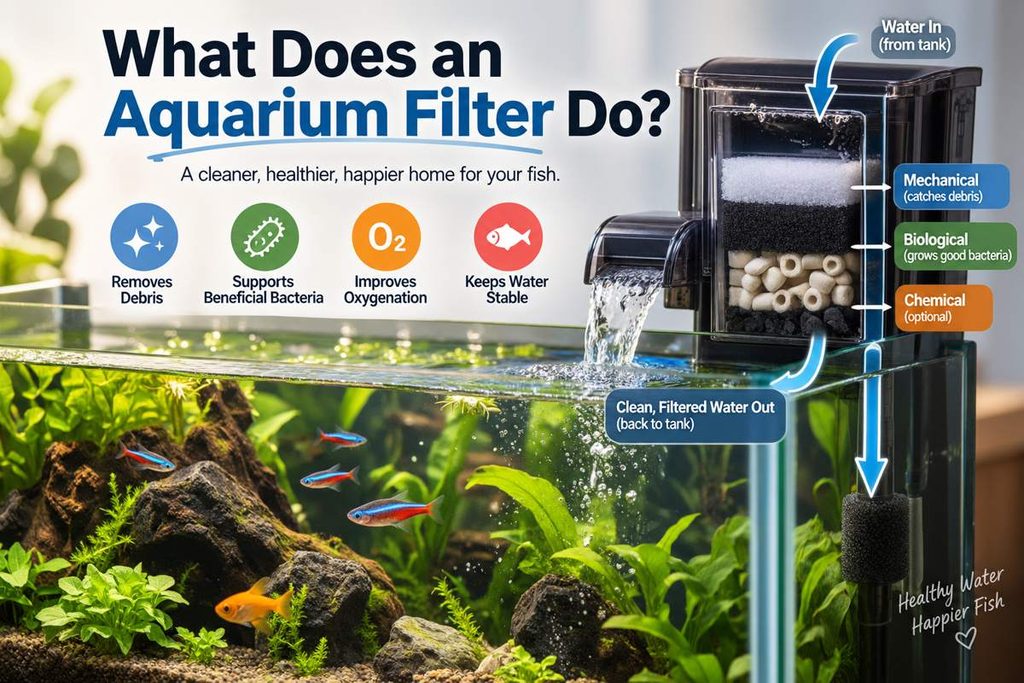
An aquarium filter removes debris, supports beneficial bacteria that process toxic waste, and circulates water to improve gas exchange and keep conditions stable.
Most aquarium filtration involves three processes:
- Mechanical filtration traps solid waste and debris.
- Biological filtration provides surfaces for microorganisms that convert toxic ammonia and nitrite into less harmful nitrate.
- Chemical filtration uses specialized media to remove certain dissolved substances when needed.
A filter also moves water around the aquarium, helping distribute oxygen, heat, nutrients, and dissolved gases.
However, an aquarium filter does not replace regular water changes, and clear water does not necessarily mean safe water.
Understanding these functions is more useful than simply buying the filter with the highest advertised flow rate.
This guide explains what aquarium filters actually do, how filtration works, the major filter types, how to choose appropriate flow and media, and the basic maintenance required to keep biological filtration stable.
What Does an Aquarium Filter Do?
An aquarium filter has several important functions, but they can be summarized into five main jobs.
| Filter Function | What It Does | Importance |
|---|---|---|
| Mechanical filtration | Traps food, waste, plant debris, and suspended particles | Important |
| Biological filtration | Supports microorganisms that process ammonia and nitrite | Essential |
| Chemical filtration | Removes selected dissolved substances using specialized media | Optional |
| Water circulation | Distributes oxygen, heat, nutrients, and dissolved gases | Important |
| Surface agitation | Improves gas exchange at the water surface | Important |
For most established aquariums, biological filtration is the most important function.
Water can look perfectly clear while still containing dangerous concentrations of ammonia or nitrite. A healthy aquarium depends on stable water conditions, not just visual cleanliness.
The filter is part of the aquarium’s life-support system.
How Does a Fish Tank Filter Work?
Most fish tank filters work by drawing aquarium water through one or more types of filter media and then returning the water to the aquarium.
A simplified filtration path looks like this:
Aquarium water → Mechanical media → Biological media → Optional chemical media → Water returned to aquarium
Each stage performs a different job.
Mechanical media captures physical debris.
Biological media provides surface area for beneficial microorganisms.
Chemical media targets specific dissolved substances when required.
The filter pump then returns water to the aquarium, creating circulation and usually some surface movement.
Different filters arrange these stages differently, but the basic principles remain similar.
The Three Types of Aquarium Filtration
1. Mechanical Filtration
Mechanical filtration physically traps particles suspended in aquarium water.
Common mechanical filter media include:
- Coarse sponges
- Fine sponges
- Filter pads
- Filter floss
These materials collect uneaten food, fish waste, dead plant material, and other debris before it continues circulating through the aquarium.
Many filters use multiple mechanical stages.
A coarse sponge may catch larger debris first, while a finer pad or filter floss catches smaller particles.
This improves water clarity and reduces the amount of organic material left to decompose inside the aquarium.
Mechanical media eventually becomes dirty and clogged. When that happens, water flow decreases and water may begin bypassing the media instead of flowing through it.
Mechanical filtration therefore requires regular maintenance.
2. Biological Filtration
Biological filtration is one of the most important processes occurring inside a mature aquarium.
Fish waste, uneaten food, and decomposing organic matter contribute to the production of ammonia.
Ammonia is toxic to fish.
In a cycled aquarium, microorganisms colonize surfaces throughout the system, including:
- Filter media
- Substrate
- Decorations
- Plants
- Aquarium glass
Filter media is particularly useful because porous materials provide substantial surface area while continuously receiving oxygenated water.
These microbial communities help process nitrogenous waste through the aquarium nitrogen cycle.
In simplified form:
Ammonia → Nitrite → Nitrate
Ammonia and nitrite can both be dangerous to aquarium animals.
Nitrate is generally less acutely toxic at typical aquarium concentrations, but it can accumulate over time and still needs to be managed.
This is why biological filtration does not eliminate the need for water changes.
Why Filter Media Matters
Sponges, ceramic media, and other porous materials provide surfaces where microorganisms can colonize.
You do not necessarily need complicated or expensive biological media. What matters is providing sufficient usable surface area with appropriate water flow and oxygen.
One of the biggest mistakes beginners make is treating established biological media as disposable.
Replacing all filter media at once can remove a substantial amount of the biological filtration associated with the filter.
Unless media is deteriorating or has another specific reason to be replaced, reusable sponge and biological media can often remain in service for a long time.
3. Chemical Filtration
Chemical filtration uses specialized media to remove particular dissolved substances from aquarium water.
Common examples include:
- Activated carbon
- Phosphate-removing media
- Ion-exchange resins
- Specialized ammonia-removing media
Unlike biological filtration, chemical filtration is not essential in every aquarium at all times.
Activated carbon, for example, can be useful for removing some medications after treatment, reducing discoloration, and adsorbing certain dissolved organic compounds.
But a healthy freshwater aquarium does not necessarily need activated carbon running continuously.
Chemical media also has a limited useful capacity.
How often it should be replaced depends on the specific material, aquarium conditions, and intended purpose. There is no universal replacement schedule that applies to every type of chemical media.
Does an Aquarium Filter Add Oxygen to the Water?
Not exactly.
A filter usually helps oxygenate an aquarium indirectly by moving water and disturbing the surface.
Most gas exchange occurs where aquarium water meets the air.
When a filter creates ripples at the surface, it continually brings water into contact with the atmosphere.
This helps oxygen enter the water and allows gases such as carbon dioxide to leave.
You usually do not need violent splashing.
Visible surface movement is often enough for many freshwater aquariums, although oxygen requirements depend on factors such as:
- Water temperature
- Fish species
- Stocking density
- Aquarium size
- Plant growth
- Water movement
Warm water generally holds less dissolved oxygen than cooler water, so heavily stocked warm aquariums may require greater attention to aeration and circulation.
Filter vs Air Pump
An aquarium filter and an air pump are not the same thing.
A filter primarily provides filtration and water circulation.
An air pump pushes air through airline tubing, usually to an air stone or sponge filter.
You do not automatically need both.
If your filter already creates adequate surface movement and your aquarium has sufficient dissolved oxygen, an additional air stone may not be necessary.
However, air pumps can be useful in heavily stocked tanks, warm-water conditions, quarantine systems, emergencies, or when operating sponge filters.
Why Water Circulation Matters
Water movement does more than improve gas exchange.
It also helps distribute heat, nutrients, dissolved gases, and suspended waste throughout the aquarium.
Temperature Distribution
Aquarium heaters warm the surrounding water.
Circulation helps distribute that heat throughout the aquarium instead of allowing significant temperature differences to develop in poorly circulated areas.
Nutrient and CO2 Distribution
In planted aquariums, circulation helps distribute nutrients and dissolved carbon dioxide.
Poor circulation can contribute to areas where nutrients, gases, and debris are distributed unevenly.
Dead Spots
If waste repeatedly collects in one area of the aquarium, circulation may be weak or poorly directed there.
Changing the direction of a filter outlet can sometimes improve circulation without requiring a larger filter.
Larger or unusually shaped aquariums may benefit from additional circulation equipment.
Types of Aquarium Filters Compared
There is no single best aquarium filter for every tank.
Different filters are better suited to different aquarium sizes, animals, maintenance preferences, and filtration requirements.
| Filter Type | Best For | Main Advantage | Main Limitation |
|---|---|---|---|
| Sponge filter | Shrimp, fry, bettas, quarantine tanks | Gentle and reliable biological filtration | Limited fine mechanical filtration |
| HOB filter | Beginner and community tanks | Easy to install and maintain | Flow may be strong for some fish |
| Internal filter | Small and medium tanks | Compact and simple | Takes up space inside tank |
| Canister filter | Medium and large aquariums | Large media capacity | More complicated maintenance |
| Undergravel filter | Lightly stocked traditional setups | Large biological surface area | Debris can accumulate in substrate |
| Sump | Large freshwater and saltwater systems | Extremely flexible | Requires space and plumbing |
Sponge Filters
Sponge filters use water movement—usually created by an air pump—to draw water through a sponge.
The sponge provides mechanical filtration while also offering substantial surface area for biological filtration.
They are particularly useful for:
- Shrimp
- Fry
- Bettas
- Breeding tanks
- Quarantine tanks
Because the intake is distributed across the sponge, tiny animals are much less likely to be sucked into the filter.
Sponge filters are inexpensive and reliable, although they usually do not polish water as finely as some powered filters.
Hang-on-Back Filters
Hang-on-back filters, commonly called HOB filters, hang on the rim of the aquarium.
They draw water through an intake tube, pass it through filter media, and return it to the aquarium.
HOB filters are popular with beginners because they are relatively simple to install and maintain.
When possible, look for designs that allow reusable media such as sponges and biological media rather than requiring complete disposable cartridge replacement.
Reusable media gives you greater control over filtration and reduces the risk of unnecessarily discarding established biological media.
Internal Filters
Internal power filters operate inside the aquarium.
They are often compact and can work well in smaller aquariums where external equipment is inconvenient.
Their main disadvantage is that they occupy valuable space inside the tank.
Media capacity can also be limited compared with larger HOB or canister filters.
Canister Filters
Canister filters sit outside the aquarium and move water through enclosed media baskets.
Their major advantage is media capacity.
A canister can hold substantial amounts of mechanical and biological media while keeping most filtration equipment outside the display.
They are popular for:
- Medium and large aquariums
- Heavily stocked tanks
- Messy fish
- Aquascaped tanks where visible equipment is undesirable
The trade-off is maintenance.
Canister filters require hoses, seals, priming, and periodic internal cleaning.
Undergravel Filters
Undergravel filters draw water through the aquarium substrate.
This effectively turns much of the gravel bed into biological filtration media.
They can work successfully, particularly in lightly stocked systems, but accumulated debris in the substrate must be managed.
Modern aquarists often choose sponge, HOB, or canister filters because their filtration media is easier to access and clean.
Sumps
A sump is a separate container—often another aquarium—connected to the main display through an overflow and return pump.
Sumps provide large amounts of space for:
- Mechanical filtration
- Biological media
- Heaters
- Protein skimmers
- Other aquarium equipment
They are particularly common in saltwater aquariums and larger freshwater systems.
The major disadvantages are additional cost, plumbing complexity, space requirements, and the need to plan carefully for power failures.
How Much Filtration Does an Aquarium Need?
You will often see aquarium filtration described using turnover rate.
Turnover describes how many times the theoretical volume of the aquarium passes through the filtration system each hour.
For example:
A 20-gallon aquarium with 100 gallons per hour of actual filter flow has approximately:
100 ÷ 20 = 5 turnovers per hour
However, turnover should be treated as a rough guideline rather than a universal rule.
Filtration requirements depend on:
- Aquarium volume
- Fish species
- Stocking density
- Waste production
- Filter design
- Media capacity
- Aquascape
- Plant density
- Additional circulation
A lightly stocked shrimp aquarium and a heavily stocked goldfish aquarium of the same size have very different filtration requirements.
Advertised Flow vs Actual Flow
Another important consideration is that the flow rating printed on a filter box may not represent the flow you actually get in your aquarium.
Flow can decrease after adding:
- Sponges
- Biological media
- Fine filter pads
- Intake prefilters
It can decrease further as debris accumulates.
For this reason, filter capacity and media volume can matter just as much as the advertised GPH or LPH number.
Matching Filter Flow to Your Fish
More flow is not automatically better.
Different aquarium animals have different preferences.
Bettas
Bettas generally prefer relatively calm water.
Strong currents can make swimming difficult, particularly for long-finned varieties.
A sponge filter or adjustable HOB filter can work well.
Shrimp and Fry
Shrimp and baby fish require protection from powerful filter intakes.
A sponge filter is an excellent option.
Alternatively, place a prefilter sponge over the intake of a powered filter.
Goldfish
Goldfish produce substantial amounts of waste.
They generally benefit from generous mechanical and biological filtration capacity.
Ease of cleaning is also important because mechanical media may accumulate debris relatively quickly.
Community Fish
For a typical community aquarium, aim for enough circulation to prevent excessive debris accumulation without forcing fish to constantly swim against strong currents.
The behavior of your fish is often more informative than a theoretical turnover number.
How Should Aquarium Filter Media Be Arranged?
There is no single arrangement that works for every filter, but a useful general principle is:
Coarse mechanical media → Fine mechanical media → Biological media → Optional chemical media
The purpose is simple.
Larger debris is captured before water reaches finer or biological media.
This reduces clogging and helps maintain consistent water flow through the filter.
A simple setup may be all you need:
Coarse sponge → Fine sponge or floss → Ceramic or other biological media
If chemical filtration is needed, place the appropriate chemical media where water can pass through it effectively after most solid debris has already been removed.
Avoid packing media so tightly that water simply flows around it.
Do You Need Activated Carbon in an Aquarium Filter?
Not necessarily.
Activated carbon can be useful, but it is not mandatory for every aquarium.
Common reasons to use activated carbon include:
- Removing some medications after treatment
- Reducing certain odors
- Removing some dissolved organic compounds
- Reducing discoloration
If your aquarium is stable and you do not have a specific reason to use carbon, additional reusable mechanical or biological media may be more useful.
Activated carbon also becomes exhausted over time and eventually needs to be replaced.
Follow the manufacturer’s recommendations and consider what you are actually trying to remove rather than replacing carbon automatically on an arbitrary schedule.
Filter Requirements for Different Aquariums
The basic principles of filtration remain the same, but different aquarium setups have different priorities.
Planted Tanks
Planted aquariums still benefit from filtration.
Filters provide biological stability and circulation while helping remove suspended debris.
In aquariums using injected CO2, extremely aggressive surface agitation can increase CO2 loss, so circulation and gas exchange need to be balanced.
Good water movement also helps distribute nutrients and CO2 around plants.
Shrimp Tanks
Shrimp tanks generally benefit from gentle filtration.
Sponge filters are particularly useful because they:
- Provide biological filtration
- Create gentle flow
- Protect baby shrimp
- Develop biofilm that shrimp can graze on
If using another filter type, install a sponge over the intake.
Goldfish Tanks
Goldfish are relatively heavy waste producers.
Prioritize:
- Large mechanical capacity
- Generous biological media
- Easy maintenance
- Adequate circulation
A powerful filter does not eliminate the need for regular water changes.
Betta Tanks
Bettas generally benefit from gentle filtration.
A small sponge filter or adjustable HOB can work well.
If the return flow is too strong, a baffle or different outlet position can reduce the current.
Even a single betta benefits from a properly cycled biological filter.
Saltwater Aquariums
Saltwater filtration can be more complex.
Live rock can provide substantial biological filtration, while sumps, protein skimmers, mechanical filtration, and chemical media may perform additional roles.
Reef tanks also commonly use separate circulation pumps because coral water-flow requirements are not necessarily the same as filtration requirements.
How Often Should You Clean an Aquarium Filter?
There is no universal cleaning schedule.
A better rule is to monitor:
- Reduced water flow
- Visible debris accumulation
- Clogged mechanical media
- Unusual filter noise
Mechanical media generally requires cleaning more frequently than biological media.
When cleaning reusable biological media, avoid aggressively sterilizing everything at once.
The goal is to remove accumulated debris while preserving biological stability.
If your filter has multiple reusable sponges or biological media sections, stagger major cleaning or replacement when practical.
Related guide: How Often Should You Clean a Fish Tank Filter?
Should You Rinse Filter Media in Tap Water?
For established biological media, a conservative approach is to rinse it gently in removed aquarium water or appropriately dechlorinated water rather than aggressively cleaning it under untreated chlorinated tap water.
The goal is not to make biological media look new.
The goal is to remove enough accumulated debris to restore flow while preserving the microbial community.
Mechanical media that does not serve an important biological role can be treated differently depending on the system and material.
Avoid cleaning every component of an established filter aggressively at the same time.
When Should Aquarium Filter Media Be Replaced?
Reusable filter media does not necessarily need to be replaced simply because it looks dirty.
Coarse sponges and durable biological media can often remain useful for years.
Replace them when they:
- Begin physically deteriorating
- Can no longer be cleaned effectively
- No longer allow adequate water flow
- Need replacement for another specific reason
Fine filter floss may be disposable and replaced much more frequently.
Chemical media follows its own replacement schedule depending on the product and its purpose.
If you need to replace a major portion of established biological media, consider replacing it gradually rather than removing everything at once.
Common Aquarium Filter Problems
Filter Flow Is Weak
Reduced flow is commonly caused by:
- Clogged mechanical media
- Dirty intake
- Dirty impeller
- Blocked hoses
- Air trapped inside the filter
Start by checking these components before assuming you need a larger filter.
Filter Is Noisy
Rattling or grinding can result from debris around the impeller, trapped air, worn components, or vibration against the aquarium or cabinet.
Cleaning the impeller and checking that the filter is correctly seated can solve many issues. For more fixes, see our aquarium filter noise troubleshooting guide
Water Is Cloudy Even With a Filter
Cloudy water can have several causes.
Fine suspended particles may require better mechanical filtration, while milky-white water can indicate a bacterial bloom.
A filter cannot solve every form of cloudiness in the same way.
Identify the cause before adding more filter media or chemicals.
Ammonia Increased After Filter Cleaning
An ammonia or nitrite increase after filter maintenance can occur if biological filtration has been significantly disrupted.
Possible causes include:
- Replacing too much established media
- Aggressively cleaning biological media
- Allowing biological media to dry
- Leaving a filter without adequate oxygenated water flow for an extended period
If ammonia or nitrite is detectable, protect the animals first through appropriate water management while the biological filter recovers.
Common Aquarium Filter Myths
Myth 1: Clear Water Means Safe Water
False.
Water can look crystal clear while containing dangerous ammonia or nitrite.
Test water parameters rather than relying on appearance.
Myth 2: Activated Carbon Is Required in Every Aquarium
False.
Activated carbon is useful for specific purposes but is optional in many established freshwater aquariums.
Myth 3: All Filter Media Should Be Replaced Regularly
False.
Durable sponges and biological media can often remain in service for years.
Replacing established media unnecessarily can reduce biological filtration.
Myth 4: Higher Flow Is Always Better
False.
Flow must match the aquarium and its inhabitants.
A strong current suitable for one species may stress another.
Myth 5: A Powerful Filter Replaces Water Changes
False.
Filters process and capture waste, but they do not prevent all dissolved substances from accumulating.
Water changes remain an important part of aquarium maintenance.
Aquarium Filter FAQ
Can Fish Live Without a Filter?
Some aquariums can operate without conventional powered filters, particularly carefully designed, lightly stocked planted systems.
However, this requires a strong understanding of biological filtration, stocking, oxygenation, and nutrient management.
For most beginners, a properly cycled filter provides a much larger margin of safety.
Does a Filter Remove Fish Waste?
A filter can trap solid fish waste through mechanical filtration.
However, trapped waste does not disappear.
It remains inside the filter until you clean the mechanical media, and organic material can continue decomposing.
This is why filter maintenance remains necessary.
Does an Aquarium Filter Remove Ammonia?
A mature biological filter helps process ammonia.
Microorganisms convert ammonia into nitrite and then nitrate as part of the nitrogen cycle.
It is more accurate to describe this as biological processing than simply saying the filter physically removes ammonia.
Does an Aquarium Filter Remove Nitrate?
Conventional biological filtration generally converts nitrogenous waste toward nitrate rather than removing nitrate from the system.
Water changes, plant uptake, and specialized biological processes or filtration methods can reduce nitrate depending on the aquarium.
Should an Aquarium Filter Run 24 Hours a Day?
In most conventional filtered aquariums, yes.
Continuous water flow provides oxygen and nutrients to microorganisms living in the filter media while maintaining circulation and gas exchange.
Regularly switching the filter off for long periods can reduce filtration effectiveness and may harm the biological community.
Can a Filter Be Too Strong for Fish?
Yes.
Strong currents can stress fish that prefer calmer environments.
Bettas, some long-finned fish, fry, and other weak swimmers may struggle in excessive flow.
Choose an adjustable filter or reduce the return flow when necessary.
Is a Bigger Aquarium Filter Always Better?
Not necessarily.
Additional media capacity can be useful, but excessive flow may create problems for some fish.
The best filter is one that provides sufficient biological and mechanical capacity while producing appropriate water movement for the aquarium.
Conclusion: What an Aquarium Filter Really Does
An aquarium filter does much more than make water look clean.
Its most important functions are to:
- Capture physical debris
- Support biological filtration
- Process ammonia and nitrite
- Circulate aquarium water
- Improve gas exchange
- Provide optional chemical filtration when needed
Among these, stable biological filtration is particularly important.
A good filter provides microorganisms with the surface area, oxygen, and water flow they need while providing enough mechanical filtration to keep excessive debris under control.
But filtration is only one part of aquarium care.
A healthy aquarium also depends on appropriate stocking, feeding, water testing, water changes, temperature, and regular maintenance.
Instead of choosing a filter based only on advertised flow rate, consider the animals you keep, how much waste they produce, how much media the filter can hold, and how easily the system can be maintained.
When those factors are balanced, the filter becomes what it should be: a stable biological and mechanical support system for the aquarium rather than simply a device that makes the water look clear.