
We are reader supported. When you purchase through links on our site, we may earn an affiliate commission. Also, as an Amazon affiliate, we earn from qualifying purchases.
Tap water is convenient, cheap, and consistent. It is not automatically safe for fish. Municipal systems add chlorine or chloramine to kill microbes. These disinfectants, and sometimes dissolved metals, burn gills and stress aquatic life. A water conditioner neutralizes these threats in seconds when used correctly. This guide explains how conditioners work, how to choose one, and exactly how to use it during setup, water changes, and emergencies. You will see common mistakes to avoid, simple testing tips, and clear routines for stable results.
Introduction
New aquarists often hear to add a capful of conditioner and move on. That advice is incomplete. The right dose depends on your actual water, your tank volume, and your method of adding new water. Considering these details prevents irritation to fish, ammonia spikes from chloramine breakdown, and test kit confusion. Keep reading to build a routine you can repeat every time with confidence.
What a Water Conditioner Does
Neutralizes chlorine
Chlorine is common in city water. Conditioner reduces chlorine to chloride, which is harmless to fish at normal levels. This reaction is fast when you use the correct dose.
Detoxifies chloramine
Many cities use chloramine, a bond of chlorine and ammonia. A proper conditioner breaks the bond and neutralizes the chlorine portion. Quality products also bind the released ammonia into a less toxic form for a limited time so your biofilter can process it. If your supplier uses chloramine, you need a conditioner designed for it.
Detoxifies heavy metals
Trace copper, zinc, or lead can leach from pipes. Some conditioners chelate these metals, making them less bioavailable. This is more important for invertebrates like shrimp and snails, which are sensitive to copper.
Optional supportive additives
Some products add slime-coat enhancers or mild stress reducers. These are optional. They do not replace good water quality and stable parameters. For everyday use, prioritize chlorine and chloramine handling over extras.
Check Your Tap Water First
Find out if your water has chloramine
Check your city’s water quality report on its website. Look for chloramine. If you cannot find it, call the utility. You can also use an inexpensive total chlorine test. If total chlorine is much higher than free chlorine, you likely have chloramine.
Know your source type
City water usually contains chlorine or chloramine. Well water does not, but can have dissolved gases, metals, or variable pH. Reverse osmosis or deionized water is free of disinfectants but lacks minerals. Conditioner use differs for each case, explained later.
Keep simple tools
Have a basic chlorine test, an ammonia test, and a reliable thermometer. These confirm your conditioner is doing its job and that your process is stable.
Choose the Right Conditioner
Essential features to look for
Pick a product that clearly states it removes chlorine and chloramine. If you keep shrimp or sensitive species, choose one that detoxifies heavy metals. If your city uses chloramine, verify the label mentions detoxifying ammonia released from chloramine.
When a basic dechlorinator is enough
If your utility uses only chlorine, a basic dechlorinator works. It is usually inexpensive and effective. Verify with a quick chlorine test after dosing.
When to choose a comprehensive conditioner
If you have chloramine, or you want extra margin during a fish-in cycle or emergency, use a comprehensive conditioner that binds ammonia and nitrite temporarily. This gives your biofilter time to catch up.
Concentration and dosage precision
Conditioners vary in strength. Concentrated products require very small amounts per gallon. This saves cost but demands accurate measuring. If you are new, a less concentrated product may be easier to dose without error.
How to Use a Water Conditioner Step by Step
First tank fill
Step 1: Estimate the true tank volume. Subtract space taken by substrate, rocks, and decor. A tank labeled 20 gallons might hold about 16 to 18 gallons of water when full.
Step 2: Read the label for dose per gallon or liter. Calculate the needed amount for your actual volume.
Step 3: Add conditioner directly to the empty tank or to the first few inches of water before adding the bulk of tap water. This protects fish immediately if you plan to fill with a hose. If fish are already in the tank, dose for the full tank volume first, then start filling.
Step 4: Start filling. Aim the flow at a plate or plastic bag to avoid disturbing substrate. Conditioned water can be used immediately; you do not need to wait for hours.
Routine water changes using buckets
Step 1: Remove the desired amount of aquarium water into a sink or drain.
Step 2: Fill a clean bucket with tap water. Add the correct conditioner dose for that bucket volume. Mix with your hand for a few seconds. This ensures full contact with the water.
Step 3: Match temperature by adjusting the tap so the bucket water is close to tank temperature. A thermometer helps prevent big swings.
Step 4: Pour the conditioned water into the tank slowly. Repeat as needed for multiple buckets.
Routine water changes using a hose or water-change system
Step 1: Dose conditioner for the full tank volume before you start refilling. This ensures the incoming tap water is neutralized at contact.
Step 2: Refill slowly and monitor temperature. Keep the flow gentle to avoid stressing fish and stirring debris.
Step 3: Stop at your desired water level. Consider a brief aeration boost after a large change to stabilize oxygen and temperature.
Top-offs for evaporation
Evaporation leaves minerals behind, so only water volume decreases. For freshwater tanks, you still need to condition tap water before topping off if disinfectants are present. Pre-treat the top-off water in a container and add slowly. In planted tanks, consider using conditioned tap or remineralized RO water based on your target hardness.
Emergency detox
If you detect a sudden ammonia spike during a fish-in cycle, or after a filter mishap, a comprehensive conditioner can bind ammonia and nitrite for a short period. Follow the label for emergency dosing limits. Maintain strong aeration and fix the root cause by reestablishing filtration and performing partial water changes.
Dosing and Measuring Without Guesswork
Calculate volume correctly
Measure internal tank dimensions and multiply length by width by water height to estimate liters or gallons. Convert using 1 gallon equals about 3.785 liters. Subtract displacement from decor. Record this number and keep it with your aquarium notes.
Measure accurately
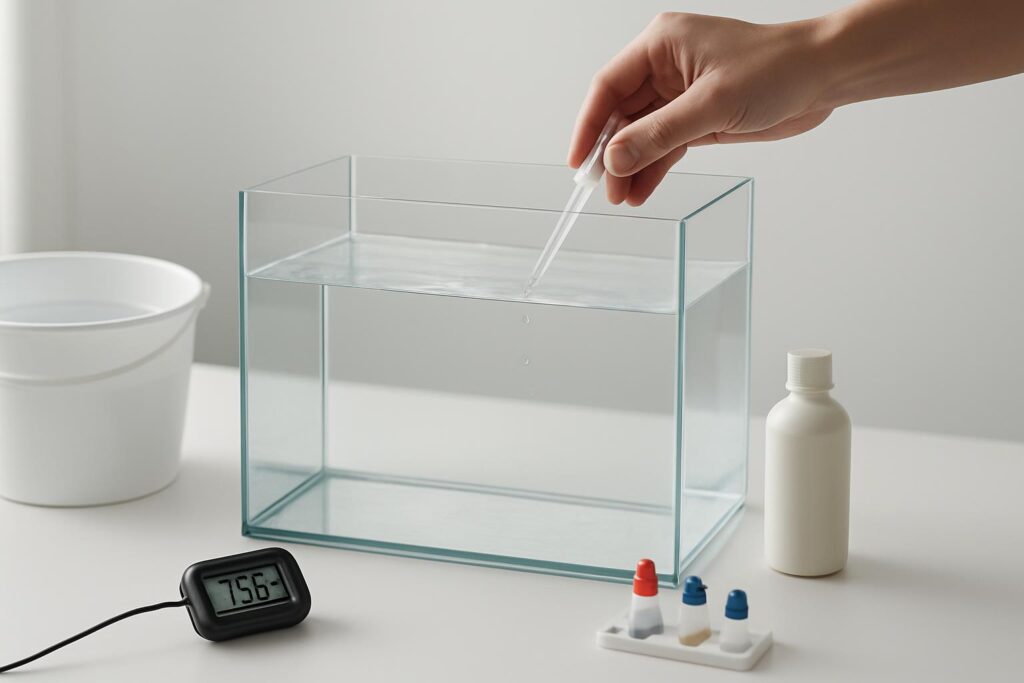
Use a syringe, pipette, or dosing dropper for small volumes. Do not guess from the cap if the scale is unclear. For very concentrated products, even a small overdose can be wasteful. An inexpensive 1 to 5 milliliter syringe improves accuracy.
Allow contact time
Conditioners react almost instantly with chlorine and chloramine. By the time water mixes in your bucket or the stream hits the tank, neutralization is engaged. You do not need to let water sit overnight when using conditioner.
Overdose and safety
Most quality conditioners are safe at up to several times the standard dose, but do not rely on that. Very high doses can reduce dissolved oxygen or affect sensitive livestock. Use only the amount needed for the job. Maintain good surface agitation during and after large changes.
Timing and Temperature
Condition water before the tank when possible
Pre-treat in buckets for small tanks. For larger tanks filled by hose, dose the tank for the full volume first. This neutralizes disinfectants as new water enters, protecting fish immediately.
Match temperature and avoid pH shocks
Keep new water within a couple of degrees of tank temperature. If your tap pH is very different from tank pH, make smaller, more frequent changes to avoid sudden swings. Conditioner does not change pH, KH, or GH unless the product specifically states it includes buffers.
Special Cases
Shrimp and snails
Invertebrates are sensitive to copper and sudden parameter shifts. Choose a conditioner that detoxifies heavy metals. Keep water changes smaller and more frequent. Match temperature closely to avoid molting stress.
Planted tanks
Most conditioners are plant safe. Some heavy metal chelators can also bind beneficial trace elements like iron for a short time. Dose fertilizers consistently and avoid excessive conditioner overdoses so nutrients remain available.
Saltwater and brackish
Conditioners work for saltwater mixing too. If you run a protein skimmer, be aware that slime-coat additives can cause overfoaming temporarily. Mix salt with conditioned RO/DI or tap water in a separate container, aerate, bring to temperature, then add to the tank.
High-chloramine city water
Use a conditioner that specifically handles chloramine and binds ammonia. Consider testing total chlorine and ammonia after treatment the first few times to confirm your process. Ensure strong biofiltration and consider smaller, frequent water changes if you see persistent ammonia readings.
Well water and dissolved gases
Well water typically has no disinfectants, so you may not need conditioner. However, it can be rich in dissolved carbon dioxide that lowers pH when first drawn. Aerate well water for an hour before use to drive off excess gas. Test pH and hardness so you understand how it differs from your tank water.
RO/DI water
RO/DI water contains no chlorine or chloramine, so conditioner is not necessary for that purpose. However, it is too pure for most fish and plants. Remineralize with GH and KH products to the target levels for your species before adding to the tank.
Testing After Conditioning
Ammonia test behavior
Some comprehensive conditioners convert free ammonia to ammonium. Many test kits detect both forms, so your test may still show a reading even though toxicity is reduced. If you need to check only free ammonia, use a test designed for that purpose. Do not panic if total ammonia shows a small value right after treatment; watch fish behavior and confirm with a free-ammonia indicator if available.
Chlorine residual check
After you establish a routine, test chlorine periodically. You should read zero free chlorine after dosing. If you detect residual chlorine, increase accuracy in measuring dose, mix more thoroughly, or confirm your actual water volume.
Observe livestock
Fish should breathe normally and swim calmly after a change. Gasping at the surface or flashing against decor suggests temperature shock, residual chlorine, or a parameter swing. Recheck temperature, dosing, and pH.
Common Mistakes to Avoid
Do not add untreated tap water directly into a tank with fish. If you refill by hose, dose the tank for the full volume first. If you refill by bucket, treat each bucket before it goes into the tank.
Do not guess dosing. Use a syringe or marked cap to measure correctly.
Do not forget chloramine. Basic dechlorinators that only remove chlorine are not enough when your utility uses chloramine. You need ammonia-binding capability.
Do not assume conditioner fixes poor maintenance. It neutralizes disinfectants, but it does not remove nitrate buildup, waste, or overfeeding problems.
Do not chase pH with conditioner. Unless the product includes buffers, it will not control pH or hardness. Use the right tools for that job.
Do not ignore oxygen. Large doses and big water changes can momentarily affect gas exchange. Keep good surface agitation.
Troubleshooting Quick Answers
If water still smells like chlorine after conditioning, confirm your dose and mixing. Test total and free chlorine. Increase aeration and redose according to the label if needed.
If ammonia reads higher after water changes in a chloramine area, your conditioner likely released ammonia from chloramine and bound it temporarily. Ensure your biofilter is healthy, maintain regular changes, and consider smaller changes until levels stabilize. Use a free-ammonia test to assess real toxicity.
If fish gasp after a water change, check temperature difference first. Then check chlorine and ammonia. Confirm correct dosing and improve surface agitation.
If shrimp die after changes, test for copper, confirm heavy metal detox on your conditioner, and reduce change size. Match TDS and temperature closely.
If your protein skimmer overfoams after adding conditioner to a marine tank, pause or lower the skimmer for a few hours and avoid conditioners with slime coat additives in the display. Mix water in a separate container.
Maintenance Routine Template
Weekly or biweekly water change
Step 1: Test ammonia, nitrite, nitrate, and temperature. Record the results.
Step 2: Siphon 20 to 30 percent of the tank volume, vacuuming debris as needed.
Step 3: Prepare new tap water. Add the required conditioner dose. Match temperature.
Step 4: Add new water slowly. Ensure surface agitation.
Step 5: Observe fish for 10 minutes. Confirm normal behavior.
Monthly checks
Verify your city water report if it changes seasonally. Test chlorine and chloramine if needed. Inspect your conditioner bottle for expiration and volume left. Replace measuring tools if markings fade.
Storage and Shelf Life
Proper storage
Store conditioner tightly closed, at room temperature, out of direct sunlight. Do not freeze. Keep it away from children and pets.
Signs to replace
If the product changes color or smells unusual compared to when new, replace it. Do not mix different conditioners in the same bottle. Label the date you opened it and aim to use within the manufacturer’s recommended period.
Safety and Environmental Notes
Use conditioners only as directed. Do not ingest. Wash hands after use. Prevent spills on floors that pets might lick. Dispose of empty bottles according to local guidelines. Do not pour concentrated chemicals into natural waterways.
Putting It All Together: A Reliable Workflow
Know your water source. Choose a conditioner that matches chlorine or chloramine content. Calculate your actual aquarium volume and measure doses precisely. For bucket changes, treat the bucket. For hose refills, treat the tank for the full volume before adding water. Match temperature and maintain good aeration. Verify results with simple tests until you are confident in your routine. Keep notes so you can repeat the process every time.
Conclusion
Using a water conditioner is simple once you understand what it does and how to apply it. It neutralizes chlorine and chloramine fast, protects fish from metal exposure, and can buy time during setbacks by binding ammonia. The key is matching the product to your water, dosing with precision, and integrating it into a stable maintenance routine. Follow the steps in this guide, avoid the common mistakes, and confirm with quick tests. Your fish will breathe easier, your filter will work as intended, and every water change will be predictable and safe.