
We are reader supported. When you purchase through links on our site, we may earn an affiliate commission. Also, as an Amazon affiliate, we earn from qualifying purchases.
Columnaris can wipe out a tank fast. It looks like a fuzzy fungus on the mouth and body, but it is actually a bacterial infection that thrives in warm, low-oxygen, and dirty water. The good news is clear. If you identify it early, stabilize the environment, and use the right treatment plan, most fish recover. This guide shows you what to look for, what to do in the first hour, how to medicate safely, and how to keep it from coming back.
Introduction
Every fishkeeper should know columnaris. It is also called cottonmouth disease for the way it coats the lips and head with off-white patches that seem to fluff out. It spreads quickly and often appears right after a stress event such as a new fish addition, a filter issue, or a warm spell. You do not need lab tools to act. You need clear signs, strong basics, and a step-by-step plan. Read on, and move in order.
What Is Columnaris
The Culprit You Are Fighting
Columnaris is caused by the bacterium Flavobacterium columnare. It prefers warm, oxygen-poor water with a high organic load. It attaches to damaged skin, fins, and gills, then expands across tissue in a film or cottony sheet. It is not a fungus, but many hobbyists mistake it for one because it looks fuzzy at the edges.
Why It Spreads Fast
The bacteria live in the water and on surfaces. Stress reduces the fish immune response and makes the skin more vulnerable. The organism multiplies quickly in higher temperatures. That is why warm community tanks packed with fish can see a sudden outbreak that seems to move from one fish to many in a day or two.
Who Is Most At Risk
Any freshwater fish can get columnaris. Newly shipped fish are at high risk because of transport stress. Livebearers, catfish, and fish kept in crowded tanks show frequent cases. Gill involvement is always urgent because it reduces oxygen uptake and can lead to rapid deaths even if the body lesions look small.
Key Signs You Can Spot Early
Cottony Film Around the Mouth
The classic sign is a pale, off-white film around the lips and face that looks like cotton or lint. It coats rather than forms discrete tufts. Lips can erode and the mouth can look shortened or frayed. This is why it is called cottonmouth. If eating becomes painful, fish lose weight and weaken very quickly.
Saddleback Lesions and Fin Edge Whitening
Look for a pale patch across the back just behind the head, like a saddle. The edges may be sharp and lighter than the surrounding skin. Fins often appear ragged with distinct white or milky edges where tissue is dying back. These fin margins are a strong clue when combined with mouth changes.
Gill Damage and Breathing Changes
If the gills are hit, fish breathe fast, gasp at the surface, or hang near filter outflow. Gills may look swollen or pale. Gill involvement can kill within 24 to 72 hours if not corrected because the fish cannot move enough oxygen across damaged tissue.
Behavior That Signals Trouble
Early behavior changes include listlessness, clamping fins, hiding, rubbing the head or body on objects, and reduced feeding. Watch the whole tank at lights on and during feeding, when signs show up fastest. One fish with mouth film and another with fin edge whitening can still point to the same disease.
Rule Out Common Lookalikes
True Fungus Versus Columnaris
True fungus such as Saprolegnia forms fluffy tufts that stick out like little balls of cotton. Columnaris tends to look like a flat or filmy patch with a fuzzy edge. It often starts at the mouth, fin edges, or a wound site. Fungus is common on dead tissue and injuries, while columnaris prefers stressed live tissue and spreads along it.
Ich Is Not the Same
Ich creates many small white salt-like dots over the body and fins. Columnaris forms larger patches and films, often with mouth involvement and saddleback lesions. The treatment and response plan are different, so look closely at pattern and size.
Test Your Water Now
Test ammonia, nitrite, nitrate, pH, and temperature. Ammonia should be zero. Nitrite should be zero. Nitrate should be low, ideally under 20 to 40 ppm depending on your maintenance routine. A rising temperature above the species normal range increases risk. Low oxygen increases risk. Poor water quality does not cause columnaris by itself, but it sets the stage for a fast attack.
If you lack a test kit, get one now and still proceed with the first hour plan below. Water quality and oxygen are part of the treatment, not only prevention.
Immediate Action Plan In The First Hour
Move Sick Fish To A Hospital Tank
Use a bare-bottom tank or tub with a heater and a strong air source. Transfer only the sick or obviously exposed fish. Keep the hospital setup simple so you can medicate without harming plants, shrimp, or the main filter bacteria.
Boost Aeration And Surface Agitation
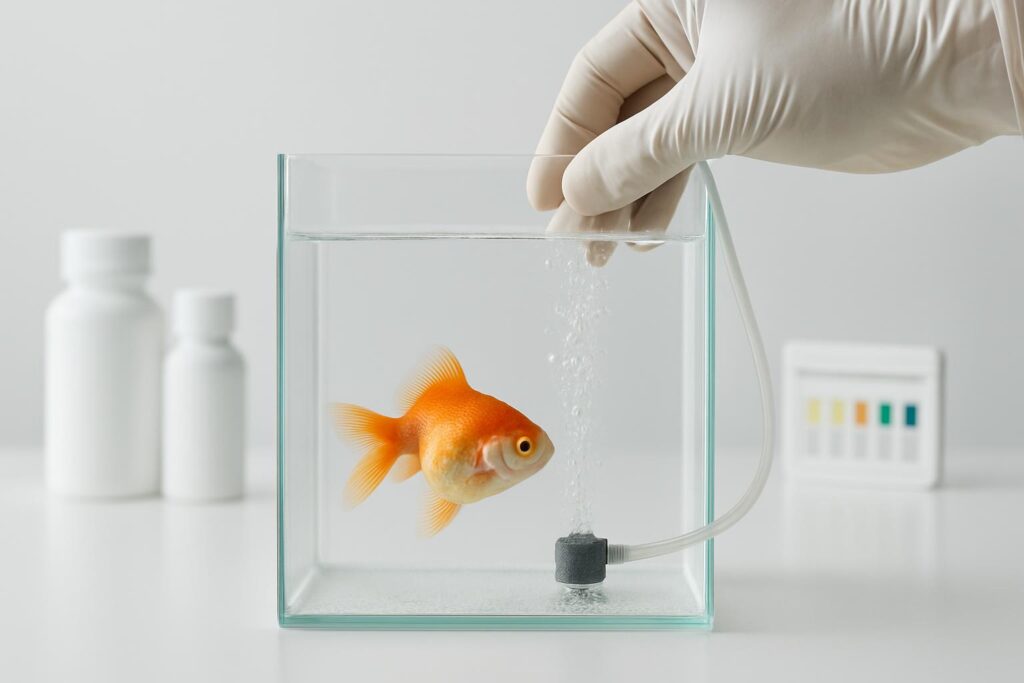
Add an airstone and raise the filter outflow to ripple the surface. Columnaris damages gills, so oxygen support is urgent. More dissolved oxygen also helps fish handle medications better.
Stabilize Temperature
For most tropical community fish, bring temperature down to the lower end of their safe range, often 23 to 24 Celsius. Do not drop more than 1 to 2 degrees per hour. Lower temperature slows the bacteria. Do not chill coldwater fish. Aim for a stable, species-appropriate level rather than a large swing.
Do A Large Water Change And Clean Up Organics
Change 30 to 50 percent of the water in both the hospital and the display tank. Vacuum the substrate to remove waste and leftover food. Rinse filter media in tank water if clogged, but do not replace all media at once. Removing organics reduces bacterial load and helps medications work.
Remove Carbon And UV Before Dosing
Take out activated carbon and turn off UV during medication. Carbon and UV strip or degrade many drugs and reduce treatment success. Restart UV only after the medication course is done and water is cleared with water changes.
Disinfect Nets And Tools Between Tanks
Use a bleach solution with one part plain household bleach to ten parts water for ten minutes, then rinse and dechlorinate thoroughly. Air-dry fully. This simple step blocks cross contamination.
Document What You See
Note which fish show mouth film, fin edge whitening, saddleback patches, and breathing changes. Write down times and progress. This helps you judge response to treatment and decide whether to adjust the plan.
Medication That Works
Antibiotic Options And Combinations
Columnaris responds best to broad gram negative antibiotics. Common choices include nitrofurazone, kanamycin, oxytetracycline, and minocycline. A combination of a nitrofuran such as nitrofurazone with a systemic antibiotic such as kanamycin is often effective because it covers external lesions and internal spread. Follow the product label for dosage and redosing after water changes. Treat in a hospital tank whenever possible to protect plants, shrimp, snails, and biofilter bacteria in the display.
How To Dose Safely In A Hospital Tank
Start with a full dose per the label. Increase aeration during treatment. Test ammonia and nitrite daily and keep them at zero with water changes. If you change water, redose the amount of medication removed. Complete the full course even if fish look better by day three. Stopping early invites relapse and resistance.
Feeding Medicated Food When Fish Can Still Eat
If appetite remains, use an antibiotic food that targets gram negative bacteria, or bind a suitable antibiotic to food with a safe binder as directed by the product. Internal dosing helps when mouth and gills are affected. Use soft, easy to swallow foods if lips are sore. Stop feeding if ammonia rises; control water quality first.
Salt Support When Appropriate
Aquarium salt can add support by reducing osmotic stress and can slow columnaris at moderate levels. In a hospital tank without plants or invertebrates, use 1 to 2 grams per liter, increased gradually over 24 hours. For sensitive or scaleless fish, use less and watch closely. Do not use salt in planted displays or with shrimp and snails. Salt is supportive, not a standalone cure.
Why Most Dips Are Not For Beginners
Potassium permanganate and peroxide dips can damage fish if used incorrectly and can harm gills when fish are already compromised. Unless you have experience and proper instructions, stick to waterborne antibiotics and medicated foods in a hospital tank.
Treatment Timeline You Can Follow
Days 1 To 3
Stabilize temperature, raise aeration, and start medication. Expect mouth film to look less fluffy and fin edges to lose the stark white line if the treatment is working. Breathing should ease as gill irritation drops. If breathing worsens and more fish fall ill despite treatment, reassess dosage, water quality, and oxygenation.
Days 4 To 7
Continue the full medication course. Keep testing ammonia and nitrite and perform water changes as needed, redosing after each change. You should see fewer new lesions, cleaner fin edges, and better appetite. Any fish that still shows expanding lesions may need a combined therapy approach or a different antibiotic choice per label options.
After Day 7
Most cases resolve by the end of a full course. If lesions persist, extend treatment per the product directions or switch to another suitable antibiotic. When signs stop progressing and tissue looks stable or healing, pause medication and maintain pristine water. Tissue regrowth takes time. Torn fins often regrow within weeks. Mouth erosion may not fully reverse but function can improve.
Protect The Main Tank
Quarantine And Observation
Keep sick fish in the hospital tank until you see clear improvement and no new lesions for at least a week after treatment. Observe the display tank daily. Remove any fish that shows pale mouth film, fin edge whitening, or saddleback patches. Early isolation prevents a tank-wide outbreak.
Sanitize And Break The Chain
Disinfect nets, siphons, and algae scrapers between tanks. Keep separate towels and buckets. For a severe outbreak in a bare tank, a full clean with a dilute bleach soak, followed by thorough rinsing, dechlorination, and complete air-drying, breaks the chain. Never mix bleach with acids and always neutralize with a dechlorinator after the final rinse.
Plants, Shrimp, And Snails
Avoid antibiotic dosing in planted display tanks. Many antibiotics harm beneficial bacteria and some harm invertebrates. Move fish to a hospital tank instead. If you must treat in place, be aware of the risks to your filter and livestock and increase monitoring of ammonia and nitrite.
Long Term Prevention
Stocking And Compatibility
Do not overcrowd. Choose compatible species to reduce chasing and fin nipping. Aggression and nips create entry points for bacteria. A well matched community stays calmer and heals faster if a disease appears.
Filtration And Maintenance
Use a filter rated for your tank volume and stock. Rinse mechanical media when flow drops. Perform routine water changes to keep nitrate in check and to remove dissolved organics that bacteria feed on. Vacuum debris from the substrate. Replace only part of the filter media at a time to protect the biofilter.
Temperature And Oxygen Management
Keep temperature in the center of your species range and avoid spikes. High temperature with low oxygen is ideal for columnaris. Use an airstone in warm weather, increase surface agitation, and never let the tank sit with a covered or stagnant surface.
Nutrition And Stress Reduction
Feed a varied, high quality diet and avoid overfeeding. Remove uneaten food within a few minutes. Reduce stress with consistent lighting, hardscape that blocks line of sight, and stable water parameters. Stability is a stronger defense than any single additive.
New Fish Quarantine Protocol
Quarantine all new fish for two to four weeks. Observe daily for mouth film, fin edge whitening, saddleback lesions, and behavior changes. Treat problems in the quarantine tank so you never introduce columnaris into the display.
Common Mistakes To Avoid
Raising Temperature For Columnaris
Do not raise temperature to speed up treatment as you might for ich. Higher heat accelerates columnaris. Keep it stable and on the lower safe side for your species.
Stopping Medication Early
Do not stop just because the mouth film looks thinner. Complete the full course. Relapses are harder to treat and can spread faster the second time.
Medicating The Display Without A Plan
Dumping antibiotics into a planted display often harms the filter and invertebrates. Use a hospital tank unless there is no other option. If you treat in place, increase testing and be ready to change water often.
Skipping Aeration
Low oxygen and gill damage are a dangerous mix. Always add extra aeration during treatment. Fish handle stress and drugs better when oxygen is abundant.
Using Salt Or Harsh Dips Carelessly
Salt can help but is not safe for every setup or species. Harsh dips can do more harm than good. If you are unsure, stick to hospital tank antibiotics and good water.
When Recovery Is Unlikely
If gill damage is extreme and the fish cannot breathe even with high aeration, treatment may not succeed. Focus on the rest of the stock and the stability of the system. Quick isolation and a strong prevention routine protect the group even when one fish is too far gone.
Conclusion
Columnaris is fast, but your response can be faster. Recognize the early signs. Stabilize water and oxygen. Lower temperature to the safe low end. Move fish to a hospital tank. Use proven antibiotics and complete the full course. Clean tools and control organics so the bacteria lose every advantage. Build prevention into your routine with quarantine, stable parameters, and steady maintenance. Do this once, and you will be ready for next time. With early action, most fish recover and your tank returns to balance.
FAQ
Q: What are the first signs of columnaris
A: Look for a pale cottony film around the mouth, white or milky fin edges, and saddleback patches behind the head. Rapid breathing or gasping suggests gill damage and calls for urgent action.
Q: Should I raise or lower the temperature for columnaris
A: Keep temperature stable at the lower safe end for your species, often 23 to 24 Celsius for tropical fish. Do not raise temperature, as heat speeds up columnaris.
Q: Which medications work best for columnaris
A: Broad gram negative antibiotics work best, such as nitrofurazone, kanamycin, oxytetracycline, or minocycline. A combination like nitrofurazone with kanamycin is often effective. Follow product labels and complete the full course.
Q: Can I treat columnaris in my planted display tank
A: It is safer to treat in a hospital tank. Many antibiotics harm beneficial bacteria and some invertebrates. If you must treat in place, monitor ammonia and nitrite closely and increase aeration.
Q: How can I prevent columnaris from coming back
A: Quarantine new fish for two to four weeks, avoid overcrowding, maintain strong filtration and routine water changes, keep temperature and oxygen stable, and feed a high quality diet without overfeeding.