
We are reader supported. When you purchase through links on our site, we may earn an affiliate commission. Also, as an Amazon affiliate, we earn from qualifying purchases.
Juggling work, travel, and family often means missing feeding times. Fish can handle short gaps, but long or irregular fasting stresses metabolism, weakens immunity, and causes finicky behavior. A good automatic feeder keeps a steady schedule and dose size, even when you are away. This guide reviews four reliable aquarium fish food dispensers that suit busy owners, with clear pros and cons, setup tips, and realistic use cases.
What matters in an automatic fish feeder
Food type compatibility. Some feeders meter pellets well but struggle with light flakes that clump or blow away. If you feed flakes, choose a model with a narrow dosing aperture and consider pairing it with a feeding ring to keep flakes from drifting into the filter intake.
Dose control and consistency. You want repeatable portions. Look for a hopper door that makes very small adjustments, or a tray-style feeder with fixed compartments for exact rations. Overfeeding is the main risk with auto feeders.
Moisture management. Evaporation and condensation can cake food in the hopper. Features that help include a small feeding window, a fan or air vent, a well-fitting lid, and the option to connect an air line to keep food dry.
Power and scheduling. Battery models are simple and last months. Rechargeable models are greener but you must remember to top them up. For most home tanks, up to 4 feedings per day is more than enough.
Mounting and alignment. A solid bracket, a stable flat lid placement, or a feeding ring prevents misfires. If your tank has a rim, canopy, or eurobracing, confirm the bracket can reach over it.
Quiet, low fuss operation. A soft motor noise is normal, but loud clacks can stress skittish fish. Clean design with minimal food dust traps is easier to maintain.
The 4 best aquarium fish food dispensers for busy owners
Eheim Everyday Fish Feeder
Why it helps. Eheim’s Everyday Fish Feeder has earned a reputation for reliability. It offers up to four feedings per day, precise portion tuning via a small sliding door, and a design that keeps food dry. For many aquarists, it just works with minimal tweaking.
Best for. Community tanks and single-species setups that eat small pellets. Owners who want a set-and-forget device that holds calibration for months.
Feeding performance. This feeder meters 0.5 to 3 mm sinking or floating pellets very consistently. It can also handle crushed flakes if you reduce the opening. If you feed mainly large flakes, pre-crush them and use a feeding ring to keep distribution even. The drum rotates smoothly and dispenses without sudden dumps when correctly adjusted.
Ease of setup and programming. Setup is straightforward. Fill the drum, set the slider to your initial trial dose, and program feeding times with the simple buttons and display. A clamp-on bracket fits most frameless or rimmed tanks, and you can also rest it on a flat lid opening.
Reliability and moisture control. The small feed window, tight drum lid, and gentle airflow from the motor path help resist clumping. Keeping the feeder above a feeding ring further reduces humidity rise from the water surface. Alkaline AA batteries usually last several months under typical use.
Maintenance and cleaning. Wipe dust from the dosing window and drum every few weeks. Avoid greasy or high-oil foods that cake. Keep the drum under half full if you notice any humidity in your canopy.
Potential downsides. The portion slider is sensitive; very small changes can significantly alter the dose. Ultra light flakes may still bridge if you keep the opening too small. The display is basic but adequate for daily schedules.
Verdict. Proven, consistent, and low-hassle. If you want one feeder that fits most tanks and feeding patterns, start here.
Fish Mate F14 Aquarium Fish Feeder
Why it helps. The Fish Mate F14 uses a rotating tray with 14 separate compartments. Each compartment is a measured meal, so you get exact portions feed after feed. It is excellent for preventing overfeeding and for mixing pellets with flakes or freeze-dried foods.
Best for. Small to medium tanks where precise dosing matters, delicate fish that need small meals, and owners who mix food types in a daily routine.
Feeding performance. Because each slot holds a fixed ration, what you load is what you deliver. This design avoids the variability of a drum and is especially good for flake-heavy diets. If you schedule one feed per day, the 14 compartments cover two weeks. If you schedule multiple daily feeds, load accordingly.
Ease of setup and programming. You place food into the 14 slots, fit the transparent cover, and use the built-in timer to set the feed times. There is a clear learning curve on the schedule ring, but once set, it is stable. The included brackets and optional air line inlet give flexible placement and moisture control.
Reliability and moisture control. With the cover on and an air line trickling dry air, food stays crisp. The tray advance is consistent, and the mechanism is less affected by food shape. Because the dispenser drops an entire slot, currents carry food well across the surface.
Maintenance and cleaning. The tray pops out for easy rinsing and drying. Dust and oil residues are simpler to remove than in a drum feeder.
Potential downsides. Bulkier than drum models. You must reload tray slots manually, and you cannot make micro adjustments mid-trip once it is set. If you use very fine crumble, a few grains may stick in corners without a gentle tap during loading.
Verdict. For precise, repeatable portions and mixed diets, the F14 is hard to beat. It suits cautious feeders and vacation coverage where you want zero surprises.
NICREW Automatic Fish Feeder
Why it helps. NICREW’s automatic feeder balances price and function. It provides up to four feedings per day with adjustable portions via a sliding window, and includes both a clamp and adhesive mounting options. For many beginners, it is a cost-effective entry that still runs reliably day after day.
Best for. Budget-friendly community tanks, beginner setups, and owners who need simple programming with decent consistency.
Feeding performance. Small to medium pellets feed well when you keep the window tight. It can handle flake diets if you pre-crush and keep the feed window conservative. A feeding ring helps avoid surface skimming by the filter, and gives flakes time to soak.
Ease of setup and programming. Buttons make scheduling intuitive, and the display is clear. The clamp is useful on most rims, and the included adhesive base can mount on flat lids. This flexibility is handy in makeshift or nano setups.
Reliability and moisture control. The hopper is decently sealed for its class. If your hood traps humidity, align the outlet over a ring and keep the hopper under half full to reduce caking. Regular wipe-downs keep the dosing gate moving freely.
Maintenance and cleaning. Disassemble the drum periodically to clear fines. Avoid packing oily foods. Replace batteries before long trips to ensure memory is retained and the motor runs at full torque.
Potential downsides. Portion adjustments are not as fine as premium feeders, so expect a little trial and error. In very humid canopies, flakes can still clump unless you use a ring and keep the opening small.
Verdict. A practical, value-focused choice that covers the fundamentals well. With a feeding ring and a short calibration phase, it can be very dependable.
Hygger Automatic Fish Feeder
Why it helps. Hygger’s unit adds modern conveniences like USB recharging and top-loading. It aims to reduce battery swaps while keeping the drum design familiar and easy to tune for pellets and crushed flakes.
Best for. Owners who prefer rechargeable gear, want quick refills without removing the feeder, and run moderate to large community tanks.
Feeding performance. With 1 to 3 mm pellets, dosing is consistent once you set the window small and test. For flakes, pre-crush and keep the drum at least one-third full, which promotes even flow. The motor is smooth and quiet, and the feeding window allows small dose steps.
Ease of setup and programming. The interface is simple, and top-loading means you can refill between feedings without disturbing alignment. The clamp bracket feels secure on most rims. Recharge via USB before long trips, and verify remaining power midweek on your first run.
Reliability and moisture control. The lid seal and compact window resist humidity. For tanks with strong evaporation, mount it over a feeding ring to decouple the hopper from rising moisture. Because the device is rechargeable, treat it like a phone and top it up regularly.
Maintenance and cleaning. Open the drum and wipe dust monthly. Do not rinse the motor area. Dry the drum fully after washing to prevent residual moisture from clumping the next fill.
Potential downsides. If you let the battery run flat, you may lose settings. Mark your baseline dosing gate so you can re-calibrate quickly after a recharge. As with most drum feeders, ultra light flakes need extra care.
Verdict. A modern, quiet feeder with easy refills and steady performance, ideal for owners who prefer recharge-and-go maintenance instead of swapping batteries.
How to dial in the perfect feeding dose
Start smaller than you think. Begin with a tiny opening or a lightly filled tray compartment. Underfeeding for a few days is safer than a single overfeed that spikes ammonia and fouls water.
Run dry tests over a bag. Trigger several manual rotations over a clean bag or cup to see the drop size. Repeat until consistent. Adjust the slider in very small steps.
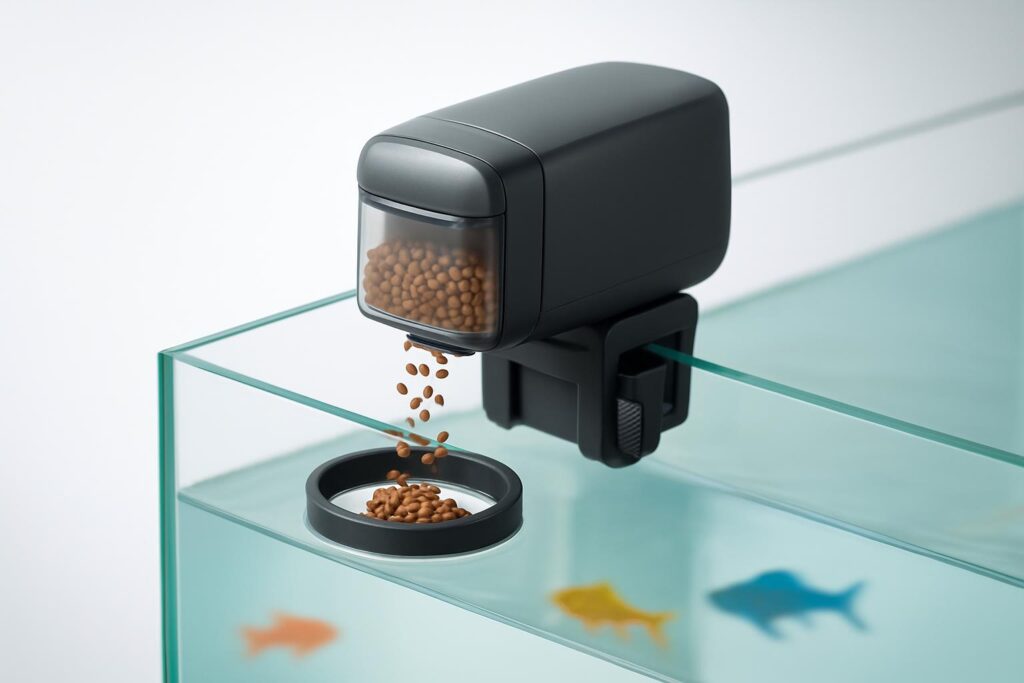
Use a feeding ring. A simple floating ring keeps food contained, reduces loss to filter intakes, and insulates the hopper from surface humidity. It also makes intake observation easy during tuning.
Match pellet size to fish. 0.5 to 1 mm micro pellets work for tetras and rasboras. 1 to 2 mm for larger community fish. Oversized pellets cause sporadic drops and clogging.
Watch the fish. The right dose is what your fish fully consume in about two minutes without leftovers drifting to the bottom or into the filter.
Setup tips for reliable day to day feeding
Place away from splashes. Keep the outlet above calm water, not near an airstone or water return. Splashes and spray are the main cause of caking.
Secure the mount. Tighten the clamp or fix a stable platform. Vibrations or lid flex can change the feeder angle and portion size.
Keep food level consistent. As the hopper empties, flow can change slightly. Topping up before it drops below one-third full helps stability.
Refresh batteries or charge before trips. Replace alkaline batteries a week before a vacation or fully recharge. Then perform daily test feeds for at least three days while you are home.
Document your baseline. Take a quick photo of the dosing window and programming screen after you finalize settings. This makes future recalibration faster if anything resets.
Common mistakes to avoid
Overfilling the hopper. Cramming it tight compresses flakes and pellets and promotes clumping. Leave space for food to flow.
Using oily or sticky foods. Some color-enhancing or high-oil pellets smear and bind. If you notice residue, switch brands or blend with a drier pellet.
Skipping the test phase. Always run several days of observation. If you must travel soon, ask a friend to do a brief check-in and send a photo of the fish and the feeder position.
Ignoring tank changes. Cleaning filters, changing flow, or adding surface skimmers can change how food disperses. Reconfirm dose after big maintenance.
Which feeder is right for you
Choose Eheim Everyday if you want proven reliability and best-in-class pellet consistency with minimal fuss.
Choose Fish Mate F14 if you need exact portions and want to mix flakes and pellets with zero surprises.
Choose NICREW if you want a solid budget feeder that covers the basics and you are willing to spend a little time calibrating it.
Choose Hygger if you prefer rechargeable convenience and easy top-loading for quick refills.
Conclusion
Automatic feeders make aquarium care resilient. They protect fish from feast or famine cycles, keep water quality stable, and let you travel without worry. Drum-style models like Eheim, NICREW, and Hygger reward careful calibration and a simple feeding ring. Tray-style Fish Mate F14 rewards planners who want exact meals. Whichever you choose, run tests, document your settings, and keep the hopper dry. Consistency is the goal. Your fish will show it in steady appetite, stable behavior, and clean water.
FAQ
Q: Which automatic fish feeder is the most reliable for daily use
A: Eheim Everyday Fish Feeder is the most reliable for daily use thanks to its consistent pellet dosing and moisture-resistant design.
Q: What is the best feeder for precise portion control
A: Fish Mate F14 is the best for precise portion control because each tray compartment is a fixed meal.
Q: How can I keep flakes from clumping in a drum-style feeder
A: Pre-crush flakes, keep the dosing window small, mount over a feeding ring, and avoid overfilling the hopper.
Q: How should I test the dose before leaving on a trip
A: Run several manual rotations over a bag, make small adjustments, observe fish for a few days, and refresh batteries or fully recharge.
Q: Do I need a feeding ring with an automatic feeder
A: A feeding ring is highly recommended because it keeps food contained, reduces loss to filters, and limits moisture reaching the hopper.