
We are reader supported. When you purchase through links on our site, we may earn an affiliate commission. Also, as an Amazon affiliate, we earn from qualifying purchases.
Smart controllers turn a busy aquarium into a stable, low-stress system. They automate temperature, top off, dosing, and power schedules, while sending alerts before small issues become big problems. If you want fewer daily chores, tighter stability, and better protection against equipment failure, the right controller pays for itself in saved livestock and saved time.
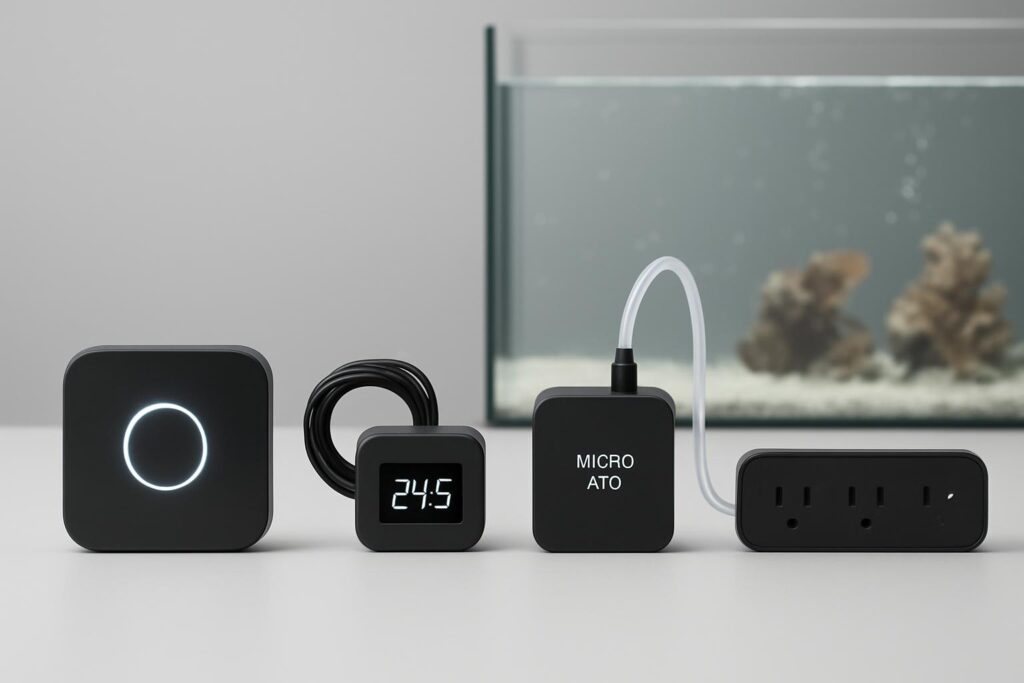
This guide explains what to look for, then reviews four reliable smart controllers that cover the key automation jobs most aquarists need. Each pick is beginner friendly but also scales as your tank and skills grow.
How to evaluate a smart aquarium controller
Safety features first
Automation should lower risk. Favor controllers with hard safety stops, high and low alarms, maximum run timers, and redundant sensors where it matters, especially for heating and auto top off.
Expandability and ecosystem
Start simple, but plan for growth. Look for systems that accept more sensors, power bars, pumps, and modules. A healthy ecosystem of add-ons extends the life of your initial purchase.
App, alerts, and remote access
Easy setup, clear graphs, and reliable push or email alerts are not extras. They are why you buy smart gear. Make sure you can check status from anywhere with minimal steps.
Reliability and redundancy
Controllers should fail safe. If a probe fails, a heater should not stay on. If a sensor times out, a pump should stop. When possible, use layered protection rather than a single device in charge of a life critical task.
Ease of setup and daily use
Look for clear wiring, labeled ports, templates for common tasks, and guided wizards. You should be able to change schedules and set alarms without reading a dense manual every time.
Budget and priorities
Decide what matters most right now. Stable temperature and top off protect more tanks than any other two jobs. Dosing and power automation come next. A full ecosystem controller is great when you want one app to rule everything.
Data and logs
Logging helps you learn your tank. Trends reveal creeping problems like a failing heater or rising evaporation rate. Choose gear that records and displays history.
The 4 best aquarium smart controllers for automation
1) Neptune Systems ApexEL Aquarium Controller
ApexEL is a proven, full-feature smart controller for both freshwater and reef tanks. It monitors core parameters like temperature and pH, controls outlets for your equipment, logs data, and sends alerts. With profiles, feed modes, and timers, it centralizes your automation and grows with your tank.
Key strengths
ApexEL brings multiple functions into one brain. It supports a dedicated power bar with individually controlled outlets, probe monitoring with alarms, and an app-based interface for rules and schedules. It integrates with add-on modules and accessories for leak detection, flow sensing, and dosing systems, consolidating many tasks into a single dashboard.
Setup and daily use
Initial setup includes mounting the base, connecting the power bar, plugging in equipment, and calibrating the pH and temperature probes. The app guides you through naming devices, setting heater control logic, creating feed modes, and adding notifications. Daily use becomes hands-off other than topping off consumables and checking alerts. Data graphs make it easy to spot drifts.
Automation ideas
- Heater cutoff with high temperature alarm and a safety maximum on time
- Return and skimmer off during feeding, then staged restart
- Light schedules and equipment cooling fans on high temp
- pH-based dosing safeguards
Why it helps: Centralized control and layered alarms reduce failure points and make changes quick and consistent.
Best for: Hobbyists who want one system to automate multiple jobs with room to expand.
Potential downsides: Higher initial cost than single task controllers. Setup takes longer than simple plug and play units.
Pro tip: Use separate heater control on the power bar plus an in-line thermostat as a second cap. Redundant limits protect livestock.
2) CoralVue HYDROS Control 2 Starter Pack
HYDROS Control 2 is a modular smart controller designed to be flexible and beginner friendly. It combines sensor inputs, app control, and integration with smart outlets. You can start with temperature and ATO, then expand to dosing, leak alerts, and power automation.
Key strengths
HYDROS uses an app with guided device setup and prebuilt task templates. Sense ports connect to temperature sensors, optical ATO sensors, and other accessories. It works with Wi-Fi power strips and smart outlets for schedules and device rules. The system is easy to scale by adding more controllers that talk to each other for redundancy.
Setup and daily use
Mount the controller, connect sensors, and pair compatible outlets or power strips in the app. Run the ATO wizard to set fill times, maximum run limits, and alarms. Add schedules for lights, skimmer, or pumps. The app presents status tiles and logs so you can confirm correct behavior and fine tune.
Automation ideas
- Temperature alarms and controlled heater outlet with safe upper limit
- ATO with maximum run timer and timeout alarm
- Auto feed mode with staged equipment restart
- Leak sensor shuts down return and alerts you
Why it helps: Clear wizards and modular growth make it simple to automate critical tasks without locking you into a single setup.
Best for: Beginners who want guided setup and experienced users who value modular redundancy.
Potential downsides: You may need extra modules or compatible outlets for advanced setups. Features improve over time, so expect periodic app updates.
Pro tip: Assign names and roles to every outlet and sensor in the app. Clear labels prevent mistakes during fast troubleshooting.
3) Inkbird ITC-306A Wi-Fi Temperature Controller
Inkbird ITC-306A is a dedicated heater controller with Wi-Fi monitoring and alarms. Temperature stability is the most important building block in aquarium automation. This unit adds precise control and a hard safety layer to your existing heater.
Key strengths
It uses an external probe to monitor tank water and directly powers your heater through a controlled outlet. You set target temperature, differential, and high or low alarms in the app. If the heater thermostat fails, the Inkbird limits runtime and cuts power at your safety cap. Alerts notify you quickly if temperature drifts.
Setup and daily use
Plug the heater into the controller, place the probe in a high flow area, and set your targets. Calibrate if needed using a known accurate thermometer. In daily use, you do nothing. The controller cycles the heater to hold your set point and messages you if limits are exceeded.
Automation ideas
- Primary heater control with a separate thermostat on the heater set slightly higher as a backup cap
- High temperature alarm triggers manual light shutoff if needed
- Seasonal temperature tweak with a single app change
Why it helps: Temperature is the foundation of stability. A dedicated controller greatly reduces risk from stuck heater thermostats.
Best for: Any tank that needs reliable heat control with minimal cost and simple setup.
Potential downsides: Single function device. For cooling control, you would need a different or additional model.
Pro tip: Secure the probe and keep it in constant flow. Stagnant placement causes false readings and overcorrection.
4) AutoAqua Smart ATO Micro
Smart ATO Micro is a compact automatic top off controller that maintains stable salinity and water level. It uses an optical sensor to detect water level and runs a small pump to add fresh water as needed. It is tiny, beginner friendly, and includes built-in safety logic.
Key strengths
The single optical sensor is easy to mount, even in narrow rear chambers of all-in-one tanks. The controller limits pump run time to prevent overfilling and sounds an alert if something is wrong. Evaporation is handled in small, frequent doses, keeping parameters steady.
Setup and daily use
Mount the sensor at your desired level, place the pump in your reservoir, and run the tubing to the tank or sump. Set the anti-siphon and confirm the pump direction. Day to day, you only refill the reservoir. The ATO keeps the tank stable without manual top offs.
Automation ideas
- Frequent micro top offs to reduce salinity swings in nano tanks
- ATO alarm routed to your phone through a smart plug notification or controller input
- Reservoir low level float as an extra stop
Why it helps: If you automate one job after temperature, choose top off. Stable water level and salinity protect livestock and stabilize skimming and dosing.
Best for: Nano to medium tanks and anyone who wants a compact, reliable ATO with minimal setup.
Potential downsides: Single optical sensor means placement matters. In very turbulent sumps you may prefer dual sensor designs.
Pro tip: Keep the reservoir output above the tank waterline. This prevents siphon and accidental overfill.
Quick picks by goal
- Best overall control hub: Neptune Systems ApexEL
- Best modular starter with guided setup: HYDROS Control 2
- Best budget stability upgrade: Inkbird ITC-306A
- Best salinity and level stability: AutoAqua Smart ATO Micro
Blueprints for common tank automation
Nano freshwater
- Inkbird ITC-306A for heat stability
- Smart ATO Micro for steady level
- Optional smart plug for light schedule
40 to 75 gallon community tank
- HYDROS Control 2 to manage heater outlet, ATO, and basic power schedules
- Add leak sensor and feed mode
Reef tank, mixed coral
- ApexEL as the central controller
- Heater controlled with alarm and staged restart after power loss
- ATO integrated and alarmed
- pH and temp logged for trend tracking
Setup and safety best practices
Layered protection for heat
Use the controller to switch the heater and set a high cut. Set the heater thermostat a bit above the controller set point. If one fails, the other caps temperature.
Test failsafes monthly
Trigger ATO maximum run timeout and confirm it stops. Unplug probes to see if alarms fire. Verify that leak sensors cut power as intended.
Power outage planning
Put the return pump or an air pump on a battery backup or UPS. Priority is oxygenation and circulation. Controllers help with staged restarts when power returns.
Probe care and placement
Place probes in high flow, away from bubbles or salt creep. Clean and recalibrate on schedule. Accurate sensors are the core of reliable automation.
Cable management and labels
Secure cables, mount controllers away from splashes, and label every plug. Fast identification prevents mistakes during maintenance.
Review logs weekly
Scan temperature and ATO graphs for drift. Rising heater on time or increased top off can point to failing equipment or seasonal changes.
Conclusion
Start with the jobs that protect livestock the most. Temperature control and auto top off stabilize your system and stop many problems before they start. Then add a controller hub to centralize rules, schedules, and alerts. The four options above cover these needs for tanks from small nanos to complex reefs.
Choose one product that solves your biggest pain today. Add the next layer once you are comfortable. With clear priorities, smart controllers make your aquarium more stable and your daily routine lighter.
FAQ
Q: Do I need a full controller or will a thermostat and ATO be enough
A: Start with temperature control and auto top off since they protect the most. A full controller like ApexEL or HYDROS helps when you want centralized rules, schedules, and alerts for multiple devices.
Q: How do I prevent a heater run away when using automation
A: Use layered protection. Let a dedicated controller like Inkbird switch the heater and set a high cut, and leave the heater thermostat slightly higher as a backup cap.
Q: Are app alerts enough or do I still need manual checks
A: You still need regular checks. Review logs weekly, test failsafes monthly, and verify probes and sensors are clean and accurate.
Q: What is the simplest starter automation stack for a beginner
A: Pair an Inkbird ITC-306A for heat stability with a Smart ATO Micro for water level, then add a smart plug or controller for light and feed schedules.
Q: How should I plan for power outages with smart controllers
A: Use a battery backup or UPS for oxygenation and circulation first. Set staged restarts in your controller to avoid surges when power returns.