
We are reader supported. When you purchase through links on our site, we may earn an affiliate commission. Also, as an Amazon affiliate, we earn from qualifying purchases.
Water on the floor is a headache you never want to meet at 2 a.m. Aquariums can seep, fittings can loosen, and hoses can pop off. A good leak detector gives you time to act before a slow drip becomes a soaked stand, ruined floor, or stressed livestock. This guide walks you through the six best aquarium leak detectors for home safety, why they work, how to place them, and how to keep them reliable long term.
Why aquarium leak detectors matter
Even a few cups of saltwater can damage cabinets, swell hardwood, and kick off mold. The goal is early detection, not cleanup after the fact. Leak detectors listen for the first signs of trouble and alert you loudly on site, on your phone, or both. The right sensor buys you response time, and that is what saves equipment and flooring.
How leak detectors work
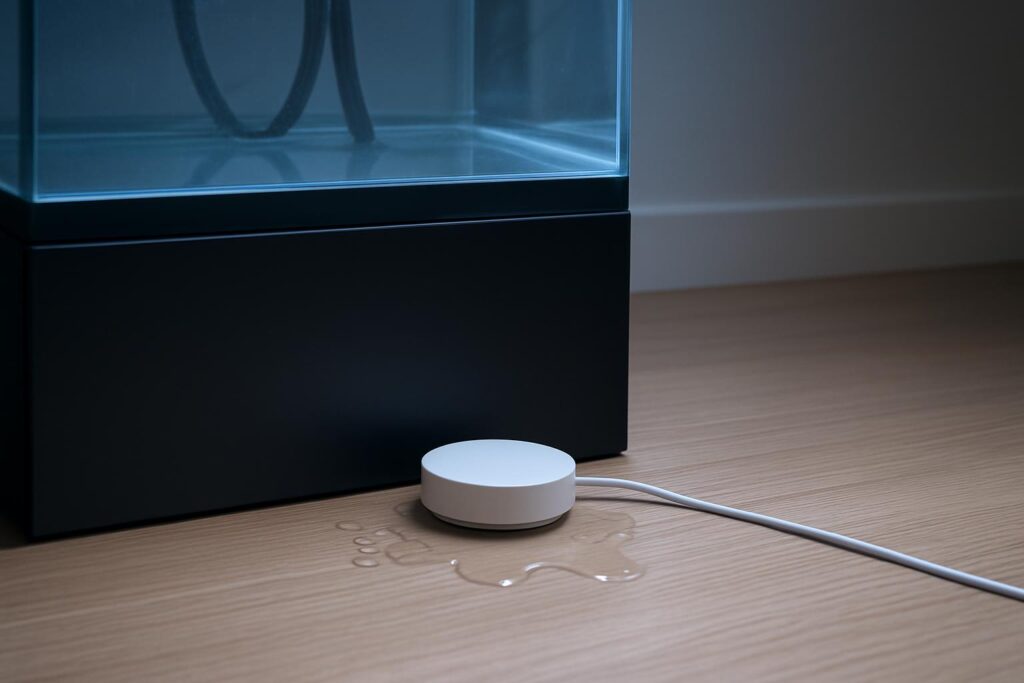
Most sensors use two metal contacts. When water bridges them, the circuit closes and an alarm sounds. Others use a cable probe or strip that senses moisture anywhere along its length. Smart models add WiFi or a hub that relays alerts to your phone. Here are the main types you will see:
Puck sensors: Compact discs that sit on the floor or cabinet base. They detect pooling water under a tank or sump.
Probe or cable sensors: A small tip or a rope-style cable you can route to tight spots, front cabinet lips, or under hoses.
Smart sensors: Connect through WiFi or a dedicated hub for phone alerts, logs, and integrations.
Standalone alarms: Battery units with a loud siren only. Simple, low cost, and fast to deploy.
Key features that matter for aquariums
Alarm volume: Aim for 85 dB or louder so you can hear it from another room.
Remote alerts: App notifications or email messages cover you when you are away.
Sensor style: Puck for pooling water, probe for edges and lines where drips start.
Power and battery life: Long-life batteries reduce maintenance. Some hubs need AC power.
Saltwater resilience: Smooth contacts wipe clean. Probe cables resist salt creep better near splash zones.
Placement flexibility: Low profile designs fit under sumps, canister filters, and stand lips.
The 6 best aquarium leak detectors for home safety
1) Govee WiFi Water Leak Detector with Hub H5040
A well-rounded smart kit with multiple sensors and loud sirens. The hub connects to your router and pushes phone alerts. Sensors have contacts on the bottom and a set on top for drips from above. That dual detection helps with both pooling water under a sump and slow weeps from fittings.
Why it helps: Early phone alerts plus loud on-site alarms mean you can act fast whether you are home or away.
Best for: Busy owners who want set-and-forget monitoring across several risk points like canister filters, ATO reservoirs, and behind the stand.
Standout features: Multiple sensors in the kit, app notifications, loud siren, test buttons, replaceable batteries.
Setup tips: Place one sensor inside the stand by the front lip, one behind the tank where hoses run, and one near the ATO or RO unit. Raise a sensor a few millimeters on plastic mesh if heavy condensation is common.
Potential downsides: Requires a hub and 2.4 GHz network. Battery checks are still needed even with app status.
2) YoLink Smart Water Leak Sensors Starter Kit
YoLink uses long-range radio to reach where WiFi struggles, like basements or detached fish rooms. The hub sends phone alerts while sensors sip power for multi-year battery life. Range and reliability are the selling points.
Why it helps: Coverage through thick walls and long distances keeps tanks in far corners protected.
Best for: Large homes, multi-tank setups, and fish rooms with spotty WiFi.
Standout features: Long-range LoRa tech, solid app alerts, long battery life, optional delay settings to reduce false triggers from splashes.
Setup tips: Start with the hub near your router. Put sensors at the cabinet front edge, along baseboards in the drainage path of the stand, and near sumps or mixing stations. Use the app delay feature for saltwater splash zones.
Potential downsides: Needs a dedicated hub. Audible alarm on the sensor is modest, so pair with phone alerts or a separate siren if you rely on in-room sound.
3) Honeywell Home RWD21 Water Leak Alarm
A straightforward battery puck with a loud alarm. No app, no hub, just place it and listen. Simplicity makes it a strong budget pick and a good backup to smart sensors.
Why it helps: Instant 85 dB alarm when contacts touch water. Fast to deploy under any stand.
Best for: Budget setups, backup protection next to a smart kit, rentals where WiFi devices are not welcome.
Standout features: Compact footprint, easy battery swap, reliable contacts.
Setup tips: Put one inside the stand and one outside in the likely drainage path. Keep contacts clean from salt creep with a quick monthly wipe.
Potential downsides: No remote alerts. Needs occasional testing and battery tracking.
4) Zircon Leak Alert WiFi
A slim sensor that combines a loud alarm with direct WiFi alerts. No hub required. It fits well under stands and along baseboards. It floats if submerged, which helps during serious spills.
Why it helps: Direct WiFi alerts and a strong siren cover both in-house and away-from-home scenarios.
Best for: Single-tank owners who want WiFi alerts without adding a separate hub.
Standout features: Direct WiFi setup, email alert capability, floatable design, compact size.
Setup tips: Place it on a thin plastic coaster near the front cabinet lip to catch the first trickle, and a second unit behind the tank near hose runs if you have multiple points of failure.
Potential downsides: Email alerts may be slower than app push in some cases. Battery care still matters for reliability.
5) Moen Smart Water Detector
A robust smart puck with a strong siren and flexible placement. An optional extension cable lets you detect leaks at a precise spot while keeping the body of the unit higher and drier inside the stand.
Why it helps: Flexible sensing in tight cabinet spaces and strong local alarm volume paired with phone alerts.
Best for: Sump systems with narrow cabinet layouts where a probe cable outperforms a flat puck.
Standout features: Loud local alarm, app alerts, optional remote sensing cable, solid build quality.
Setup tips: Run the extension cable to the lowest point inside the stand or under external plumbing. Keep the puck itself mounted to the inner wall with adhesive strips to avoid splash zones.
Potential downsides: Uses specialty batteries in some versions. App setup adds a few steps compared to a basic puck.
6) Basement Watchdog BWD-HWA High Water Alarm
A classic alarm with a remote probe on a cable and a piercing siren. The probe can sit exactly where the first drop would travel, like the front inner edge of a stand, while the alarm body stays higher and protected.
Why it helps: Cable probes reach spots pucks miss, which is key for catching the first trickle before it spreads.
Best for: Sumps, canister filter cabinets, and stands with a defined drainage lip at the front.
Standout features: Very loud siren, long cable probe, reliable 9V battery design.
Setup tips: Mount the alarm module high inside the cabinet. Tape the probe so the tip sits flush with the lowest edge. Add a second unit behind the tank if external plumbing runs there.
Potential downsides: No phone alerts. Replace 9V batteries on a schedule to avoid silent failures.
How to place sensors for maximum protection
Map the water path: If a leak starts inside the stand, water usually runs forward and out along the lowest edge. Place one sensor inside at the front lip and a second on the floor just outside the stand.
Cover plumbing and gear: Add sensors near canister filters, under bulkheads, beneath external overflows, and beside ATO reservoirs or mixing barrels.
Watch the back side: Run a sensor behind the tank where hoses or return lines travel. Drips often trace along hoses before reaching the floor.
Use probe tips for tight spots: Cable probes catch early drips under unions, hose barbs, and valves.
Avoid splash zones: Skimmer outputs and drain socks can mist small drops. Keep sensors a short distance away or elevate slightly on plastic mesh to reduce false alerts.
Saltwater considerations
Salt creep management: Wipe sensor contacts monthly. Salt bridges can set off alarms or prevent proper triggering.
Placement balance: Far enough to avoid daily spray, close enough to catch the first trickle. A one to two inch offset from the sump rim works well.
Cable probes shine: Where salt creep is heavy, a cable tip is easier to clean and less prone to buildup than large puck contacts.
Smart alerts and redundancy
Layer your coverage: Use at least one loud local alarm plus at least one device with remote alerts. Redundancy is cheap insurance.
Use zones: Group sensors by location in the app so you know exactly where to run first. Label them clearly during setup.
Alert tuning: If your smart system allows delays, add a brief delay in splash-prone areas to reduce nuisance alerts without sacrificing safety.
Maintenance to keep alarms reliable
Monthly quick test: Touch a damp cloth across the contacts to confirm a trigger and notification. For cable probes, dip just the tip.
Battery routine: Replace batteries annually or at the first sign of low level. Mark the date on painter tape inside the stand.
Clean and inspect: Wipe contacts, remove salt crystals, and check that sensors did not shift. Confirm hub connectivity if you use a smart system.
Log your checks: A simple note on your maintenance sheet prevents guesswork later.
Troubleshooting false alarms
Condensation: Elevate the sensor slightly on a plastic spacer or mesh. Improve stand ventilation.
Splash and spray: Relocate a few inches from the source or use a cable probe for pinpoint sensing.
Salt bridges: Clean contacts with a damp cloth, then dry. Add a small shield to block salt mist in heavy-skimming systems.
Notification noise: If alerts are too frequent from minor humidity, enable a short delay on systems that support it.
Choosing the right mix for your tank
One display tank, simple plumbing: A direct WiFi sensor like Zircon or a smart kit like Govee covers most risks. Add a basic puck like Honeywell as a backup.
Sump system with cabinet: Use a cable-probe alarm like Basement Watchdog inside the stand plus a smart unit with phone alerts outside the stand along the likely water path.
Large home or fish room: Leverage YoLink for range and battery life, then add a loud standalone puck where in-room sound matters.
Conclusion
Aquarium leaks do not start as disasters. They start as a damp line along a hose, a tiny drip from a bulkhead, or a slow weep near a canister O-ring. The right leak detector finds that first sign and calls you to action. Choose a mix that fits your space: one or two smart sensors for remote alerts, at least one loud local alarm, and cable probes where early drips form. Place them with intention, test monthly, and keep contacts clean. Done right, a small sensor can save your floor, your stand, and your peace of mind.
FAQ
Q: Where should I place aquarium leak detectors for best coverage
A: Place one inside the stand at the front lip, a second on the floor just outside the stand, another behind the tank where hoses run, and one near ATO or RO reservoirs and mixing stations. Route cable probes to the lowest points and under external plumbing.
Q: What is the difference between puck-style and probe-cable sensors
A: Puck sensors sit on the floor and detect pooling water, while probe or cable sensors reach tight spots and edges to catch early drips along hoses and fittings. Choose based on your cabinet layout and where water is likely to travel first.
Q: How often should I test and maintain leak detectors
A: Test monthly with a damp cloth across the contacts, replace batteries annually or when low, and wipe contacts to remove salt creep. Log tests and battery changes so you never wonder when you last checked.
Q: Which detector works best for large homes or weak WiFi
A: The YoLink system is best for large homes or fish rooms because its long-range radio reaches through thick walls and long distances, with multi-year battery life and reliable phone alerts.
Q: How do I reduce false alarms around saltwater tanks
A: Keep sensors a short distance from splash zones, elevate slightly on plastic mesh for condensation, wipe salt creep from contacts, use cable probes near skimmer and drain areas, and enable short alert delays if your smart system supports it.