
We are reader supported. When you purchase through links on our site, we may earn an affiliate commission. Also, as an Amazon affiliate, we earn from qualifying purchases.
Power outages do not give you a warning. In a few hours without circulation, oxygen can crash and fish begin gasping at the surface. A small battery backup air pump is the simplest insurance to keep oxygen moving until power returns. This guide walks you through what matters, how to pick the right pump, and six proven options that are easy to use and beginner friendly.
Every recommendation below is focused on one job: keep water oxygenated. You do not need to run your full filter or lights during an outage. Air plus gentle surface movement buys you crucial time. Read on to choose a reliable unit, set it up in minutes, and build a simple outage plan you can trust.
What your fish need during an outage
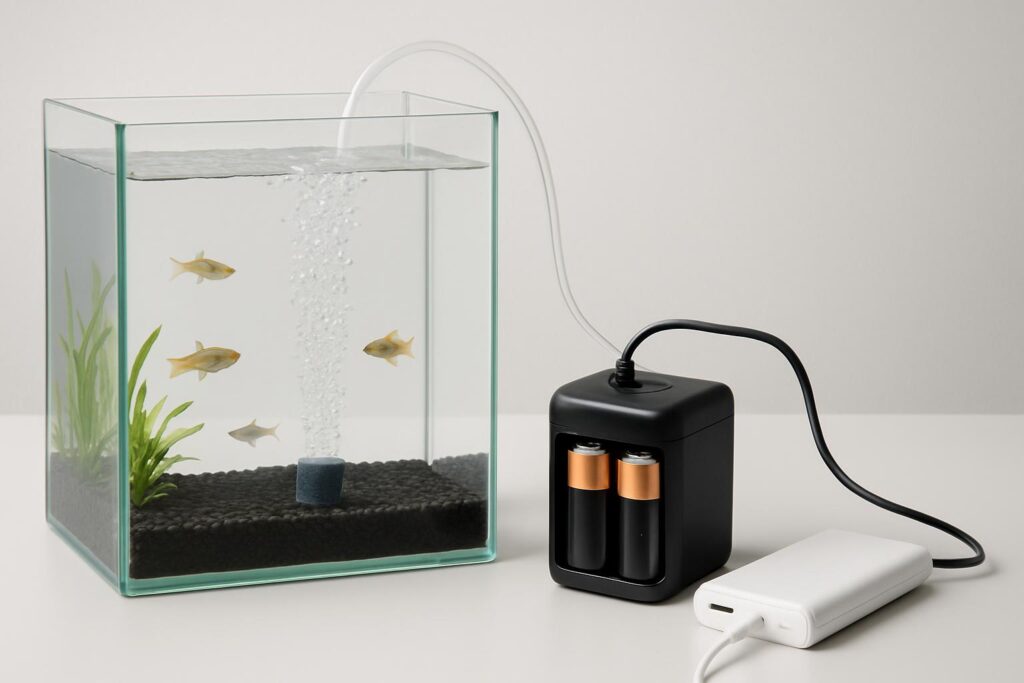
Oxygen is the first limiter. Without aeration, bacteria and fish consume dissolved oxygen faster than it can be replenished, especially in warm or stocked tanks. An air pump with a stone restores gas exchange at the surface and circulates water gently.
Oxygen first, everything else later
Focus on getting air into the tank immediately. Most fish can tolerate cooler water for a short period if oxygen stays adequate. Filtration and heating can wait. Feeding should stop until power returns.
Surface agitation matters
An airstone near the bottom sends bubbles up and disturbs the surface where gas exchange happens. You only need 1–2 strong boil points to raise and maintain oxygen across the tank.
How to choose a battery backup air pump
Pick the right power source
There are three common power designs:
- D-cell battery pumps. Simple, long shelf life, easy to store spare batteries, widely used for emergencies.
- Rechargeable USB units. Charge from wall USB or a power bank. Good for longer outages when paired with a large power bank.
- Auto-switch backup pumps. Designed to detect power loss and start on their own when the main power drops.
Auto-on failover is valuable
If an outage strikes while you are away, auto-on makes a big difference. If you plan to be home or keep the pump in a go-bag, a manual unit is fine.
Air output and outlets
For emergency use, you want a consistent bubble stream at your normal tank depth. Dual outlets let you run two stones or a sponge filter plus a stone. In a pinch, one strong stone is enough for most community tanks.
Noise, mounting, and simplicity
Air pumps vibrate. Look for rubber feet, a sturdy clip, or a way to hang the pump. Fewer modes mean easier use when stressed. Water resistant housings are a plus in humid fish rooms.
Reliability and testability
Choose pumps you can test monthly in under two minutes. Keep spares for airline, check valves, stones, and batteries together with the pump.
6 best aquarium battery backup air pumps for power outages
Penn-Plax Silent-Air B11 Battery Backup Air Pump
This is a well-known emergency standby that auto-starts during power loss. The B11 sits in-line and stays idle while grid power is on. When power cuts, it switches to battery and begins aeration. It runs on D-cell batteries, which are easy to store for long periods.
Why it helps
- Auto-on failover covers outages when you are not home.
- D-cell batteries provide long shelf life and quick swaps.
- Simple setup with airline and airstone included in many kits.
Best for single aquariums where you want set-and-forget protection that triggers automatically.
Setup tips mount above the waterline or use a check valve. Test monthly by unplugging your main power to confirm instant startup.
Potential downsides single outlet only and not designed to push very deep water columns. If your tank is unusually deep, place the airstone higher on decor for easier startup during an outage.
Bottom line easy, dependable auto-switch backup and an affordable first line of defense.
Cobalt Aquatics Rescue Air USB Rechargeable Pump
A compact, rechargeable unit designed for emergencies and travel. It charges from USB and can be paired with a power bank for extended runtime. Many users set it up on a wall USB adapter so it can detect a power loss and run on its internal battery.
Why it helps
- Rechargeable via USB, no need to store disposable batteries.
- Works with power banks for multi-day support if needed.
- Designed with emergency failover in mind.
Best for aquarists who keep a power bank handy or want a travel-friendly pump that doubles as emergency gear.
Setup tips leave it plugged into a USB adapter near the tank. Keep a large power bank in the same drawer so you can extend runtime if the outage runs long.
Potential downsides lower maximum airflow than rugged baitwell pumps and runtime depends on battery capacity. For big cichlid or goldfish tanks, position the airstone strategically to get the most from its output.
Bottom line modern, flexible, and easy to deploy with a power bank for longer coverage.
Marine Metal Hush Bubbles B-11 Portable Aerator
A rugged D-cell aerator trusted by anglers for bait buckets and livewells, and it pulls double duty for aquariums in a pinch. It is simple, tough, and pushes steady air, even with some back pressure.
Why it helps
- Proven durability with steady airflow.
- D-cell design makes it easy to store spare batteries.
- Water resistant case handles humid fish rooms and splashes.
Best for larger or heavily stocked tanks where you want robust airflow and reliability over bells and whistles.
Setup tips use a weighted airstone to keep bubbles consistent. Clip the pump securely or place it on a non-slip pad to manage vibration.
Potential downsides louder than compact aquarium-branded units and does not auto-start. Keep it where you can reach it fast during an outage.
Bottom line a workhorse D-cell aerator that moves air reliably when you need it most.
Tetra Whisper Battery-Operated Air Pump
A familiar name with a simple emergency pump that is easy to use. It is compact, takes D cells, and is quiet enough for living rooms. Ideal as a grab-and-go backup for quick oxygen support.
Why it helps
- Quiet and compact for small to mid-size tanks.
- Beginner friendly with straightforward on and off operation.
- Includes basic accessories in many kits so you can start fast.
Best for community tanks and nano to mid-size aquariums where you want a quiet emergency option you can store in the stand.
Setup tips pair with a quality check valve and a ceramic or stone airstone for a consistent bubble stream. Test your stone depth so the pump starts easily.
Potential downsides manual startup and modest airflow compared to heavy-duty bait aerators. For bigger tanks, run the stone near the center for better circulation.
Bottom line a simple and quiet battery option from a trusted aquarium brand.
Frabill Portable Aerator
Another baitwell-style unit known for reliable output and long D-cell runtimes. Many aquarists keep a Frabill for buckets, hospital tanks, and emergency use on the display tank when needed.
Why it helps
- Strong airflow with minimal fuss.
- Sturdy clip and simple control for quick deployment.
- Widely used, so replacement stones and parts are easy to source.
Best for fish rooms and larger tanks where reliable airflow and durability take priority over compact size.
Setup tips keep spare D cells taped to the unit and a pre-cut airline with a check valve attached, ready to drop in within seconds.
Potential downsides more audible than small USB designs and no auto-on. Store it in a consistent place so you can find it in the dark.
Bottom line dependable emergency air with strong output and simple operation.
Marina Battery Operated Air Pump
A compact emergency pump from a well-known aquarium brand. It is light, portable, and comes ready for quick setup. An easy pick for nano tanks, betta setups, and smaller community aquariums.
Why it helps
- Small footprint and quiet operation for bedside or office tanks.
- Simple, budget-friendly safety net for short outages.
- Light enough to travel with for fish transport or show days.
Best for nano, hospital, or quarantine tanks where gentle but consistent aeration is enough to keep fish stable.
Setup tips use a fine airstone to get consistent bubbles from a compact motor. If you need more movement, place the stone under the filter intake or in the tank center.
Potential downsides manual startup and lighter airflow. For bigger tanks, keep it as a secondary or backup to a stronger unit.
Bottom line a quiet and compact emergency option that fits anywhere.
How much emergency air do you need
Use this quick sizing logic as a starting point:
- One strong airstone is enough for many tanks up to 20–40 gallons in an emergency. Place it near the center or under a return for broader movement.
- Heavily stocked tanks or big fish need more air. Plan for two stones or a dual-outlet pump.
- Saltwater generally needs more vigorous surface movement to maintain gas exchange. Consider two stones on opposite ends for larger marine tanks.
- Deep tanks create more back pressure. Choose a pump known for steady output or place the stone higher to ensure reliable startup.
Set up your battery backup in 10 minutes
What to do right now
- Attach airline and a check valve with the arrow pointing toward the tank.
- Add a weighted airstone so bubbles rise straight up without drifting.
- Mount the pump above the waterline or create a drip loop on the airline.
- Test once by disconnecting main power to simulate an outage and confirm bubbles start.
- Store spare batteries, a second airstone, and airline in the same bag as the pump.
Build a simple outage kit
- D cells or a charged power bank, pump, 6–10 feet of airline, 2 check valves, 2 stones, suction cup holders, and a small towel.
- Label the kit so anyone in the house can deploy it fast.
Your outage playbook
- Start the air pump immediately. Confirm visible surface agitation.
- Stop feeding to reduce oxygen demand and waste.
- Keep the lid closed to slow heat loss. Wrap the tank with a blanket if the room is cold, leaving the top slightly vented for gas exchange.
- Monitor fish. If they cluster at the surface, add a second stone or reposition for stronger agitation.
- For long outages, rotate fresh batteries or connect a power bank to a USB pump.
Maintenance and testing
- Test monthly. Turn the unit on for two minutes and check for steady bubbles.
- Replace disposable batteries annually even if unused.
- Rinse or replace airstones if bubbles weaken over time.
- Keep airline runs short and avoid kinks to maximize airflow.
Putting it all together
For most aquariums, a battery backup air pump is the highest impact emergency tool you can buy. It is small, affordable, and easy to use. If you want set-and-forget protection, pick an auto-on unit like the Penn-Plax Silent-Air B11 or a rechargeable design that can detect power loss. If you just need a reliable manual pump, a rugged D-cell model from Marine Metal or Frabill is hard to beat. For small or office tanks, compact options from Tetra or Marina do the job with minimal noise.
Set your kit up once, test it monthly, and keep fresh batteries or a charged power bank ready. When the lights go out, you will know exactly what to do, and your fish will keep breathing calmly until power returns.
FAQ
Q: Which battery backup air pumps can turn on automatically during an outage?
A: Penn-Plax Silent-Air B11 and Cobalt Aquatics Rescue Air are designed for emergency failover so aeration can start even if you are away.
Q: How many airstones do I need for a 40-gallon tank during a power outage?
A: One strong airstone is often enough for 20–40 gallons in an emergency, but heavily stocked tanks benefit from two stones or a dual-outlet pump.
Q: Can a battery air pump run a sponge filter during an outage?
A: Yes. If airflow is adequate at your tank depth, a battery air pump can drive a sponge filter. If output is limited, prioritize a single airstone for oxygenation first.
Q: How often should I test my emergency air pump setup?
A: Test monthly for two minutes and confirm steady bubbles. Replace disposable batteries annually even if unused.
Q: What should I do first when the power goes out?
A: Start the air pump, stop feeding, keep the lid closed to slow heat loss, and monitor fish. Add a second stone or reposition it if fish remain near the surface.