
We are reader supported. When you purchase through links on our site, we may earn an affiliate commission. Also, as an Amazon affiliate, we earn from qualifying purchases.
Temperature swings stress fish, slow coral growth, and invite disease. A dedicated temperature controller keeps your tank in a safe window day and night, even when room temperatures shift or a heater sticks. If stability is your goal, a controller is the simplest upgrade with the biggest impact.
Below you will find the 6 best aquarium temperature controllers that balance reliability, ease of use, and safety. You will also get clear setup advice and beginner-friendly tips to keep your system rock solid.
Why a Temperature Controller Matters
What a Controller Actually Does
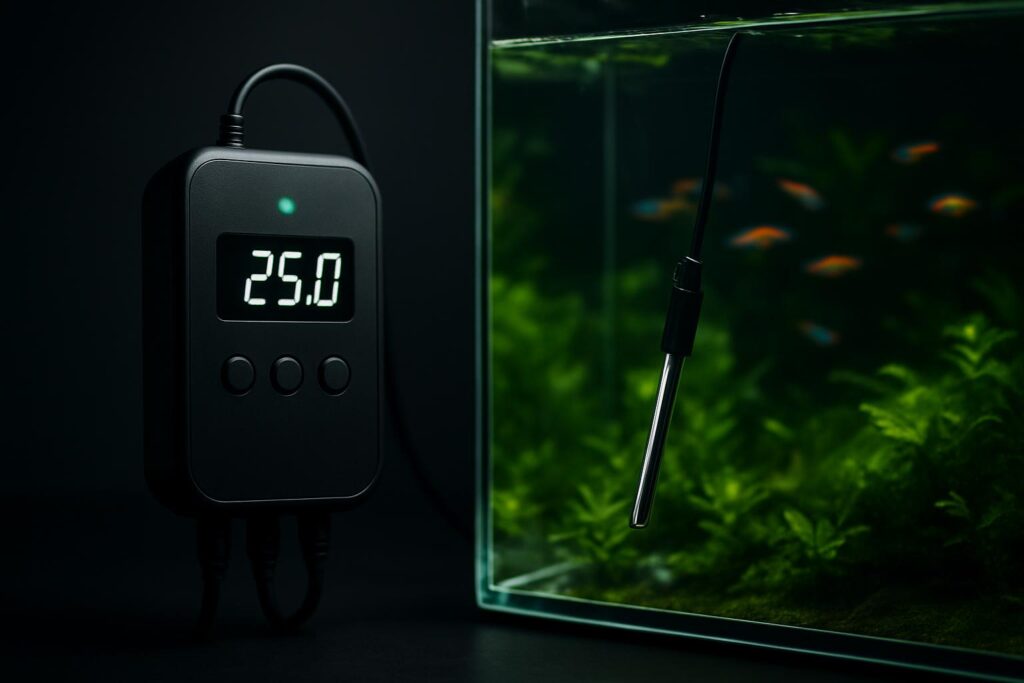
A temperature controller reads water temperature from a probe and powers your heater and, if needed, a cooling device such as a fan or chiller. You set a target temperature and a small allowed swing. The controller turns the equipment on or off to maintain that setpoint.
Stable Aquarium Ranges
Most freshwater community tanks do well at 24 to 26 C. Reef and many saltwater systems sit well at 25 to 26 C. More important than the exact number is keeping the swing narrow. Aim for no more than 0.5 to 1.0 C total fluctuation per day.
Why Not Trust Built-in Heater Thermostats
Heater dials can drift and some fail in the on position. A stand-alone controller gives a precise digital setpoint, audible alarms, and a second relay that can interrupt power if a heater sticks. It is a cheap insurance policy against crash events.
How These 6 Were Chosen
Key Criteria in Plain Language
- Safety first: strong relays, tight control differential, and alarms
- Accuracy and stability: probes that hold calibration and respond quickly
- Build quality: robust plugs, clear displays, and water-resistant probes
- Ease of use: simple setup, readable screen, and helpful instructions
- Flexibility: heating and cooling support where useful
- Value: fair pricing for features that directly help stability
6 Best Aquarium Temperature Controllers for Stability
1) Inkbird ITC-308 Digital Temperature Controller
The Inkbird ITC-308 is a proven, plug-and-play controller with separate heating and cooling outlets. It is popular because it is simple, dependable, and dialed in for aquariums and terrariums. You set a target temperature and a small differential and let it run. It includes high and low temperature alarms and a waterproof stainless probe.
Why it helps: Dual outlets manage both heater and fan or chiller for year-round stability. Alarms give you time to correct problems before livestock is affected.
Highlights: Clear display, easy buttons, tight control range, and a sturdy, water-resistant probe. Good balance of features and price for most tanks.
Setup notes: Mount the controller above the sump or tank lip to avoid splashes. Place the probe in an area with steady flow, not right next to a heater or return nozzle.
Best for: Most freshwater and reef owners who want simple, stable control with room to add cooling later.
Potential downsides: No app connectivity on the standard model. The beeper is modest, so pair it with a smart plug or camera if you need remote alerts.
Bottom line: A reliable default choice that covers the needs of most hobbyists with minimal fuss.
2) Inkbird ITC-308 WiFi
This is the WiFi-enabled sibling of the ITC-308. It adds app control, remote monitoring, and push notifications while keeping the same dual-outlet design and straightforward interface.
Why it helps: Remote alerts and data visibility reduce anxiety. If the tank overheats or cools too much, your phone tells you in time to act. The app lets you check logs and adjust the setpoint without touching the controller.
Highlights: Dual outlets for heat and cool, app graphs, configurable alarms, and familiar Inkbird build quality. It is as easy to operate locally as the non-WiFi version.
Setup notes: Connect to 2.4 GHz WiFi per the app instructions. Test alerts after setup by adjusting the setpoint to trigger an alarm. Keep the probe in good flow as with any controller.
Best for: Owners who travel, keep higher value livestock, or just want remote peace of mind.
Potential downsides: Requires a stable 2.4 GHz network. App notifications depend on your phone settings and connectivity.
Bottom line: A strong upgrade if remote alarms and graphs will help you act faster and sleep better.
3) Finnex HC-810M Digital Heater Controller
The Finnex HC-810M is a dedicated heater controller known for tight regulation and a robust probe. It offers precise control and a clean, compact footprint. Many aquarists pair it with a reliable submersible or titanium heater to create a stable and safe system.
Why it helps: Focused heater control reduces overshoot and keeps temperature steady even when room temperatures swing. The display is easy to read at a glance.
Highlights: Simple interface, fast response, and a probe designed for aquatic use. A popular match for mid to large tanks where stable heating is the priority.
Setup notes: Confirm the heater wattage is within the controller rating and leave headroom. Calibrate once against a trusted thermometer and recheck monthly.
Best for: Hobbyists who want a clean heater-only control solution without cooling control.
Potential downsides: Single-purpose heater control means no cooling outlet. If you plan to add a fan or chiller for summer, choose a dual-outlet model.
Bottom line: A sturdy, precise option when heating stability is your main focus.
4) Bayite BTC211 Digital Thermostat with Dual Outlets
The Bayite BTC211 is a budget-friendly controller with separate outlets for heating and cooling and a high-capacity relay. It is versatile enough for aquariums, fermentation, and terrariums, but many aquarists use it precisely because it delivers stable results at a fair price.
Why it helps: Dual outlets and a responsive probe make it easy to keep water in a tight band. It has strong current capacity for larger heaters or multiple smaller heaters on a power strip.
Highlights: Generous power rating, readable display, waterproof probe, and ample settings to fine-tune differential and alarms.
Setup notes: As with any controller, keep outlets dry and create drip loops. In saltwater environments, wipe down the probe periodically to prevent deposits.
Best for: Larger tanks, budget builds, or anyone who wants dual-mode control with extra power headroom.
Potential downsides: The interface is utilitarian. If you prefer an app and cloud alerts, look to a WiFi-enabled model.
Bottom line: Solid value with real-world stability and plenty of power for most heaters and fans.
5) WillHi WH1436A Temperature Controller
The WillHi WH1436A is a compact, budget controller that can be set to heating or cooling mode. It uses a simple display and a reliable probe, and it is easy to dial in for a small to medium aquarium.
Why it helps: A low-cost control layer is still a big safety step up from trusting a heater dial. You get a specific setpoint, alarms, and tighter stability.
Highlights: Small footprint, clear temperature display, flexible differential settings, and a proven track record across many hobbies.
Setup notes: It uses a single outlet in either heating or cooling mode. If you need both at the same time, pick a dual-outlet unit. Check heater watt draw against the controller rating and allow headroom.
Best for: Nano to mid-size tanks and budget-minded hobbyists who still want controlled stability.
Potential downsides: No dedicated cooling outlet and no app. The buttons are small, so set it once and leave it.
Bottom line: A dependable starter controller that meaningfully improves safety and stability without extra cost.
6) JBJ True Temp Controller with Titanium Heater
The JBJ True Temp pairs a digital controller with a titanium heater, creating a unified heating solution with strong durability. Titanium resists corrosion and handles heavy use, while the controller anchors a precise setpoint.
Why it helps: Integrated systems reduce compatibility guessing. The controller is matched to the heater for predictable performance and stable temperatures.
Highlights: Titanium heating element, digital controller with calibration, and a package designed for aquarium safety and long-term stability.
Setup notes: Choose the heater wattage that fits your tank volume and ambient conditions. Place the probe away from the heater and in steady flow for accurate readings.
Best for: Aquarists who prefer a turnkey heating solution with a corrosion-resistant element.
Potential downsides: Less modular than buying controller and heater separately. If you already own a favorite heater, a standalone controller may be more flexible.
Bottom line: A durable all-in-one heating setup that keeps temps locked without guesswork.
Setup Tips for Rock-Solid Stability
Place the Probe Correctly
- Put the probe in an area of consistent flow, such as the display near a circulation path or in a sump chamber with steady water height
- Avoid placing it right next to the heater or return nozzle, which can skew readings
- Secure the probe so it cannot float or touch the heater body
Pair the Right Heater
- Size the heater to about 3 to 5 watts per gallon as a starting point, adjusting for room temperature and insulation
- Use two smaller heaters instead of one large one where possible for redundancy and gentler cycling
- Ensure the total heater wattage stays within the controller rating and leave at least 20 percent headroom
Calibrate and Verify
- Calibrate the controller against a trusted thermometer after 24 hours of stable operation
- Recheck monthly or after any maintenance that may affect readings
- Set a narrow differential, often 0.3 to 0.5 C, for smooth operation without rapid short cycling
Set Alarms and Failsafes
- Enable both high and low temperature alarms and test them
- Use a leak detector and a smart plug or camera if you want remote backup awareness
- Keep all power strips and controllers above potential splash zones and make drip loops
Common Mistakes to Avoid
- Hiding the probe behind rock or in dead-flow areas, which delays response and causes drift
- Letting the heater thermostat fight the controller; set the heater slightly above tank setpoint so the controller remains in charge
- Oversizing a single heater beyond the controller or outlet rating
- Skipping calibration and relying only on factory settings
- Mounting controllers where salt creep or humidity can enter outlets or the housing
Conclusion
Temperature stability is one of the simplest, highest-impact wins for any aquarium. A dedicated controller anchors your setpoint, adds alarms, and reduces risk from heater failure. The models above cover the full range of needs, from budget to app-connected systems and integrated titanium solutions. Pick the one that matches your tank size, desired features, and future plans, then place the probe well, calibrate once, and let it hold a steady line. Your fish and corals will show the difference in behavior, color, and growth.
FAQ
Q: Why use a temperature controller instead of just the heater dial?
A: Heater dials can drift and some fail in the on position. A stand-alone controller gives a precise digital setpoint, audible alarms, and a second relay that can interrupt power if a heater sticks.
Q: Where should I place the temperature probe?
A: Put the probe in an area of consistent flow, such as the display near a circulation path or in a sump chamber with steady water height, and avoid placing it right next to the heater or return nozzle.
Q: What temperature range should I target for most tanks?
A: Most freshwater community tanks do well at 24 to 26 C, and reef and many saltwater systems sit well at 25 to 26 C, with a daily swing of no more than 0.5 to 1.0 C.
Q: Do I need both heating and cooling control?
A: Dual outlets are helpful if your room gets hot in summer and you plan to add a fan or chiller. If you only need heating, a single-purpose heater controller works well.
Q: How often should I calibrate the controller?
A: Calibrate the controller against a trusted thermometer after 24 hours of stable operation and recheck monthly or after any maintenance that may affect readings.