
We are reader supported. When you purchase through links on our site, we may earn an affiliate commission. Also, as an Amazon affiliate, we earn from qualifying purchases.
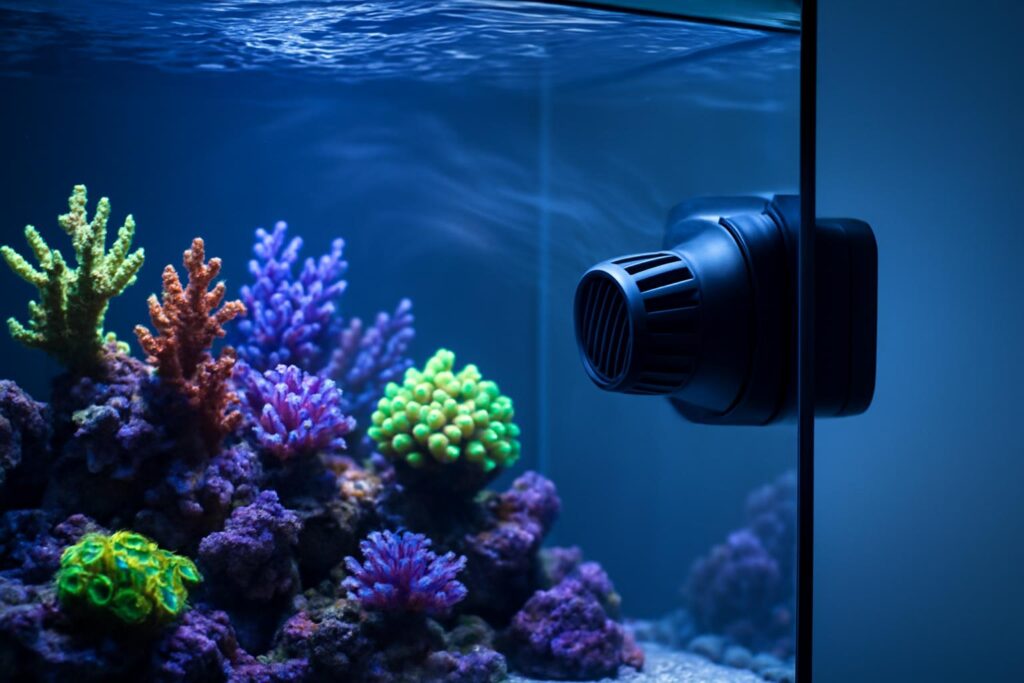
Flow makes or breaks a nano reef. Corals need consistent, varied water movement to breathe, feed, and shed waste. Fish rely on oxygen-rich water. Rockwork stays cleaner when detritus does not settle. In small tanks, a good wave maker is not optional. It is the engine that keeps the system stable. This guide explains what matters for nano reef flow and reviews four proven wave makers that fit tight spaces yet deliver the right movement for coral health.
How to Choose a Wave Maker for a Nano Reef
Size and output that fit your tank
Small tanks magnify mistakes. A pump that is too strong will kick up sand and stress corals. One that is too weak lets film algae and detritus take over. A practical starting point is 20 to 40 times the display volume per hour as total flow, split across return and wave maker. Ensure the pump is adjustable so you can tune it for your specific aquascape and coral mix.
Flow pattern that corals prefer
Broad, dispersed flow prevents harsh jets that damage tissue. Random or pulsing modes help avoid dead spots and mimic natural variability. Gyre-style circulation that sweeps around the perimeter works well in long, shallow nanos. For rock-heavy scapes, wide flow heads reduce hot spots.
Quiet operation and compact form
Hum in a small room becomes annoying fast. Look for brushless DC motors or external dry-side drive systems if silence is a priority. A small profile keeps attention on the reef, not the hardware, and makes placement easier behind rockwork.
Mount strength and safety
Strong magnets prevent slips on 6 to 10 mm glass. A protective cage or foam guard helps keep snails, shrimp, and small fish away from the impeller. Cable quality and strain relief matter in saltwater.
Control, modes, and app support
Pulse, random, and feed modes make daily life easier. App control can simplify fine-tuning and scheduling. Some pumps sync with lights or other gear for more complex ecosystems, but plain and reliable often wins in nanos.
Ease of maintenance
Simple disassembly encourages regular cleaning. Lime and algae buildup raise noise and reduce output. A unit that opens without tools, with easily removable rotor and cage, cuts maintenance time.
4 Best Aquarium Wave Makers for Nano Reef Tanks
AI Nero 3

AquaIllumination AI Nero 3 Submersible Wavemaker Pump with Fish Guard, 2,000 GPH Powerful Water Flow for Saltwater & Reef Aquariums, Compact Quiet Pump with Magnetic Mount
View on AmazonThe Nero 3 balances power, wide flow, and near-silent operation in a compact body. It is a favorite in 10 to 30 gallon reefs where random, gentle movement is important. The magnetic mount rotates freely, making it simple to aim across rockwork without blasting corals.
Key strengths
- Up to 2000 gph with broad, even flow that reduces hot spots
- DC motor with smooth ramping for quiet adjustments
- App control with pulse, random, and schedule modes, plus a quick feed pause
- Small footprint and easy-to-clean cage
Why it helps: The wide, laminar-leaning output keeps detritus suspended without tearing polyps off small frags. Fine control allows you to shape current around branching SPS while still giving LPS and softies a gentle sway.
Best for: Mixed nano reefs with a blend of SPS, LPS, and soft corals; hobbyists who want set-and-forget schedules and quiet performance.
Setup tips: Start at 20 to 30 percent output and pulse in short intervals. Aim slightly toward the surface for extra gas exchange. If sand stirs, raise the pump higher or widen the pulse period.
Potential downsides: App control can feel like overkill for very simple setups. The guard reduces but does not fully prevent snail interference, so check it during lights-out grazing hours.
Ecotech Vortech MP10 QuietDrive

hygger Aquarium Wave Maker for 5-10 Gallon Fish Tanks, Adjustable DC Power Heads for Aquarium with Controller, Aquarium Circulation Pump With Magnetic Base for Saltwater Freshwater Tank 660 GPH
View on AmazonThe MP10 places the motor outside the tank, leaving only a small wet-side propeller inside. This design reduces heat transfer, frees up space, and keeps wires out of the display. It is powerful enough for SPS-dominant nanos yet tames easily for soft coral systems.
Key strengths
- Up to 1500 gph with sophisticated control modes including reef crest, lagoon, and nutrient transport
- External motor keeps the in-tank profile minimal and simplifies wet-side cleaning
- Very low vibration inside the tank which helps reduce noise
- Compatible with additional ecosystem control if you expand later
Why it helps: Keeping the motor dry reduces heat in small water volumes and makes maintenance faster. Randomized modes rapidly break up detritus and move it to the filter sock or skimmer intake.
Best for: SPS-leaning nano reefs, minimalist aquascapes that need an unobtrusive pump, and users sensitive to in-tank noise or heat.
Setup tips: Use lagoon or reef crest at 30 to 50 percent to start. Place the wet side about one third below the surface and offset from the centerline to promote a rotational gyre. Re-seat the magnet carefully to avoid misalignment hum.
Potential downsides: The price is high for small tanks. Alignment matters; a slightly off-center mount can introduce noise until adjusted.
Jebao SLW-10

Jebao Jecob ELW-10 DC Wave Maker Pump with Controller, 1056 GPH / 4000 LPH, Ultra Quiet, Energy Saving, Circulation Pump, Magnetic Base,No App Control Trouble Free.
View on AmazonThe SLW-10 is a budget-friendly, wide-flow DC pump with a very thin profile. It moves water gently across a broad area, making it suitable for shallow or cube-style nanos. The simple controller gives you speed steps and pulsing without a learning curve.
Key strengths
- Approximate peak around 1000 gph with very wide output that reduces sandstorms
- Low-profile face ideal for tight scapes and peninsula nanos
- Pulse and else modes provide basic randomness at a low cost
- Easy disassembly for vinegar soaks
Why it helps: The disc-style outlet spreads velocity across a large cross-section, so you can run higher total flow with less stress on fleshy LPS and soft corals. This is valuable in smaller footprints where close-range jets are risky.
Best for: 10 to 25 gallon mixed reefs on a budget; nano tanks where wide flow is a priority over advanced app features.
Setup tips: Begin near the mid-height of the glass and angle across the front pane to create a gentle circular path. Use short pulse intervals for detritus lift and lengthen them if polyps retract.
Potential downsides: Controller feels basic and lacks fine scheduling. Quality control can vary, so inspect the impeller and magnet during setup and after the first month of use.
Hydor Koralia Nano 240 or 425

Hydor Koralia Nano Aquarium Circulation Pump, Includes Built-In Cable Protector, 240 GPH, Measures 2.4-Inches & is Ideal for Fresh or Salt Water Use
View on AmazonIf you want simple and reliable AC powerheads without controllers, the Koralia Nano line remains a proven option. The 240 is gentle enough for pico reefs and low-flow soft coral tanks. The 425 suits most 10 to 20 gallon nanos when paired with a moderate return pump.
Key strengths
- Simple, durable design with wide, gentle output
- Compact footprint and ball-joint mount for flexible aiming
- Low cost and low electrical draw
- Minimal parts, straightforward to clean
Why it helps: The broad nozzle and diffuser produce a clean, even flow that moves water around rockwork without short, harsh jets. For softies and LPS, this is often all you need.
Best for: Entry-level nano reefs, soft coral and LPS tanks, or as a secondary pump to complement a controllable main unit.
Setup tips: Position one Koralia near the upper back corner aimed toward the opposite front corner to start a gyre. Combine the 240 with a stronger return for very small tanks, or use the 425 alone in a 15 to 20 gallon if you keep placement high.
Potential downsides: No pulse or random modes and no app control. Startup chatter can occur if used on a wavemaker timer not designed for AC pumps.
Tuning Flow for Common Nano Reef Layouts
All-in-one tanks with rear chambers
Use the wave maker on the opposite side of the display from the return nozzle. Aim slightly upward to intersect the return stream. This crumble-and-carry interaction lifts detritus off rock and drives it to the surface film and overflow teeth.
Pendant or island aquascapes
Mount the pump a few inches below the surface and aim tangentially along the curve of the rock. The goal is to wrap flow around the island, not crash directly into it. Short pulse modes enhance eddies that keep the underside clean.
Shallow lagoons
Choose wide flow units. Point the outlet along the long axis, just under the surface, to create a slow gyre. Keep sand grain size in mind; very fine aragonite will move with even modest direct flow.
Placement Tips That Prevent Dead Spots
Use the glass to soften output
Aiming along or slightly at the front pane spreads velocity and pushes water down and under the rock ledges. This often clears detritus pockets without raising sand.
Run a gentle night profile
If your pump supports schedules, reduce speed overnight but keep at least a slow gyre. Oxygen drops fastest when lights and photosynthesis stop. Stable flow protects fish and inverts during these hours.
Pulse smarter, not harder
Short pulses lift debris; longer pulses move it to the overflow. Alternate between them during maintenance windows or when you notice buildup behind structures.
Maintenance That Keeps Pumps Quiet and Strong
Monthly cleaning routine
Unplug the pump, remove the cage and impeller, and soak in a 1 to 10 white vinegar solution for 15 to 30 minutes. Rinse well, reassemble, and check for smooth start. This prevents calcium scaling that raises noise and cuts flow.
Inspect magnets and guards
Salt creep and trapped sand under magnets can cause slipping or scraping noises. Clean both sides and ensure dry mounting surfaces. Verify the guard is properly seated to protect snails and small fish.
Monitor cables and strain relief
Route the cable with a drip loop. Ensure no sharp bends at the pump body or controller. Replace worn guards or clips before they fail.
Which One Should You Choose
Pick based on your coral mix, noise tolerance, and control needs. Nero 3 and MP10 deliver refined control, quiet performance, and compact profiles for premium builds. Jebao SLW-10 offers wide flow at low cost with basic modes. Hydor Koralia Nano keeps things simple and reliable with minimal maintenance overhead. You can also combine two smaller pumps to create intersecting currents that outperform a single large unit in complex rockwork.
Quick Sizing Guide
For 10 gallons with softies or LPS, start with a Koralia Nano 240 or a low-speed Nero 3. For 15 to 20 gallons mixed reefs, consider Nero 3, MP10, or Koralia Nano 425. For SPS-leaning 20 to 30 gallons, Nero 3 or MP10 at moderate settings covers most needs. Always verify sand movement and coral response in the first week and adjust.
Common Mistakes to Avoid
Pointing directly at corals
Direct jets cause tissue recession and stress. Aim past or above coral heads and use the glass or rock contours to diffuse flow.
Overpowering fine sand
Raising the pump higher and widening pulses often fixes sand storms. If not, use a slightly coarser top layer in high-flow paths.
Neglecting maintenance until noise appears
By the time you hear grinding or chatter, performance has dropped. Light monthly cleaning keeps output steady and extends pump life.
Conclusion
Healthy nano reefs depend on stable, varied water movement. The right wave maker prevents dead spots, boosts oxygen, and supports coral growth. Nero 3 excels at broad, quiet, and controllable flow. MP10 keeps heat out of the display and offers advanced random modes. Jebao SLW-10 gives wide output on a budget. Hydor Koralia Nano stays simple and dependable. Match the pump to your livestock and aquascape, place it to create a gentle gyre, and maintain it monthly. Your corals and fish will show the results in polyp extension, color, and steady growth.
FAQ
Q: How much total flow should a nano reef have?
A: A practical starting point is 20 to 40 times the display volume per hour as total flow, split across return and wave maker.
Q: What is the main difference between Nero 3 and MP10 in small tanks?
A: Nero 3 offers a compact in-tank DC pump with wide, quiet flow and app control, while MP10 keeps the motor outside the tank to reduce heat and leaves a very small wet side inside with advanced random modes.
Q: Is a budget pump like Jebao SLW-10 good enough for a mixed nano reef?
A: Yes, the SLW-10 provides wide, gentle flow with basic pulse modes that suit 10 to 25 gallon mixed reefs, though its controller is simpler and quality control can vary.
Q: Where should I place a wave maker to avoid dead spots?
A: Mount it a few inches below the surface and aim along or slightly at the front glass to create a gyre that sweeps around rockwork and carries detritus to the overflow.
Q: How often should I clean a wave maker in a nano reef?
A: Perform a light monthly cleaning by soaking parts in a 1 to 10 white vinegar solution for 15 to 30 minutes, then rinse and reassemble.