
We are reader supported. When you purchase through links on our site, we may earn an affiliate commission. Also, as an Amazon affiliate, we earn from qualifying purchases.
Conductivity looks technical, but it is one of the easiest ways to understand what is dissolved in your aquarium water. It tells you how many charged minerals and salts are present. With one quick test, you get an early warning for over dosing fertilizers, salinity creep, or a failing RO filter. You also get a target to aim for when breeding sensitive fish or shrimp. Keep reading to learn what conductivity measures, how it compares to TDS, GH, KH, and salinity, and exactly when to test it.
What conductivity measures
Conductivity is the ability of water to conduct electricity. Charged ions like calcium, magnesium, sodium, potassium, chloride, and bicarbonate carry the current. More ions means higher conductivity. Meters display microSiemens per centimeter for freshwater and milliSiemens per centimeter for brackish and marine. Temperature affects readings, so good meters use automatic temperature compensation to standardize to 25 C.
Conductivity vs TDS
Many TDS pens are conductivity meters that apply a conversion factor. The factor ranges from 0.5 to 0.7 depending on ion mix. That is why two TDS pens can disagree. If you want precision, read and record in microSiemens per centimeter or milliSiemens per centimeter. Convert to TDS only if your meter allows setting the correct factor.
Conductivity vs GH and KH
GH is calcium and magnesium hardness. KH is carbonate hardness and buffering capacity. Both contribute to conductivity, but conductivity counts all ions. You can have the same conductivity with very different GH and KH. Use GH and KH for hardness control. Use conductivity for total ionic load and stability.
Conductivity vs salinity
In seawater, conductivity correlates tightly with salinity because sodium chloride dominates. Natural seawater at 25 C is about 53 milliSiemens per centimeter at salinity 35 parts per thousand. In freshwater, conductivity does not indicate salinity in parts per thousand. Treat it as its own metric.
Target ranges that make sense
Use the ranges below as starting points, then refine for your livestock and plants.
- RO or DI product water 0 to 10 microSiemens per centimeter
- Discus and softwater breeders 30 to 100 microSiemens per centimeter
- Caridina shrimp 80 to 150 microSiemens per centimeter
- Neocaridina shrimp 200 to 300 microSiemens per centimeter
- Planted community 150 to 350 microSiemens per centimeter
- General community 200 to 500 microSiemens per centimeter
- African cichlids 300 to 800 microSiemens per centimeter depending on lake
- Brackish 5 to 20 milliSiemens per centimeter
- Marine reef about 53 milliSiemens per centimeter
When to test conductivity
Baseline your source water
Test tap, well, or spring water before it touches the tank. This tells you how much dilution you need with RO or DI and how much remineralizer you should add. Record the number and the temperature.
After water changes
Check conductivity 15 minutes after a change to confirm you hit your target. If it is higher than planned, adjust your next batch by blending more RO or using less remineralizer. If it is lower, add minerals in small steps and retest.
During fertilizing and dosing
Fertilizers, buffers, and medications add ions. Log conductivity before and after dosing. If the trend climbs week after week, you are overdosing or evaporation is high. If it falls, nutrients are being consumed or you are diluting too much at changes.
Daily for reef stability
In reef systems, conductivity tracks salinity. Test daily or monitor continuously, especially if you use auto top off. Evaporation raises conductivity. Auto top off with pure water brings it back down. Sudden jumps point to a dosing error or a failed top off pump.
Before breeding attempts
Many breeders trigger spawning by hitting a precise conductivity and holding it stable. Test before and after adjustments so you can reproduce success.
How to test correctly
Use a calibrated meter
Calibrate with a standard solution that matches your range. Pick 1413 microSiemens per centimeter for freshwater or 12.88 milliSiemens per centimeter for brackish. For reef, use a seawater standard near 53 milliSiemens per centimeter. Calibrate monthly or whenever readings seem off.
Rinse and sample cleanly
Rinse the probe with RO or DI water before each test. Use a clean plastic cup. Avoid fingerprints and fertilizer residue. Stir gently and wait for the reading to stabilize with temperature compensation.
Log and compare
Write down the number, temperature, and what you changed. You will spot drift early and fix small issues before they become big ones.
Interpreting changes
Evaporation
Water leaves, ions stay, conductivity rises. Top off with pure RO or DI to restore the previous value. Do not use tap for top off if you run a low conductivity system.
Fertilizer and buffer buildup
Slow creep up week to week often means accumulation. Reduce dose or increase water change frequency. Aim for a flat trend line.
Filter media and substrates
Crushed coral, aragonite, and some rocks release minerals that raise conductivity. New active substrates can lower KH while holding conductivity steady. Test weekly during the first six weeks.
RO or DI exhaustion
Product water should read near zero. If output rises above 10 to 15 microSiemens per centimeter, prefilters or the membrane may need service, or the DI resin is exhausted.
How to adjust conductivity safely
To lower
Use RO or DI water for partial changes. Blend to your target by testing the new water before adding it. Large sudden drops stress livestock, so reduce in steps of 10 to 20 percent per day if you need a big correction.
To raise
Use a remineralizer that fits your goal. Shrimp specific salts for Caridina. GH and KH builders for community fish. For cichlids, use mineral buffers designed for their lakes. Add in small increments, mix, and retest.
To hold steady
Match the conductivity of new water to the tank before each change. Keep evaporation under control. Dose fertilizers consistently. Stability beats chasing numbers.
Recommended tools and supplies
Apera Instruments EC20 Conductivity Tester
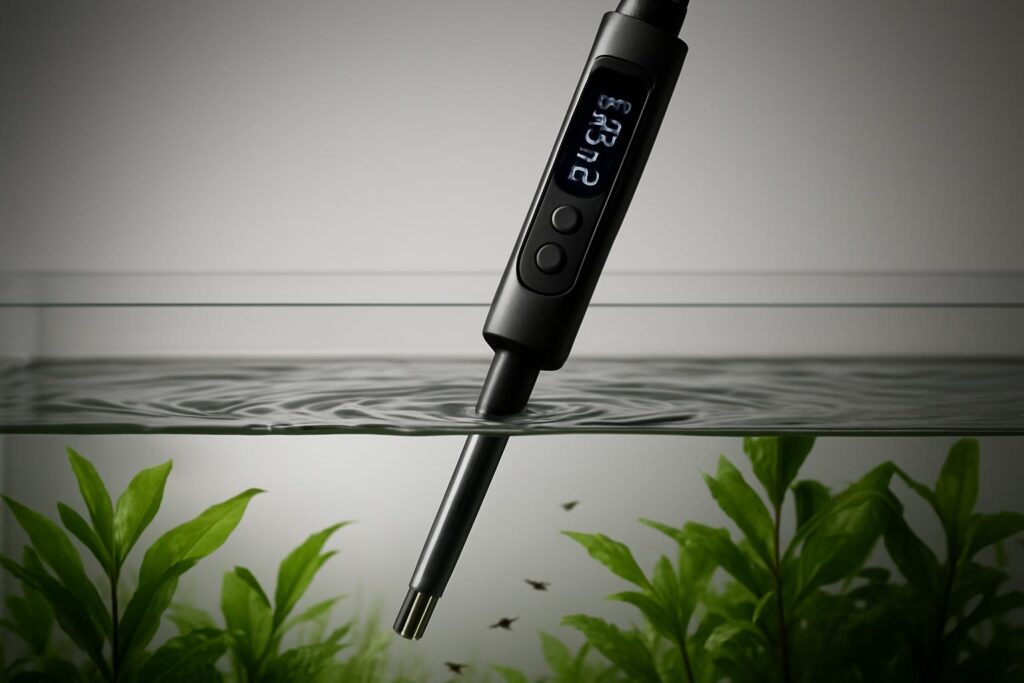
The EC20 is a simple handheld meter with automatic temperature compensation, a replaceable probe, and single point calibration. It reads accurately in the freshwater range and handles brackish water with ease.
Why it helps Reliable, repeatable numbers help you adjust dosing and water changes with confidence. A clear screen and quick stabilization save time each week.
Best for Freshwater keepers, planted tanks, shrimp keepers, and anyone who wants better accuracy than a basic TDS pen.
Potential downsides Not designed for continuous monitoring, and you must store the probe properly to maintain speed and accuracy.
HM Digital COM-100 EC TDS Temperature Meter
The COM-100 measures conductivity, TDS, and temperature with adjustable TDS conversion factors. It is sensitive across a wide range, from very soft water to brackish.
Why it helps Being able to set the conversion factor gives more accurate ppm readings, and the broad range covers many systems with one tool.
Best for Hobbyists who track both EC and TDS and want one meter for shrimp, planted, and low end brackish setups.
Potential downsides Needs careful calibration across ranges if you switch between very low and higher conductivity water.
Aquatic Life RO Buddie 4 Stage RO DI
This compact RO DI unit produces very low conductivity water that you can remineralize to exact targets. It is budget friendly and fits under a sink or on a shelf.
Why it helps Starting from near zero microSiemens per centimeter makes dialing in softwater and shrimp parameters straightforward, and it eliminates tap water swings.
Best for Softwater fish, shrimp breeders, and anyone with hard or variable source water.
Potential downsides Prefilters and resin need scheduled replacement, and production rate is modest without a booster pump.
Salty Shrimp GH Plus or GH KH Plus
These powdered remineralizers add calcium, magnesium, and trace minerals in known amounts. GH Plus targets low KH Caridina systems. GH KH Plus suits Neocaridina and community tanks.
Why it helps Predictable dosing raises conductivity to precise set points while delivering the right balance of gh and kh for your species.
Best for Shrimp keepers who rely on consistent parameters to prevent molts issues and to promote breeding.
Potential downsides Requires careful measurement and mixing outside the tank to avoid spikes.
American Marine Pinpoint Salinity Monitor
This is a conductivity based salinity monitor with a probe for continuous tracking. It displays practical salinity in reef relevant units and alerts you to drift.
Why it helps Real time monitoring catches evaporation changes or dosing errors before they impact corals and invertebrates.
Best for Reef tanks and brackish setups that benefit from always on salinity visibility.
Potential downsides Probes require periodic cleaning and calibration to prevent biofilm from skewing readings.
Simple workflows that work
Freshwater weekly routine
Test tank conductivity before a water change. Mix new water to match that value or to reach your desired target. Change 10 to 20 percent. Retest after 15 minutes. Log the numbers and any dosing you plan to do.
Shrimp water prep
Start with RO DI. Add remineralizer until you reach the target conductivity for your species. Let it mix with a powerhead. Verify again before adding to the tank. Keep the tank within a 10 percent band day to day.
Reef daily stability
Monitor conductivity continuously or test every day at the same time. Top off with RO DI only. If conductivity drifts, check auto top off, look for salt creep, and verify calibration against a standard.
Conclusion
Conductivity turns guesswork into simple numbers. It shows the total ionic load, complements GH, KH, and nutrient tests, and guides water changes and dosing. Set a target, test on a schedule, and log your results. Stability follows. Fish, shrimp, and corals respond with better health and consistent growth.
FAQ
Q What does conductivity measure in an aquarium
A Conductivity measures the total ions that carry electrical current in water, including calcium, magnesium, sodium, potassium, chloride, and bicarbonate.
Q How is conductivity different from TDS GH KH and salinity
A Conductivity counts all ions, TDS pens estimate ppm from EC using a factor, GH is calcium and magnesium hardness, KH is carbonate buffering, and salinity in marine tracks closely with conductivity.
Q When should I test conductivity
A Test your source water, after water changes, during dosing, daily in reef systems, and before breeding attempts.
Q How do I lower or raise conductivity safely
A Lower by diluting with RO or DI water in small steps, and raise by adding appropriate remineralizers in measured increments while testing.
Q What are good target ranges
A Examples include 80 to 150 microSiemens per centimeter for Caridina shrimp, 200 to 300 for Neocaridina, 150 to 350 for planted community, 300 to 800 for African cichlids, and about 53 milliSiemens per centimeter for marine.